
Understanding How Step Scores Really Matter in Neurology
For a non-US citizen IMG aiming for neurology residency in the United States, your USMLE performance shapes the trajectory of your application—but not always in the way people assume. “Step score strategy” is not just about getting the highest possible number. It is about:
- Understanding how programs interpret Step scores for neurology
- Knowing realistic thresholds for a foreign national medical graduate
- Using Step 1 and Step 2 CK deliberately to tell a consistent story: “I can handle US neurology residency training”
- Compensating intelligently if you have a low Step score match profile
Neurology residency has become more competitive over the past decade, but it remains more accessible to non-US citizen IMG applicants than many surgical specialties or dermatology. Programs value:
- Strong clinical reasoning
- Comfort with neuroanatomy and internal medicine
- Reliable test performance (especially Step 2 CK)
- Evidence of genuine interest in neurology
Your Step score strategy must integrate all of these.
Before we dive into tactics, keep two key realities in mind:
- Step 1 is now Pass/Fail, but its context still matters—especially for a non-US citizen IMG.
- Step 2 CK is now the primary numerical filter for many neurology programs and a critical focus of your neuro match strategy.
The rest of this article walks you through how to think about Step scores, how to plan if you haven’t taken them yet, and how to recover if your scores are lower than you hoped.
Step 1 for Non-US Citizen IMG in Neurology: Pass/Fail but Not Irrelevant
Even though Step 1 is now scored Pass/Fail, your performance and timeline still affect how neurology programs perceive you—especially as a non-US citizen IMG.
How Program Directors Now View Step 1
For neurology residency, most PDs now use Step 1 in three broad ways:
Basic competence screen
- A first-attempt pass is expected for essentially all applicants.
- A fail on Step 1 is not an automatic rejection, but it raises concern about test-taking reliability.
Context for Step 2 CK
- If Step 1 was passed on first attempt and Step 2 CK is strong, most concerns disappear.
- If there is a Step 1 fail + strong CK, PDs may interpret it as “late adaptation but now ready.”
- Step 1 pass + borderline Step 2 CK is weaker than average, especially for a foreign national medical graduate.
Timing and planning signal
- Passing Step 1 before graduation, with reasonable time before CK, suggests organized planning.
- Very delayed Step 1 or cutting it close to application season can raise questions about preparation and reliability.
Strategic Goals for Step 1 as a Foreign National Medical Graduate
If you have not taken Step 1 yet:
Goal #1: Pass on the first attempt.
As a non-US citizen IMG, multiple attempts signal risk. Your visa status already makes some PDs cautious; you want your exam record to reduce, not increase, perceived risk.Goal #2: Pass with a margin of comfort, not perfection.
With Step 1 now P/F, you do not need to aim for maximal mastery of every detail. Instead:- Focus on high-yield systems (neuroanatomy, psychiatry, cardiovascular, renal, endocrine)
- Build test-taking consistency—no panic, no rushing
- Ensure you are truly ready before scheduling
Goal #3: Time Step 1 to protect your Step 2 CK strategy.
You cannot allow Step 1 prep to delay CK so much that you end up rushing CK just to be on time for the Match.
Optimal timing for Step 1 as a non-US citizen IMG interested in neurology:
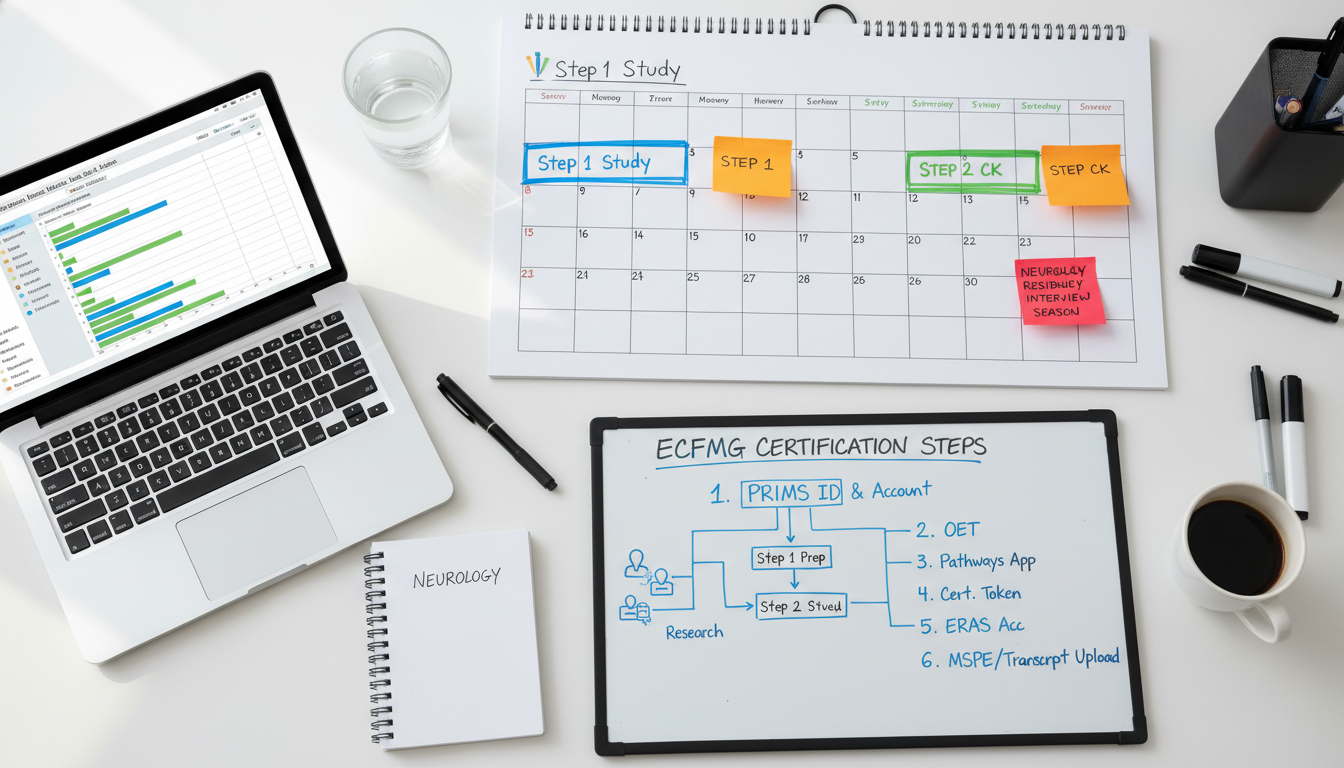
- Pass Step 1 no later than 12–18 months before the Match cycle you are targeting.
- Give yourself enough room for:
- 4–6 months focused CK preparation
- Time for OET / pathway / ECFMG certification steps
- Potential clinical electives or observerships
What If You Already Have a Step 1 Fail?
If your Step 1 record includes a fail:
Accept and reframe quickly.
You cannot hide it; instead, focus on creating a strong Step 2 CK narrative: “I learned from this and improved.”Double down on CK excellence.
PDs will look hard at your Step 2 CK score as proof that the failure is not your “ceiling.”Address it briefly in your personal statement or interviews (if asked).
- Take responsibility (no excuses).
- Emphasize specific adjustments: new study methods, active recall, NBME practice, time management.
- Tie it to later success: improved CK score, better clinical performance.
A single early failure is survivable—especially in neurology—if your later performance is clearly strong.
Step 2 CK: The Core of Your Neurology Step Score Strategy
For neurology, Step 2 CK is now the central quantitative signal of your readiness. For a non-US citizen IMG, this is often the decisive metric.
What Is a “Competitive” Step 2 CK Score in Neurology?
Exact cutoffs vary, but several patterns are common:
- Many academic university programs informally screen around 240–245+ for US graduates…
- …but often tolerate slightly lower scores for non-US citizen IMG if other aspects are strong, especially for neurology-focused programs that are IMG-friendly.
- Community and mid-tier university programs may use 230–235+ as an approximate lower screen.
For a foreign national medical graduate in neurology, a rough interpretation:
- 250+
- Very strong for neurology, including many academic programs
- Can compensate somewhat for lack of US experience or average grades
- 240–249
- Solidly competitive for most neurology programs
- Still need strong application, but definitely above many IMGs
- 230–239
- Competitive for many IMG-friendly neurology programs, especially with strong neurology exposure and letters
- May be borderline for powerhouse academic programs as a non-US citizen IMG
- 220–229
- This is a low Step score match zone for neurology as a non-US citizen IMG
- You must be highly strategic: target IMG-friendly programs, strengthen research, clinical experience, and network
- Below 220
- Very challenging as a foreign national medical graduate, but not impossible if:
- You have substantial US neurology experience
- Strong advocacy from US neurologists
- Additional degrees or significant research productivity
- Very challenging as a foreign national medical graduate, but not impossible if:
These ranges are not official cutoffs but realistic patterns from recent match data and PD surveys.
Timing Step 2 CK for the Neuro Match
For neurology residency, especially as a non-US citizen IMG:
- Your Step 2 CK score should ideally be available by ERAS opening (September).
Without a CK score, many programs will not offer interviews to IMGs.
Strategic timeline (working backward from September of your application year):
- Aim to take Step 2 CK by May–July of the application year.
This:- Ensures your score is reported before programs screen applications
- Leaves time for potential issues (delayed score reporting, technical problems)
If you are still in medical school outside the US:
- Try to align CK immediately after your strongest internal medicine rotations; they provide a good foundation for CK clinical reasoning.
- Do not rush CK just to meet a date if your NBME practice scores are low; a poor Step 2 CK score can hurt more than a slightly delayed application.
Study Approach for a Non-US Citizen IMG Targeting Neurology
Step 2 CK is not a neurology-only exam, but neurology content is meaningful, and CK-style thinking mirrors neurology residency demands.
Key principles:
US-style clinical reasoning first, then memorization.
As a foreign national medical graduate, you may have strong theoretical knowledge but weaker familiarity with typical US-style question patterns and guidelines.Heavier emphasis on:
- Internal medicine (especially stroke, epilepsy evaluations, systemic diseases with neuro manifestations)
- Psychiatry and behavioral sciences (cognitive impairment, mood disorders, psychosis, substance use)
- Emergency medicine (acute stroke, seizure, trauma, toxicology)
Active recall + timed blocks from early in prep.
- Daily Qbank questions under timed conditions
- Simulate 40-question blocks, then full-length tests as exam approaches
Use NBMEs and UWSA realistically.
- Do not take the real exam until your recent NBMEs and self-assessments are consistently at or above your target range.
- For neurology applicants, aiming for practice tests at least in the 230+ range before scheduling CK is wise.
Low Step Score Match Strategy for Neurology: Turning Weakness into a Managed Risk
If your Step 2 CK is lower than you hoped, your neuro match is still possible, but you must be deliberate, honest, and strategic.
Step 1: Know Exactly Where You Stand
As a non-US citizen IMG:
- Below ~230 is commonly perceived as a low Step score match profile in neurology.
- Your strategy changes depending on how low and the rest of your application.
Define your situation:
- Step 1: Pass/Fail or any failure?
- Step 2 CK: actual number, number of attempts
- Medical school: well-known vs lesser-known, language of instruction, clinical exposure level
- Graduation year: recent graduate vs older graduate (>5 years since graduation)
The further you are from “standard” (recent grad, first-attempt pass, 240+ CK), the more you must compensate with other elements.
Step 2: Build a Compensating Application Profile
For a foreign national medical graduate with a low Step score match profile, programs will ask:
“Can this person handle the cognitive load and stress of neurology residency, and will they be reliable?”
You respond not just with words, but with evidence.
Key compensation tools:
Targeted Neurology Clinical Experience in the US
- Arrange observerships, externships, or electives in neurology or stroke services at US hospitals.
- Prioritize programs known to be IMG-friendly or with leaders who trained abroad.
- Aim for at least 2–3 months of neurology-related US experience if possible.
Strong Letters of Recommendation from US Neurologists
- Ideally 2–3 letters from neurologists who have directly observed your clinical skills.
- Ask them to comment specifically on:
- Your reasoning and differential diagnosis
- Work ethic and reliability
- Improvement over time
- Communication skills and empathy
- A powerful letter can override some concern about a modest Step score.
Evidence of Academic Interest in Neurology
- Case reports, QI projects, retrospective chart reviews, or participation in stroke/epilepsy research.
- Posters or presentations at local or national neurology conferences (AAN, regional neurology society) show serious commitment.
Personal Statement with a Coherent Story
- Do not dwell on your Step scores.
- Instead, highlight:
- Why neurology is the right fit for you
- Specific experiences with neuro patients
- Skills you bring: persistence, multilingual communication, cross-cultural care
- If addressing low Step scores, do it briefly and constructively:
“My initial exam performance did not reflect my later development. Since that time, I have improved my test-taking strategies and clinical reasoning, as reflected in…”
Step 3: Intelligent Program Selection
Program selection is one of the most overlooked aspects of a low Step score match strategy.
As a non-US citizen IMG with modest Step scores, you should:
Prioritize IMG-friendly neurology programs
- Look at historical match lists and current residents—do you see non-US citizen IMG residents?
- Review program websites, social media, and FREIDA entries.
- Join online forums or IMG neurology groups for updated informal knowledge.
Balance your list:
- Some higher-tier programs (stretch applications)
- Majority mid-tier and community-affiliated neurology programs
- A subset of “safety” applications at programs known for significant IMG intake
Apply broadly.
- As a foreign national medical graduate with low Step scores, 80–120 applications is common and reasonable for neurology.
- Filter wisely but do not over-limit yourself to 30–40 programs; the odds may become very low.
Pay attention to visa policies.
- Mark whether programs sponsor J-1, H-1B, or neither.
- As a non-US citizen IMG, exclude programs that clearly do not sponsor any visas unless you already have a different valid status.
Step 2 CK Strategy Tweaks Based on Your Current Position
Scenario 1: You Have Not Taken CK Yet
You can still shape your Step 2 CK strategy aggressively.
Actions:
- Baseline assessment: Take a practice NBME early. Understand your current range.
- Set a realistic target:
- If your baseline is ~210, a realistic target may be 230–240 with focused work.
- Study full-time if possible:
- If you can dedicate 3–4 months completely to CK, your chance of significant improvement increases.
- Use a structured plan:
- Months 1–2: System-based review + daily Qbank
- Months 3–4: High-yield review + NBMEs + UWSAs, then refine weak areas
If practice scores remain <220 near your exam date, consider:
- Extending your exam date if possible
- Re-evaluating whether to apply this season or aim for the next, especially if you want neurology and not a backup specialty
Scenario 2: You Already Have a Low CK Score
If your Step 2 CK is already low and cannot be changed (or you do not want to risk a retake):
Commit to neurology or consider alternatives?
- Be honest: if you have 210-220 and no strong neurology background, internal medicine might be more realistic.
- If neurology is your deep passion and you have or can build strong neurology experience, you can still pursue it—but accept that odds may be lower and plan a backup if needed.
Maximize the rest of the application:
- US neurology exposure
- Strong LoRs
- Excellent, error-free application materials
- Early ERAS submission
Be strategic about backup options:
- Some foreign national medical graduates apply to both neurology and internal medicine, or to categorical IM with the hope of transferring to neurology later.
- This can succeed but requires careful planning and honest reflection.

Integrating Everything into a Coherent Neuro Match Plan
To make your Step score strategy truly effective, connect it with the rest of your neurology application and the Match timeline.
12–24 Months Before Match
- Plan Step 1 (if not done) to avoid late surprises.
- Begin early preparation for Step 2 CK.
- Explore potential US neurology observerships or electives.
- Start basic neurology involvement at your home institution (clubs, teaching, small projects).
6–12 Months Before Match
- Take Step 2 CK with enough time for score release.
- Secure US neurology rotations and work to earn strong LoRs.
- Begin drafting your personal statement with a neurology-specific focus.
- Build your program list and categorize them by competitiveness, IMG-friendliness, and visa policy.
ERAS Season (Application Year)
- Ensure your ERAS is error-free, polished, and consistent.
- Emphasize neurology interest everywhere: personal statement, experiences, LoRs.
- Apply broadly, including programs where your profile (Step scores + experience) is reasonable.
- Prepare early for neurology interviews—practice answering questions about Step scores calmly and confidently.
During Interviews
When asked indirectly about your Step scores (often phrased as “Tell me about any challenges you’ve faced”):
- Stay concise, honest, and problem-focused:
- What went wrong?
- What did you change?
- How do your later successes prove your growth?
- Do not appear defensive or ashamed; show maturity and resilience.
- Shift focus back to your neurology strengths: patient care, analytical skills, communication, and dedication.
FAQs: Step Score Strategy for Non-US Citizen IMG in Neurology
1. What Step 2 CK score do I need as a non-US citizen IMG to match into neurology?
There is no single cutoff, but for a foreign national medical graduate:
- A Step 2 CK ≥ 240 is generally competitive for many neurology programs, including some academic centers.
- 230–239 can still match well if paired with strong neurology exposure and LoRs.
- 220–229 becomes a low Step score match profile; you must focus heavily on IMG-friendly programs, US neurology experience, and strong letters.
- Below 220, matching neurology is challenging but not impossible; you need substantial compensating strengths and realistic backup planning.
2. Is a Step 1 fail fatal for a neurology neuro match as an IMG?
No, a Step 1 fail is not automatically fatal, even for a non-US citizen IMG, but it raises concern. To compensate, you need:
- A clear first-attempt pass and stronger score on Step 2 CK
- Evidence of consistent performance afterward: clinical grades, neurology rotations, possibly research output
- A brief, honest explanation if asked, emphasizing what you learned and how you improved
Programs will care more about your current capability and reliability than about one early misstep, especially if you can demonstrate substantial growth.
3. Should I delay my application if my Step 2 CK practice scores are low?
If your practice NBMEs are significantly below 220 and you are targeting neurology as a non-US citizen IMG, it may be wise to:
- Consider delaying your exam and possibly your application year
- Use more time to strengthen both your Step 2 CK performance and your neurology CV
- Discuss with mentors whether a one-year delay could meaningfully improve your competitiveness
A slightly later but stronger application may be better than rushing into a cycle with a weak score that permanently stays on your record.
4. Can strong US clinical experience and letters compensate for a low Step 2 CK in neurology?
They can significantly help, but they rarely fully overwrite very low scores. High-quality US neurology rotations and strong letters can:
- Convince PDs that you function well in US systems
- Show that your clinical reasoning is better than your test score suggests
- Improve your chances at IMG-friendly programs
However, for many programs, especially academic ones, Step 2 CK still acts as a screening tool. The stronger your US experience and neurology portfolio, the more likely you are to overcome a modest score—but there are still practical limits.
A deliberate Step score strategy, especially around Step 2 CK, is essential for every non-US citizen IMG aiming for neurology. Understand where you stand, act to strengthen your weak points, and build a coherent neurology-focused profile that reassures programs: you are ready to succeed in residency, regardless of where you started.