
Understanding Your Context as a US Citizen IMG
As a US citizen IMG or an American studying abroad, your Step score strategy must account for two realities:
- You are “home” in terms of citizenship (no visa issues).
- You are “foreign” in terms of medical education (IMG status).
Program directors know you don’t need a visa, which is a strong advantage, but they also worry about:
- Variability in international school quality
- Limited familiarity with your curriculum
- How to interpret your Step exam performance
That means your Step 1 score and Step 2 CK strategy are central to how programs judge your readiness. Even in the pass/fail era for Step 1, quantitative performance (NBME practice scores, timing of tests, and Step 2 CK outcomes) still matters a lot—especially for a US citizen IMG.
This article will walk you through:
- How programs think about Step exams for US citizen IMGs
- Strategic planning by exam (Step 1 and Step 2 CK)
- What to do if you already have a low Step score and still want to match
- Specialty-specific score strategy
- A concrete action plan and timeline you can start using immediately
How Programs View Step Scores for US Citizen IMGs
1. You’re “easier to hire” than non‑US IMGs, but still under more scrutiny than US MD/DO
As a US citizen IMG you:
- Don’t need visa sponsorship
- Often have better cultural/linguistic familiarity with US health care
- May have easier geographic flexibility (family in the US, etc.)
That’s good. But program directors still compare you to:
- US MDs (top tier in most programs’ minds)
- DOs
- Non‑US IMGs
Where you sit in that ranking depends heavily on your Step profile.
2. Step 1 (even pass/fail) is used as a filter signal
With Step 1 pass/fail, programs still use it as a signal:
Early, first-time pass
- Suggests strong baseline knowledge and good test discipline.
- Less concern that you needed extra time or attempts.
Late pass (e.g., delay, extended leave, or second attempt)
- Can raise concerns about academic difficulties or lack of readiness.
No Step 1 at time of application (only Step 2 CK)
- For some programs, okay if Step 2 CK is strong;
- Others still feel uneasy without seeing Step 1 done before applications.
Even though there’s no numeric Step 1 score, your Step 2 CK score becomes the main standardized academic comparison tool, and the story around your Step 1 experience still matters.
3. Step 2 CK is often your key differentiator
For a US citizen IMG, the Step 2 CK score:
- Serves as the objective academic metric programs can compare across all applicants
- Helps counter biases about international schools (“Shows they can compete at a US standard”)
- Can completely reframe a weaker Step 1 story—up or down
Because of this, your Step 2 CK strategy is the heart of your Step score strategy.
4. Programs assess your score in the context of your specialty and background
Program directors don’t look at your score in isolation; they evaluate:
- Your school reputation
- Your clinical experiences (USCE vs home country)
- Specialty competitiveness
- Trends over time (Step 1 → Step 2 CK; NBME practice exams if mentioned in MSPE)
A “low Step score match” is still possible—especially as a US citizen IMG—if:
- The rest of your application is strong and targeted
- Your Step 2 CK trend is upward
- You choose specialties and programs strategically
- You present a compelling story and network intentionally
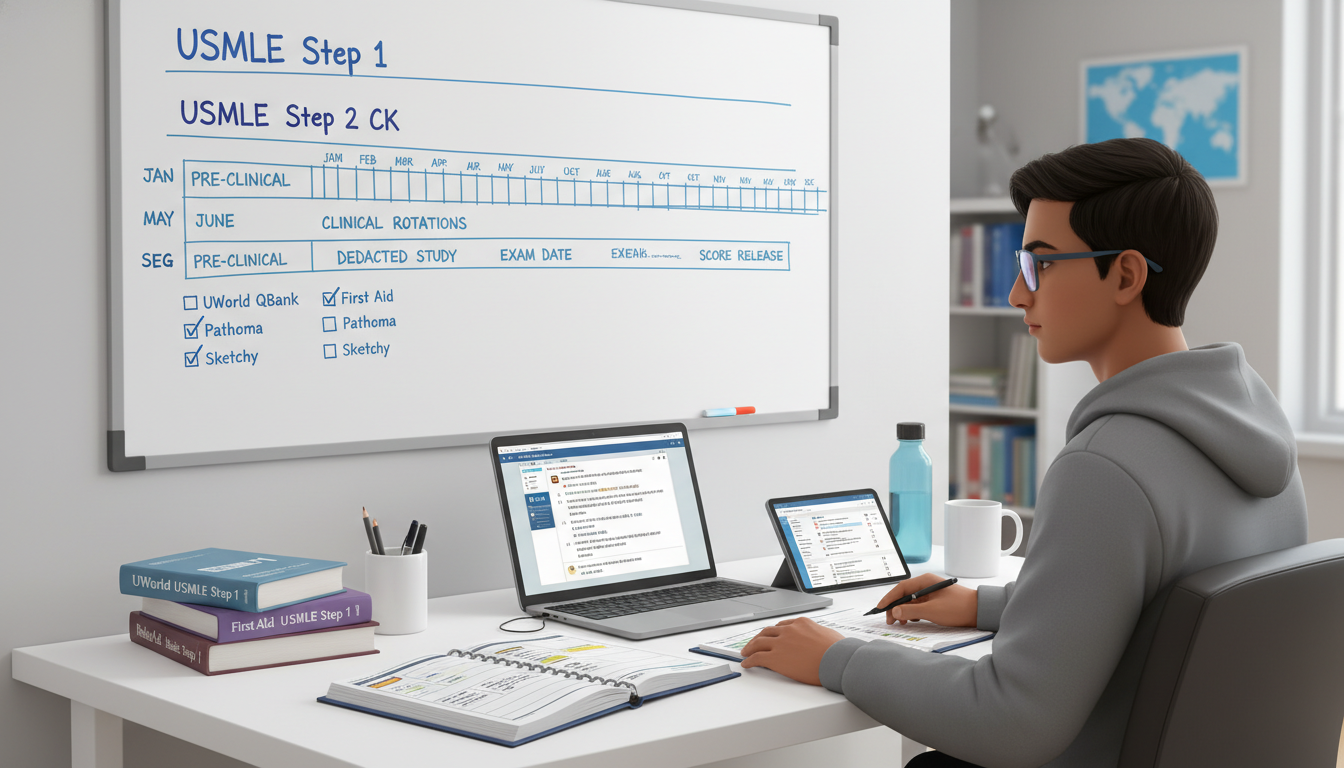
Designing a Step 1 Strategy as a US Citizen IMG
Even pass/fail, Step 1 remains an important filter. Your Step 1 strategy should be built around first-time pass probability and downstream leverage for Step 2 CK.
1. Decide: When should you take Step 1?
For an American studying abroad, the timing usually falls into one of three patterns:
Classic timing – End of preclinical years (after basic sciences)
- Best if your school has a USMLE-oriented curriculum.
- You can keep momentum from basic sciences into dedicated prep.
Delayed timing – After early clinical rotations
- Sometimes necessary if school timing or academic struggles delay you.
- Risk: too much time away from basic sciences.
- Mitigation: ongoing low-intensity review before dedicated.
Strategic early pass, fast pivot to Step 2 CK
- Minimal aim: “solid pass” rather than Step 1 mastery;
- Then heavily invest in Step 2 CK preparation, where your numeric score lives.
For most US citizen IMGs, the priority is:
Don’t chase Step 1 perfection; ensure a confident first-time pass and protect bandwidth for Step 2 CK.
2. Core Step 1 study structure
Three phases:
Foundations (during preclinicals)
- Align lecture studying with USMLE-style resources:
- First Aid / Boards & Beyond / Pathoma
- Do low-volume timed USMLE-style questions (UW or AMBOSS) early.
- Goal: Learn how questions are asked, not just facts.
- Align lecture studying with USMLE-style resources:
Pre-dedicated ramp-up (3–6 months before exam)
- Increase question volume (20–40/day).
- Begin taking low-stakes NBMEs to see baseline.
- Identify systems with repeated weak performance and target them.
Dedicated period (usually 6–10 weeks)
- 60–80+ questions per day in timed, random blocks.
- 1 NBME every 1–2 weeks.
- Not about being a genius; about reaching a safe passing band with cushion.
3. Objective “go/no-go” criteria for Step 1
Because Step 1 is now pass/fail, your decision rule is simple but critical:
If your NBME practice scores are consistently above the passing cutoff (with a margin)
- Aim for at least 10–15 points above the NBME’s passing threshold.
- You’re generally safe to test.
If you’re hovering at or below the margin
- Delay if possible.
- Intensify targeted review (not blanket re-reading).
- Shift from content-cramming to question- and explanation-based learning.
A failed Step 1 is one of the hardest red flags to overcome as a US citizen IMG. A slightly delayed exam with a pass is almost always better than rushing into a fail.
4. How Step 1 performance shapes your message
Even though no number appears, you can still cultivate a narrative:
Smooth, on-time pass; no remediation
- Message: “Solid baseline, ready for advanced clinical knowledge.”
Delayed Step 1 but first-time pass with strong Step 2 CK later
- Message: “Initial adjustment to curriculum; overcame this and excelled when clinical medicine came into focus.”
Step 1 failure but later strong Step 2 CK
- Message: “Early miscalculation about readiness; I developed structure and discipline that led to a major turnaround.”
- This must be backed by clear evidence: significantly higher Step 2 CK score, strong clinical evaluations, and consistent improvement.
Mastering Your Step 2 CK Strategy: The Core of Your Application
For a US citizen IMG, Step 2 CK strategy is everything. This is your chance to prove you can compete head-to-head with US MD/DO peers.
1. When should you take Step 2 CK?
The goal is to align your Step 2 CK score with ERAS timing:
- Ideal: Step 2 CK completed by late June–July before the application cycle
- Latest reasonable: Early August, scores back before programs heavily screen in September
If you’re recovering from a low Step 1 score or a failure:
- It may be worth delaying applications by one cycle to:
- Take Step 2 CK with maximum preparation
- Show a clearly strong score that resets the academic narrative
2. How high should your Step 2 CK score be?
Target depends on specialty, but as a US citizen IMG your standards should be ambitious:
Highly competitive specialties (Derm, Plastics, Ortho, ENT, Rad Onc)
- Realistically very difficult with IMG status, even as a US citizen.
- If you insist, you generally need a very high Step 2 CK (e.g., 250+) plus research and strong mentorship connections.
Moderately competitive (EM, Anesthesiology, Neurology, PM&R, Radiology, some Internal Medicine programs)
- Strong target: 245+
- A score in the 240s can still be workable with strong USCE, letters, and targeted applications.
Less competitive (Family Medicine, Psychiatry, Pediatrics, many Internal Medicine community programs)
- Solid target: 230–240+
- A low Step score match is still feasible if you:
- Apply broadly
- Have strong USCE and letters
- Communicate your growth and fit well
These are not strict cutoffs, but realistic competitive zones to guide your Step 2 CK strategy and specialty choice.
3. Building an effective Step 2 CK study plan
Think of Step 2 CK as a clinical reasoning exam, not a memorization test.
Core components:
- Question banks: UWorld (primary), possibly AMBOSS as second pass
- Assessment tools: NBMEs, UWSAs, and sometimes school-specific shelf exams
- Review resources: Online MedEd, Boards & Beyond, high-yield notes
Framework: 4–6 month path
Clinical rotation integration (3–4 months before dedicated)
- Use UWorld throughout third year instead of cramming at the end.
- For each rotation:
- Do the corresponding UWorld blocks (e.g., IM, Surgery, Pediatrics).
- Treat shelf exams like “mini-Step 2 CKs.”
Early dedicated (6–8 weeks)
- Daily schedule might look like:
- 2–3 timed blocks (40 questions each)
- Full, careful review of explanations
- Notes on recurring missed concepts
- Content refresh via Online MedEd or targeted videos for weak areas.
- Daily schedule might look like:
Late dedicated (2–3 weeks before exam)
- NBME/UWSA every 5–7 days.
- Focused remediation on recurrent patterns:
- Weak systems (e.g., cardio vs neuro)
- Weak skills (management vs diagnosis vs ethics)
“Go/no-go” threshold:
- Aim for practice tests consistently near or above your target range
- For primary care fields: mid-230s or higher on practice tests
- For moderate-to-competitive fields: 240s+
- If you’re far below your goal and can afford time:
- Consider pushing the exam back.
- Reassess specialty competitiveness and whether another cycle might yield a better long-term outcome.
4. Using Step 2 CK to offset a low Step 1 score
If you already have a low Step score (Step 1 fail or borderline pass), you can still be competitive with the right Step 2 CK strategy:
Set a clear “redemption” target
- You want a score that clearly exceeds expectations given your earlier struggles.
- Example: Step 1 fail → Step 2 CK 235–245+ can be a powerful turnaround story in many non-ultra-competitive specialties.
Control the narrative in your application
- Explain briefly (in personal statement or interview), not defensively:
- What went wrong
- What you changed (study methods, time management, resources, mindset)
- How this led to sustained improvement
- Explain briefly (in personal statement or interview), not defensively:
Pair your score with strong clinical performance
- Honors in key rotations (Internal Medicine, Surgery, Pediatrics, Psych, FM).
- Strong letters emphasizing:
- Work ethic
- Clinical reasoning
- Improvement over time
Apply smart, not just broad
- Target programs that traditionally interview US citizen IMGs.
- Consider community-based and university-affiliated community programs.
- Use geographic ties (where you grew up, family, prior work) to build connection.

Specialty Choice and Application Strategy Around Step Scores
1. Aligning specialty choice with your Step profile
Your Step 1 score residency implications and Step 2 CK strategy should inform which specialties you target.
If you have:
- Solid Step 1 pass + Strong Step 2 CK (e.g., 240s+)
- Good US clinical experience
- US letters of recommendation
You can credibly consider:
- Internal Medicine (including some academic programs)
- Pediatrics
- Psychiatry
- Anesthesiology
- Neurology
- Emergency Medicine (depending on SLOEs and program IMG friendliness)
- PM&R and Radiology in select settings
If you have a low Step score or Step 1 failure but decent or improving Step 2 CK:
- Focus on:
- Family Medicine
- Community-based Internal Medicine
- Psychiatry
- Some Pediatrics programs
- Strategy:
- Apply very broadly (60–100+ programs if feasible).
- Emphasize real interest and fit in your personal statements and emails.
- Seek programs known to be IMG-friendly and US-citizen-friendly.
2. Using non-score strengths to supplement your Step profile
Even with average or low Step scores, you can enhance competitiveness with:
High-quality US clinical experience (USCE)
- 3–6 months of US rotations (sub-internships, electives) at sites with residency programs.
- Strong performance with US faculty letters.
Research
- Specialty-relevant projects, especially if you’re targeting IM, Neuro, Psych, or academic tracks.
- Publications or posters can show academic maturity and persistence.
Geographic focus
- Programs in regions where you have personal ties (family, school, prior job).
- Midwestern, Southern, and some community programs may be especially IMG-friendly.
Consistent narrative
- Show why your chosen specialty truly fits your experiences and personality.
- Use specific patient stories and clinical moments, not generic statements.
3. “Low Step score match” tactics
If your Step score is lower than you hoped:
Maximize the rest of your file
- Strong personal statement (no excuses, honest reflection, future-focused).
- Thoughtful, specific letters from US clinicians.
- Clean, well-organized ERAS application.
Strategic communication with programs
- Short, professional emails to program coordinators or PDs expressing:
- Genuine interest
- Geographic or personal connection
- Brief mention of growth since the exam (if relevant)
- Short, professional emails to program coordinators or PDs expressing:
Be realistic but not defeatist
- Adjust your specialty and program list according to data—not fear.
- Consider SOAP and backup options early, but aim for a regular Match.
Action Plan and Timeline for US Citizen IMGs
1. Preclinical years (M1–M2 equivalent)
- Use USMLE-style resources early (First Aid, question banks, Pathoma, etc.).
- Start building a portfolio:
- Shadowing or virtual US experiences
- Early research if feasible
- Keep Step 1 in view:
- Don’t cram everything into dedicated
- Get comfortable with multiple-choice reasoning
2. Dedicated Step 1 phase
- Plan 6–10 weeks of serious, structured studying.
- Take 3–6 NBMEs across your prep; watch for trending upward.
- Don’t register for a date you can’t realistically be ready for—protect your first attempt.
3. Clinical years and Step 2 CK prep
- Treat each clerkship as Step 2 CK prep:
- Target honors when possible, but especially strong evaluations.
- Use UWorld aligned with your rotation.
- Begin serious Step 2 CK planning at least 4–6 months out:
- Map dedicated time.
- Arrange away rotations or electives around your exam, not on top of it.
4. Application year
- Aim for Step 2 CK done and score available before ERAS submission.
- Choose specialties based on:
- Your Step 1 and Step 2 CK profile
- Research/USCE strength
- Realistic competitiveness as a US citizen IMG
- Apply broadly and smartly:
- Mix of safety, target, and a few reach programs.
- Factor in IMG and US-citizen friendliness.
Frequently Asked Questions (FAQ)
1. I’m a US citizen IMG with a low Step 1 score. Can a strong Step 2 CK still get me into residency?
Yes. For many specialties (especially IM, FM, Psych, and some Pediatrics), a strong Step 2 CK can substantially offset a low or borderline Step 1 performance. Programs increasingly use Step 2 CK as the primary academic metric. The key is:
- Show a clear upward trend.
- Score in or above the typical range for your desired specialty.
- Back it up with strong USCE and letters.
You may need to adjust your specialty or aim for more IMG-friendly programs, but a low Step 1 does not automatically mean you won’t match.
2. As an American studying abroad, should I delay graduation to improve my Step scores and application?
Sometimes, yes. If:
- You failed Step 1 or scored low and risk repeating that pattern on Step 2 CK, or
- You haven’t had time for meaningful USCE or research
…then extending by 6–12 months can be a rational investment. Use the extra time to:
- Prepare thoroughly for Step 2 CK
- Do US-based clinical rotations
- Strengthen your CV (research, teaching, leadership)
But don’t delay arbitrarily; your extra time must create a clear, documentable improvement in your file.
3. Is it better to apply with only Step 1 (pass) or wait until I have my Step 2 CK score?
For most US citizen IMGs, it is better to apply with a completed Step 2 CK score, especially if you expect that score to be a strength. Step 2 CK:
- Gives programs an objective metric to compare you to US MD/DOs
- Can help overcome any concerns about your school or earlier performance
The only reason to apply without it is if:
- Timing makes it impossible, or
- You have strong school guidance that your application carries sufficient weight without it
Even then, you should aim to have Step 2 CK done early in the season.
4. What’s the single most important Step-related piece of advice for US citizen IMGs?
Guard your first attempts and prioritize Step 2 CK excellence. As a US citizen IMG, your Step 2 CK score is your best tool to:
- Demonstrate that your training is on par with US graduates
- Counteract biases about international schools
- Open doors in a wider range of specialties and programs
A smart Step 1 plan to secure a pass, followed by a deliberately structured Step 2 CK strategy, is the most powerful way to convert your status as a US citizen IMG into a successful residency match.