Understanding the Step Score Landscape for Caribbean IMGs in Medicine-Psychiatry
Medicine-Psychiatry (med psych) combined residency is a small, competitive niche—and as a Caribbean IMG, your USMLE strategy matters even more than for many other applicants. The transition of Step 1 to pass/fail has shifted emphasis toward Step 2 CK, clinical performance, and the overall narrative of your application.
For applicants from a Caribbean medical school, residency directors are trying to answer three questions:
- Can you handle the academic rigor?
- Do you understand U.S. clinical systems and culture?
- Are you a strong fit for the unique demands of a medicine psychiatry combined program?
Your Step scores—especially Step 2 CK—help answer the first question. The rest of your application and strategy answers the other two.
This article will walk you through:
- How programs look at Step 1 and Step 2 CK today
- What Step 2 CK ranges look like for med psych residency
- How to recover from a low Step score match situation
- How to craft a strong SGU residency match–style strategy as a Caribbean IMG
- Practical, step-wise plans you can start implementing now
Throughout, we’ll anchor everything to the reality of Caribbean medical school residency paths and the quirks of combined medicine psychiatry programs.
How Program Directors View Step Scores for Medicine-Psychiatry
Step 1 (Pass/Fail) Still Matters—Just Differently
Even though Step 1 is now pass/fail, it still carries weight for a Caribbean IMG:
- Pass on first attempt = baseline academic safety signal
- Fail then pass = not a deal-breaker, but a red flag you must actively counterbalance
- Multiple attempts = serious concern for many programs
For med psych residency, program directors care less about your knowledge of basic science and more about:
- Consistency over time
- Ability to adapt and improve
- Evidence that academic challenges are behind you
If you are from a Caribbean school like SGU, AUC, Ross, etc., some programs may assume weaker baseline academic screening compared to U.S. MD schools. A clean Step 1 pass helps neutralize this bias.
Step 2 CK: The New Academic Filter
With Step 1 pass/fail, Step 2 CK strategy is the core of your test-based competitiveness.
Medicine psychiatry combined programs care about:
- Internal medicine rigor: You must survive and thrive on medicine ward months.
- Psychiatry depth: You must engage complex psychopathology, psychopharmacology, and systems of care.
Step 2 CK is now the closest standardized metric that reflects:
- Understanding of both medicine and psychiatry content
- Ability to apply knowledge under time pressure
- Readiness to handle the cognitive demand of combined training
For Caribbean IMGs, PDs often use Step 2 CK as a sorting mechanism when hundreds of ERAS applications arrive. It’s not the only thing they care about, but it’s often the first thing they look at.
What Scores Do You Actually Need for Med Psych as a Caribbean IMG?
There is no universal cutoff, but we can reasonably describe ranges based on current trends and feedback from applicants and program directors.
Important: These are approximate ranges, not hard rules. Programs vary widely.
Competitive Step 2 CK Ranges for Caribbean IMGs
230+:
- Solidly competitive for many categorical psychiatry and some internal medicine programs.
- For medicine psychiatry combined: your score is respectable and workable, especially if the rest of your application is strong.
- You’ll still need strong clinical evaluations, narrative, and letters.
220–229:
- Borderline-competitive for medicine psychiatry combined as a Caribbean IMG.
- You are not eliminated, but you must strategize carefully: targeted programs, strong letters, great personal statement, and a very coherent med psych story.
- More realistic at community-based or less well-known combined programs.
210–219:
- This is a low Step score match zone for medicine psychiatry combined.
- You’ll need:
- Strong U.S. clinical performance
- Excellent psychiatry and internal medicine letters
- Strategic program selection (and possibly applying broadly to categorical medicine and psychiatry as well)
- Your Step 2 CK strategy must shift to damage control and narrative-building.
Below 210:
- Very challenging for med psych combined as a Caribbean IMG.
- Not impossible, but you must:
- Aggressively strengthen every other part of your application
- Apply widely to categorical IM and psych
- Consider a longer-term plan (e.g., prelim year + reapplication, additional Step exams if not yet taken, or strengthening with research and observerships).
Remember: many med psych programs are small (often only a few spots per year). Even “medium” scores can be less competitive simply because of low supply.
Step 2 CK Strategy: Before, During, and After the Exam
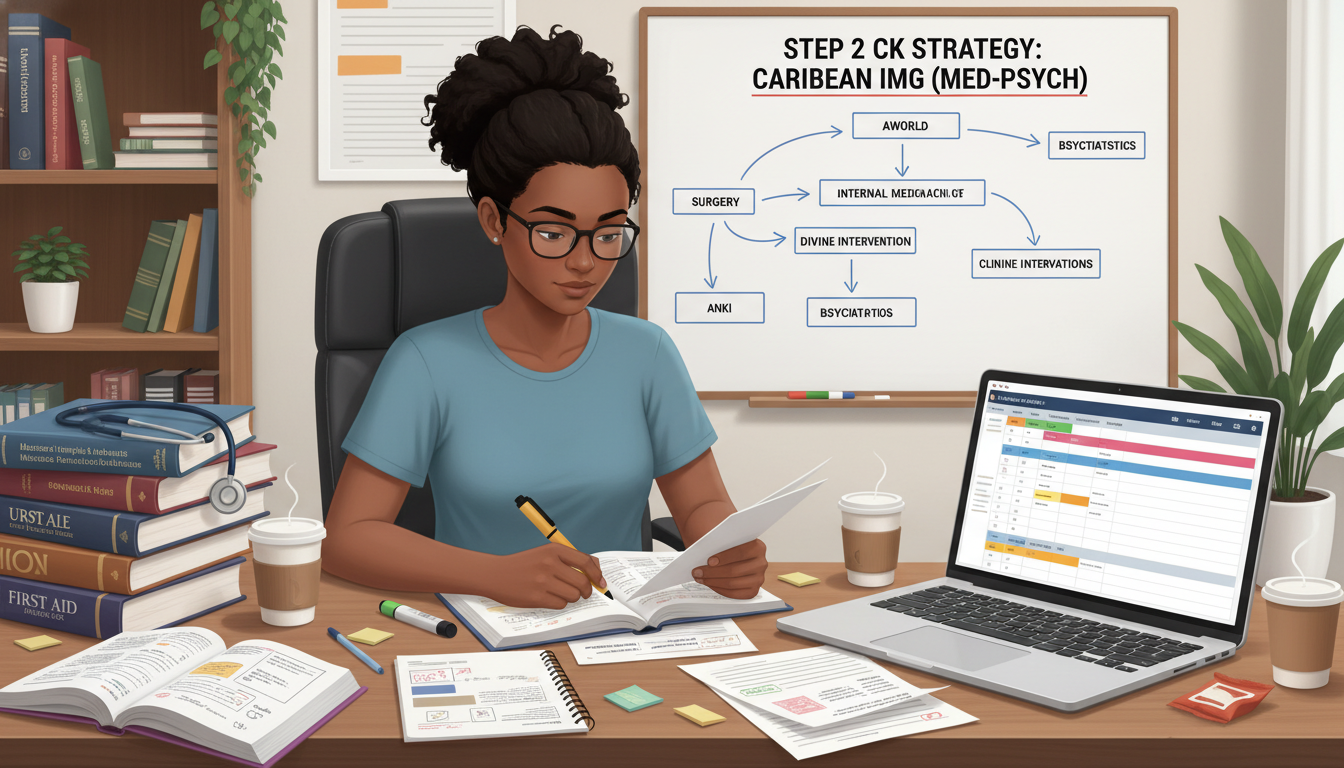
If You Haven’t Taken Step 2 CK Yet
Your Step 2 CK strategy is your biggest lever. As a Caribbean IMG with medicine psychiatry ambitions, approach this like a high-stakes project.
1. Diagnose Your Baseline
- Take a NBME Comprehensive Clinical Science self-assessment (CCSSA) or UWorld Self-Assessment early.
- Use the score to:
- Identify weakest systems (e.g., neuro, psych, cardiology)
- Set a realistic target (e.g., improve by 15–25 points before exam day)
If you’re aiming for medicine psychiatry combined:
- Pay extra attention to:
- Psychiatry/behavioral health
- Neurology
- Cardiology, pulmonary, renal (IM core)
- Ethics and health systems
2. Build a Priority-Focused Study Plan (8–12 Weeks)
A common Step 2 CK strategy for Caribbean IMGs:
- Daily UWorld:
- 60–80 questions/day, timed and random
- Review every explanation, especially missed questions
- Core resources:
- UWorld as main Qbank
- NBME self-assessments periodically
- Online MedEd, AMBOSS, or similar for structured review
- Psych and IM integration:
- As you study psych, always ask:
- “What medicine conditions mimic this?”
- “What lab, imaging, or physical exam differentiation is key?”
- This mindset is very aligned with med psych residency expectations.
- As you study psych, always ask:
3. Timing Your Exam for ERAS
- Ideally, you want your Step 2 CK score available before ERAS submission (mid-September).
- If your practice scores are low:
- It can be wiser to delay the exam a few weeks and improve your score than to rush and lock in a low score.
- However, if you delay too much:
- You may appear incomplete early in the season, which is risky for a Caribbean IMG.
Balance:
- If your practice scores are within 5–10 points of your target and trending upward, you may proceed as planned.
- If they’re >15–20 points below your target and not improving, strongly consider postponing and intensifying your prep.
If You’ve Already Taken Step 2 CK (and It’s Not Ideal)
You cannot change the score, but you can change the message it sends.
Accept and analyze:
- Which systems were weakest?
- Was time management a problem?
- Were there external stressors (illness, family issues) you might explain succinctly if asked?
Reinforce your clinical strength:
- Excel in core medicine and psychiatry clerkships and sub-internships.
- Secure letters that directly speak to your clinical reasoning, reliability, and growth.
Consider Step 3 strategically (only in select cases):
- Step 3 can rarely rescue a very low Step 2 CK; it is not usually worth rushing.
- It may help later (e.g., during reapplication or for visa reasons) if you have stronger clinical performance and time to study properly.
Building a Med Psych–Aligned Application Around Your Step Scores

Your Step scores are only one part of your Caribbean medical school residency profile. The key is to build a coherent, compelling med psych narrative around them.
1. Crafting a Strong Med Psych Story
Medicine psychiatry combined programs want applicants who:
- Understand both fields and their intersections
- Are interested in complex, comorbid patients
- Appreciate systems of care (hospital, community, consult-liaison, etc.)
Your story should answer:
- Why not just medicine or just psychiatry?
- When did you realize med psych was the best fit?
- How have your experiences prepared you for a dual-focus career?
Examples of strong narrative themes:
- Working with patients with severe mental illness and diabetes in an underserved setting
- Interest in consult-liaison psychiatry (e.g., delirium, medically complex depression)
- Experiences in addiction medicine with significant medical comorbidity
- Rotations on inpatient psych units with high medical complexity
If you have a low Step score match concern, your med psych narrative must be even more vivid and specific, so PDs see more than just your numbers.
2. Using Clinical Rotations Strategically
For a Caribbean IMG, U.S.-based clinical rotations are crucial.
Aim for:
- Strong third-year core rotations in:
- Internal medicine
- Psychiatry
- Neurology
- Fourth-year electives/sub-internships:
- Consult-liaison psychiatry
- Inpatient internal medicine
- Addiction medicine
- Inpatient psychiatry with medical complexity
Always approach rotations with the mindset:
“I am auditioning for medicine psychiatry combined training.”
That means:
- Show curiosity about both psychiatric and medical aspects of each patient.
- Ask integration-focused questions: e.g., “How does this patient’s poorly controlled COPD affect our choice of psychotropic?”
- Demonstrate reliability and maturity—PDs know med psych residents carry heavier training loads.
3. Letters of Recommendation That Offset Step Concerns
If your Step 2 CK is not stellar, letters of recommendation (LORs) must do heavy lifting.
Aim for:
- 2 letters from internal medicine attendings who can speak to your:
- Clinical reasoning
- Work ethic
- Reliability and progression over the rotation
- 1–2 letters from psychiatry attendings (especially if they are core or well-known faculty) who highlight:
- Empathy and communication skills
- Insight into patient psychology
- Ability to manage difficult, high-risk patients carefully
For med psych specifically, ideal letters:
- Explicitly mention your interest in medicine psychiatry combined training
- Emphasize your ability to integrate medical and psychiatric thinking
- Comment directly (if appropriate) that your Step scores under-reflect your clinical capabilities
4. Personal Statement: Turning a Weakness into a Mature Narrative
If your Step 1 score residency record includes a failed attempt or if your Step 2 CK is lower than ideal, you do not need to write a long justification in your personal statement.
Instead:
- Briefly acknowledge if there was a clear, genuine factor (e.g., personal crisis)
- Emphasize what you learned:
- Improved time management
- Better self-care strategies
- Realization that medicine is a long-term growth process
- Focus 90%+ of the statement on:
- Your med psych journey
- Patient stories that shaped you
- Your future goals and alignment with combined training
Over-explaining your Step score can backfire. Be honest, concise, and forward-looking.
Program Selection Strategy: Where and How to Apply as a Caribbean IMG
Medicine psychiatry combined programs are few, and most are affiliated with academic centers. As a Caribbean IMG, you must be both ambitious and realistic.
1. Build a Tiered Application Strategy
Think of your applications in three tiers:
Med Psych Combined (Target + Reach)
- Apply to all med psych residency programs unless you truly cannot see yourself in a location.
- You might have a better shot at less famous, more clinically focused programs, but even top academic programs sometimes value unique, well-prepared Caribbean IMGs.
Categorical Internal Medicine
- Target community and university-affiliated programs that have:
- History of accepting IMGs
- Psychiatry or psych liaison exposure
- This creates a backup pathway toward psych/med integration later (e.g., consult-liaison, addiction, psychosomatic medicine).
- Target community and university-affiliated programs that have:
Categorical Psychiatry
- Apply to a broad mix of community and university programs.
- Many are IMG-friendly and may value your strong medicine interest and experience.
- You can later seek medicine-related tracks, consult-liaison, or internal medicine-heavy fellowships.
This three-layer strategy keeps your med psych dream alive while protecting you against a catastrophic no-match year.
2. Researching IMG-Friendliness and Program Fit
When evaluating programs:
- Look for:
- Current or past Caribbean IMGs in the roster
- Faculty involved in consult-liaison, addiction, or integrated care
- Program descriptions that emphasize collaboration between IM and psych
Tools:
- Program websites and resident lists
- FREIDA and residency explorer tools
- Alumni networks from your own Caribbean medical school (e.g., reviewing SGU residency match lists, Ross/AUC match reports to identify IMG-friendly sites)
Use this information to:
- Prioritize programs where your background is not an anomaly
- Tailor your ERAS application and interviews with program-specific reasons for interest
3. Dealing with a Low Step Score Match Profile
If your low Step score match risk is significant (e.g., Step 2 CK < 220 as a Caribbean IMG), adapt your strategy:
- Apply to every medicine psychiatry combined program regardless of location.
- Greatly expand your list of:
- Community internal medicine programs with IMG history
- Community psychiatry programs with strong clinical teaching
- Consider:
- Prelim medicine or transitional year if categorical spots are out of reach (only if you have a clear plan to reapply).
Interview Season and Communication Strategy
When interviews arrive, your Step scores may come up directly or indirectly. Your goal is to project maturity, growth, and readiness.
1. If Asked About Step Scores
Do:
- Take responsibility: “I underestimated the exam structure/time demand and adjusted my strategy afterward.”
- Show growth: “Since then, I have excelled in clinical rotations where my evaluations reflect my true capabilities.”
- Be concise and pivot: “That experience reinforced the importance of consistent preparation, which I’ve applied throughout my clerkships.”
Don’t:
- Blame the exam, the school, or others.
- Spend 5–10 minutes on your score story—keep it under a minute unless they probe further.
2. Highlighting Med Psych Fit in Interviews
Use examples:
- A patient with schizophrenia and heart failure where you collaborated with cardiology and psych.
- An ICU delirium case where you thought critically about both psychopharmacology and hemodynamics.
- Addiction cases with advanced liver disease, discussing how you balanced medical and psychiatric priorities.
These clinical stories show that despite any Step score limitations, you already think like a future medicine psychiatry combined resident.
Long-Term Perspective: If You Don’t Match Med Psych Initially
Despite doing everything right, some Caribbean IMGs will not match directly into a medicine psychiatry combined program.
If that happens:
If you match internal medicine:
- Seek psychiatry-heavy rotations (consult-liaison, addiction, integrated care clinics).
- Build expertise in psychosomatic medicine; consider fellowship later.
- You can become a de facto med psych clinician through practice focus.
If you match psychiatry:
- Take medicine-heavy rotations during PGY-1 and PGY-2.
- Maintain close collaboration with internists; join integrated primary care projects.
- Explore additional training or certifications in general medicine or addiction medicine.
If you don’t match at all:
- Analyze what went wrong (scores, LORs, research, interview skills, program list).
- Strengthen your profile:
- U.S. clinical experience, preferably with psych/IM overlap
- New, stronger LORs
- Possibly Step 3 if it fits a broader, carefully planned strategy
- Reapply with refined Step 2 CK strategy and improved narrative.
Many SGU and other Caribbean graduates who initially miss their dream specialty still eventually carve out careers they love—your trajectory is shaped by persistence and strategic choices, not just a single match cycle.
FAQs: Step Score Strategy for Caribbean IMGs in Medicine-Psychiatry
1. Can I match medicine psychiatry combined with a low Step 2 CK score as a Caribbean IMG?
Yes, but it’s difficult. If your Step 2 CK is in the 210–219 range, you are in a low Step score match scenario for med psych. Success becomes heavily dependent on:
- Strong U.S. clinical evaluations
- Excellent IM and psych letters
- A compelling, focused med psych narrative
- Strategic program selection and broad applications to categorical IM and psych
Below 210, your chances drop further, and you should strongly emphasize backup pathways.
2. Is it better to delay Step 2 CK to get a higher score or apply earlier with a mediocre score?
For Caribbean IMGs, this is a balancing act. Generally:
- If your practice scores are far below your target and there is clear potential for improvement with a few more weeks of structured study, it is reasonable to delay the exam slightly.
- However, taking Step 2 CK too late can delay score reporting and weaken your application’s initial competitiveness when ERAS opens.
Discuss timing with your school’s advisors, and use NBME/UWorld trends to make a data-driven choice.
3. Should I explain my low Step scores in my personal statement?
Only briefly, and only if there is a clear, meaningful context (e.g., documented personal or medical crisis). The primary focus of your personal statement should be your motivation for medicine psychiatry combined training, not an extended defense of your scores. Program directors are more interested in how you have grown and what kind of resident you will be than in a long narrative about one exam.
4. Does matching from a Caribbean school like SGU into med psych require research?
Research is helpful but not mandatory. For combined medicine psychiatry programs:
- Clinical excellence and a strong integration-focused narrative are usually more important.
- Research in:
- Integrated care
- Consultation-liaison psychiatry
- Addiction
- Severe mental illness with medical comorbidities
…can strengthen your application and may resemble profiles seen in SGU residency match success stories at academic centers. But lack of research can be offset by outstanding clinical performance and letters.
A thoughtful Step score strategy, especially focused on Step 2 CK, can significantly improve your chances as a Caribbean IMG pursuing medicine psychiatry combined training. Your scores open or close some doors, but your clinical performance, narrative coherence, and strategic planning ultimately shape your path into residency and beyond.