
Understanding Step Scores in the OB GYN Residency Landscape
For a Caribbean IMG aiming for an obstetrics and gynecology residency, Step scores are both a gatekeeper and a lever. They will not define your entire application, but they strongly influence whether programs will read the rest of your file.
Despite Step 1 becoming pass/fail, program directors still use exam performance—now organized around Step 2 CK—and other objective signals to manage thousands of applications. As a graduate or student from a Caribbean medical school, you are often filtered separately from U.S. MD and DO applicants. That means:
- You must avoid hard cutoffs (fails, extremely low scores).
- You should aim to use your scores as a signal of readiness for a demanding surgically oriented specialty like OB GYN.
- If you have a low Step score, you must build a deliberate strategy to compensate in other areas.
This article focuses on how to use your Step-related profile—whether strong, average, or low—as a strategic tool for the obstetrics match, particularly as a Caribbean IMG (including those from SGU and other Caribbean schools).
How Program Directors View Caribbean IMGs and Step Scores in OB GYN
Obstetrics & gynecology is moderately competitive and trending upward in competitiveness. For Caribbean IMGs, it is not impossible—but it is not a “safety” specialty either. Understanding how program directors think is critical for shaping your Step score strategy.
Key realities for Caribbean IMGs
Filter-first reality
Many OB GYN programs receive 400–900 applications for a handful of PGY-1 positions. Program directors and coordinators often filter by:- USMLE Step 2 CK score thresholds
- Citizenship/visa status
- Medical school type (US MD / DO vs IMG vs Caribbean)
- Gap since graduation
Step 2 CK is now the main academic differentiator
With Step 1 pass/fail, your Step 2 CK strategy is central:- It’s used as evidence of clinical knowledge and exam stamina.
- It often functions as a numerical filter (e.g., “auto-screen < 225 or < 230” – thresholds vary).
- For a Caribbean IMG, a strong Step 2 can offset some bias against offshore schools.
Step 1 still matters—even as P/F
Even though programs do not see a numeric Step 1 score anymore, they do see Pass/Fail and attempts:- A first-attempt Pass is neutral to mildly positive.
- A Fail then Pass is a significant red flag and must be addressed.
- Multiple attempts can seriously limit interview invitations, especially in a competitive specialty like OB GYN.
Caribbean school name recognition (e.g., SGU) can help—but not replace scores
- Some programs are familiar with SGU, AUC, Ross, etc., and have past experiences with their graduates.
- An SGU residency match history in OB GYN at a given hospital suggests they are at least open to your profile—but they will still look at scores and failed attempts carefully.
Building a Step Timeline Strategy as a Caribbean IMG in OB GYN
To use your Step scores effectively, you must coordinate your exam timing, rotation performance, and application deadlines.
1. Preclinical and Step 1: Setting the foundation
Even though Step 1 is pass/fail:
- Aim to pass on the first attempt. A fail puts you at a serious disadvantage in the obstetrics match and forces you into damage-control mode later.
- Use school-provided NBME practice exams to identify weaknesses early, especially in:
- Reproductive physiology and pathology
- Endocrine
- Pharmacology (especially pregnancy-related meds and contraindications)
- Target a comfortable margin (e.g., consistent NBME practice scores at or above the passing range with room to spare) before scheduling the actual exam.
If you already have a Step 1 fail:
Your Step 2 CK strategy becomes critical:
- You must demonstrate a clear upward trajectory.
- You should target an above-average Step 2 CK score for OB GYN applicants (discussed below).
- You’ll also need a strong narrative in your personal statement and MSPE/Dean’s Letter explaining how you addressed the setback.
2. Clinical years and Step 2 CK: The main leverage point
Your Step 2 CK strategy should be built around:
Timing:
- Take Step 2 CK after you have completed your core clinical clerkships (IM, Surgery, Pediatrics, OB GYN, Psychiatry, Family Medicine).
- Avoid taking it during an especially heavy sub-internship or during a key audition rotation in OB GYN, unless absolutely necessary.
Study integration with clinical rotations:
- Use OB GYN and Surgery rotations to reinforce clinical reasoning and management questions common on Step 2 CK.
- Track your NBME and UWorld performance continuously.
Goal setting by competitiveness:
For Caribbean IMGs targeting OB GYN, a rough guideline:- Strongly competitive for interviews: Step 2 CK ≥ 245
- Viable but variable chances: Step 2 CK 230–244
- Low Step score match territory: Step 2 CK < 230
(Not impossible, but you must be highly strategic and realistic.)
These are not strict cutoffs; many programs do not announce exact thresholds. However, they reflect where your application may shift from “screened out” to “considered.”
3. Aligning your exams with ERAS timing
To maximize your obstetrics match potential:
Ideal scenario:
- Step 1: Passed on first attempt during preclinicals.
- Step 2 CK: Taken by June–July prior to ERAS opening in September.
- Score available before programs start the initial screen.
If you expect a low or borderline score:
- Try to identify that early through practice exams.
- If score is already official and lower than desired, your goal moves from “boosting score” to “reframing application,” i.e., strengthening everything surrounding a low Step score match.
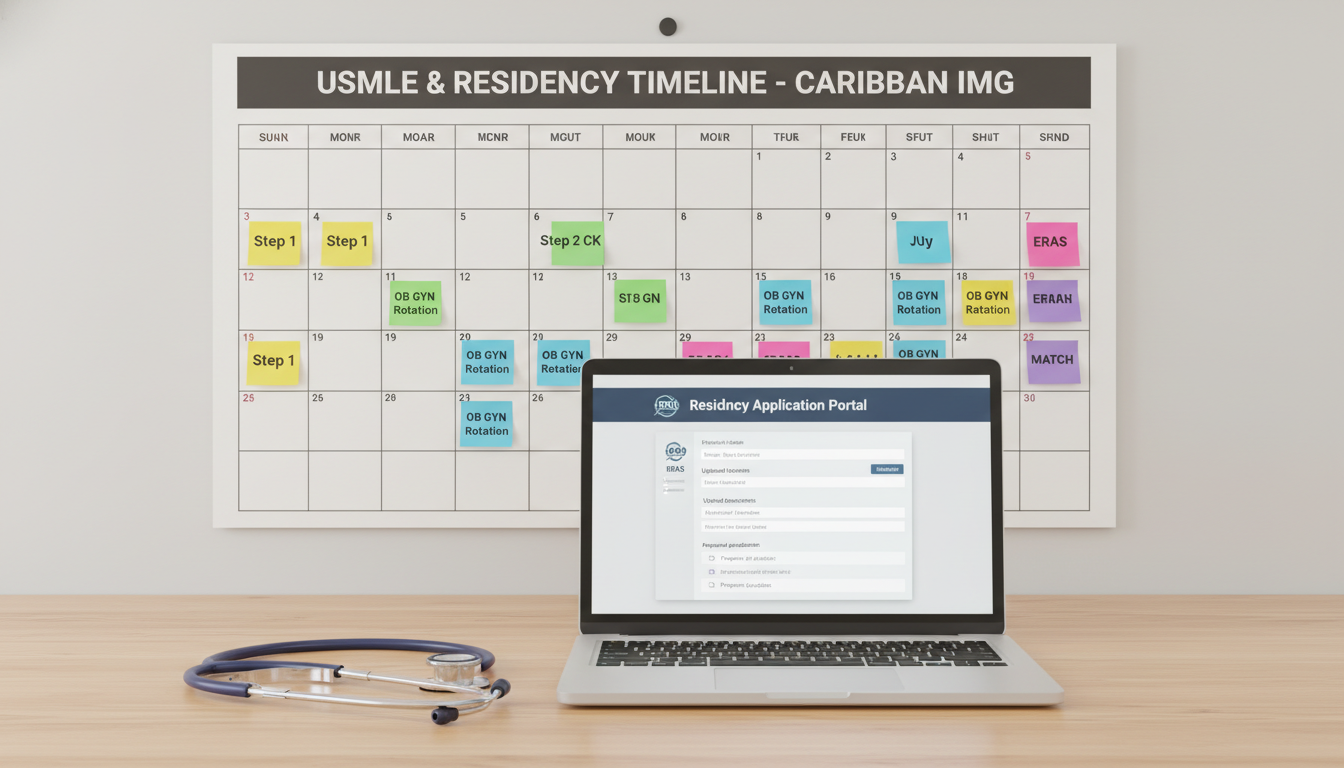
Step 2 CK Strategy by Score Range for Caribbean IMGs
Your optimal plan depends on where your Step scores fall. Below are realistic pathways for different profiles.
A. High Step 2 CK (≥ 245) and Pass Step 1
Profile:
- Caribbean medical school residency applicant with:
- First-attempt Pass Step 1
- Step 2 CK ≥ 245
- Solid clinical evaluations
Strategic advantages:
- You will clear most automated score screens.
- Some programs that are IMG-skeptical may become more open due to your strong score.
- You are more competitive for mid-tier university and strong community OB GYN programs.
How to leverage it:
Apply broadly but targeted:
- Target a wide range of OB GYN programs—university-affiliated community programs, academic centers with a history of IMGs, and strong community hospitals.
- Check program websites and FREIDA for IMG and visa policies.
Obtain strong OB GYN letters:
- Secure at least two letters from OB GYN attendings, ideally from U.S. clinical experiences or SGU-affiliated hospitals.
- Aim for a Sub-I or acting internship in OB GYN at a program that accepts Caribbean IMGs—this can lead to a strong letter and advocacy.
Highlight academic rigor:
- Mention your Step 2 CK performance in your personal statement only if it supports your narrative (e.g., “demonstrated strong clinical reasoning and exam performance, as evidenced by high Step 2 CK score”).
- Showcase any honors in clerkships, especially OB GYN and Surgery.
B. Mid-range Step 2 CK (230–244) and Pass Step 1
Profile:
- Caribbean IMG with:
- Step 1 Pass (first attempt)
- Step 2 CK in the 230–244 range
Strategic implications:
- You are competitive for many OB GYN programs but may be screened out by the most score-sensitive programs.
- You must optimize every other part of your application to rise above other mid-range applicants.
Action plan:
Maximize clinical excellence:
- Aim for honors in OB GYN rotation.
- Volunteer for extra procedures, on-call opportunities, and patient continuity where possible.
- Ask for feedback early so you can improve mid-rotation.
U.S. clinical experience in OB GYN:
- Arrange U.S. OB GYN electives or sub-internships at programs:
- Known to take Caribbean IMGs
- In less hyper-competitive cities (avoid only applying to NYC, LA, Miami if your scores are mid-range)
- Arrange U.S. OB GYN electives or sub-internships at programs:
Targeted program selection:
- Use your dean’s office, advisors, or alumni networks (e.g., SGU residency match lists) to identify OB GYN programs with:
- Prior Caribbean IMG residents
- Lower average Step 2 scores historically
- Apply to a large number of programs (60–100) given your IMG status.
- Use your dean’s office, advisors, or alumni networks (e.g., SGU residency match lists) to identify OB GYN programs with:
Add differentiators:
- Research experiences in women’s health, maternal-fetal medicine, reproductive endocrinology, or global health.
- Leadership roles in OB GYN interest groups, women’s health outreach, or simulation teaching.
C. Low Step 2 CK (< 230) or Step 1 Fail: Low Step Score Match Strategy
This is where deliberate strategy is crucial. You are now planning a low Step score match pathway.
Profile:
- Step 2 CK < 230, and/or
- Step 1 fail (even with later pass), and
- Caribbean school graduate
This is a significantly uphill battle for OB GYN, but not uniformly hopeless—especially at lesser-known community programs committed to underserved populations, or at hospitals with a track record of holistic review.
Key priorities:
Stabilize your narrative:
- Understand why you underperformed (test anxiety, poor timing, gaps in basic sciences).
- Document what you changed: formal test-prep course, tutoring, dedicated study schedule, improved NBME trajectory.
- Be prepared to address this briefly, maturely, and constructively in personal statements and interviews.
Outperform in everything under your control:
- OB GYN rotation: be the top-performing student; ask for granular, detailed letters.
- Show procedural comfort and OR professionalism—OB GYN is a surgical specialty.
- Take on OB GYN-specific research, case reports, or QA/QI projects.
- Build continuity volunteering in women’s health clinics, prenatal education, or doula support programs.
Program list strategy:
- Apply extremely broadly (often 80–120 programs).
- Focus on:
- Community programs
- Programs in less popular locations (Midwest, South, smaller cities)
- Hospitals with known Caribbean IMG residents (research every program’s current residents page)
- Consider programs that explicitly state “holistic review” or no formal Step 2 cutoff, but still assume most will prefer higher scores.
Parallel planning and backup options:
- Think critically about your risk tolerance.
- Consider:
- Parallel applications in a less competitive specialty (e.g., Family Medicine, Internal Medicine) if OB GYN appears unrealistic with your profile.
- OB GYN preliminary or transitional year positions (where offered) as a bridge—but treat this realistically; converting to a categorical OB GYN position later is not guaranteed.
- Talk to trusted mentors who can review your full profile quantitatively (scores, rotations, letters, gaps).
Practical Step Prep Tactics for Caribbean IMGs Aiming at OB GYN
Beyond strategy, your day-to-day Step prep influences your eventual score.
Using Obstetrics & Gynecology to Improve Step 2 CK Performance
OB GYN content appears in Step 2 CK well beyond pregnancy complications. To leverage it:
Master common OB triage and emergencies:
- Pre-eclampsia/eclampsia
- Postpartum hemorrhage (PPH)
- Shoulder dystocia
- Fetal heart rate tracings interpretation
- Preterm labor and PPROM
Integrate ambulatory women’s health:
- Contraception & contraindications
- Cervical cancer screening guidelines
- Management of abnormal pap smears
- Prenatal care visit schedules and routine screening
Systematic approach to questions:
- Always identify:
- Gestational age
- Maternal vital signs and stability
- Fetal status
- Key labs or imaging
- Develop a mental algorithm for:
- Bleeding in early pregnancy
- Hypertension in pregnancy
- Third-trimester bleeding
- Always identify:
Build OB GYN-specific flashcards:
- High-yield tables for:
- Hypertensive disorders of pregnancy
- Stages of labor and abnormal labor patterns
- Indications and contraindications for induction or C-section
- High-yield tables for:
General Step 2 CK strategy for Caribbean students
Resource discipline:
- Use one main question bank (UWorld) as your core.
- Supplement with NBME practice exams and, if needed, one concise review book or online course.
- Avoid spreading yourself across too many resources; time is limited during clinical rotations.
Data-driven self-monitoring:
- Track UWorld performance by subject, focusing on low-scoring systems (e.g., OB GYN, surgery, internal medicine).
- Use NBME practice scores as your most reliable predictor:
- Delay Step 2 CK if your practice scores are consistently below your target range and if changing your exam date is feasible.
Realistic scheduling in the Caribbean context:
- Caribbean rotations may involve travel, visa logistics, and inconsistent schedules.
- Plan protected study time during lighter rotations, not while moving between islands or clinical sites.

Turning Step Scores into a Convincing OB GYN Application Story
Numbers matter, but narrative and fit also shape the obstetrics match. You must integrate your Step scores into a convincing overall story.
1. Personal statement and narrative building
Your personal statement should:
- Clearly explain why OB GYN, using:
- Specific clinical experiences
- Mentors or role models
- Commitment to women’s health or underserved populations
- Avoid dwelling excessively on scores or failures; instead:
- Acknowledge any major red flags briefly and directly (“During my first attempt at Step 1…”).
- Emphasize what you learned and how later performance (e.g., improved Step 2 CK, strong clinical evaluations) demonstrates growth.
2. Letters of recommendation that contextualize scores
For Caribbean IMGs, letters are crucial in balancing concerns about school quality or Step performance.
Ask your OB GYN letter writers to speak to:
- Your clinical judgment and reliability.
- Your ability to handle call, emergencies, and procedural tasks.
- Any observed improvement that counters earlier struggles (e.g., after a Step 1 fail).
- How you compare to U.S. students they have supervised (e.g., “performs at or above the level of U.S. MD students I have worked with”).
3. Interview preparation with score-related questions in mind
Many Caribbean IMGs are asked explicitly about:
- Low or borderline Step scores
- Step 1 failures
- Gaps in training
Prepare short, structured answers:
- Own the problem (“I underestimated the volume,” “I mismanaged my schedule,” etc.).
- Explain the solution (new study strategy, tutoring, schedule changes).
- End with evidence (“My improved clinical evaluations and Step 2 CK score reflect these changes.”).
Actionable Checklist for Caribbean IMGs Targeting OB GYN
During basic sciences (preclinical):
- Plan Step 1 for a time when you can dedicate intensive study.
- Use NBME practice exams to ensure a margin above passing.
- Aim for first-attempt Pass on Step 1.
During clinical years:
- Schedule OB GYN and Surgery rotations before Step 2 CK if possible.
- Use UWorld and NBME exams to guide Step 2 CK timing.
- Target at least 230–240+ on Step 2 CK, with 245+ giving more leverage as a Caribbean IMG.
Before ERAS:
- Have Step 2 CK score available by early application season.
- Secure 2 strong OB GYN letters (preferably from U.S. attendings).
- Identify OB GYN programs that have matched SGU and other Caribbean IMGs in recent years.
- Build a broad list of programs emphasizing those open to IMGs and located outside the most competitive cities.
If scores are low:
- Strengthen every other part of your application (letters, rotations, research, service).
- Craft a clear, honest explanation for any Step failure.
- Consider backup specialties and/or preliminary positions realistically.
FAQs: Step Score Strategy for Caribbean IMGs in OB GYN
1. What Step 2 CK score do I need as a Caribbean IMG to match into an OB GYN residency?
There is no absolute cutoff, but for a Caribbean medical school residency candidate:
- More competitive position: ≥ 245
- Reasonable interview chances at many programs: 230–244
- Low Step score match zone (< 230): Requires a very strong overall application, broad program list, and often focus on community programs in less competitive locations.
Programs also look at attempts and overall trajectory (improvement vs decline), not just the final number.
2. Can I still match OB GYN if I failed Step 1 as a Caribbean IMG?
Yes, but it becomes significantly more challenging. A Step 1 fail is a red flag, particularly in a surgical specialty like OB GYN. To remain a viable obstetrics match candidate:
- You should aim for a strong Step 2 CK score (ideally 240+).
- You must demonstrate excellent performance on clinical rotations, especially OB GYN and Surgery.
- Your letters should explicitly highlight your maturity, reliability, and growth after the failure.
- You’ll need to apply very broadly and prioritize programs known to be more IMG-friendly.
In some cases, a backup specialty should be seriously considered.
3. Does being from SGU or another well-known Caribbean school help offset lower Step scores?
Attending a well-recognized Caribbean school (such as SGU) may provide some advantages:
- Some programs have a documented SGU residency match history and are more comfortable with the school’s training and evaluation systems.
- Alumni networks might help you obtain away rotations, mentorship, or letters.
However, school name alone cannot “cancel out” low scores or exam failures. You still need to meet each program’s thresholds and demonstrate readiness through Step 2 CK, rotation performance, and strong recommendations.
4. If my Step 2 CK score is low, should I delay applying to OB GYN and try to improve other parts of my application first?
It depends on your overall profile and career timeline:
If you are still early (e.g., just finished Step 2 CK, no major gaps yet), you could:
- Spend extra time strengthening OB GYN research, U.S. electives, and clinical letters.
- Apply in the next cycle with a more complete portfolio.
If delaying would create a large gap since graduation, that can become its own red flag. In such cases, it might be better to:
- Apply with a strong holistic application now, and
- Include a backup specialty or consider more IMG-friendly fields.
Discuss your specific situation with a knowledgeable advisor who understands Caribbean IMG patterns in OB GYN; individualized guidance is essential.
By approaching your Step scores as one part of a deliberate, multi-year strategy—and not just a single hurdle—you give yourself the best chance to move from Caribbean medical school residency applicant to future OB GYN resident. The combination of thoughtful Step 2 CK strategy, strong clinical performance, and targeted program selection can turn even a challenging test history into a credible, compelling application story.