
Understanding Low Step Scores in the Context of Community Hospital Residency Programs
Community hospital residency programs can be excellent destinations for applicants with a low Step 1 score or below average board scores. These programs often emphasize “fit,” work ethic, and genuine interest in their communities as much as they do test performance. To use that to your advantage, you need a deliberate strategy.
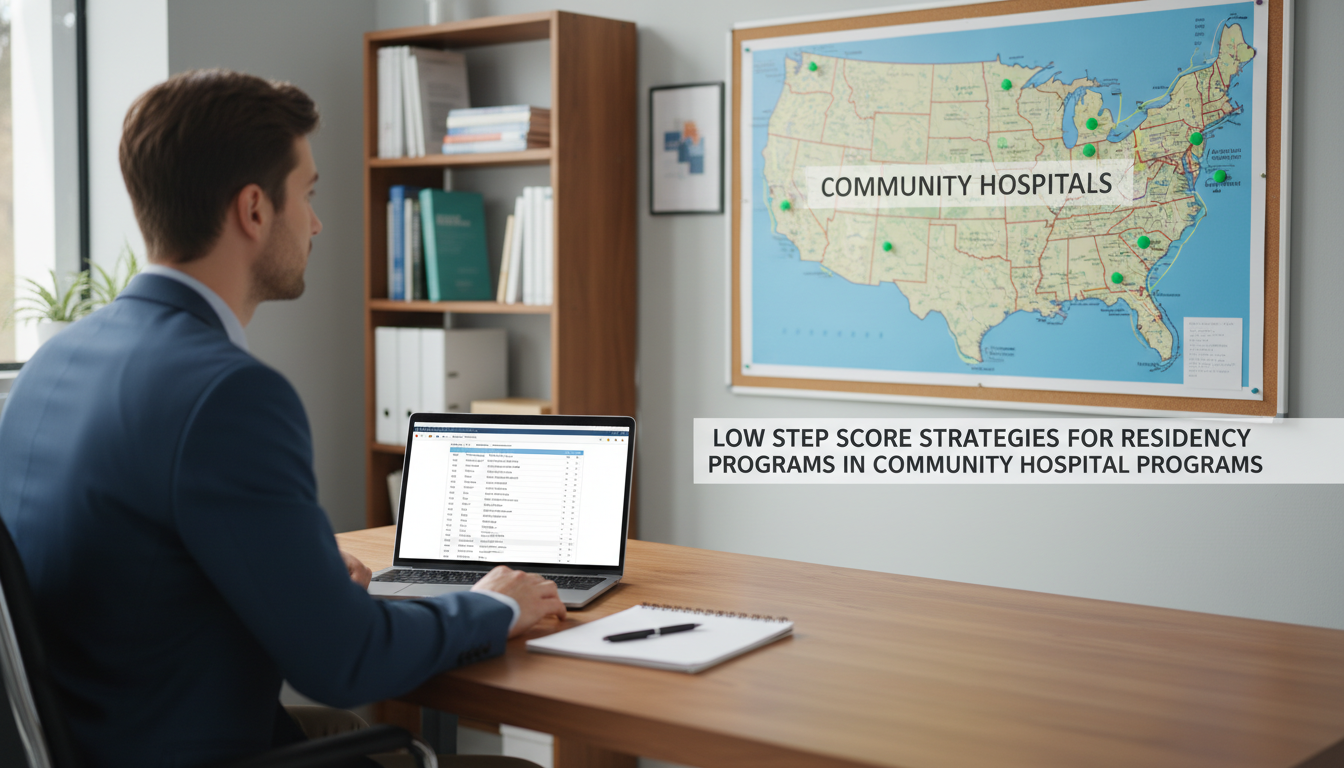
This article focuses on low Step score strategies specifically for community hospital residency and community-based residency programs. You’ll learn how programs in these settings actually view scores, what parts of your application can compensate, and how to build a concrete plan for matching with low scores.
We’ll primarily reference USMLE Step 1 and Step 2 CK, but the principles generally apply to COMLEX as well.
How Community Hospital Programs View Low Step Scores
1. Community vs. University Programs: Different Emphasis
While every program values strong board performance, community hospital residency programs often use a more holistic review than large academic centers. Common differences:
University/academic programs
- Large applicant volume; use strict numerical filters
- May heavily favor research, publications, and prestige
- Tend to be more competitive for applicants with weak test scores
Community-based residency programs
- Smaller applicant pools; more likely to read full applications
- Strong emphasis on:
- Clinical performance and work ethic
- Professionalism and communication skills
- “Fit” with program culture and community
- More willing to consider applicants with below average board scores if the rest of the application is compelling
This doesn’t mean community programs ignore scores. Many still have cutoffs (explicit or implicit), but they’re more open to context and growth.
2. What “Low” Step Scores Mean in Practice
“Low” is relative to specialty and year. Broadly:
- Step 1 (numeric) below average or a pass on pass/fail with concerns elsewhere
- Step 2 CK significantly below national mean, or below a program’s typical match range
- Multiple attempts or a failure on Step 1 or Step 2 CK
From a program’s standpoint, low scores raise two questions:
Can this applicant pass boards on the first attempt?
Programs are accredited based partly on their board pass rates. They’re understandably cautious.Will this applicant handle residency workload and stress?
Poor test performance can be interpreted (fairly or not) as a proxy for time management, consistency, or foundational knowledge.
Your strategy must directly address these concerns with evidence: performance trends, clinical excellence, and a credible plan for future exams.
Choosing the Right Specialties and Programs When You Have Low Scores
1. Being Strategic About Specialty Choice
Some specialties remain extremely competitive regardless of the setting (e.g., dermatology, plastic surgery, orthopedic surgery, neurosurgery). With a low Step 1 score or below average board scores, you need to be realistic.
Specialties that are generally more accessible in community settings include:
- Internal Medicine (especially community programs)
- Family Medicine
- Pediatrics (varies by region)
- Psychiatry (competitive in some regions, but many community options)
- Transitional Year (selectively, and often as a pathway to another field)
- Preliminary Medicine (for those with long-term specialty goals)
If you’re already committed to a highly competitive specialty, consider a parallel plan:
- Apply broadly to a less competitive field (e.g., Internal Medicine)
- Focus heavily on community programs
- Consider a categorical back-up option you would truly accept if your first choice doesn’t work out
2. Targeting Community Hospital Residency Programs Intelligently
When matching with low scores, where you apply can matter as much as how you apply.
Look for community programs that:
- Are non-university affiliated or only loosely affiliated
- Are located in smaller cities or less competitive regions
- Have missions that emphasize:
- Serving underserved or rural populations
- Training community-based clinicians
- Diversity, second-career applicants, or non-traditional backgrounds
Signals that a program may be more open to low scores:
- Higher proportion of international medical graduates (IMGs)
- History of accepting applicants with USMLE attempts (if noted on forums or reports)
- Program website language emphasizing:
- Holistic review
- “Strong clinical skills and work ethic”
- “Commitment to our community”
Practical example:
- Applicant with Step 1: Pass (borderline) and Step 2 CK: 218
- Interested in Internal Medicine
- Strategy:
- Prioritize community-based residency programs in the Midwest and South
- Add smaller community hospitals in suburban or semi-rural areas
- De-emphasize large academic centers in major metropolitan areas unless there’s a strong personal connection
Application Components That Can Offset Low Step Scores
1. Maximizing Step 2 CK as Your Redemption Exam
If your Step 1 is low (or pass/fail with concerns elsewhere), Step 2 CK becomes critical.
Strategies:
Treat Step 2 CK as a fresh start:
- Build a structured 8–12 week study plan
- Focus on UWorld, NBME practice exams, and active recall
- Track progress and delay the exam (within ERAS timelines) if practice scores are still very low
If you already have a low Step 2 CK:
- Reflect honestly on what went wrong (time, illness, strategy, burnout)
- Incorporate a clear remediation story into your application (personal statement and interviews)
- Consider additional evidence of knowledge:
- In-training exam results if you did a preliminary year
- Shelf or rotation exam scores (if strong)
- Graduate coursework (e.g., MPH with strong academic standing)
Programs value an upward trajectory. A low Step 1 followed by a solid or high Step 2 CK is far less concerning than consistently low performance.
2. Clinical Rotations: Your Strongest Weapon in Community Programs
Community hospital programs care deeply about how you function on the wards. Stellar clinical performance can partially offset lower exam scores.
Key targets:
- Core clerkships (IM, Surgery, Pediatrics, OB/Gyn, Psychiatry, Family Medicine)
- Sub-internships / acting internships in your chosen specialty
- Audition rotations at community hospitals you’re targeting
How to stand out clinically:
- Show up early, stay late when needed, and volunteer to help
- Be the student who:
- Knows every patient thoroughly
- Follows up on labs and imaging without being asked
- Communicates clearly with nurses and staff
- Ask for mid-rotation feedback and correct weaknesses quickly
Community attendings often value reliability and humility. They will write strong letters for students who clearly care about patients and the team.
3. Letters of Recommendation (LoRs) That Speak Beyond Your Scores
A powerful letter can change how your low scores are perceived.
For community hospital residency applications, aim for LoRs that:
- Are from clinical supervisors who saw you work closely (attendings, not just residents)
- Explicitly address:
- Your work ethic and reliability
- Ability to manage clinical responsibilities
- Improvement over time
- Professionalism and communication skills
If your scores are low, it can help if a letter contextualizes them indirectly, for example:
“While standardized tests have not always reflected their full abilities, this student is among the most clinically mature, reliable, and compassionate trainees I have worked with.”
Prioritize:
- Letters from community-based attendings in your chosen specialty
- At least one letter from a rotation at a community hospital, if possible
- If you did an away/audition rotation, request a letter before leaving, when you are still fresh in the writer’s mind
4. Personal Statement: Owning Your Story Without Over-Explaining
For applicants matching with low scores, the personal statement is an opportunity to reframe your narrative.
What to do:
Briefly acknowledge the issue if it was significant (e.g., a Step failure) and own it:
- 2–3 sentences is usually sufficient
- Avoid making excuses; focus on:
- What you learned
- How you changed your study habits
- How you developed resilience
Redirect to your strengths:
- Commitment to patient care, especially in community settings
- Meaningful clinical, volunteer, or work experiences
- Long-term goals aligned with community practice (e.g., outpatient primary care, hospitalist in underserved area)
What not to do:
- Do not spend half the statement justifying your scores
- Do not blame a single external factor (e.g., “The exam was unfair” or “The test center was noisy”)
- Do not sound defensive or bitter
Your tone should signal maturity, insight, and forward momentum.
5. CV and Experiences: Demonstrating Grit and Fit
Low scores can be partially offset by a robust track record of commitment.
Particularly valuable for community programs:
- Long-standing community service (clinics, shelters, health education)
- Work experience before or during medical school (especially in healthcare)
- Leadership roles (student organizations, quality improvement projects)
- Projects focused on:
- Underserved populations
- Rural or community health
- Continuity of care
When program directors see evidence of perseverance—working through school, caring for family, overcoming adversity—it can make them more willing to look past lower numbers.

Program-Specific Strategies: How to Appeal to Community Hospitals
1. Show You Genuinely Want a Community-Based Residency
Programs can tell when applicants are using them as a “backup” to university hospitals. That’s a red flag, especially if your scores are weak.
Demonstrate genuine interest by:
Emphasizing in your personal statement:
- Why you value community-based training
- Prior experiences in similar settings
- Plans to work in community practice or underserved areas
Tailoring messages and interview responses:
- “I’m looking for a program where I can have early autonomy and meaningful continuity with patients.”
- “My experiences in free clinics and community hospitals have shown me that this is where I want to build my career.”
Highlighting geographic ties:
- Family in the region
- Grew up nearby or studied there
- Familiarity with local communities or cultures
Programs are more willing to take a chance on a lower-score applicant who is likely to stay and thrive long-term.
2. Audition Rotations at Community Hospital Programs
If possible, consider doing audition (away) rotations at community hospitals where you hope to match.
Benefits:
- You can show that your clinical performance exceeds what your scores suggest
- You gain advocates (attendings, residents, program leadership) who have seen your work
- You demonstrate serious interest in that program and region
How to maximize the impact:
- Treat the rotation like a month-long interview
- Ask for feedback early and often
- Request a letter from the strongest advocate you identify
- Stay in contact afterwards with a brief, professional update (e.g., when ERAS is submitted)
3. Strategic Communication: Signaling Interest and Fit
Community hospital programs may receive fewer applications than large academic centers, so demonstrated interest matters.
Tactics:
- Program signaling (if available): If your specialty has a signaling system (e.g., ERAS signals), prioritize community programs that are a good fit.
- Emails to program coordinators or PDs (brief and professional):
- Focus on:
- Genuine interest in the program
- Geographic ties
- How your experiences align with their mission
- Avoid oversharing about low scores; instead, emphasize strengths
- Focus on:
- Post-interview thank-you notes:
- Specific references to what impressed you about their program
- Reinforce your alignment with community-based practice
Building a Realistic Match Strategy With Low Scores
1. Applying Broadly and Wisely
With a low Step 1 score or below average board scores, the number and type of programs you apply to matter.
General guidelines (adjust for specialty and region):
- For less competitive fields (e.g., FM, IM in community settings):
- 40–60 programs if you are a US MD with low scores
- 60–80+ if you are a US DO or IMG with low scores
- For moderately competitive fields (e.g., Pediatrics, Psychiatry):
- Often 60–100+ programs, with a strong emphasis on community hospitals
Spread your applications across:
- Multiple states and regions
- Different tiers of competitiveness
- A mix of programs where your stats are:
- Below average (reach)
- In range (target)
- Above the program’s typical range (safer)
2. Parallel Planning and Backup Pathways
If your scores are very low or you have multiple exam failures, consider parallel strategies:
- Applying to a second, less competitive specialty in community settings
- Considering preliminary or transitional year positions (if they provide a clear path to a categorical spot later)
- Exploring community-based residency programs that explicitly welcome non-traditional paths or career-changers
Be honest with yourself:
- What is your ultimate career goal (type of work, not job title)?
- Are you willing to adjust your specialty to secure a stable and fulfilling clinical role?
- Would you be content long-term in your backup specialty?
3. Interview Preparation: Reframing Low Scores Confidently
If you reach the interview stage, programs have already decided your application merits serious consideration. At that point:
Prepare for questions like:
- “Can you tell me about your Step 1/Step 2 score?”
- “What did you learn from that experience?”
- “How have you ensured you are ready for the demands of residency?”
Effective approach:
- Acknowledge briefly and calmly
- Explain contributing factors without making excuses
- Emphasize growth:
- Changed study methods
- Improved time management
- Strong clinical evaluations or later exam scores
- Reassure them about the future:
- Concrete plan for in-training exams and board prep
- Examples of sustained, consistent performance since the low score
Programs want to see resilience and insight, not perfection.
Frequently Asked Questions (FAQ)
1. Can I match into a community hospital residency with a very low Step 1 score or a Step failure?
Yes, it is possible, especially in community-based residency programs and in less competitive specialties (e.g., FM, IM, some Pediatrics and Psychiatry programs). Your chances improve if:
- You show a significant improvement on Step 2 CK
- You have strong clinical evaluations and letters
- You demonstrate genuine interest in community medicine
- You apply widely across multiple states and community hospitals
A single failure or very low score is a serious obstacle, but not an automatic disqualification if the rest of your profile is strong and upward trending.
2. Should I delay my Step 2 CK exam to improve my score for residency applications?
If your practice scores are well below your target range and you believe additional focused study time will meaningfully improve your performance, delaying Step 2 CK—within ERAS timelines—can be wise. For applicants with a low Step 1 score, Step 2 is often the “redemption exam,” so underperforming a second time can be more damaging than a slightly later score release.
However:
- Don’t delay so long that your score isn’t available when programs start reviewing applications
- Don’t delay without a clear, realistic plan for improvement
Discuss timing with a dean, advisor, or trusted mentor who knows your situation.
3. How many programs should I apply to if I have below average board scores and I’m targeting community programs?
It depends on your specialty, medical school (US MD, DO, or IMG), and how low your scores are. As a rough guide for matching with low scores into community programs:
- US MD, low scores, less competitive specialty: 40–60 programs
- US DO, low scores: 60–80+ programs
- IMG, low scores: often 80–120+ programs, with a heavy emphasis on community hospital residency programs in multiple regions
Work with your school’s advising office and examine match data from similar applicants to refine these numbers.
4. Do community hospital programs care less about research if I have low scores?
Most community programs care less about research than large academic centers, and more about your clinical performance, professionalism, and commitment to community care. Research is rarely the deciding factor for community-based residencies, especially in primary care fields.
That said:
- A modest amount of research or quality improvement work can still help, as it shows initiative and academic curiosity
- Strong clinical evaluations and letters usually carry more weight than research when you have below average board scores
If your time is limited, prioritize Step 2 CK performance, clinical excellence, and strong letters over research.
By understanding how community hospital residency programs evaluate applicants and implementing a focused, realistic strategy, you can significantly improve your chances of matching with low scores. Your scores are one part of your story—not the entire narrative. Ground that story in resilience, community commitment, and consistent clinical performance, and many community-based residency programs will be willing to listen.