You didn't match. The email landed, and for a few hours, you couldn't breathe. Now the shock is fading, and you're staring at two diverging roads: commit to a research fellowship or grab a clinical job. Everyone has advice. Most of it is generic garbage. Here's the truth, neither path automatically fixes anything. The right choice depends entirely on what broke your application in the first place.
This article is for educational purposes only and is not financial advice, not legal advice, and not tax advice. Figures vary by institution, specialty, and geographic region. If you're facing contract or employment decisions, consult a qualified professional.

The Post-Match Reality Check: Diagnosing Why You Went Unmatched
Before you fire off emails to every PI in your state or apply for every clinical job on Indeed, stop. You need a brutal, honest audit of your ERAS application. Not a gentle review. A forensic teardown.
Print your entire application. Every component. Now go through it piece by piece with the coldest eyes you can muster.
Step scores. Were they below the specialty's mean? Below the filter cutoff? A 215 on Step 1 doesn't sink you in internal medicine, but it's a death sentence in dermatology. Know the numbers for your target specialty.
Letters of Recommendation. Are they generic? Did your letter writers actually know you, or did they just sign their names to a template? A weak LoR is worse than no LoR because it actively signals that nobody was impressed enough to fight for you.
US Clinical Experience. If you're an IMG, did you have enough hands-on USCE? Observerships don't count the way rotations with evaluations do. Programs want to see that you've functioned inside the American healthcare system, not just watched it from the corner.
Professionalism and red flags. Failed attempts on Steps? Gaps in your CV that you can't explain? A professionalism citation? These are different animals than "my research portfolio was thin." One is a credibility problem. The other is a volume problem.
Geographic mismatch. Did you only apply to California programs with 250 Step scores? Were your letters from a region where you had no geographic ties? Programs filter on this more than they admit.
Here's what matters: red flags (failed steps, professionalism issues, repeated application failures) require different interventions than yellow flags (weak letters, thin research, limited USCE). A research fellowship doesn't fix a failed Step 2 CK. A clinical job doesn't fix a publication count of zero for ortho. You must match the intervention to the actual problem, not the problem you wish you had.
The clock is already ticking. The next ERAS cycle opens in roughly five months. Whatever you choose needs to produce visible, documentable results by August. Not October. Not "maybe next cycle." August. That means you need to move now, with specificity, not in three weeks after you've "processed everything."
The Research Fellowship Path: Metrics, Productivity, and Network ROI
A research fellowship is not a magic wand. It's a strategic instrument, and most people use it wrong.
What a good research fellowship looks like:
A legitimate research year gives you three things in measurable quantities: publications, mentorship access, and institutional backing. If you're not getting all three, you're wasting a year. I've seen applicants spend twelve months in a lab and walk out with one poster presentation and a PI who can't remember their name. That's a failed gap year, and it happens constantly.
A good fellowship puts you in a high-volume publishing environment. You want a PI who churns out papers, not a PI who's working on their magnum opus that will publish in 2027. Look at the PI's PubMed output over the last two years. If they're producing 8-12 papers annually with residents and fellows as co-authors, that's your target. If their last first-author paper was in 2019, run.
The hidden traps:
Unpaid positions. I'm not saying unpaid fellowships are always bad, but they're exploitative more often than not. If a PI wants you to work 60 hours a week for free, they should be giving you guaranteed co-authorship, protected time for your own projects, and active mentorship. Get it in writing. "You'll get your name on some papers" is not a commitment. "You will be second author on a minimum of four publications by August" is a commitment.
Toxic PIs. Some principal investigators view research fellows as disposable labor. They'll have you doing data entry, IRB paperwork, and grant administration while their favored postdocs get the publishing opportunities. You need to talk to current and former fellows before you sign anything. Ask directly: "How many papers did you publish during your year? Did the PI write you a letter for residency?"
Low clinical relevancy. If you're applying into internal medicine, a year of bench research on molecular pathways in oncology is fine. If you're applying into surgery, spending a year in a health policy lab is a harder sell. Your research should ideally have some connection to your target specialty, or at least demonstrate transferable skills like clinical trial design, retrospective analysis, or outcomes research.
The ROI calculation for competitive specialties:
For dermatology, orthopedic surgery, plastic surgery, ophthalmology, and the surgical subspecialties, research isn't optional. It's table stakes. The average matched applicant in dermatology has 14+ publications, posters, and presentations. If you went unmatched with three posters, a research year isn't a choice, it's a requirement. But the math has to work. One year of productive research in a high-output lab should yield 6-10 publications if you're aggressive. That moves you from "below average" to "competitive." Two publications from a sleepy lab does nothing.
For less competitive specialties like internal medicine, family medicine, psychiatry, and pediatrics, the research ROI drops significantly. A research year helps, but it's not the highest-yield intervention if your problem was clinical exposure, interviewing, or Step scores. Don't do a research year for internal medicine if your real problem was that you couldn't get a USCE rotation and your letters were from observerships.
Network leverage is the real currency. A research fellowship at your home institution or a target institution puts you in the same room as the program director. That's worth more than three publications. If your PI is on the admissions committee or has co-residency leadership roles, you've bought yourself a meeting that no cold email could ever get.
The Clinical Job Path: T-Gears, Urgent Cares, and Proving Competency
What's available to you:
If you're a US grad who went unmatched, your options include clinical instructor roles, medical assistant positions in specialty clinics, and in some states, assistant physician roles that allow you to practice under supervision with a full medical license. Not every state offers the assistant physician pathway, but roughly 12 states do, including Missouri, Utah, and Arkansas. These roles give you direct patient care experience and a paycheck. That's a rare combination in the gap-year world.
IMGs face a harder road. Without ECFMG certification and a state license, direct patient care is often off the table. But clinical research coordinator positions, scribe roles in academic centers, and medical assistant positions in outpatient clinics remain accessible. These positions keep you in the clinical environment, give you patient interaction, and, critically, put you in front of physicians who can write letters.

Clinical job vs. research for your CV:
Here's where people get confused. A clinical job doesn't pad your publication count, but it does something research can't: it proves you can function in a clinical environment. If your application screamed "this person has never touched a patient in the American system," a year of scribing or working as a clinical assistant is a direct counter to that narrative. Program directors want residents who won't fall apart on rounds. Clinical experience demonstrates that.
A scribe position in a busy ED or a specialty clinic gives you exposure to documentation, workflow, and patient interaction. It's not glamorous, and the pay is modest, but it puts you in a position where attending physicians see you every day. Do a good job, and you've got a letter that says "I worked alongside this applicant for 12 months and can personally attest to their clinical judgment and professionalism." That letter hits differently than a research letter that says "they were productive in my lab."
The gap year stigma:
Let's be honest. There's a stigma. Program directors see a gap year and wonder. Your job is to control the narrative before they do. A clinical job isn't a step down, it's a demonstration of resilience. You didn't match, and instead of sitting around, you got back into clinical medicine, kept your skills sharp, and continued caring for patients. That's a story. A compelling one.
The mistake people make is treating the clinical job as a holding pattern. Don't. Use it as an active intervention. Get new letters. Build relationships with attendings who have connections. Study for and crush Step 3 if you haven't taken it. Present a case at a departmental conference. Turn the job into proof that you've grown.
Decision Matrix: Which Path Fixes Your Specific Application Flaw?
Here's the decision framework. No hedging.
If your Step scores are fine but your CV lacks academic depth: Research fellowship. This is the clearest call. You passed the numerical filters, but your application looked thin next to applicants with 15 publications. A productive research year with a high-output PI directly addresses this. Target competitive specialties that weigh research heavily.
If your application lacked US clinical experience or interviewing soft skills: Clinical job. You need patient-facing work and physician relationships. Research won't fix a deficit in clinical comfort or communication. A clinical job puts you in front of patients and attendings daily, builds your confidence, and gives you letters that speak to clinical competence.
If your Step scores are below the filter cutoff: Neither path alone fixes this. You need to retake and improve your scores. A research fellowship with a Step retake is a reasonable combined strategy. A clinical job without addressing your scores is rearranging deck chairs. Fix the numbers first.
If you failed to match due to a professionalism or red flag issue: You need to address the root cause directly, through remediation, honest reflection, and letters that specifically speak to your professionalism and growth. Neither research nor clinical work alone overcomes this. You need trusted faculty advocates who will vouch for you in specific terms.
Financial pressure as a tiebreaker:
If you're drowning in loan payments and can't afford an unpaid research year, the clinical job wins by default. A year of financial ruin doesn't help you match. It breaks you. Take the clinical job, earn income, study for Step 3, and reapply with financial stability and new clinical letters. I've seen applicants make the "noble" choice of an unpaid fellowship and then burn out by November because they couldn't pay rent. That's not resilience. That's self-sabotage.
The hybrid approach:
Can you do both? Yes, but it's harder than people pretend. A clinical job that pays the bills plus one high-yield retrospective chart review with a sympathetic attending is realistic. A full-time clinical job plus a full-time research fellowship is not. You'll produce mediocre results in both, and program directors can smell desperation on a CV. Pick a primary path. Commit 80% of your energy there. Let the other 20% handle the secondary gap.
Execution Playbook: How to Pivot and Win in the Next Cycle
Timeline from Match Day to September:
March-April: Diagnose your application. Reach out to mentors. Secure your position, research or clinical. Don't wait until June.
May-July: Execute. If research, start producing. If clinical, build relationships. Study for and take Step 3 if needed. Your score needs to be in your application by September.
August: Finalize your ERAS. Update every section. New publications. New experiences. New letters. Rewrite your personal statement from scratch.
September: Submit on day one. Not day three. Day one.
Securing new LoRs:
Your old letters didn't get you matched. You need new ones. The best letters come from people who've worked with you during your gap year and can speak to your growth in specific terms. Give your letter writers the narrative: "I went unmatched, I identified my weaknesses, I took action, and here's what I've accomplished." Ask them to address your growth directly in the letter. A letter that says "they've shown remarkable improvement and resilience" is gold. A letter that says "they're a good student" is useless.
Rewriting your personal statement:
Do not reuse last year's personal statement. Do not pretend the gap year didn't happen. Address it. Own it. Show accountability, then pivot to what you did about it. "After not matching, I took an honest inventory of my application and identified a lack of clinical research experience. I committed to a year of productive research under Dr. X, resulting in four publications and a deeper understanding of evidence-based medicine." That's a narrative. That's momentum.
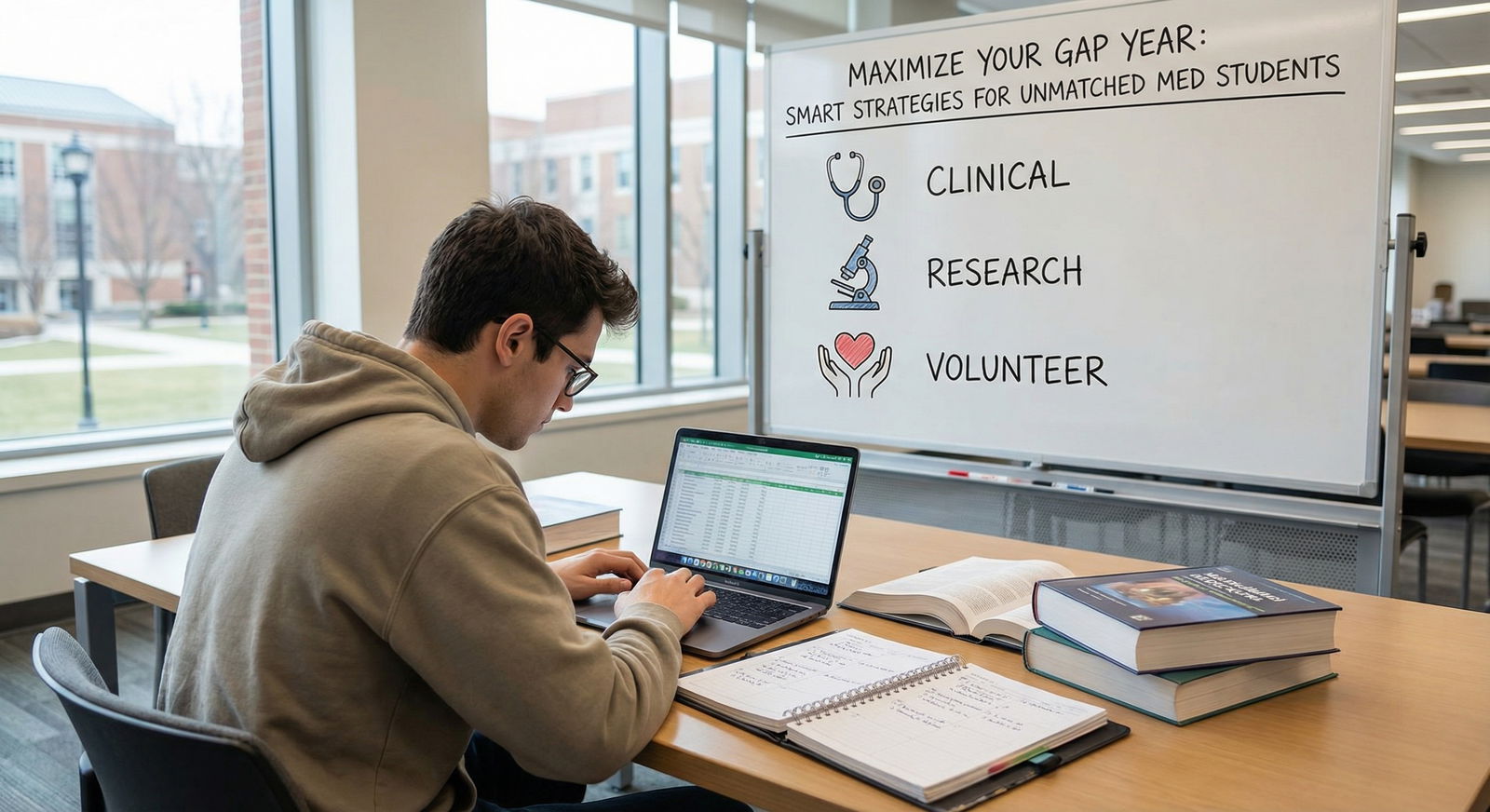
The final move:
Apply broadly. If you only applied to 30 programs last cycle, apply to 150 this time. If you only applied to one specialty, consider adding a backup specialty if your profile supports it. The match is a numbers game as much as a quality game. Play both sides.
Your gap year isn't a failure. It's an intervention. Execute it like one.