
The idea that “research is king” in residency applications is lazy, half-true, and causing a lot of students to sabotage themselves.
I keep seeing the same pattern. MS3 starts hearing horror stories: “You need ten pubs to match derm.” “If you don’t have research, you’re toast for anything competitive.” They panic, grab three meaningless poster projects, neglect clerkships, and end up with mediocre clinical evaluations, a weak Step 2, and a CV full of fluff. Then they wonder why their interview yield is terrible.
Let me be direct: research does not always trump clinical strength. For many applicants and many specialties, it does not even come close. And the data backs that up.
What the Data Actually Shows (Not What People Repeat on Reddit)
Everyone quotes “research is important” but almost no one bothers to look at what program directors actually say.
The National Resident Matching Program (NRMP) publishes the Program Director Survey every couple of years. It’s not perfect, but it’s a lot better than third-hand rumors. Here’s a simplified snapshot of what those surveys consistently show across major non-surgical specialties:
| Factor | Relative Importance* |
|---|---|
| Clerkship clinical performance | Very High |
| Letters of recommendation | Very High |
| Step 2 CK / Licensing exams | High |
| Personal knowledge of applicant | High |
| Research experience | Low–Moderate |
*“Relative Importance” summarized from multiple NRMP Program Director Surveys; exact numbers vary by specialty and year, but the hierarchy is remarkably consistent.
For core fields like internal medicine, pediatrics, family medicine, psych, EM, OB/GYN, research shows up far below:
- Clinical grades
- MSPE/Dean’s letter narrative
- Letters of recommendation
- Step scores
Even in competitive fields, research is rarely the top factor. Orthopedics programs still rate clinical performance on rotations and letters from orthopedic faculty above research. Dermatology and radiation oncology care about research more than average, but still won’t touch you if your clinical performance suggests you’re unsafe or difficult to work with.
Research is a force multiplier, not a substitute for being good clinically.
To make this vivid, let’s contrast two archetypal applicants I’ve seen repeatedly.
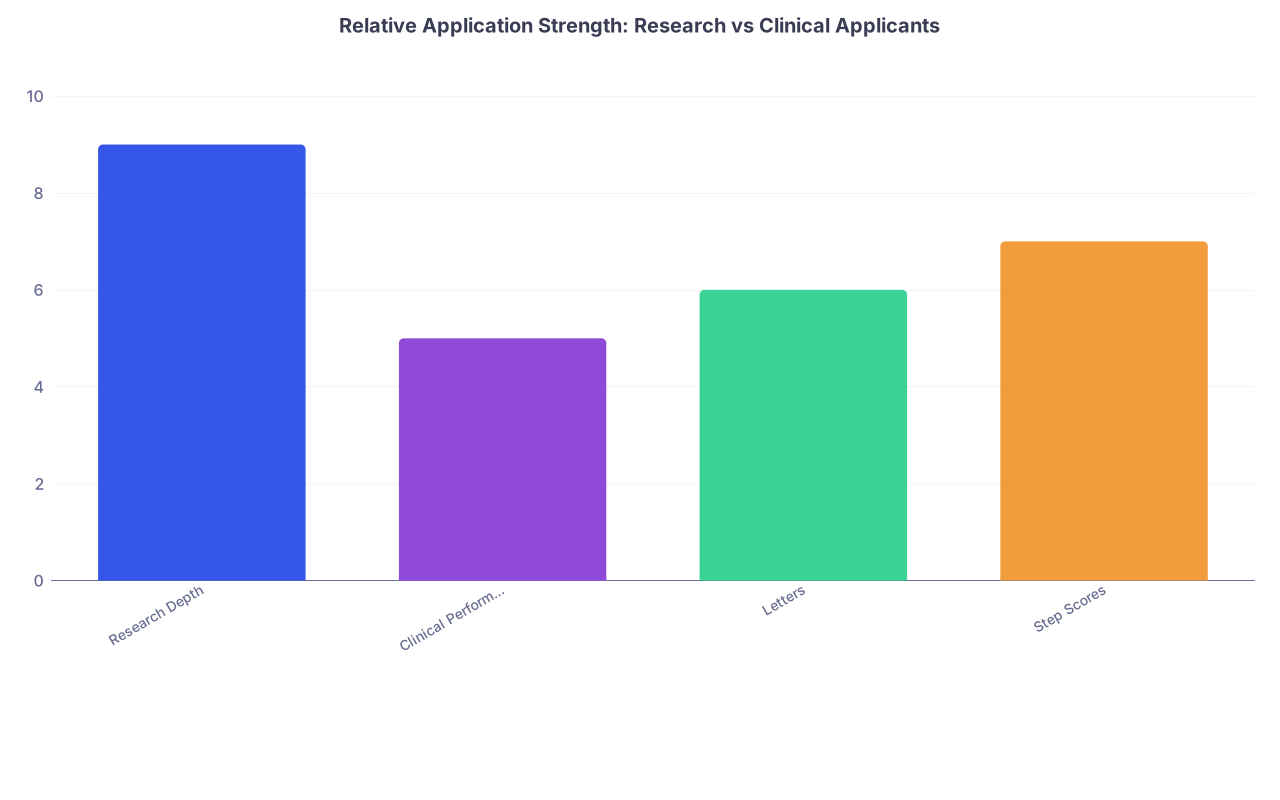
| Category | Value |
|---|---|
| Research Depth | 9 |
| Clinical Performance | 5 |
| Letters | 6 |
| Step Scores | 7 |
Imagine Applicant A (above chart) is the “heavy research, weaker clinical” type and Applicant B (not shown) flips those values—moderate research, very strong clinical and letters. In most non-ultra-competitive fields, Applicant B does better on interviews and rank lists. I’ve watched this play out year after year.
The First Gate: Are You Safe and Functional Clinically?
Program directors are not hunting for the “most academic CV” first. They’re looking for the resident least likely to be a disaster at 2 a.m. on call.
I’ve sat in those rank meetings. The talk is not, “She has 12 publications.” It’s:
- “Can I trust him to call for help?”
- “Is she coachable?”
- “What did the medicine attending say about him on wards?”
- “Her Step 2 was a 244 and comments said ‘reads on her patients and follows through’—solid.”
If your clinical profile looks scary, your research will not save you. It might get you read, maybe a courtesy interview if someone knows your PI, but it won’t erase red flags like:
- Multiple low clerkship grades in core rotations (especially the specialty you’re applying to)
- Lukewarm or concerning comments in the MSPE
- Poor sub-I performance
- Step 2 CK significantly below a program’s usual range
Here’s the uncomfortable truth: clinical performance is the filter. Research is the bonus.
Strong clinical + no research? You’ll match solidly in most fields (except a few ultra-competitive niches) if you target appropriately.
Weak clinical + strong research? You’re in trouble in almost every field.
Specialty Reality Check: Where Research Matters and Where It Really Doesn’t
Let’s get specific because the “research is everything” myth thrives in vagueness.
Fields where research is a big deal
There are a few specialties where research genuinely moves the needle more:
- Dermatology
- Plastic surgery
- Radiation oncology
- Neurosurgery
- Occasionally ENT, ortho, and some academic internal medicine tracks
In these fields, being research-empty hurts you. But even here, people exaggerate.
I’ve seen a derm candidate with 2 genuine derm-related projects, strong clerkships, and excellent letters match at a very respectable program, while the “18 publications” candidate with a sketchy MSPE and mediocre clinical reputation slid down their list or slid into a prelim year.
Why? Because faculty know what bad residents cost them: patient complaints, service disruption, call coverage disasters. A resident who cannot function clinically is a liability no matter how many posters they have.
Fields where research is nice but not decisive
Internal medicine, pediatrics, psych, EM, OB/GYN, anesthesia, PM&R, neurology, general surgery (community-heavy programs especially) all tend to rank:
- Clinical performance and letters
- Step 2 and professionalism
- Fit and communication skills
- Research and “extras”
A student with strong clinical rotations, great Step 2, and authentic letters from people who actually worked with them will beat the “research-only” CV in these fields most of the time.
Fields where research is truly secondary
Family medicine, many community-based programs, and some smaller or less competitive specialties care much more about:
- Whether you seem like someone they can work with for three years
- Whether you’ve shown sustained interest in their population or type of work
- Whether you’re dependable and low-drama
I’ve watched PDs in these fields flip through an application and literally skip the entire research section. Not because they hate research, but because they don’t need it to answer the question they actually care about: “Will this person show up, work, and care about our patients?”
How Overvaluing Research Quietly Wrecks Your Application
The myth is not just wrong. It’s actively harmful.
I’ve seen smart students wreck their trajectory by chasing the wrong optimization problem. Common failure modes:
1. Trading away clerkship performance for low-yield research
The classic move: you’re on medicine wards, overwhelmed, trying to impress attendings and residents. Instead of investing in getting efficient, reading on your patients, and learning how to write notes that don’t get destroyed in sign-out, you insist on keeping a forced, superficial research commitment going in the background.
So you do both badly. You show up tired, unprepared, and your evaluations use phrases like “occasionally disorganized” or “would benefit from prioritization.” Meanwhile the poster you’re working on is a retrospective chart review where you’re entry #7 of 11 authors.
You traded the most heavily weighted part of your application (clinical evaluation in a core rotation) for something program directors will barely register.
2. Accumulating volume instead of depth
A CV with 1–2 meaningful, explainable, coherent projects beats a CV with 10 random abstracts where you can’t describe the methodology without reading your own poster.
PDs are not counting lines. They’re scanning for patterns:
- Did you stick with something over time?
- Do you understand what you actually did?
- Does your work relate in some believable way to your stated interests?
If you rattle off “three QI projects, one chart review, two case reports” and cannot articulate a single clear takeaway beyond “I learned about the research process,” you sound like someone who chased checkboxes, not someone who actually grew.
3. Ignoring Step 2 because “my pubs will compensate”
They won’t. A 225 with “great research” is still a 225 in a stack of 250s at competitive programs. For most specialties, Step 2 has become more, not less, important after Step 1 went pass/fail.
I’ve seen applicants with heavy research from big-name labs get screened out by automated filters before a human ever looked at their CV because of Step 2 cutoffs. That’s the part no one tells you when they rave about publications.
How Program Directors Actually Think About Research
Let me translate the unspoken rules I’ve heard in real committee rooms.
Research helps you when:
- It aligns with the specialty or at least the type of medicine (e.g., oncology research for internal medicine is fine)
- It’s clear you had a substantial role
- Your PI wrote you a strong, specific letter
- You can talk about it cogently and humbly in an interview
- It’s part of a narrative that makes sense: “I’m interested in academic X,” “I like quality improvement and systems work,” etc.
Research hurts you when:
- The volume looks inflated and you clearly don’t understand your own work
- It seems to have come at the expense of clinical performance or test scores
- It looks performative—10 things in 12 months that all say “submitted” or “in preparation” with no follow-through
- You’re pushing an “I’m a serious investigator” brand without the actual depth to back it up
Most PDs are not trying to build a bench of future R01 investigators. They’re trying to run a residency program. They need 80–90% of their residents to be reliable clinicians, teachers, and maybe a few to pursue academics seriously. One or two per class who are genuinely research-heavy? Great. But that’s not every slot.

How to Prioritize if You’re Not Trying to Game the Wrong Thing
You have limited time and cognitive bandwidth. Here’s the blunt, practical ordering for most students in most fields:
- Do not tank clinical performance. Your third-year clerkships and sub-Is are sacred. Protect them.
- Don’t blow Step 2. That score frequently decides whether your app is even opened.
- Get real letters from people who can actually describe working with you.
- Then layer in research that is:
- Sustained (over months to years)
- Coherent with your interests
- Deep enough that you can explain what was done and why
If you’re aiming for derm/neurosurg/PR/RO, yes, you should move research up the list. But even then: clinical failure is not an option. A derm applicant with an honors sub-I and strong derm letters but “only” 2 solid projects is still competitive. A derm applicant with a marginal sub-I but a huge pile of posters feels risky.
When Research Really Does Change the Game
To be fair, there are scenarios where research can punch above its usual weight.
I’ve seen:
- An IMG with stellar research in a top U.S. academic lab break into a very strong internal medicine program because their PI personally vouched for them and the work was excellent.
- A borderline Step 2 applicant in radiation oncology rescued by a very strong, long-term relationship with a rad onc mentor and multiple solid projects that showed commitment and potential.
- A candidate switching fields (e.g., PhD in basic science going into neurology) use deep, methodologically sophisticated work to signal value to academic departments.
The pattern in all of these? It’s not “I have 8 abstracts.” It’s “I did something serious, with people who know me, in a way that convinced a department I’m worth the investment.”
That is not the same as random summer research or senior year panic posters.
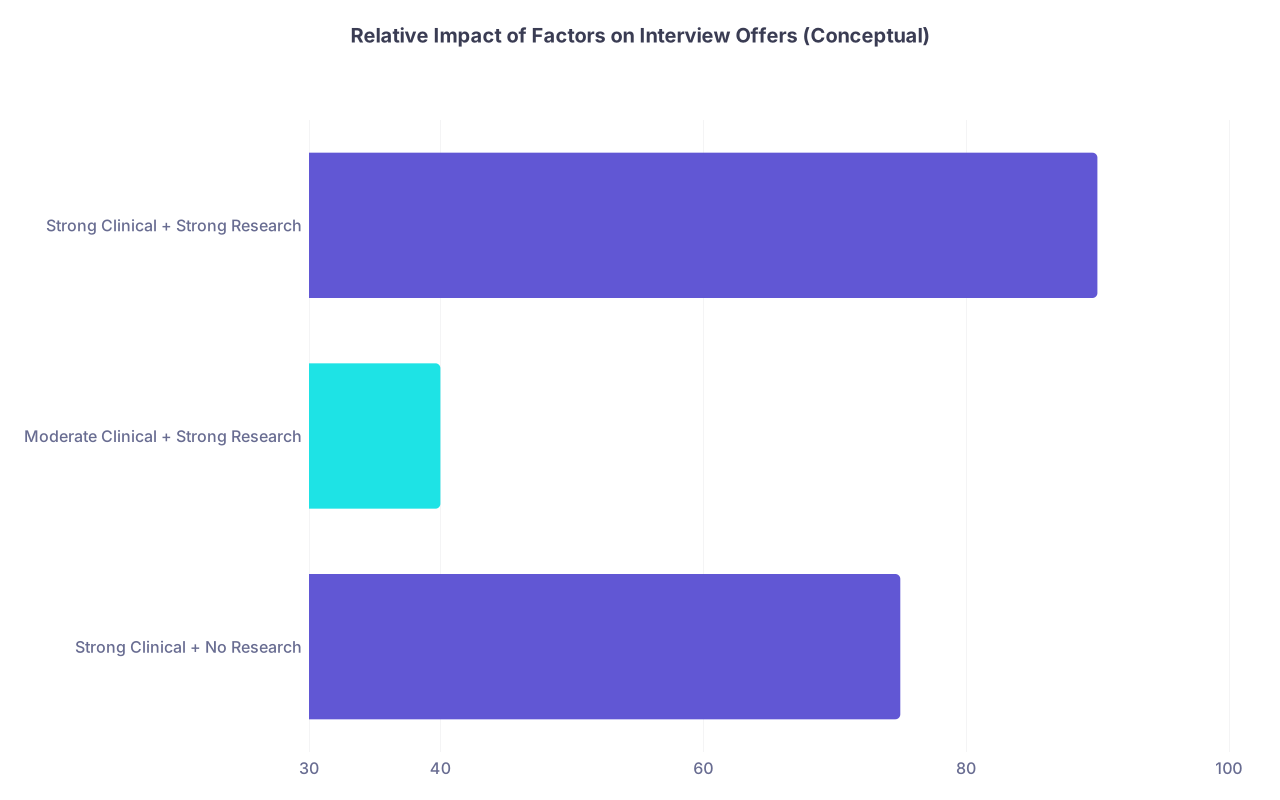
| Category | Value |
|---|---|
| Strong Clinical + No Research | 75 |
| Moderate Clinical + Strong Research | 40 |
| Strong Clinical + Strong Research | 90 |
The conceptual point of that chart: strong clinical performance alone usually beats strong research alone. Combine both and you’re golden. But trying to substitute one for the other is a losing bet.
The Bottom Line
Let’s put the myth to bed.
- Research does not “always trump” clinical strength. For most specialties, it is additive, not foundational.
- Weak clinical performance plus strong research is a fragile application. Strong clinical performance plus modest, coherent research is a robust one.
- If you are sacrificing clerkship performance, Step 2, or genuine letters of recommendation to chase more lines on your CV, you’re optimizing the wrong variable—and program directors know it.