
If Your Dean’s Letter Is Lukewarm: Strategies to Offset a Weak MSPE
The student slid their laptop across the table and pointed at one line in the MSPE summary: “performed at the expected level for training.” That was it. No “outstanding.” No “among the top students.” Just… fine. They stared at me and said what a lot of applicants think but don’t say: “Is this going to screw my chances?”
If you’re reading this, you probably saw your MSPE (Dean’s Letter) and felt your stomach drop. Maybe you were hoping for glowing language and got phrases like “meets expectations” or “solid performance.” Let’s not sugarcoat it: a lukewarm MSPE is a problem. But it’s not a death sentence—if you handle it correctly and aggressively.
First: Figure Out How Bad It Really Is
Before you start panicking, you need to calibrate. “Lukewarm” can mean very different things.
Here’s how to assess the damage:
Compare the summary language to your classmates’
Ask trusted classmates (especially those aiming for similar specialties) what their MSPE summary phrases look like. You’re looking for patterns like:- “Outstanding”
- “Excellent”
- “Above expectations”
- “Among the top X% of students” versus
- “Meets expectations”
- “Performs at the expected level”
- “Solid medical student”
If everyone got “meets expectations,” you might be at a school that just doesn’t gush. If you’re one of the few with that wording while others got “exceptional,” that’s different. That’s a flag.
Check for coded ranking language
Many schools don’t explicitly rank, but they use consistent phrases that basically are ranks. Often hidden in:- “Among the top / upper / middle / lower group of students”
- “One of our stronger / most capable / reliable students”
- Or the absence of those terms
If your letter never puts you in any “top group” and you know they do that for others, programs will read that as: average or below.
Scan clerkship comments versus summary tone
Sometimes the MSPE narrative is bland, but the clerkship comments are solid or even great. That’s less of a problem. But if:- Your core rotation comments are consistently generic
- You see repeated wording like “pleasant,” “on time,” “completed tasks” and nothing about initiative, clinical reasoning, leadership, or work ethic—then yes, your clinical performance came across as just ok.
Identify any obvious red flags
Go line by line and look for:- References to professionalism incidents
- “Required remediation”
- “Needed close supervision”
- “Struggled with time management / clinical reasoning”
- Gaps in explanation (missing rotations, leaves, etc.)
A truly damaging MSPE is one that is lukewarm plus a few subtle (or not-so-subtle) dings.
If after this audit you’re thinking, “Yeah, this isn’t great,” then stop hoping it’ll magically be ignored. Programs read the MSPE. Especially now that Step 1 is pass/fail and they’re hunting for other signals.
Now you switch to mitigation mode.
Strategy #1: Use Your Letters of Recommendation as Your Counterpunch
If your MSPE doesn’t fight for you, your letters of recommendation need to.
You’re trying to create a loud, clear counter-narrative: “Whatever the Dean’s Letter sounds like, this person is actually excellent in the clinical environment.”
Here’s how you do that, step by step.
1. Prioritize writers who actually know you clinically
Not the famous researcher. Not the chair you met twice. You want:
- Attendings who directly supervised you on busy services
- Sub-I or acting internship supervisors
- Program directors or clerkship directors who saw you under pressure
Someone who watched you manage cross-cover at 2 a.m. is worth more than a big name who barely remembers your face.
2. Have an explicit conversation with your letter writers
You don’t say, “My Dean’s Letter is bad.” But you can say:
- “I’m worried my MSPE doesn’t fully reflect how much I’ve grown clinically, especially on my sub-I. Would you feel comfortable commenting specifically on my clinical reasoning, teamwork, and reliability?”
- “Programs will be looking hard at clinical performance this year. If you feel you can honestly comment on my work ethic, ability to manage responsibility, and growth, that would be really helpful.”
You’re nudging them to:
- Use strong positive adjectives
- Give concrete examples
- Contrast you favorably with peers
3. Anchor the letter around specific moments
Good letters don’t just say “hard working.” They say:
- “On night float, she independently prioritized a list of 15 cross-cover calls, appropriately triaging acute issues and presenting concise plans.”
- “He consistently arrived before the team and was the last to leave, often taking the time to call families personally to update them.”
Ask your writer if you can email them a short bullet list of memorable cases or moments to jog their memory. Make it easy for them to advocate for you.
4. Balance breadth and depth in your letter set
You want at least:
- 1 letter from your home specialty (or 2 if you’re going competitive)
- 1 letter from a sub-I or acting internship
- 1 letter from a non-home but demanding rotation (e.g., medicine, surgery, ICU)
If the MSPE feels “meh,” the impression from your LORs should be: “Wait, this is not the story I was expecting from that Dean’s Letter.” That tension actually helps you.
Strategy #2: Make Your Personal Statement Do Heavy Lifting
No, your personal statement won’t erase a weak MSPE. But it can reframe your story.
You’re not writing some vague, dreamy essay about “since childhood I wanted to help people.” You’re using it to:
- Show maturity
- Own any dips or delays without sounding defensive
- Demonstrate insight and growth from your clinical years
What to do if your clinical years started rocky
If your third year wasn’t strong and your later rotations were better, then quietly but clearly tell that story:
- Mention how you initially struggled with the transition from classroom to wards—briefly.
- Focus on exactly what you changed: seeking feedback, reading patterns, time management systems, pre-rounding discipline.
- Tie this directly to specific improvements: “By the time I reached my medicine sub-internship, I was consistently trusted to…”
You’re sending a signal: “Yes, there was a maturity curve. I climbed it. I’m not who I was in month one of third year.”
What not to do
- Don’t attack your school, the grading system, or “biased evaluators.” That reads as toxic instantly.
- Don’t over-explain with paragraphs of justification. One tight paragraph is enough if you’re addressing a pattern.
- Don’t pretend everything was perfect if anyone with eyes can see otherwise. Programs see through that.
The goal: after reading your statement, a PD should think, “This person is honest, self-aware, and trending upward,” not “This person is bitter and blames everyone else.”
Strategy #3: Use Other Parts of ERAS to Build a Different Picture
Your MSPE is one data point. Programs also look at your experiences, leadership, and narrative.
Here is where you start being intentional.
Be surgical with your “Experiences” section
The worst thing you can do is fill this with random fluff: “Medical Student Volunteer,” “Shadowed Dr. X,” “Attended Y club meetings.”
Instead:
- Lead with your strongest clinical responsibilities
- Sub-I roles
- Night float duties
- Longitudinal clinic responsibilities
- Emphasize positions where someone trusted you with real responsibility
- Chief of a free clinic
- Running multidisciplinary meetings
- Organizing coverage for other students
Be explicit. Spell out what you did, not just where you were. “Rounded” is meaningless. “Managed a list of 8-10 patients, presented plans, followed results, and communicated with families” is not.
Show you can function under pressure
Anywhere you’ve:
- Covered multiple patients at once
- Handled acute issues
- Triaged competing demands
…put that in. This is how you counter the “lukewarm” sense that you’re just… there but not particularly strong.
Strategy #4: If You Have a Step 2 CK Strength, Lean on It Hard
With Step 1 pass/fail, Step 2 CK is now the big objective anchor.
If your Step 2 CK score is stronger than your MSPE vibe, you use that as your spear.
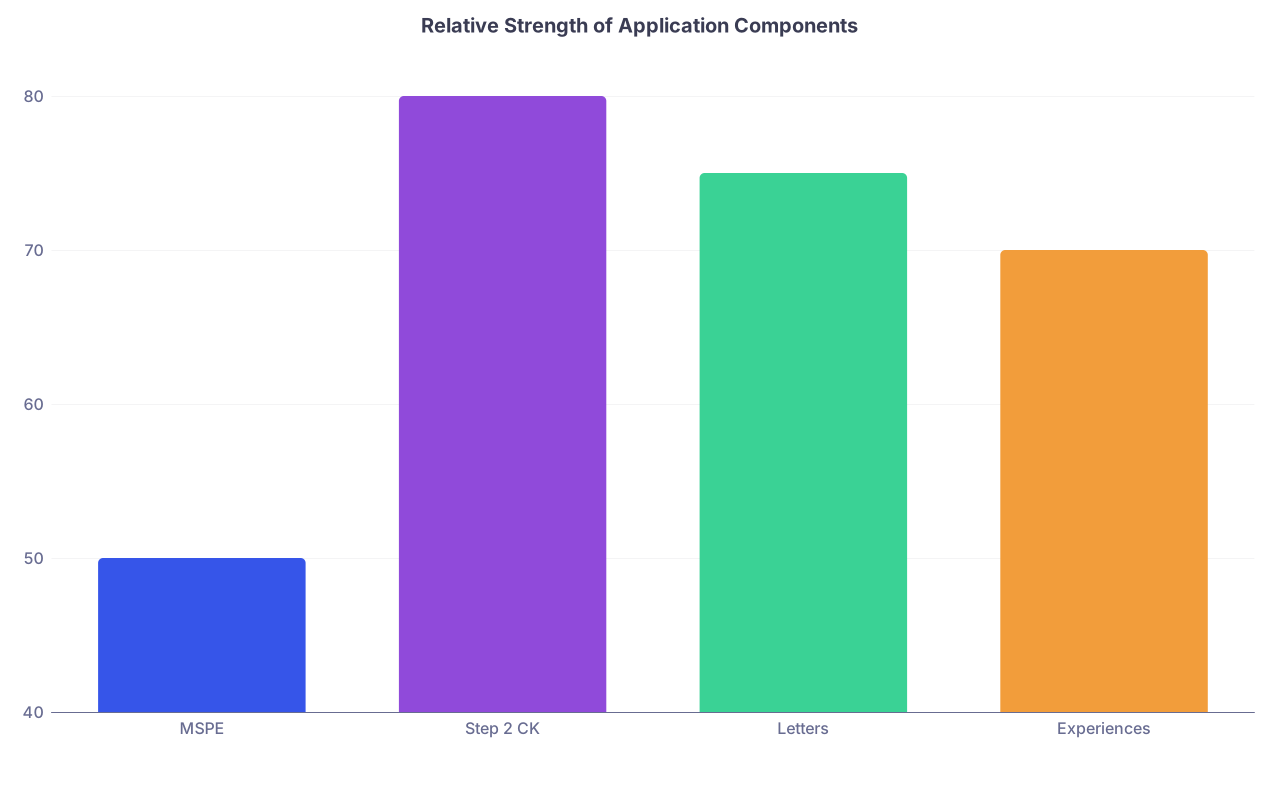
| Category | Value |
|---|---|
| MSPE | 50 |
| Step 2 CK | 80 |
| Letters | 75 |
| Experiences | 70 |
If your MSPE feels like a 50/100 but your Step 2 CK is 245+ (for less competitive fields) or 255+ (for more competitive ones), that’s a big deal. It says:
- You can study efficiently
- You have solid medical knowledge
- You took things seriously later in training
In your personal statement and any communications with programs, you can subtly align your narrative: “I grew over third and fourth year, which is reflected in my Step 2 CK performance and my later clinical rotations.”
If your Step 2 is weak and the MSPE is lukewarm—different game. You need to double down on fit, narrative, and targeted outreach. I’ll get there.
Strategy #5: Use Away Rotations Wisely (If You Still Can)
If you’re reading this early enough in fourth year and you haven’t done away rotations yet, treat them as auditions and letter opportunities.
On an away rotation with a lukewarm MSPE, your mindset should be:
- Show up early. Every day.
- Know your patients better than anyone.
- Volunteer (sanely) for work that moves the team forward.
- Ask for feedback halfway through and implement it fast—make it obvious.
Then you ask for a letter from someone who watched you closely. If that letter says “This student functioned at or above the level of our own students,” you’ve just directly contradicted the Dean’s Letter in the eyes of that program and anyone they share notes with.
And if an away PD likes you and says, “We’d be happy to see you apply here,” take that seriously. That can overcome a lot.
Strategy #6: Direct Communication with Programs—When and How
You do not blast every program with a “please understand my MSPE” email. That’s a good way to get quietly screened out.
But there are situations where a short, precise message can help:
Scenario A: You had a known issue that is now resolved
Example: early professionalism incident, academic warning, repeat of a clerkship.
You might say something like (post-application, maybe pre-interview or post-interview):
“I wanted to briefly acknowledge that during my third year I struggled with [X] and this is reflected in my MSPE. Since then, I’ve [brief specific steps], and my performance on [sub-I / Step 2 / recent rotations] reflects that growth. I’m very committed to continued improvement and wanted to be transparent with you about this.”
Short. Direct. Ownership. No whining.
Scenario B: You’re a strong fit but worried they’ll pre-judge you
This is more sensitive. You don’t mention “weak MSPE” explicitly. You highlight strengths that didn’t come through.
“I’m particularly interested in your program because of [X very specific reason]. While my MSPE summary is modest, my more recent experiences on [sub-I] and my performance on [Step 2 CK / evaluations] better reflect the resident I’m ready to be. If there is any additional information I can provide, I’d be happy to.”
Only do this for a few key programs you genuinely care about and where you have some connection or hook (home program, away site, geographic tie, mentor connection). Not 60 programs.
Strategy #7: Be Ruthless and Realistic with Specialty and Program List
This is where a lot of people sabotage themselves. They pretend their application is stronger than it is.
If you’ve got:
- Lukewarm MSPE
- Average Step 2 CK
- No huge research or leadership spike
…then applying to 40 university categorical internal medicine programs on the coasts and 5 community programs is just denial.
You need to:
- Over-apply to mid-tier and community programs
- Include a wide geographic range (not just the “cool cities”)
- Consider a parallel plan if you’re in a competitive specialty
| Program Type | Target % of Applications |
|---|---|
| Top Academic | 10–20% |
| Mid-Tier Academic | 30–40% |
| Strong Community | 30–40% |
| Safety / Broad Community | 10–20% |
Do not skip “safety” programs and then act shocked in February with 4 interviews total.
If you’re aiming at something competitive (derm, ortho, plastics, ENT, rad onc) and your MSPE is meh, you must have either:
- A parallel categorical specialty (IM, prelim + something, FM, peds), or
- A research year / gap strategy with a very clear plan and strong mentor backing
Magical thinking is how people end up in SOAP crying in call rooms.
Strategy #8: Nail Interviews So Programs Walk Away Forgetting the MSPE
Once you’re in the interview door, your MSPE becomes background noise if you perform well in person.
You want the vibe to be: “Whatever the Dean’s Letter suggests, this person feels like a solid resident.”
Focus your preparation on three things:
Explaining your growth arc in one clean, confident answer
You need a practiced, honest answer to any version of:- “Tell me about a challenge in medical school.”
- “If we read your MSPE, what should we understand about your performance?”
Your answer should:
- Admit the issue in 1–2 sentences
- Highlight 2–3 specific things you changed
- Point to recent evidence (sub-I, Step 2, leadership) as proof
And then shut up. Don’t oversell, don’t over-defend.
Showing you understand the grind of residency
Lukewarm MSPE sometimes reads as “They just floated through.” Your mission: show the opposite.Talk concretely about:
- Handling cross-cover pages
- Managing multiple unstable patients
- Owning a patient panel longitudinally
Use specific stories, not generic “I work hard” lines.
Being someone people want on night float at 3 a.m.
Programs are thinking: can I handle being stuck with you for 14 hours on a bad shift?That means:
- You’re calm, not frantic
- You can laugh a little, not humorless robot
- You listen and don’t dominate every conversation
If they like you in person, they’ll mentally downgrade the MSPE’s importance, especially if the rest of the file supports your growth.
Strategy #9: If You’re Already in the Match and It’s Going Poorly
Let’s say it’s mid-season:
- You have very few interviews
- You’ve heard PDs subtly reference “concerns”
- You’re realizing the MSPE is hurting you more than you hoped
You still have moves:
Ask for an honest appraisal from one trusted faculty member
Sit down with a mentor who knows the match landscape and say:
“With my MSPE and current interview count, do you think I should be preparing a SOAP plan or a backup specialty?”If they say yes, listen. Pride will not protect you in March.
Aggressively follow up with places with any connection to you
Home programs, away sites, places where your mentors know faculty. They can send targeted emails or calls advocating for you, especially emphasizing your improvement and letters.Prepare for SOAP early
Do not wait until you’re unmatched to figure this out. By January/February, you should:- Draft a SOAP-focused personal statement
- Decide your SOAP specialty boundaries
- Talk to your Dean’s office about logistics
Brutal? Yes. But far better than denial.
Quick Reality Check: What Not To Waste Time On
I’ve seen students spin their wheels on things that don’t move the needle when the MSPE is weak:
- Rewriting their CV layout 50 times
- Obsessing over tiny wording tweaks in ERAS experience descriptions
- Fantasizing that one more random “leadership” bullet will offset 18 months of “meets expectations”
Your energy should go to:
- Powerful letters
- Tight personal narrative
- Strategic program list
- Strong interview performance
Everything else is detail work.

| Step | Description |
|---|---|
| Step 1 | See Lukewarm MSPE |
| Step 2 | Assess Severity |
| Step 3 | Target Strong Letter Writers |
| Step 4 | Revise Personal Statement for Growth Arc |
| Step 5 | Optimize ERAS Experiences |
| Step 6 | Adjust Program List Strategically |
| Step 7 | Prepare Focused Interview Answers |
| Step 8 | Consider Backup/SOAP Plan if Needed |

If You’re in This Situation, Here’s What To Do Today
You don’t fix a lukewarm MSPE by worrying about it. You fix it by outworking it.
Today, not “later this week,” do these three things:
Email two attendings who saw you at your best and ask if they’d be willing to write a strong, detailed letter focusing on your clinical performance, work ethic, and growth. Offer to send them a 1-page summary of cases and responsibilities to jog their memory.
Open your personal statement and find the first place you can briefly and confidently describe your growth during clinical years. Add 3–5 sentences that:
- Acknowledge you weren’t perfect
- Explain what you changed
- Point to concrete evidence that you’re different now
Open your program list and mark which ones are true reaches versus realistic. Add at least 5–10 more solid mid-tier community or academic programs where your numbers and profile are comfortably in range.
Do those three things, and you’ve already started shifting the story away from whatever your Dean’s Letter didn’t say about you.