You’ve just clicked “Certify and Submit” on ERAS. Your heart rate is finally coming down. You reopen a PDF copy of your application to admire your work… and there it is.
A “pubic health project.”
“Responsbilites included…”
Two “its” where you meant “it’s.”
Now you’re wondering: How many typos are “too many” before you have to fix your ERAS and resend everything? And what if programs already downloaded it?
Let me answer this straight and then break it down.
If you have one or two minor, non-embarrassing typos scattered in the app, you do not need to resubmit. If you have repeated errors, obvious spelling/grammar problems in key sections (personal statement, meaningful experiences), or anything that changes meaning (like “pubic” vs “public”), you should fix it and re-send—even if it stings.
The nuance is knowing which is which.
First: What Program Directors Actually Care About
Program directors are not counting typos like they’re grading a high school English paper. They’re asking three questions:
- Does this applicant look careless or sloppy?
- Does anything here make me question their professionalism or communication skills?
- Do the mistakes distract me from understanding who this person is?
So, the bar isn’t “absolutely perfect forever.” The bar is “does this look like an adult professional document?”
Most PDs I’ve worked with or talked to will generally tolerate:
- One or two minor typos in the entire application
- A slightly awkward sentence or two in the personal statement
- A missing comma or mild grammar quirk, especially if you’re an IMG/ESL
They start to get annoyed (or concerned) when they see:
- Multiple obvious typos in important sections
- Repetitive errors (same misspelling across experiences)
- CV-style sections with inconsistent formatting, tense, or capitalization
- Errors that change meaning or are unprofessional (“pubic,” wrong dates, wrong program name, etc.)
That’s the real threshold: pattern and impact, not perfection.
The Real Question: Do I Need to Resubmit?
Here’s the answer you’re actually hunting for.
When You Don’t Need to Resubmit
You find something like:
- One stray typo in a work/activities description (“mange” instead of “manage”)
- A missing word that doesn’t confuse the meaning
- Awkward phrasing in one sentence of your personal statement, but it’s still clear
- Mild formatting inconsistency (e.g., one bullet says “June 2022 – July 2023” and another says “06/2022–07/2023”)
If the error:
- Appears once
- Doesn’t change the meaning
- Doesn’t make you look unprofessional or careless in a big way
…you live with it. Do not pull and resend a whole application over that.
Programs are not downloading your file and running a forensic grammar analysis. They’re skimming for:
- Academic profile
- Clinical exposure
- Fit for specialty
- Communication baseline
A single harmless typo is noise.
When You Should Fix and Resubmit
You need to seriously consider fixing and re-sending if:
- The typo is embarrassing or unprofessional
- “Pubic” instead of “public”
- “Oral preentation” in your “national presentation”
- The error changes meaning
- Wrong GPA (if included), wrong dates, wrong title, wrong role
- You wrote “retrospective randomized trial” (which doesn’t make sense)
- The error is in a very high‑visibility spot
- First sentence or first paragraph of your personal statement
- Section headers, rotation titles, program names
- Your email address or contact info
- There are multiple errors in a single section
- Two–three typos in one experience entry
- Repeated misspellings (“reserach,” “responsibilites”)
- There’s clear evidence of copy‑paste sloppiness
- Mentioning the wrong specialty in the PS
- Having “I look forward to training at [Hospital X]” in a generic PS
- Writing “internal medicine” in your surgery personal statement
If your application looks like it was never proofread, that’s a professionalism red flag. In that case, yes—fix it and resubmit.
How Bad Is It Really? A Simple 3-Level Triage
Let’s put some structure on this so you’re not guessing.
| Level | What It Looks Like | Action |
|---|---|---|
| Level 1 | 1–2 tiny, harmless typos total | Leave it |
| Level 2 | Several minor issues, not catastrophic | Fix if possible, but don’t panic if already downloaded |
| Level 3 | Patterns of errors or meaning-changing mistakes | Fix and resubmit ASAP |
Now let’s define those in plain English.
Level 1: Totally Fine, Don’t Touch It
Examples:
- “I assited the resident…” in one line of one experience
- A missing “the” in your PS: “On wards I learned value of communication.”
- “February 2023 – July 2023” in one place and “Feb 2023 – Jul 2023” in another
If your entire 15–20 page ERAS PDF has one or two of these, you are absolutely fine. PDs expect some imperfection in a document this long.
Level 2: Mildly Sloppy, But Not Fatal
Examples:
- Two or three typos total, across different sections
- One section with more than one small error
- Inconsistent tense all over your experiences (mix of “managed” and “manage” for past roles)
- A single awkward or run-on sentence in your PS that’s clunky but understandable
Action here:
- If you catch this before most programs download your app: fix it.
- If it’s already mid/late season and interviews are coming in: don’t torch your sanity. You can leave it and learn for fellowship or future applications.
If you’re not sure whether programs have downloaded it, assume by late September that many already have.
What If Programs Already Downloaded My Application?
Here’s the part people get stuck on.
Once a program downloads your ERAS, they have a snapshot of that version. Future edits don’t overwrite what they already pulled.
But two key points:
- Not every program downloads on Day 1.
- Some still review applications later, and those will see your corrected version.
So does it still help to fix?
- Early in the cycle (September–early October): Yes. A lot of programs are downloading, but not all. Updating helps.
- Mid-season (late October–November): Mixed. Some late-review or prelim programs may still see the fix.
- Late season: Only worth it if the error is truly bad/embarrassing.
Don’t obsess over retroactively “fixing” what’s already in someone’s downloads folder. Focus on:
- Not repeating the same mistake in future communications
- Fixing anything that’s truly glaring
- Letting the rest go
What About the Personal Statement Specifically?
Personal statement typos feel like a gut punch because that’s “your voice.”
Here’s how I’d handle PS errors:
You Don’t Need to Resubmit If:
- There’s one mild typo in the middle of a paragraph
- You have one mildly clunky sentence
- There’s a missing article (“the,” “a”) that doesn’t confuse the meaning
Example:
“I learned importance of trust between patient and physician.”
Annoying? Yes. Fatal? No.
You Probably Should Fix/Resubmit If:
- There’s a typo in the first sentence or first paragraph
- You misspell the specialty name
- You name the wrong specialty anywhere
- You say something that sounds unprofessional or unpolished in a glaring way
If your opening line is:
“Ever since chilhood, I have wanted to be a pediatrition.”
Yeah. Fix it.
If you have an IM PS that says:
“I’m excited to pursue a career in family medicine…”
That’s not a typo. That’s a content error and needs to be corrected.
Concrete Examples: Fix or Leave It?
Let’s run through some realistic scenarios.
Scenario 1: Single Minor Typo in Experiences
You wrote:
“Researched outcomes of patients with sepsis in a tertairy care center.”
One experience entry, one misspelling (“tertairy”).
Verdict: Leave it. No resubmit. Almost no one will care.
Scenario 2: Multiple Errors in One Description
You wrote:
“Responsbilites included colaborating with multi-disiplinary team, asisiting in patient education, and colecting data.”
Three obvious misspellings in a short blurb.
Verdict: Fix it. That looks like you didn’t proofread at all. If you’re still early in the season, update and resend.
Scenario 3: Wrong Specialty in PS
You’re applying to Emergency Medicine. Your PS says:
“I’m excited to contribute to the continuity of care in family medicine…”
Verdict: Fix and resubmit immediately. This is a content problem, not just a typo. If different specialties are using the same PS file, that’s an issue.
Scenario 4: One Embarrassing Word
You wrote: “public health” as “pubic health” once in a description.
Verdict: If you catch it early and it’s easy to fix, fix and resubmit.
If it’s already late October, and this is one line in an otherwise clean app, you can also accept it, cringe internally, and move on. But early in the cycle, I’d correct it.
How Many Typos Is “Too Many”?
If you want an actual number guideline, here’s how I’d frame it for a standard application (2–3 PS versions, 10–20 experiences, research, activities, etc.):
- 0–2 minor typos total: Not worth resubmitting
- 3–5 minor typos, spread out, none in first lines or critical spots: Gray zone. Fix if early; otherwise, live with it
- >5 typos or repeated patterns of bad grammar: You look sloppy. Fix it if there’s still time
Remember: this isn’t a legal contract, but it is your first professional document many PDs will ever see from you. You don’t want it riddled with basic mistakes.
If You Decide to Fix: How to Do It Without Making a Bigger Mess
If you’re going to resubmit, don’t half‑do it.
- Make a full list of everything you want to fix before you touch ERAS again.
- Print or PDF your current ERAS and mark it up with a pen or comments.
- Have one other person proofread: friend, mentor, co-resident, whoever actually reads carefully.
- Fix everything in one clean pass. Don’t keep making micro-edits every day.
- Save/print a new PDF, check again for errors, then stop.
You want Version 2 to be your last version, not the start of an infinite editing loop.
How Much Do Typos Really Affect Your Chances?
Here’s the honest answer: Typos rarely make or break an otherwise strong or weak application.
They do this:
- Nudge borderline impressions one way or another
- Make you look less polished if there are many
- Reinforce a stereotype if other red flags already exist (poor Step scores, weak letters, poor communication, etc.)
Most PDs will forgive one typo and forget it. But if you stack:
- Weak scores
- Mediocre letters
- Sloppy PS
- Numerous typos
…you’re giving them an easy “no” in a huge pile of applications.
So yes, details matter. But don’t catastrophize one missed apostrophe.
Quick Reality Check: Don’t Lose the Forest
Don’t spend five hours agonizing over whether to fix “cooridnated” while ignoring these bigger levers:
- Your Step 2 score
- Where you’re applying (range and volume)
- How strong your letters are
- How you present yourself on interview day
If your application is fundamentally strong, a typo or two will not tank you. If your application is fundamentally weak, a perfect proofread will not save it.
Use your energy where it moves the needle.
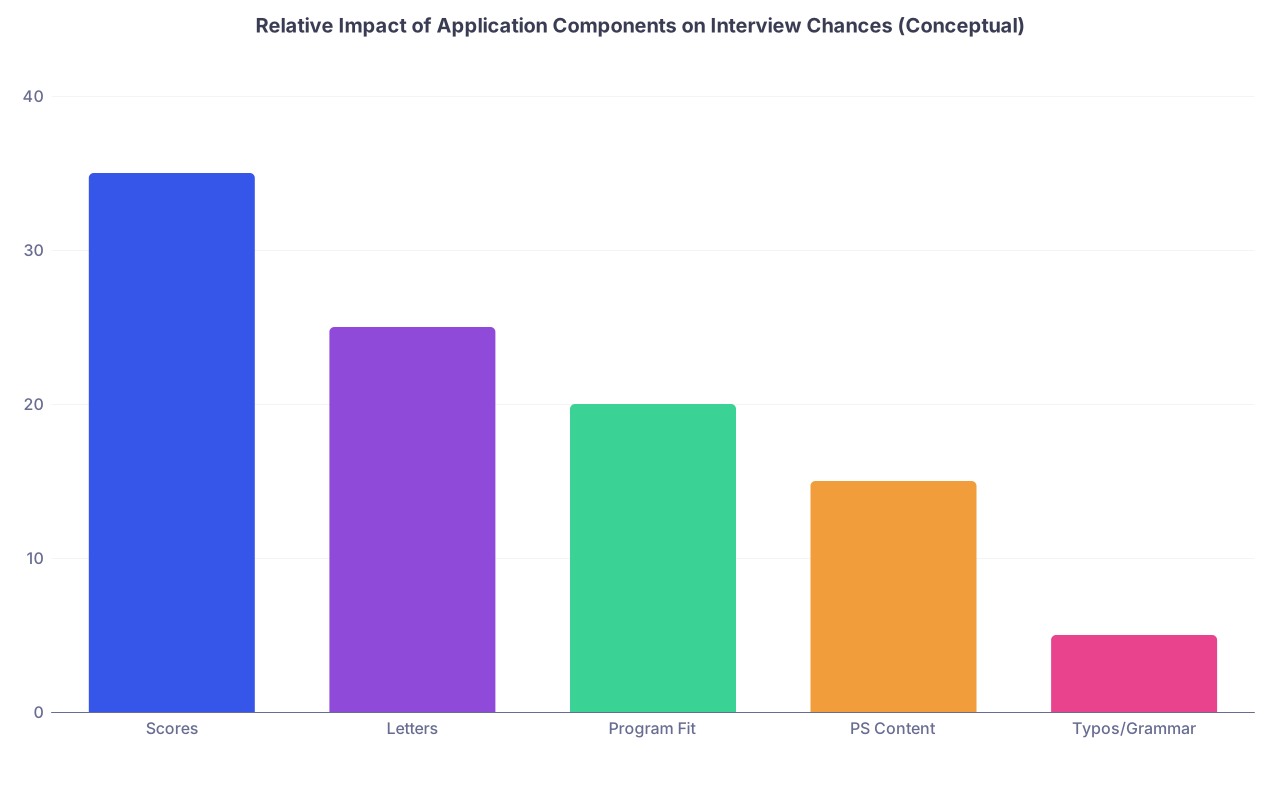
| Category | Value |
|---|---|
| Scores | 35 |
| Letters | 25 |
| Program Fit | 20 |
| PS Content | 15 |
| Typos/Grammar | 5 |

| Step | Description |
|---|---|
| Step 1 | Found a typo |
| Step 2 | Fix and resubmit |
| Step 3 | Fix if easy, otherwise accept it |
| Step 4 | Leave it and move on |
| Step 5 | Does it change meaning or look unprofessional? |
| Step 6 | Early in season? |
| Step 7 | More than 3-5 typos total? |
Bottom Line: What You Should Do Right Now
If you’re still unsure, here’s the simple action plan:
- Read your entire ERAS PDF out loud. You’ll catch 90% of issues this way.
- Count actual errors. Don’t guess. Is it 1–2, or 6–7?
- Ask: Does this look like a pattern, or just human-level imperfection?
- If it’s a pattern or changes meaning → fix and resubmit.
- If it’s one or two harmless things → accept it and focus on interview prep.
And then stop doom‑scrolling Reddit horror stories about “one typo ruining my match.” That’s not how this works.
Key points to walk away with:
- One or two small typos across your entire ERAS are not a reason to panic or resubmit.
- Fix and resubmit if you see patterns of errors, meaning-changing mistakes, or obvious unprofessional wording—especially early in the season.
- Beyond that, your time is better spent improving where it actually counts: your letters, your school list, and how you show up on interview day.