
The worst red flags in residency applications are not the ones on your record. They’re the ones you pretend do not exist until January.
If you’re six months from Match and you have a Step failure, a leave of absence, poor clerkship comments, or a messy PD change, you’re on a clock now. The mistake most applicants make is waiting for a “perfect moment” to bring them up. That moment never comes. You need a structured, time-based plan.
Here’s how to handle red flags month-by-month, then week-by-week, so you are actually in control of the narrative instead of letting ERAS and whispers do it for you.
First, know what really counts as a “red flag”
By six months before Match (early September for most), you should already know which of these apply to you. If you don’t, this is step zero.
Common red flags that must be addressed:
- USMLE/COMLEX:
- Step/Level failure
- Multiple attempts on any exam
- Very low but passing scores in a highly competitive specialty
- Academic:
- Course/clerkship failures or repeats
- Leave of absence not clearly for something “acceptable” (e.g., formal research year is fine; unclear “personal leave” is not)
- Probation or professionalism concerns
- Conduct:
- Any disciplinary action, Title IX investigation, professionalism write-up
- Background:
- Prior non-medical legal issues (DUIs, arrests, etc.) that appear on a background check
- Application pattern:
- Switching specialties late with little evidence of commitment
- Huge gap in training or odd timeline (e.g., multiple unmatched cycles)
- PD / institutional:
- Loss of home program support
- PD or chair refusing to write a letter or making it clear they can’t support you strongly
At this point you should make a brutally honest list. Every item that would prompt an interviewer to raise an eyebrow needs a plan.
Six Months Before Match (Early September): Triage and Strategy
At this point you should stop guessing and start planning.
1. Week 1–2: Inventory and categorize your red flags
Sit down and write them out. No sugarcoating. For each issue, answer four questions:
- What exactly happened? (Facts only, no spin.)
- Is there documentation? (Dean’s letter, transcripts, evaluations, official report.)
- Is it already visible to programs? (MSPE, transcript, exam history.)
- Can it be reasonably improved or reframed in 6 months? (Behavioral change, new performance, new letter.)
Then sort them:
- High-risk / must explain up front
- Failed Step/Level
- Formal probation
- LOA for unexplained “personal” reasons
- Legal/disciplinary issues
- Moderate-risk / contextualize
- Below-average scores for chosen specialty
- Single bad clerkship evaluation
- Late specialty switch
- Low-risk / optional to address
- Non-traditional path but consistently explained
- Research year clearly documented
If you’re not sure which category something falls into, assume it’s one level worse and plan accordingly. That mindset saves people.
2. Week 2: Book the right meetings
By the end of week 2, you should have scheduled:
- Meeting with:
- Your school’s advisor or dean for student affairs
- Your home PD (if you have a home program in your specialty)
- A trusted faculty mentor not directly responsible for your MSPE if available
Do not wait “until after ERAS is submitted.” Too late. These people need time to:
- Decide how they’ll describe your issues
- Coordinate messaging between MSPE, PD letter, and your personal statement
- Alert you if your expectations are unrealistic
You should go into these meetings with a written 1-page summary of your red flags and your initial thoughts on how to address each.
Five Months Before Match (October): Align the story and pick your battles
Applications are in. Now you’re dealing with the second big mistake: silence.
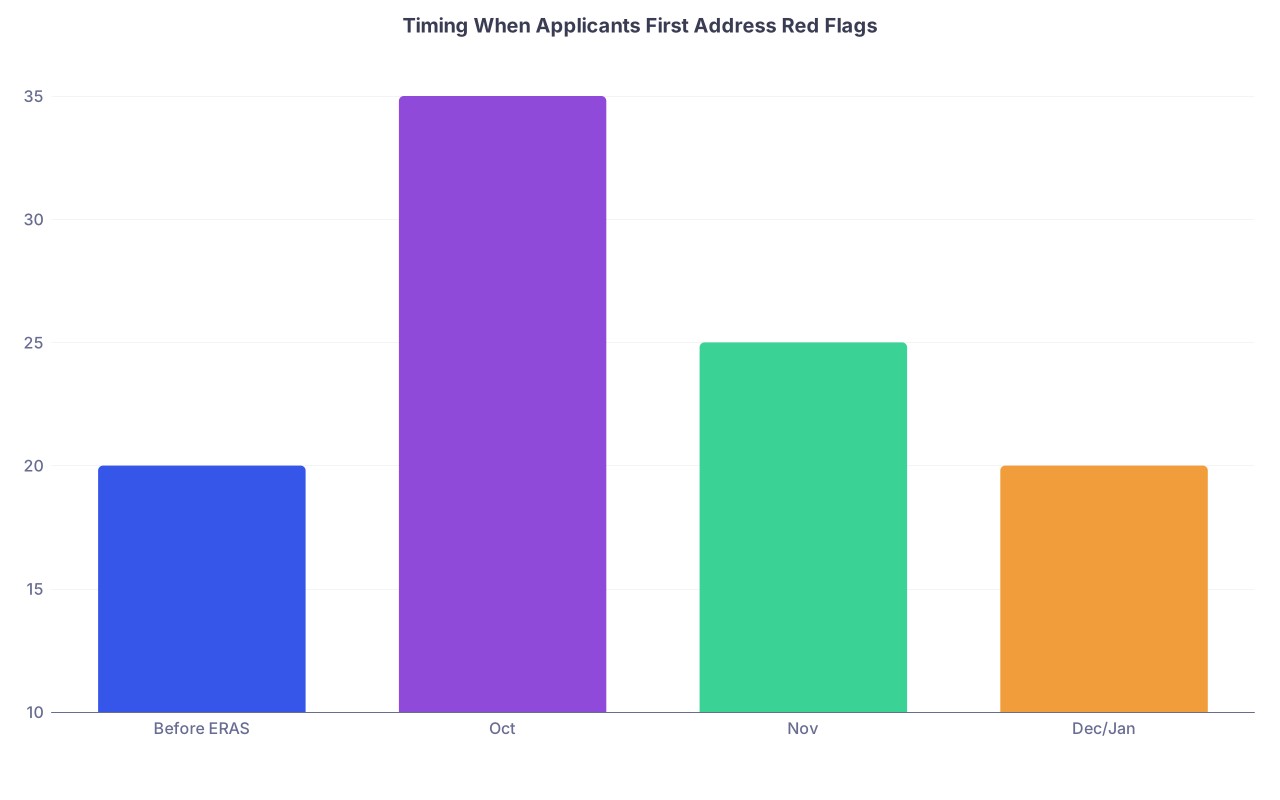
| Category | Value |
|---|---|
| Before ERAS | 20 |
| Oct | 35 |
| Nov | 25 |
| Dec/Jan | 20 |
A big portion of applicants wait until November or December to “explain” things in interviews they may never get. You’re going to do it earlier and more strategically.
3. Week 1–2 of October: Calibrate with your dean/advisor
At this point you should:
- Review the MSPE language with your dean/advisor if possible.
- Ask directly: “How is my Step failure / LOA / professionalism issue being described?”
- If the language is vague and ominous (“personal concerns,” “professionalism issues”), push for specificity without spin.
- Ask your advisor:
- “If you were a PD reading my file, what would your top 2 worries be?”
- “Would you recommend I address this in my personal statement, at interviews, or both?”
This is where you decide who tells which parts of the story:
- MSPE → Factual baseline
- PD letter → Support and reassurance
- Personal statement → Insight, growth, ownership
- Interview → Brief, confident explanation, then move on
Red-flag mistake here: writing three different versions of your story that don’t match. PDs do compare notes. I’ve seen interviews sink because the MSPE said “voluntary LOA” and the applicant spun a crisis that clearly wasn’t documented.
4. Week 3–4 of October: Decide when to tell PDs directly
Now you face the big decision: Do you reach out to PDs before they reach out to you?
General rule:
- If a red flag appears as:
- “Concerning + unexplained”
- and it is likely to block you from even getting interviews
→ You may need to proactively address it with some programs (through your advisor or PD, not cold emails from you).
Scenarios where early PD contact is reasonable:
- You have:
- Failed Step 1 and later strongly passed Step 2,
and your home PD is willing to vouch for your turnaround.
- Failed Step 1 and later strongly passed Step 2,
- You:
- Took an LOA for health/family reasons that is now fully resolved,
and your dean can attest to your current stability and performance.
- Took an LOA for health/family reasons that is now fully resolved,
- You:
- Were on professionalism probation,
and your current evaluations show consistent, clear improvement.
- Were on professionalism probation,
In these cases, by the end of October, you should:
- Ask your home PD or advisor:
- “Would you be comfortable reaching out to X, Y, Z programs on my behalf to give context and support?”
- Provide them a tight, consistent paragraph they can adapt:
- 2–3 lines of what happened (factual)
- 2–3 lines of what’s changed (performance, feedback, stability)
- 1 line of explicit support (“I believe [Name] will succeed in residency.”)
Do not mass-email programs yourself with a long red-flag manifesto. Faculty-to-faculty contact carries 10x the weight of your own explanation.
Four Months Before Match (November): Prepare for how you’ll talk about it
At this point you should have some interview invites or you’re getting worried. Either way, November is script month.
5. Early November: Write your red-flag scripts
You need 2–3 versions of every explanation:
- One-sentence version
For casual or indirect references. - 30–45 second version
For direct questions in interviews. - 2–3 sentence written version
For emails, supplemental questions, or PD follow-ups.
Example: Step 1 failure
One-sentence:
“I failed Step 1 early in med school, then changed my study approach and passed Step 2 comfortably on the first attempt.”30–45 seconds:
“I failed Step 1 during a period where I underestimated how much structure I needed. I was trying to balance too many commitments and didn’t build in regular self-assessment. After that, I sat down with our learning specialist, created a strict schedule with weekly NBME checks, and treated studying like a job. I passed on my second attempt, and I applied the same approach to Step 2, where I passed on the first try with a score I’m proud of. I’ve kept those habits in my clinical work as well.”Written version (for PD/advisor communication):
“During my initial Step 1 attempt, my preparation lacked consistent structure and objective self-assessment. I failed the exam, which prompted me to work with our learning specialist to redesign my study approach. I implemented a detailed schedule with regular NBMEs, improved my time management, and successfully passed Step 1 on my second attempt and Step 2 on the first attempt. These changes also translated to improved performance in my clerkships.”
You should do this—on paper—for each serious red flag.
6. Mid–Late November: Practice with live people
Reading it in your head is useless. At this point you should:
- Run mock interviews with:
- Your advisor
- A resident you trust
- A friend who will not sugarcoat feedback
- Ask them:
- “Where do I sound defensive?”
- “Where do I sound like I’m hiding something?”
- “What are you still wondering after I finish talking?”
Fix those parts. Your goal is calm, concise, and done. Not a courtroom defense.
Three Months Before Match (December): Fine-tune and selectively clarify
By now you’re either:
- Getting interviews and actually fielding questions
- Or staring at your inbox and wondering whether your red flag is killing your chances
Either way, December is about targeted clarification, not panic-mailing.
7. Early December: Track patterns in what PDs actually ask
After 3–5 interviews, you’ll notice something:
- Some red flags you obsessed over? Nobody cares.
- Other issues you thought were minor? PDs ask about them every time.
At this stage, you should keep a simple log:
- For each interview:
- Did they ask about: Step? LOA? Clerkship? Switch? Gap?
- What exact phrases did they use?
- Which explanation landed well vs. felt awkward?
Common pattern I’ve seen:
- Students with a Step failure think that’s the main issue.
PDs are actually more worried about a vague “personal leave” with no clear resolution.
Use this intel to adjust:
- Sharpen explanations for what keeps coming up
- Shorten or drop explanations for what no one asks about
8. Mid–Late December: When you should email a PD yourself
There are times when you, personally, should reach out before rank lists:
Appropriate reasons:
- A new development that strengthens your application and reframes a red flag:
- New strong letter from a rotation that directly contradicts old concerns
- Documented, completed treatment of a prior health issue that affected performance
- A clear discrepancy you discover:
- MSPE misrepresents your LOA reason
- An error in how many attempts it shows for a test
In December, if this applies, you:
- Draft a short, structured email (5–7 sentences):
- Acknowledge the red flag directly
- Clarify the factual error or update
- Reaffirm your interest in the specialty/program
- Run it by:
- Your advisor or PD first
If they say, “I’ll reach out instead,” let them.
- Your advisor or PD first
What you should not do in December:
- Long apology tours for issues PDs have already seen and decided to tolerate
- “Please give me a chance despite my Step failure” messages with no new information
Two Months Before Match (January): Rank list alignment and last clarifications
At this point you should stop editing your past and start aligning your future. Red flags still matter—but now it’s about fit and honesty for the next 3–7 years.
9. Early January: Reality-check your rank list with advisors/PDs
You’re building your rank list. This is where some applicants blow it by ranking only “reach” programs that might quietly be worried about their red flags.
You should:
- Sit down with:
- Your advisor
- If possible, your home PD
- Review:
- Your interview list
- Any programs that brought up your red flags more aggressively
- Programs where you felt they had already accepted your explanation
Ask blunt questions:
- “Given my exam history / LOA / professionalism issue, which of these programs do you think are most realistic?”
- “Are there programs on this list where you’d be surprised if they ranked me to match?”
This is also when you might ask a PD/advisor:
- “Would you be comfortable reaching out to Program X before rank lists if I rank them highly?”
Short faculty-to-faculty comments in January can matter, especially for candidates with prior problems who have clearly turned things around.
10. Late January: Final PD communication, if any
If you are going to send any direct PD communication about red flags, this is the last reasonable window. After that it looks panicked.
Good reasons to reach out now:
- You had a follow-up request from an interviewer (“Send me that updated evaluation once it’s available.”)
- You’ve had significant improvement or clarification since the interview:
- Strong new sub-I evaluation that contradicts prior concerns
- Official resolution of a pending disciplinary issue, in your favor
Bad reasons:
- “I’m just worried my Step failure will hurt me.”
- “I didn’t get a warm vibe and want to fix it.”
Your message at this point should be shorter than ever:
- 2–3 sentences max about the update or clarification
- 1 sentence reaffirming interest
No re-litigating your past.
One Month Before Match (February): Stop explaining, start accepting
By February, your job is not to “fix” your red flags. It is to:
- Make a rank list that reflects:
- Programs that clearly accepted your explanation
- Programs where you felt seen as a whole person, not as a problem file
- Be mentally prepared for:
- A match that may be less “prestigious” but more realistic
- Or, in the worst case, a no-match plan that doesn’t repeat past mistakes
At this point you should:
- Stop bringing up your red flags unless asked or there’s a truly new material change.
- Let your PDs and advisors handle any last-minute clarifications if they think it’s helpful.
- Focus on transitioning: if you match, how will you ensure the problems that caused the red flags won’t show up again in residency?
Quick Timeline Snapshot
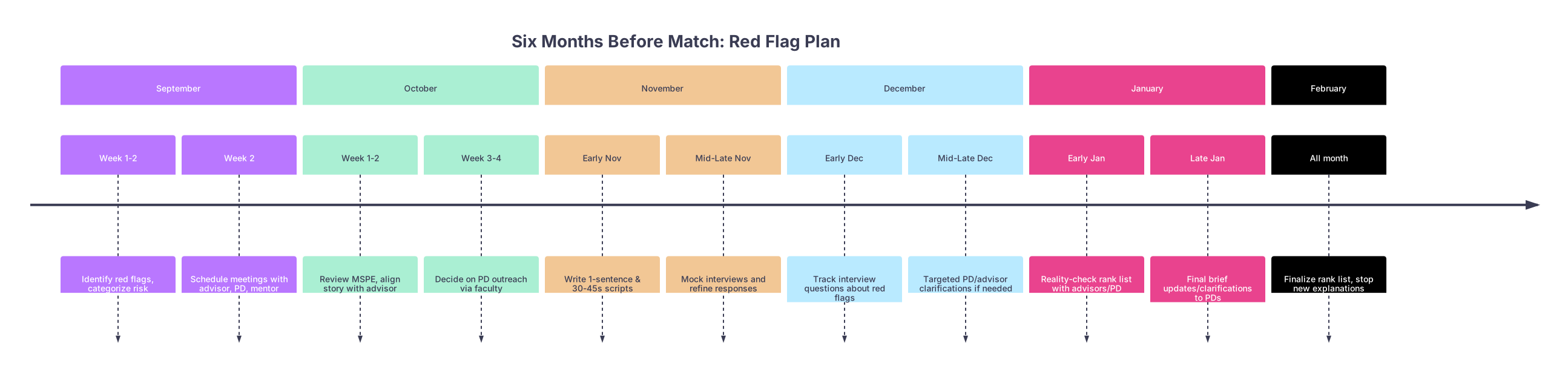
| Period | Event |
|---|---|
| title Six Months Before Match | Red Flag Plan |
| September - Week 1-2 | Identify red flags, categorize risk |
| September - Week 2 | Schedule meetings with advisor, PD, mentor |
| October - Week 1-2 | Review MSPE, align story with advisor |
| October - Week 3-4 | Decide on PD outreach via faculty |
| November - Early Nov | Write 1-sentence & 30-45s scripts |
| November - Mid-Late Nov | Mock interviews and refine responses |
| December - Early Dec | Track interview questions about red flags |
| December - Mid-Late Dec | Targeted PD/advisor clarifications if needed |
| January - Early Jan | Reality-check rank list with advisors/PD |
| January - Late Jan | Final brief updates/clarifications to PDs |
| February - All month | Finalize rank list, stop new explanations |
A quick comparison: when to address red flags and with whom
| Situation | Who Leads | Best Timing |
|---|---|---|
| Step/Level failure | Advisor + You | Sept–Oct (planning), Nov–Dec (interviews) |
| LOA for health/personal reasons | Dean/Advisor | Sept (planning), Oct (MSPE review) |
| Professionalism/probation issue | Dean + PD | Sept–Oct (alignment), Briefly in interviews |
| Late specialty switch | You + Specialty Mentor | Oct–Nov (statement + interviews) |
| Background/legal issue | Dean/Student Affairs | Sept–Oct (strategy), Only if asked in interviews |
The three things to remember
- Red flags do not ruin applications. Silence, inconsistency, and last-minute panic do.
- Six months out, you should be aligning who says what, when—not writing 3-page defenses of your past.
- The earlier you involve your dean, advisors, and PDs, the more they can protect you from your record—and the less you’ll feel like you’re hiding.