It’s 11:38 p.m. Your personal statement has gone through seven drafts, two friends, one attending, and your mother. You are hovering over “Certify & Submit” on ERAS, wondering if that one sentence about “ever since I was a child” is too cliché.
Across the country, a program director is also staring at your personal statement.
But here’s the truth you were not told: they are reading it on a second monitor, half‑glancing between your PS, your USMLE scores, and the ACGME duty hour attestation they still haven’t signed. They’re tired. They’re skimming. And they’ve already read fifty variations of “I want to be a physician because…”
Let me walk you through exactly what happens in their head, line by line, and why certain phrases get you mentally binned before you even reach the second paragraph.
First Pass: How PDs Actually Encounter Your Statement
Let’s start with the setting, because that explains 80% of the behavior.
Program directors do not sit with a latte, print your statement, and highlight it like an English professor. Most of the initial reading happens in one of three places:
- At their office computer, late, after clinic, during application season hell
- In conference with your file open during a selection meeting
- On a tablet/phone on the couch while half‑watching the news
They’re tired, they’re busy, and they’re triaging.
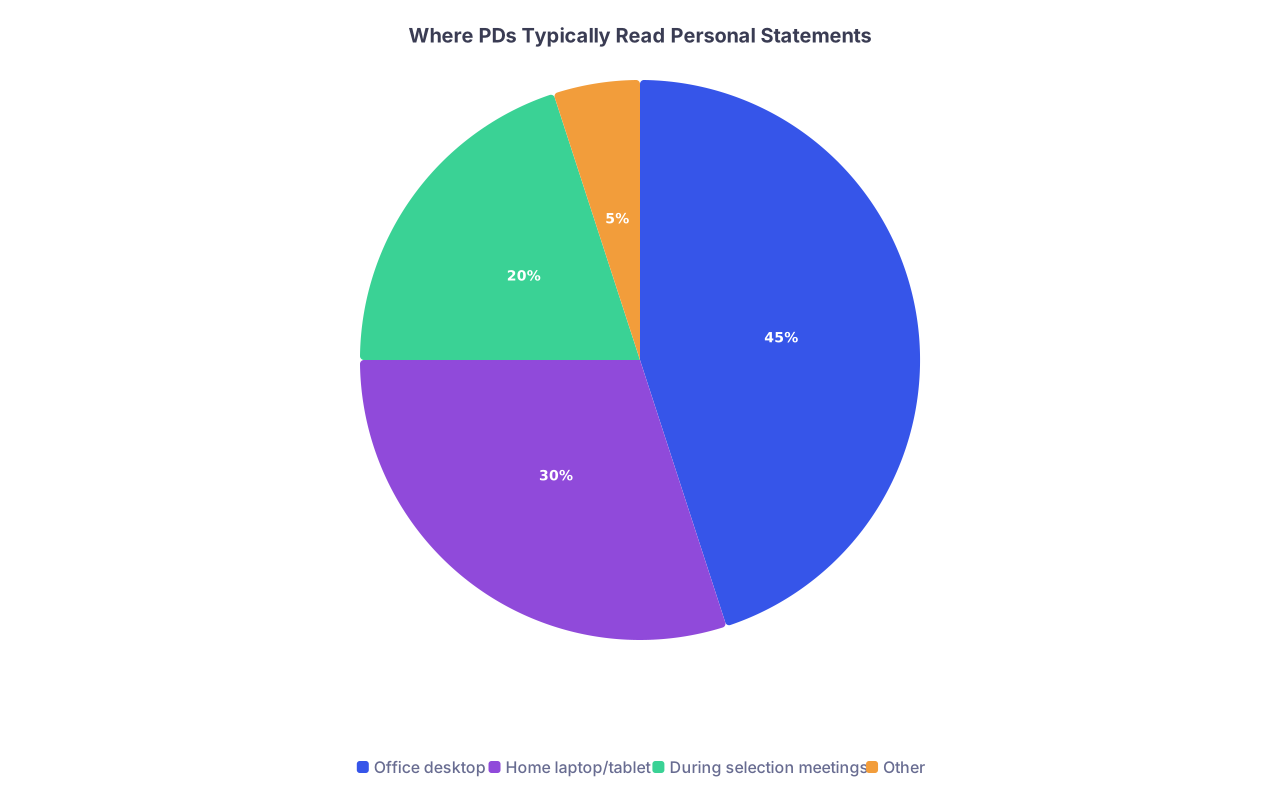
| Category | Value |
|---|---|
| Office desktop | 45 |
| Home laptop/tablet | 30 |
| During selection meetings | 20 |
| Other | 5 |
I’ve watched PDs “read” personal statements in real time. Here’s the dirty secret: for the majority of applicants, they skim your first paragraph, glance at the middle for red flags or something memorable, and then read the last 3–4 lines more carefully.
That’s it.
If you’re applying to a competitive specialty or a top‑tier academic program, they might read more thoroughly. But they’re still scanning for specific things. Not your prose. Not your narrative arc. Signals.
Line 1: The Opening Sentence Reality Check
Your first line is the only line you can almost guarantee gets read. So what usually shows up?
“I have wanted to be a doctor for as long as I can remember.”
The PD’s reaction? Mental eye‑roll. Whether they show it on their face or not.
By October, they’ve seen that sentence, or some version of it, hundreds of times. It does nothing for you. At best, it’s invisible. At worst, it marks you as generic and unoriginal before you’ve even started.
I’ve literally watched a PD scroll past an entire statement after that line, mumbling, “Nothing here I haven’t read.”
Same category:
- “Ever since I was a child…”
- “My journey to medicine began when…”
- “I have always been passionate about helping others.”
These openers all have the same problem: they tell the PD nothing they can use to rank you. They don’t distinguish you from the herd.
What makes them pause?
An opening sentence that does one of three things very quickly:
- Anchors to a concrete, specific moment
- Reveals something about your thinking, not just your feelings
- Signals maturity and self‑awareness instead of melodrama
Example of an opener PDs actually comment on (positively):
“On my third night on call as a sub‑intern, I realized my favorite part of medicine wasn’t the diagnostic puzzle. It was the moment right after, when I had to explain that puzzle to an anxious family at 2 a.m.”
Specific. Grounded in a role. Shows they actually know what sub‑I nights feel like. Not a masterpiece, but a lot better than “ever since I was a child.”
That’s the bar. Not Pulitzer-level writing. Just real.
Lines 2–5: The “Story” That Usually Kills You
If your first line doesn’t lose them, your next 3–5 lines often do.
This is where you get the trauma monologues. The extended “my grandmother died and I realized I wanted to be a doctor” story. The patient vignette that reads like a dramatized chart note with adjectives.
Program directors are not monsters. They understand you’ve had meaningful experiences. Many share those same experiences. The problem is not “having a story.” The problem is how you tell it.
Behind closed doors, here’s what gets said:
- “This is trauma dumping.”
- “They’re centering themselves too much.”
- “This didn’t need three paragraphs.”
The main mistake: you think the story is the point. It isn’t. The point is what the story shows about how you think, how you work, and how you’ll function on a team at 3 a.m. when the ED is flooded.
If you write 10 lines about a patient and 1 line about what you learned about yourself as a future [insert specialty], you’ve inverted the ratio.
The mental rubric in a PD’s head during these lines:
- Does this applicant show insight, or just emotion?
- Are they idealizing medicine, or do they have a realistic sense of the work?
- Are they writing like a colleague or like a premed trying to impress?
Any hint of “savior complex” (“I realized I was meant to save lives”) gets flagged. Yes, actually flagged. I’ve watched attendings turn to each other and say, “I don’t want this person in my ICU.”
The Middle: Where PDs Start Skimming Aggressively
By the time they reach your second paragraph, most PDs are scanning, not reading. They’re looking for anchor words and concepts. Not finished thoughts. Not stylistic flourishes.
They’re hunting for:
- Clear specialty motivation
- Evidence you understand the field’s realities
- Career direction (even if it changes later)
- Any sign you’re difficult, unrealistic, or unstable
What PDs Actually Want To See In The Middle
Example: Internal Medicine
They’re subconsciously scanning for things like:
- Longitudinal relationships
- Comfort with uncertainty
- Interest in complex, chronic disease
- Curiosity, intellectual humility
If your middle paragraphs are all about “I love procedures” and “I like fast‑paced settings,” they’ll think: “Why are they not applying to EM or anesthesia?” Even if they don’t say it aloud, it dents fit.
Example: General Surgery
They’re scanning for:
- Grit and resilience without drama
- Comfort with hierarchy and feedback
- Team mentality
- Evidence you’ve actually been in an OR more than twice
If your statement is all “I love working with my hands” without any nod to the lifestyle, the culture, the long hours, some PDs will literally say: “They don’t know what they’re signing up for.”
You cannot fake this part with grand phrases. They see right through it.
The “Red Flag Scan”
While they’re moving through the middle, there’s a parallel process going on. A quiet “red flag scan.” They’re asking themselves:
- Are they blaming others for setbacks?
- Are they vague about gaps or leaves?
- Is there any weird, intense religiosity or political content that suggests poor boundaries with patients?
- Are they oversharing personal mental health details in a way that suggests instability rather than resilience?
None of this is written in the official handbook. But it absolutely happens.
Here’s a hard truth: your personal statement is not the place to fully unpack every unresolved trauma you’ve experienced. If an experience absolutely shaped your path, you can reference it. Briefly. Grounded. With distance. Not as a raw, open wound.
I’ve watched selection committees get very quiet when a statement leans heavily into graphic patient death descriptions or unresolved grief, especially if there’s no sign the applicant has processed this with support.
The question in their heads is simple: “Is this person going to fall apart on night float?”
Fair or not, that’s reality.
The “Accomplishment Paragraph” That Backfires
This is the part where many of you try to summarize your CV in prose.
You write:
“Through my extensive research in cardiology, numerous leadership positions, and dedication to community service, I have developed skills in teamwork, communication, and perseverance.”
Program directors already saw your CV. They know your research. They don’t need a narrative version of your activities section.
Here’s what does catch their eye:
- One research experience that genuinely changed how you think about medicine
- One leadership role that clearly shows how you function in a group
- One teaching/mentoring experience that shows you understand how to talk to humans, not just exams
You get one or two focused examples. Not a laundry list. Not a humble‑brag collage.
Behind the scenes, here’s what they say when you overdo it:
“Alright, we get it, you’re amazing.”
Or worse: “This is insecurity disguised as accomplishment.”
If you sound like you’re trying to prove you belong, they assume you’re not used to high‑performance environments. The strongest applicants always sound oddly matter‑of‑fact about their achievements. “I worked on X. I learned Y. Here’s how it changed how I approach patients.”
That’s it. No drumroll.
The Specialty Commitment Test
At some point, the PD’s eyes will hunt for one key thing: do you actually seem committed to this specialty?
Not “my passion for dermatology began when I realized the skin is the largest organ.” They’ve seen that 500 times.
They’re asking:
- Do you know the bread‑and‑butter of this field?
- Do you understand its unglamorous side?
- Does your story fit the specialty’s values and daily reality?
| Specialty | PDs Listen For In Your PS |
|---|---|
| Internal Med | Curiosity, chronic care, complexity, continuity |
| General Surgery | Resilience, team-first attitude, OR reality |
| Pediatrics | Patience, communication with families, gentleness |
| Psychiatry | Self-awareness, boundaries, emotional steadiness |
| EM | Decisiveness, tolerance of chaos, team coordination |
If your personal statement for psychiatry is all about you and your own psychological journey, with very little about how you conceptualize patients, red flags go up. I’ve seen PDs say, bluntly: “They’re working their stuff out on paper. Not here.”
If your EM statement talks a lot about “adrenaline” and “action” but never once touches on burnout, shift work, handoffs, or interdepartmental politics, you sound like a 3rd‑year on their first ED rotation. Not like someone who can survive EM as a career.
You don’t need to be cynical. But you do need to sound like you’ve seen the warts and still chose the field.
The Last Paragraph: Where You Either Stick the Landing or Vanish
PDs nearly always read your last few lines. Even if they skimmed the middle. That’s just how the eyes work when scrolling: top, then quick scan, then bottom.
This is where a lot of people implode.
You end with something like:
“I am excited to continue my journey in [specialty] and believe that my passion, dedication, and hard work will make me an excellent resident in your program.”
This sentence could be copied and pasted into literally any statement. With any name. For any program. That’s why it’s useless.
The ending needs two things:
- A clear, grounded sense of who you’ll be as a resident
- A forward‑looking, realistic tone that sounds like a colleague, not a college applicant
Better versions sound like this:
“As a resident, I hope to be the person on night float others trust to show up, think clearly, and never leave a nurse hanging. I’m looking for a program that will treat me like a junior colleague and push me to own my patients while still having backup when I’m in over my head.”
Or:
“In residency, I want to keep asking hard questions, not just about why my patients are sick, but about why some of them never had a fair chance at health. I’m looking for a program where that kind of restlessness is seen as a strength, not a distraction.”
Notice: no flattery of the program. No “your esteemed institution.” It’s about the kind of resident you intend to be and the type of environment where you’ll thrive. That’s what they’re recruiting for.

| Step | Description |
|---|---|
| Step 1 | Open PS |
| Step 2 | Skim bottom, move on |
| Step 3 | Scan middle for fit |
| Step 4 | Discuss at committee, may screen out |
| Step 5 | Read last paragraph carefully |
| Step 6 | Positive note in file |
| Step 7 | Neutral, decision based on rest of app |
| Step 8 | First line decent? |
| Step 9 | Any red flags? |
| Step 10 | Memorable & grounded? |
How Committees Actually Use Your Personal Statement
Here’s another reality check: your personal statement rarely gets you an interview by itself. But it can absolutely lose you one.
Typical use cases in real meetings:
- Two applicants have similar scores and letters. Someone says, “What did you think of their personal statement?” That’s when the impression matters. Not the details.
- A PS is weird, grandiose, or unhinged. It becomes the reason to drop you from the maybe pile.
- A PS is quietly strong and mature. It’s used to justify bumping you up a notch: “I liked how grounded they were. They get what this job is.”
What they almost never do: go line by line analyzing your metaphors.
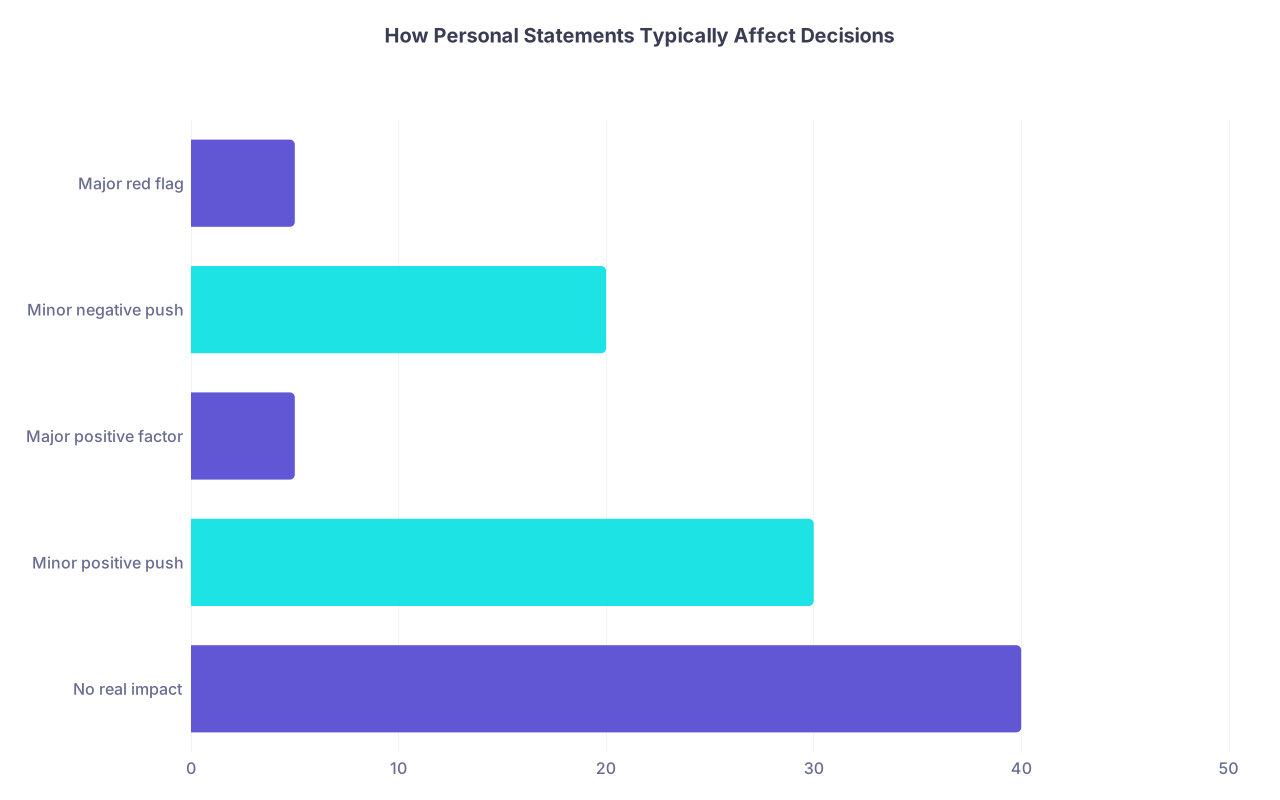
| Category | Value |
|---|---|
| No real impact | 40 |
| Minor positive push | 30 |
| Major positive factor | 5 |
| Minor negative push | 20 |
| Major red flag | 5 |
The goal is simple: avoid the negative side of that chart, and give them just enough substance to put you into the “minor positive push” category.
You’re not trying to be unforgettable. That’s where people get theatrical and weird. You’re trying to sound like someone they’d be comfortable handing a pager to.
Common Mistakes PDs Complain About (Behind Closed Doors)
I’ve sat through enough selection seasons to know the greatest hits of complaints. Let me be blunt about them.
The “creative writing” essay.
Writing in second person. Overwrought analogies. Cute narrative tricks. Committees hate this much more than you think. The quiet comment is always: “This isn’t an MFA workshop.”The martyr complex.
Endless sacrifice narrative. “Despite overwhelming obstacles, I fought my way here.” You can absolutely mention adversity. But if the tone feels like “you owe me a spot for surviving,” PDs recoil.The savior fantasy.
Dramatic “I realized my calling is to save lives” rhetoric. It reads as naive and unsafe. Medicine is not about you being a hero. It’s about you being part of a system that tries to help, and sometimes fails.Name‑dropping their program.
“I would be honored to train at [Program X].” They know you sent the same line to 40 programs, or worse, you forgot to change the name somewhere. This doesn’t help you. Focus on who you are, not flattery.Overexposure of personal mental health details.
I’m not talking about a mature, brief mention of depression, anxiety, or burnout with clear evidence of treatment and stability. I’m talking about raw, still‑bleeding disclosures. They scare people, even if they shouldn’t.Trying to explain away every flaw.
The PS is not your SOAP note explaining all your red flags. One major issue? Maybe. A failed step? Maybe mention. But five paragraphs defending every B on your transcript? That reads poorly.

What A “Quietly Strong” Personal Statement Actually Looks Like
You want to know what PDs remember a week later? It isn’t the most poetic statement. It’s the applicant who sounds like a future colleague.
The pattern is surprisingly consistent:
- Simple, clear opening that feels real, not theatrical
- One or two specific clinical experiences that show how you think
- A clear connection to the specialty’s real work, not just its highlights
- Brief nod to your major experiences (research, leadership) with actual reflection
- A closing that sounds like someone who understands what residency is
No grand declarations. No sweeping “I will change the healthcare system” in three lines. Just grounded confidence.
There’s a phrase I’ve heard multiple PDs use for this: “adult voice.” That’s what you’re aiming for.
FAQ (What You’re Probably Still Wondering)
1. Do PDs actually notice grammar and typos?
Yes. They do. Not all of them, and not equally, but I’ve watched people get visibly annoyed by repeated errors. One or two minor issues? Fine. A pattern of sloppy writing? They start asking what else you’re careless about. You don’t need poetic style, but you do need clean, competent English.
2. Should I talk about my personal mental health history?
Carefully. If it’s central to why you chose your specialty and you can describe it with distance, maturity, and clear treatment/stability, it can be powerful. If it’s raw, unresolved, or described in graphic, recent crisis terms, many PDs will worry about your ability to withstand residency stress. Unfair? Maybe. Real? Yes.
3. Is it OK to reuse the same personal statement for multiple programs?
Almost everyone does. PDs know this. What they care about is whether your statement makes sense for the specialty. You don’t need to customize it for each program. But do not mention specific program names. If you do tweak, tweak the last paragraph slightly to reflect academic vs community interests, not flattery.
4. Can a great personal statement make up for a low Step score?
“Make up for”? No. Nothing truly replaces numbers in the first-pass screen at many places. But a strong, mature PS can absolutely move you from “maybe” to “let’s invite” when your metrics are borderline. It’s rarely the sole reason, but it helps people advocate for you in the room: “Their scores are a bit low, but did you read their statement? They get it.”
Years from now, you won’t remember the exact sentences you wrote in that personal statement. You will remember, very clearly, the kind of resident you actually turned out to be at 3 a.m. with the pager going off.
Write like that person. Not like the anxious version of you trying to impress strangers on a committee.