It’s late, you’ve got 12 programs saved in ERAS, and your brain is fried from re-writing the same life story. You’re applying to two different specialties, you’ve got one “pretty good” personal statement, and you’re staring at the screen asking:
“Can I just reuse this same statement for both and be done with it?”
Here’s the blunt answer:
You can reuse the same personal statement for multiple specialties. You just usually shouldn’t—at least not without smart, specialty-specific modification. Using a single generic statement for different fields is one of the most common, quiet application killers I see.
Let’s walk through what’s actually safe, what’s risky, and how to do this without burning out or tanking your chances.
Short Answer: Is It Safe To Reuse the Same Personal Statement?
If you want the 10-second version:
- Reusing the exact same personal statement for different specialties (e.g., IM and EM) = bad idea.
- Reusing the same core story/structure but customizing for each specialty = usually fine and often smart.
- Reusing the same statement for multiple programs within the same specialty (e.g., all IM programs) = generally safe, as long as it’s good and not program-specific.
The danger isn’t “ERAS will catch you and ban you.” That’s not the problem.
The danger is human: PDs, faculty, and reviewers read hundreds of these and can smell generic, non-committal, or misaligned statements in about 10 seconds.
If you’re dual applying or pivoting specialties, you need to be tactical, not lazy.
How PDs Actually Read Personal Statements
Before you decide what you can reuse, understand how your audience reads:
Most PDs and screeners use the personal statement to answer 3 questions:
- Why this specialty?
- Who are you as a human and colleague?
- Are you aligned with what we do every day?
They’re not reading to be entertained. They’re looking for:
- Clear specialty interest (not “I like everything and haven’t decided.”)
- Evidence you understand the work (e.g., continuity in IM vs procedures in EM)
- Fit with their culture/mission (academic vs community vs primary care vs procedural focus)
When your statement could plausibly be used for any specialty, you fail question #1 and #3. That’s the heart of the “reusing” problem.
What You Can Safely Reuse (And What You Shouldn’t)
Let’s break the personal statement into pieces and label them: safe to reuse, modify, or avoid.
| Component | Reuse Across Specialties? | Reuse Within Same Specialty? |
|---|---|---|
| Childhood background | Yes, with minor tweaks | Yes |
| Core personal traits | Yes | Yes |
| Specific “why this specialty” paragraph | No | Yes (with small edits) |
| Key clinical anecdote | Maybe, if reframed | Yes |
| Research/leadership section | Often yes, reframed | Yes |
| Closing/future goals | Only if specialty-specific | Yes |
Safe-ish to reuse across specialties
You can usually reuse:
- Personal background (first-gen, non-traditional, previous career, etc.)
- Core values/traits: curiosity, teamwork, humility, resilience
- General work ethic stories (working through challenges, learning from failure)
- Non-specialty-specific leadership and research, framed correctly
These sections are about who you are, not what field you picked.
Dangerous to reuse across specialties
You should not reuse, unchanged:
- Any “Why X specialty” explanation
- Future career goals that clearly fit one field more than another
- Specialty-flavored experiences (trauma bay stories for EM vs continuity clinic for FM/IM)
- Specialty jargon that doesn’t match
Example of obvious mismatch I’ve seen:
Applicant reuses an IM statement for FM and leaves in “I am especially drawn to the complexity of inpatient medicine and ICU co-management.” In a community FM program that heavily emphasizes outpatient continuity. Not fatal, but it screams “copy-paste” and “didn’t think this through.”
Reusing For Different Specialties: Smart vs Dumb Approaches
Let me be direct: if you’re dual applying (e.g., IM + Neurology, EM + FM, Ortho + TY/prelim), your goal is:
- Minimize total writing.
- Maximize clarity that you want each field you’re applying to.
- Avoid sounding like you’re hedging or undecided.
The dumb way
One generic statement like this:
“I have enjoyed every rotation: surgery, IM, pediatrics, OB/GYN, psychiatry, and EM. Each has shown me the rewards of patient care, teamwork, and lifelong learning. I look forward to continuing my training in residency, where I can grow as a clinician.”
This tells the reader exactly nothing. It could go to literally any specialty. And PDs know that.
The smart way
You create a base template and plug in specialty-specific content.
Something like this structure:
- Intro: brief story or hook (can be reused with slight tweaks)
- Paragraph 1–2: who you are, formative experiences (mostly reusable)
- Paragraph 3: strongly specialty-specific “why X field” + example
- Paragraph 4: skills/strengths linked explicitly to specialty demands
- Closing: future goals that clearly make sense for that field
Then you clone that document for each specialty and only heavily rework 2–3 paragraphs.
Example:
- You apply to IM and Neurology.
- You keep the same origin story: your grandfather’s stroke and your early exposure to healthcare.
- For IM: you highlight complexity, multi-system disease, longitudinal relationships, breadth.
- For Neuro: you highlight localization, diagnostic puzzles, specific neuro cases, long-term disease management in that context.
Same skeleton, different organs.
Concrete Example: What Reuse Can Look Like
Let’s say this is your original IM-focused paragraph:
“On my internal medicine clerkship, I was drawn to managing patients with multiple chronic conditions over several days. I enjoyed following their progress, adjusting medications, and seeing how social determinants shaped their outcomes. The opportunity to think broadly, coordinate with consultants, and build rapport with patients and families convinced me that internal medicine is the right field for me.”
Here’s how you could adapt the same core experience for Family Medicine:
“On my family medicine rotation, I was drawn to caring for patients with multiple chronic conditions across different stages of life. I enjoyed discussing lifestyle changes, coordinating follow-up, and seeing how family dynamics and social context shaped their health. The chance to think broadly, focus on prevention, and build long-term relationships convinced me that family medicine is the right field for me.”
Same brain, different clothes. And that’s fine.
What you don’t do is send the IM paragraph to an EM program or a pathology program. That’s how you quietly get filtered into the “no thanks” pile.
How Much Can Programs Actually See Or Compare?
Short version:
- Programs don’t see what personal statement you sent to other specialties.
- They just see the one you assigned to their specialty/program.
- ERAS isn’t cross-analyzing your PS across fields to catch you.
The problem isn’t getting “caught.” It’s that if your EM program reads a statement that screams IM, they’re going to assume:
- You’re not actually committed to EM,
- Or you’re just spraying applications blindly.
Neither helps you.
Managing Time: A Practical System That Works
You’re busy. You don’t have 6 weeks to craft five completely different masterpieces. So here’s a realistic approach I’d use in your shoes.

| Step | Description |
|---|---|
| Step 1 | Define Target Specialties |
| Step 2 | Choose Main Specialty |
| Step 3 | Write Strong Core Statement for Main Specialty |
| Step 4 | Identify Reusable Sections |
| Step 5 | Create Copies for Other Specialties |
| Step 6 | Rewrite Specialty-Specific Paragraphs |
| Step 7 | Align Future Goals per Specialty |
| Step 8 | Quick Proofread for Jargon/Mismatches |
Step-by-step:
- Pick your primary specialty (the one you most want / are strongest for).
- Write one solid, complete statement purely optimized for that field.
- Highlight:
- What’s general (background, values, major experiences)
- What’s IM- or EM- or Neuro-specific
- For each secondary specialty:
- Duplicate the document.
- Rebuild the “why this specialty” and “future goals” sections from scratch.
- Adjust examples and language so they clearly fit that field.
- Read the whole thing out loud once per specialty to catch leftover words: “inpatient”, “OR”, “clinic”, “procedural”, “outpatient”, etc., that may not fit.
This gives you 2–3 well-targeted statements instead of 5 mediocre clones.
Special Cases: When Reuse Is More (or Less) Forgivable
Some scenarios are different.
IM vs Primary-Care-Oriented FM
Reusing core content here is often pretty safe if:
- You understand and reflect FM’s cradle-to-grave + community/prevention angle.
- You tweak goals: IM → hospitalist, subspecialist; FM → outpatient continuity, underserved, broad scope.
Don’t just Ctrl+F “internal medicine” to “family medicine” and call it done. That reads fake.
IM Categorical vs IM Preliminary / TY
You can reuse 80–90%:
- For prelim/TY: emphasize being well-prepared for advanced training, broad clinical foundation, being a hard worker and good team player.
- For categorical IM: it should sound like you actually want a career in IM, not just “one year and I’m out.”
Overly competitive specialty plus a backup
Example: Ortho + Prelim Surgery, Derm + IM.
You need fully distinct specialty motivations. Your derm programs shouldn’t read a statement that sounds like, “I’m just here because I couldn’t do ortho.”
In these cases, I’d put more distance between the statements. Same person, fine. Same exact narrative arc and phrasing? I’d avoid it.
The Most Common Personal Statement Reuse Mistakes
Here are the things that actually hurt people:
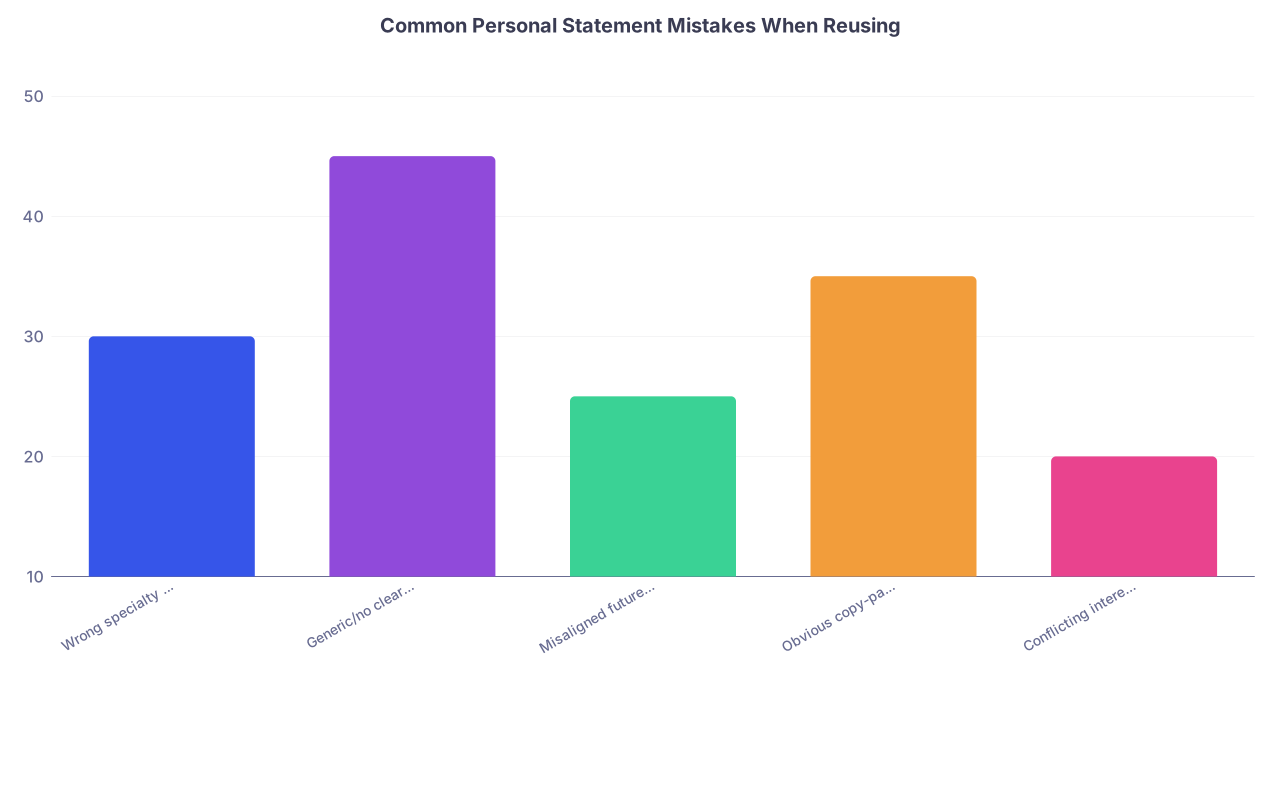
| Category | Value |
|---|---|
| Wrong specialty named | 30 |
| Generic/no clear specialty | 45 |
| Misaligned future goals | 25 |
| Obvious copy-paste wording | 35 |
| Conflicting interests mentioned | 20 |
Leaving the wrong specialty name in.
Happens every year. “I am excited to apply to internal medicine” in a neurology application. It makes you look careless. Worst case, it comes up in an interview with that exact quote.Generic “I love everything” statements.
That’s not a strength at this stage. It’s indecision.Misaligned goals.
Telling a community FM program you’re “committed to a career as a tertiary-care academic subspecialist doing bench research” is… not a match.Using the same ultra-specific anecdote that clearly fits one field.
Example: a big EM resuscitation story used in a psych application, with no meaningful connection to psychiatry.Tone mismatch.
Surgery statement: rugged, procedural, OR focus. Then you recycle to pediatrics and barely touch the tone. It feels off.
What Good Reuse Actually Looks Like (Checklist)
If you want to reuse safely across specialties, your statement for each field should:
- Explicitly name the specialty within the first 1–2 paragraphs.
- Describe 1–2 experiences that clearly tie to that specialty’s work.
- Link your skills/traits to things that actually matter in that field.
- Close with goals that would make sense to a PD in that specialty.
If I read your IM and EM personal statements side by side, I should think: “Same applicant, same core person, but I believe they genuinely understand and want each field.”
If I can’t tell which specialty each one is for without searching for the word “medicine” or “emergency,” you haven’t customized enough.
Quick Comparison: One Statement vs Multiple Specialty-Specific Ones
| Approach | Pros | Cons |
|---|---|---|
| One generic statement | Saves time, less writing | Looks unfocused, weaker specialty fit |
| Slightly tweaked copies | Moderate time, better alignment | Risk of leftover mismatches |
| Fully distinct statements | Best specialty fit, strongest | More time, more editing |
If you’re applying to 2 specialties, the middle option (shared core + clearly different specialty sections) is usually the sweet spot.
FAQs: Reusing Personal Statements Across Specialties
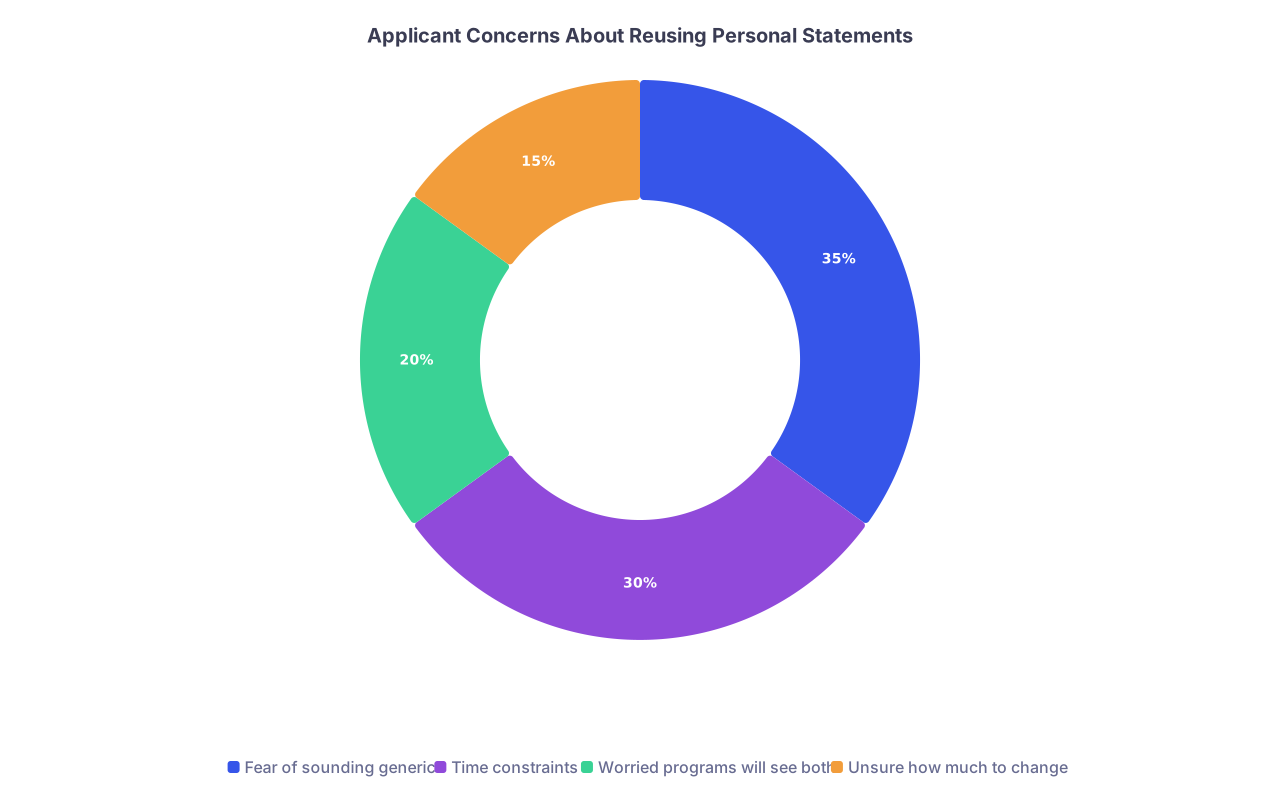
| Category | Value |
|---|---|
| Fear of sounding generic | 35 |
| Time constraints | 30 |
| Worried programs will see both | 20 |
| Unsure how much to change | 15 |
1. Will programs know if I reuse the same personal statement for different specialties?
No. A neurology PD can’t log into your EM application and compare. They only see what you send to them. The real problem isn’t being “caught,” it’s sending an EM program an IM-sounding statement (or vice versa) and undermining your perceived interest.
2. Can I use the exact same personal statement for all programs in the same specialty?
Yes, and most people do. As long as:
- It’s a strong, clear statement for that specialty.
- You haven’t hard-coded a different program’s name or a hyper-specific geographic preference that contradicts their location.
You don’t need 40 unique IM statements. One excellent one is fine.
3. What if I honestly like both specialties equally? How do I not sound fake?
You don’t need to confess your existential crisis in the PS. For each specialty:
- Write as if you are choosing it.
- Make a coherent case for why that field fits you.
- Leave the “I like both” discussion for advisors, not PDs.
Split identity on paper reads as lack of commitment. Don’t put that in front of selection committees.
4. Is it okay to reuse the same opening story for multiple specialties?
Usually yes. Just make sure:
- The way you interpret the story matches the specialty.
- You don’t say “That experience showed me I was meant for internal medicine” in a statement going to EM.
Same story, different lesson emphasized is completely acceptable.
5. How long should each specialty-specific section be if I’m reusing the rest?
As a rule of thumb:
- At least 1–2 solid paragraphs in a 1-page statement should be clearly about that specific specialty.
- That usually means 40–60% of your statement has specialty-tuned content (motivation, experiences, goals), not just generic “I like medicine” fluff.
6. What if I already submitted the same generic PS to two very different specialties?
You can’t retroactively fix what’s already submitted, but you can:
- Improve what you send to future programs (if still adding).
- Tighten your narrative in interviews to clearly explain why each field.
- If you get interviews, your performance there will matter more than a mediocre but not disastrous PS.
Don’t obsess over what you can’t change. Fix what’s still under your control.
7. I’m short on time. What’s the minimum I should change to be safe?
Bare minimum, if you’re reusing:
- Correct specialty name everywhere.
- One clear paragraph explaining why that specialty, with at least one concrete example.
- A closing that matches realistic goals within that field.
It won’t win awards, but it’ll keep you out of the “clearly misaligned” pile.
Do this today:
Open your current personal statement draft. At the top, write the name of each specialty you’re applying to. Then highlight in one color everything that’s generic and in another everything that clearly anchors to a specific specialty. If you can’t tell which specialty it’s for just by reading the highlighted text, you need to rewrite at least one full paragraph for each field—start with that paragraph now.