The worst place to deal with a red flag is nowhere.
You have to own it—strategically. And that means deciding where and how to talk about it, not just if you should.
Let me answer your core question up front:
Most red flags should be addressed briefly in the written application (personal statement or dedicated section) and then expanded on in interviews if asked.
But not all red flags are created equal, and not all belong in your personal statement.
Here’s the framework I use when I advise applicants.
Step 1: Figure Out What Kind of Red Flag You Have
First, be brutally honest about what you are dealing with. “Red flag” gets thrown around too much. Some issues are yellow lights, not full-on red.
Common true red flags in residency applications:
- Failed USMLE/COMLEX attempt
- Course or clerkship failure
- Leave of absence (especially non-medical or non-academic)
- Significant professionalism concern (documented)
- Criminal record or institutional action
- Large unexplained gap in training or employment
Then there are “soft” concerns:
- Below-average Step 1/2 scores
- Few or no publications
- Late specialty switch
- No home program in your specialty
Those softer issues usually don’t need a “confession” segment. They need a strategic narrative, not a formal explanation.
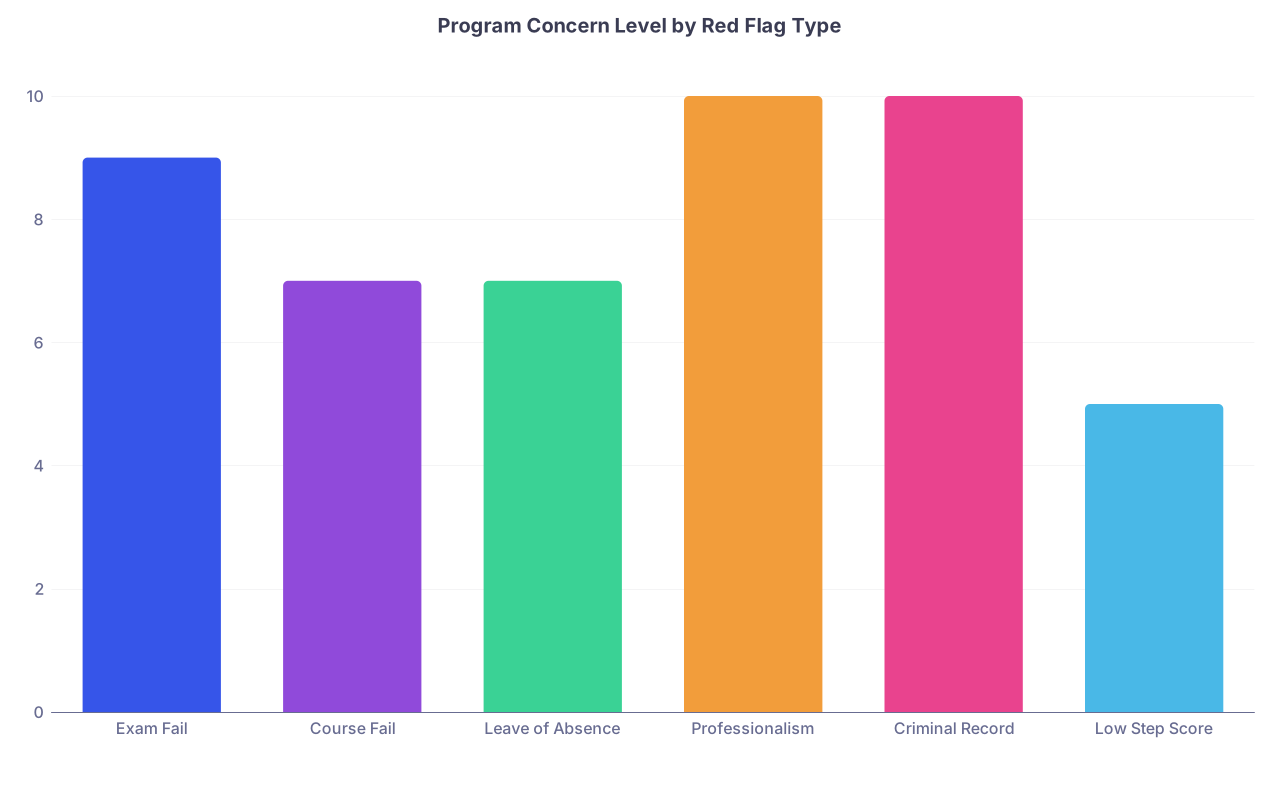
Here’s how programs typically weight these:
| Category | Value |
|---|---|
| Exam Fail | 9 |
| Course Fail | 7 |
| Leave of Absence | 7 |
| Professionalism | 10 |
| Criminal Record | 10 |
| Low Step Score | 5 |
(Scale 1–10, with 10 being “programs care a lot and will ask.”)
If you’re in the exam fail / course fail / LOA / professionalism / criminal / big gap group, assume programs will notice and care. Silence will not save you.
Step 2: Decide Between Three Locations
You’ve got three real options for addressing red flags:
- Personal statement
- Dedicated ERAS explanation field / “education interruption” / “adverse action” sections
- Interview conversations
Here’s the big rule:
Use the written application to give a short, professional explanation so you’re not a mystery. Use interviews to show insight, maturity, and growth.
Let’s compare them quickly.
| Red Flag Type | Best Primary Location |
|---|---|
| Single Step/COMLEX failure | Brief in PS or ERAS comment |
| Multiple exam failures | ERAS comment + ready in IV |
| Course/clerkship failure | ERAS comment + optional PS |
| Leave of absence | ERAS comment (required) |
| Professionalism action | ERAS comment, not PS center |
| Legal/criminal issue | ERAS comment + IV discussion |
Notice what’s missing: “Make it the heart of your personal statement.”
That’s almost never the right move.
Step 3: When You SHOULD Use the Personal Statement
You use the personal statement for a red flag when:
- The red flag directly shapes your path, perspective, or motivation in a way that is actually central to who you are as a physician
- The issue will raise immediate questions about your reliability or readiness if left unaddressed
- You can explain it in 3–5 sentences and pivot to growth, not sit in the drama
Good candidates for brief PS inclusion:
- A single exam failure with a clear, now-resolved cause
- A medical or family crisis that led to an LOA and strongly influenced your values
- A serious challenge that genuinely drove you to your specialty and doesn’t sound like an excuse
Example of appropriate PS red-flag handling (USMLE failure):
During my third year, I failed Step 1 on my first attempt. At the time, I tried to juggle clinical responsibilities, family stress, and an inefficient study strategy. I restructured my approach, sought faculty mentorship, and passed on my second attempt with a 22-point increase. More importantly, I learned to be proactive about asking for help, to protect my preparation time, and to build systems rather than rely on last-minute effort—habits I now apply on every rotation.
Short. Responsible. Growth-oriented.
What you do not do:
- Start your PS with your red flag
- Spend multiple paragraphs defending yourself
- Blame your school, your ex, your attending, “the system,” or vague “personal issues”
- Turn your PS into a legal defense brief
If explaining the red flag takes more than 20–25% of your statement, it usually doesn’t belong there.
Step 4: When the Personal Statement Is the WRONG Place
There are times when putting the red flag in your PS actually hurts you:
When it’s not central to your story
If the main impression from your PS is “this person has problems,” you did it wrong. The red flag becomes your brand.When it’s unresolved or recent and raw
Ongoing legal cases, fresh professionalism issues, still-unaddressed behavior? Do not try to spin that in your PS. Give the required facts in ERAS, then be factual and calm in interviews.When you sound defensive or bitter
Any whiff of “I was treated unfairly” without humility and ownership is lethal. Programs see enough of that. They do not want it in their residents’ notes, emails, or patient interactions.When you’re stacking red flags
If you have multiple serious issues, your PS should not be a tour of disasters. Address the worst one briefly in writing; the rest can be clarified if asked.
Use this mental test:
If a PD skimmed just your first and last paragraphs, would they think, “Interesting candidate,” or “Lot of baggage”?
If the answer is the second, you over-explained.
Step 5: Use ERAS / Application Fields First When Available
If ERAS (or your application system) gives a dedicated place to explain:
- Academic or professionalism actions
- Leaves of absence
- Gaps in training
Use that first. That’s the “official” house for these problems.
In that space:
- State what happened in 1–2 sentences
- Take ownership without self-flagellation
- Explain what changed and what evidence shows it’s different now (scores, rotation performance, LORs)
Something like:
I took a leave of absence from March 2022 to October 2022 due to a major depressive episode. I engaged in treatment, returned with clearance from my physician, and have since completed all required rotations without interruption. This experience has made me more attentive to my own wellbeing and more empathetic to patients facing mental health challenges.
That’s cleaner and more appropriate there than using half your PS on it.
Then, in your personal statement, you might reference the growth more subtly:
My own experience receiving care in my third year changed how I think about vulnerability in medicine.
You don’t need the full recap again.
Step 6: What Absolutely Belongs in Interviews (Not the PS)
Some topics are better handled live, where they can see your face, hear your tone, and ask follow-ups.
These are often better saved for interviews:
- Nuanced professionalism issues where context matters
- Complicated legal histories
- Situations with ongoing sensitivity (family conflict, trauma, severe illness in a loved one)
- Anything where the written version might look worse without the human element
The pattern I like:
Brief written acknowledgment somewhere in ERAS / PS:
“I addressed a professionalism concern early in my clinical years and took steps to improve my communication with the healthcare team.”Full, honest, calm explanation in interviews when asked, focusing on:
- What actually happened (briefly)
- What you learned
- How your behavior has changed
- How others can see that change (evaluations, LORs, leadership roles)
Programs are not just evaluating what you did. They’re evaluating how you talk about what you did.
Step 7: How Much Detail Is Enough?
Use this rule: One sentence for what happened, two to three for what you learned and how you improved.
Too little: looks evasive.
Too much: looks chaotic and self-focused.
Bad version:
I failed Step 1 because my school did not give us enough time and my family situation was difficult and I had to travel and I was also sick and I just have bad test anxiety and it has always affected me and…
Better:
I failed Step 1 on my first attempt due to poor study planning and trying to push through family stress instead of asking for help. I changed my approach by working with a learning specialist, creating a structured schedule, and regularly self-testing. I passed on the next attempt and have since performed at or above expectations on all standardized exams and clinical rotations.
Notice the structure: event → responsibility → changes → proof of improvement.
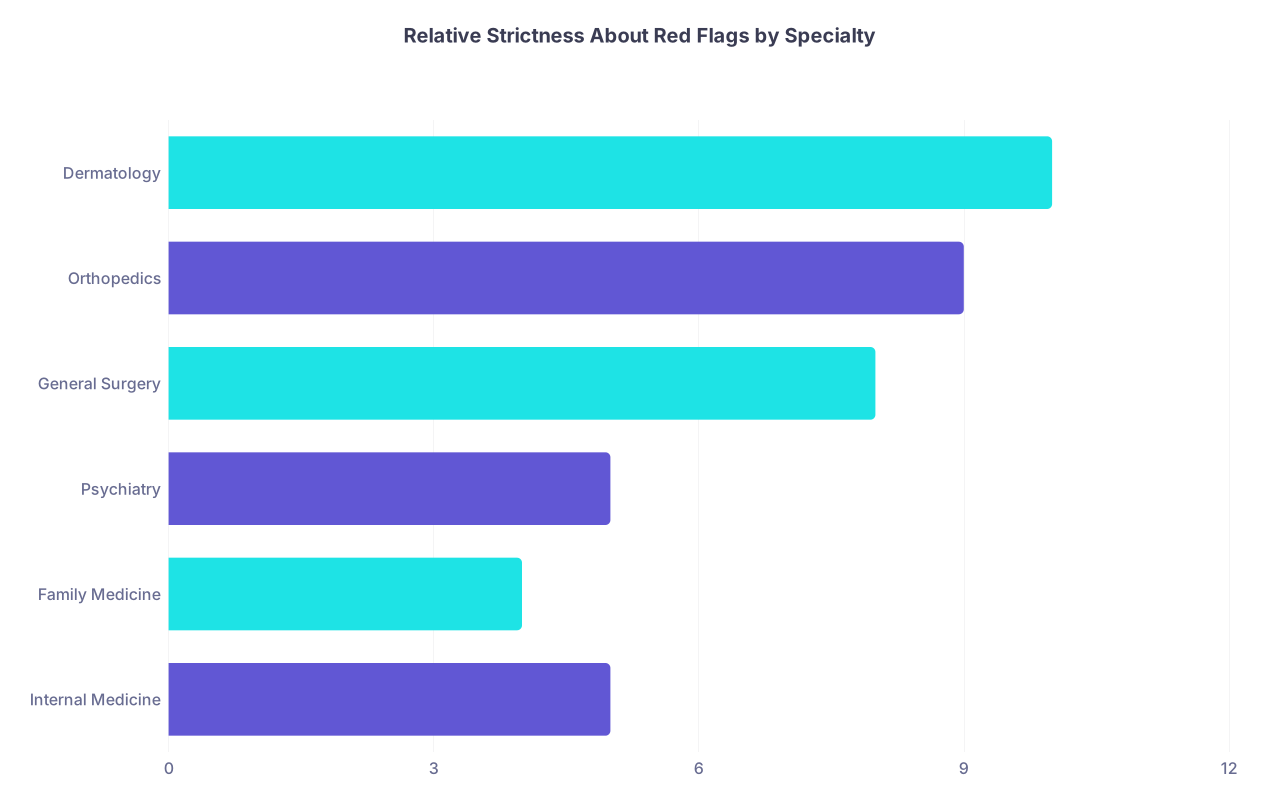
Step 8: How Different Specialties React (Yes, It Matters)
Some specialties stomach red flags better than others.
| Category | Value |
|---|---|
| Internal Medicine | 5 |
| Family Medicine | 4 |
| Psychiatry | 5 |
| General Surgery | 8 |
| Orthopedics | 9 |
| Dermatology | 10 |
(Again, 1–10, with 10 = “very unforgiving.”)
Reality check:
- Competitive surgical and lifestyle specialties are far less tolerant of exam failures, professionalism issues, and leaves without very strong evidence of turnaround.
- Primary care and psychiatry may be more open to applicants with red flags, especially when the story is tied to growth, resilience, and empathy.
That doesn’t mean you hide things from competitive specialties. But it does mean you should be even more surgical (pun intended) in how you frame them:
- Shorter in PS
- Very polished ERAS explanations
- Absolutely rock-solid evidence of current performance (LORs, rotation grades, Step 2, etc.)
Step 9: Common Mistakes to Avoid
You asked about common residency application mistakes. These are the big ones around red flags:
Ignoring an obvious red flag
Programs notice. If they have to guess, they assume the worst.Building your PS around your “trauma resume”
Your statement becomes heavy, dark, and about your problems instead of your potential as a resident.Over-sharing personal details
Going deep into family conflict, graphic illness descriptions, or intimate trauma that’s not necessary. You’re not writing a memoir.Sounding like a victim
If every sentence points to someone else as the problem, programs see future conflict—on rounds, with nurses, with admin.Being inconsistent across documents
If your MSPE, ERAS fields, and PS all tell slightly different versions of the same event, that’s a red flag on top of the red flag.Waiting until the interview to say anything
For major issues (exam failure, LOA, formal action), you should not be a “surprise” in person. That erodes trust.
A Simple Decision Flow You Can Follow
Use this quick logic:

| Step | Description |
|---|---|
| Step 1 | Identify Red Flag |
| Step 2 | Use ERAS or official field |
| Step 3 | Add 3-5 line note in PS |
| Step 4 | Save details for interview |
| Step 5 | Is it official/visible? |
| Step 6 | Does it shape who you are? |
| Step 7 | Needs narrative context? |
If you’re still unsure, default to:
- Minimal, honest written explanation
- Deeper, thoughtful discussion in interviews when prompted
That balance keeps you transparent without letting the red flag dominate your entire application.
What You Should Do Today
Open your personal statement draft and do three things:
- Highlight every sentence that mentions your red flag.
- Ask: “Could a program understand what happened and how I’ve grown in 3–5 sentences instead?”
- Cut the excess, tighten the explanation, and move anything highly technical or procedural into ERAS comment fields instead.
You want your red flag addressed, not featured.
FAQ: Red Flags in Personal Statements vs Interviews
1. If I failed Step 1 once but passed Step 2 with a strong score, do I have to mention the failure in my personal statement?
No, you do not have to, but you probably should address it somewhere in your application. A single concise explanation in ERAS or a short paragraph in the PS is enough. With a strong Step 2, I’d lean toward a brief mention in ERAS only, then be ready to talk about it in interviews.
2. I had a mental health–related leave of absence. Should I say that explicitly?
You need to explain the leave honestly, but you do not have to share every detail of your diagnosis. It’s acceptable to say you took a medically necessary leave, engaged in treatment, and have been stable and fully functional since your return, backed up by solid clinical performance. Depth of disclosure is your choice; basic transparency is not.
3. What if my school already explained the issue in my MSPE—do I still need to say something?
Yes, usually briefly. Programs will see the MSPE, but they also want your interpretation. Even 2–3 sentences somewhere in ERAS or the PS that show insight and ownership help them see you’re not avoiding the topic.
4. I had a minor professionalism warning that never became an official action. Do I bring it up?
If it’s not documented and does not appear in your MSPE or official records, you generally do not put it in your application. Instead, learn from it, change your behavior, and be an absolute model resident on rotations. If it comes up in a letter or MSPE commentary, be prepared to address it in interviews.
5. Can talking about red flags actually help me stand out positively?
Yes—when done right. Applicants who own their mistakes, clearly show growth, and now perform at a high level can come across as mature, resilient, and self-aware. But that only works if the red flag is no longer ongoing and your current performance is strong.
6. Is it better to address multiple red flags separately or all at once?
Do not write a catalog of problems. Prioritize what is most visible and serious (exam failure, LOA, formal action). Address that cleanly in ERAS and possibly your PS. If there are smaller related issues, you can group them as part of a single period of difficulty, but keep it short and centered on your turnaround.
7. What if I’m still not sure whether to put my red flag in the personal statement or just wait for interviews?
Ask yourself: “If I were a PD reading my application with zero explanation of this issue, would I feel uneasy or misled?” If yes, put a concise explanation in writing (ERAS field first, PS second). If no, keep it out of the PS, make sure your current performance is strong, and be ready with a clear, practiced answer for interviews.
Open your application now and identify your biggest concern. Decide today: one sentence in ERAS, three in the PS, or interview-only. Then rewrite that section so your red flag is explained, owned, and no longer the loudest thing in your file.