
It’s late November. You finally click into Thalamus or Interview Broker and see… almost nothing. You had a solid Step 2, good clerkship comments, research, leadership. Your classmates with weaker numbers are stacking interviews. You’re sitting there thinking, “What the hell did I miss?”
Let me give you the answer most people don’t want to hear:
For a decent chunk of you, the problem is sitting in a PDF called “Letter of Recommendation – Confidential.”
One lazy, vague, or quietly negative letter from someone you trusted.
You will not see it. No one will tell you. But I’ll walk you through how that single document can quietly sink an otherwise competitive file—and how to avoid being the applicant who gets burned by it.
What Program Directors Really Do With Your LoRs
Here’s the part that students underestimate: program directors don’t read every word of every LoR for every applicant. They can’t. There isn’t enough time in the universe.
But they absolutely do use letters to separate the “safe to interview” from the “do not touch” pile.
In real life, it looks like this:
A PD or associate PD opens your ERAS packet:
Step 2: fine.
MSPE: nothing catastrophic.
Transcript: normal.
Then they scroll to letters. They do not read them like literature. They skim like triage.
They’re hunting for three things:
- Red flags
- Strength of endorsement
- Signal of comparative rank (“top 10% of students,” “one of the best I have worked with”)
If they smell even a hint of “meh,” vague, or coded concern, they move on to the next applicant. No explanation. No appeal. You never even know you were close.
I have sat in these meetings where someone says, “Scores look fine, but did you see that medicine letter? That’s a no for me.” That’s it. Discussion over.
The Anatomy of a Sloppy or Damaging LoR
You’re imagining a “bad” letter as something obviously toxic: “Do not rank this person.” That almost never happens. The dangerous letters are the boring, lazy, or subtly negative ones.
Let’s break down what program leadership actually reads between the lines.
1. The Vague, Content-Free Letter
This is the most common, and it is absolutely deadly for borderline or mid-tier applicants.
This is the letter that sounds like this:
“I had the pleasure of working with [Name] during their internal medicine rotation. They were punctual, professional, and eager to learn. They interacted well with patients and staff. I believe they will be a good resident.”
You think: “That sounds fine.”
Program directors think: “This attending either didn’t remember them, didn’t care enough to write a good letter, or had concerns and kept it neutral.”
A high-effort, strong letter never reads like that. It is concrete, comparative, and specific: details, anecdotes, and clear ranking language.
2. The Faint-Praise Letter
This is the “damning with faint praise” special. It does not say you’re bad. It just clearly does not say you’re good.
Key phrases faculty use when they don’t want to endorse you strongly:
- “Met expectations”
- “Performed at the expected level for their training”
- “Will make a solid resident”
- “Given appropriate supervision, they will do well”
- “I believe they can succeed in residency”
You will never see the letter, so you won’t know this is in there. But PDs have read thousands of these and know exactly what those phrases mean.
A real endorsement does not sound like a performance improvement plan.
3. The Sloppy, Low-Effort Letter
This one hurts the most because it often comes from “big name” faculty who agreed to write for you.
The clues:
- Obvious copy-paste with someone else’s name still in there once
- Wrong specialty mentioned (“She will be an excellent internal medicine resident” on a surgery application)
- Basic biographical errors (wrong med school, wrong rotation dates)
- Generic template-style structure, zero detail
Behind closed doors, attendings and PDs absolutely comment on this.
I’ve heard:
“Wow, if this big-name cardiologist couldn’t be bothered to proofread, how strong can their support be?”
“I don’t trust this letter. I don’t think they know the student well.”
The subtext: If the writer respected you, they’d have taken 10 minutes to get your details right.
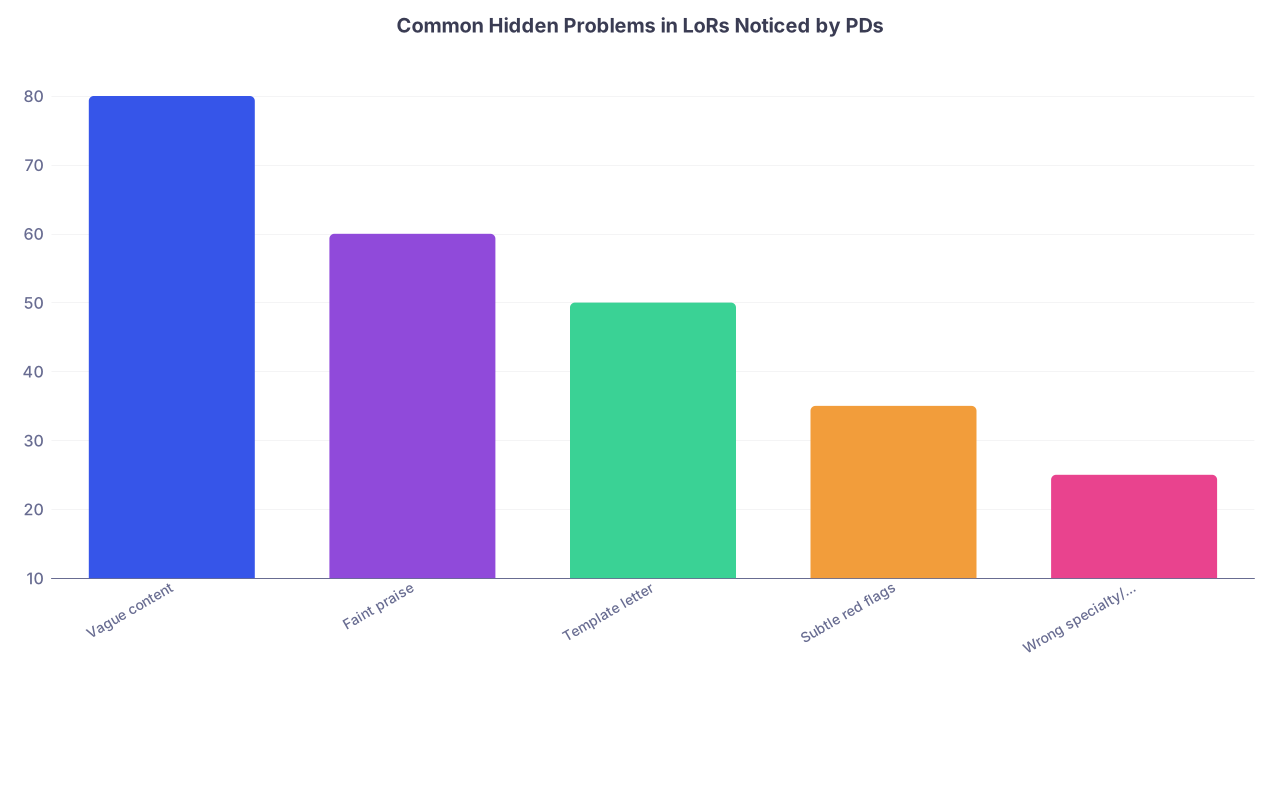
| Category | Value |
|---|---|
| Vague content | 80 |
| Faint praise | 60 |
| Template letter | 50 |
| Subtle red flags | 35 |
| Wrong specialty/details | 25 |
4. The “Polite Red Flag” Letter
Almost no one writes, “Do not take this applicant.” The risk to the writer is too high.
Instead, they write like this:
“At times, [Name] required close supervision but was receptive to feedback.”
“With continued development of their organizational skills, they will be an effective resident.”
“On occasion, [Name] struggled with time management but showed improvement over the course of the rotation.”
“While there were some interpersonal challenges on the team, [Name] worked through them.”
PD translation: You had issues. Enough that the writer felt they needed to mention them in a one-page document meant to sell you.
I have seen strong applications completely blocked by a single line like that. The room goes quiet, someone says, “Yeah, that’s concerning,” and you’re done.
Why One Bad Letter Matters So Much More Than You Think
You’re probably asking: “If the rest of my file is great, won’t they overlook one mediocre letter?”
No. Not usually. And here’s why.
Programs Are Screening For Risk, Not Just Talent
Everyone applying looks “talented” on paper. The game at the PD level is: who is least likely to become a problem?
Residents who are unsafe. Unreliable. Maverick. Toxic to team culture. Those are the nightmares that get PDs called into the chair’s office.
A single letter that hints at reliability issues, borderline professionalism, or just “not impressive” is enough to trigger that risk-avoidance instinct.
So if your file is:
- Good-but-not-stellar scores
- Some research
- Decent MSPE
- And then: one lukewarm or sloppy LoR
It is far easier for them to move to the next person with equally good numbers and no questionable letter.
Letters Are Their Only “Unfiltered” View
Everything else in your application has either been:
- Polished by you
- Massaged by your dean’s office
- Standardized to the point of uselessness (core clerkship grades, MSPE boilerplate)
Letters are supposed to be the unfiltered commentary from people who actually worked with you.
So when that piece of the puzzle is underwhelming, PDs assume the writer is telling them something real—especially if that writer is from a home department they know or another reputable program.
I’ve literally heard: “If their own medicine department couldn’t say something strong, I’m not taking the risk.”

How Sloppy Letters Happen (Even From People Who ‘Like’ You)
Students always say, “But they told me they’d write a strong letter.” Sure. They probably believed they would. Reality is uglier.
Here’s how bad letters get created behind the scenes.
1. The “Too Busy to Care” Attending
Big-name faculty, division chiefs, PDs. They mean well. They agree in the hallway while rushing between cases. Then what?
- They forget who you are by the time they sit down
- They tell their admin, “Pull me a template”
- They reuse last year’s letter for some other student with minimal edits
Final product: vague, error-prone, full of generic clichés.
They’re not out to sabotage you. They just did not invest the time required to create a letter that actually helps.
2. The “Neutral but Not Impressed” Evaluator
This is the attending who worked with you, thought you were fine, but not memorable.
When you ask, “Can you write me a strong letter?” they feel awkward saying no. Almost no one wants that confrontation.
So they say yes.
Then they sit down and try to write something “supportive” without lying. That’s how you get:
“Met expectations for level of training.”
“Given adequate supervision, I anticipate they will perform well.”
They think they’re being nice. PDs read it as, “This person was average, maybe slightly concerning.”
3. The Intern or Fellow Ghostwriter
In plenty of places, overworked faculty send this email to their fellow or chief:
“Draft letter for Student X, I’ll edit and sign.”
Sometimes the ghostwriter knows you well and writes a detailed, specific letter. Great.
Sometimes they barely remember you, have 30 other things to do, and bang out five bland paragraphs in 15 minutes.
Faculty skims it, changes a couple of adjectives, signs. That letter now carries their name and reputation—PDs trust it. You never find out the fellow who barely remembered you wrote 90% of the content.
4. The “I Have Concerns But I’m Conflict-Avoidant” Attending
This one is the silent killer.
The attending did not think you were terrible… but had real concerns. About judgment. Professionalism. Ownership.
They don’t want to crush your career, and they definitely don’t want a student complaint or a dean calling them. So when you ask for a letter, they rationalize:
“I’ll just be honest but not too harsh.”
That’s where all the “with further development,” “at times,” “occasionally struggled” phrases come from.
On a PD’s screen, those words flash like warning lights.
How PDs Read A Set of Letters (And Spot the Outlier)
Let me walk you into a real scenario.
Applicant A, applying to IM:
Letter 1 (Sub-I at away program):
“Top 5% of students I’ve worked with in the last 10 years. Ran the team like an intern. Patients loved him. I would be thrilled to have him as a resident.”Letter 2 (Home IM faculty):
“Met expectations for their level of training. Interacted well with staff. With continued development of their clinical reasoning, I expect they will succeed as a resident.”Letter 3 (Research PI):
Long, very strong, specific.
On paper, you might think: 2 strong, 1 neutral = net positive.
What PDs actually say in ranking meetings:
“Why did his home IM letter sound so lukewarm if he’s really this good? Did something happen on that rotation?”
At that moment, you’re no longer “safe.” You’re a “question mark.” And when they have 800 applications and 120 interview spots, guess how often question marks make the cut.
| Letter Pattern | PD Interpretation |
|---|---|
| All strong, specific | Safe, likely interview |
| 2 strong, 1 vague | Mild concern, context needed |
| 1 strong, 2 vague | Risky, probably pass |
| Any letter with subtle red flag phrase | High risk, often reject |
| One sloppy/wrong-specialty letter | Doubt about support/effort |
How To Avoid Getting Crushed By One Bad Letter
You cannot control everything. But you can dramatically reduce your odds of ending up with a silent torpedo in your file.
1. Ask The Right Question, The Right Way
Stop asking, “Can you write me a letter?” Start asking:
“Would you feel comfortable writing me a strong letter of recommendation for [specialty]?”
Then watch their reaction. Not just the words.
If there’s even a half-second of hesitation, if they say anything like “Sure, I can write you a letter” (without the word “strong”), you should hear alarm bells.
The honest attendings will tell you directly: “I can write a letter, but I’m not sure I’m the best person for a strong one.” Believe them. Do not push.
2. Choose Observers, Not Titles
Everyone chases the “big name”: department chair, famous researcher, PD. That’s how they end up with shallow template letters.
The hierarchies PDs actually respect:
- A detailed letter from someone who supervised you closely and clearly knows you well
beats - A generic letter from a nationally-known name who barely remembers you
If you have to choose between the attending who saw you on your Sub-I day in, day out vs the department celebrity you scrubbed with once… go with the person who can actually write a story about you.
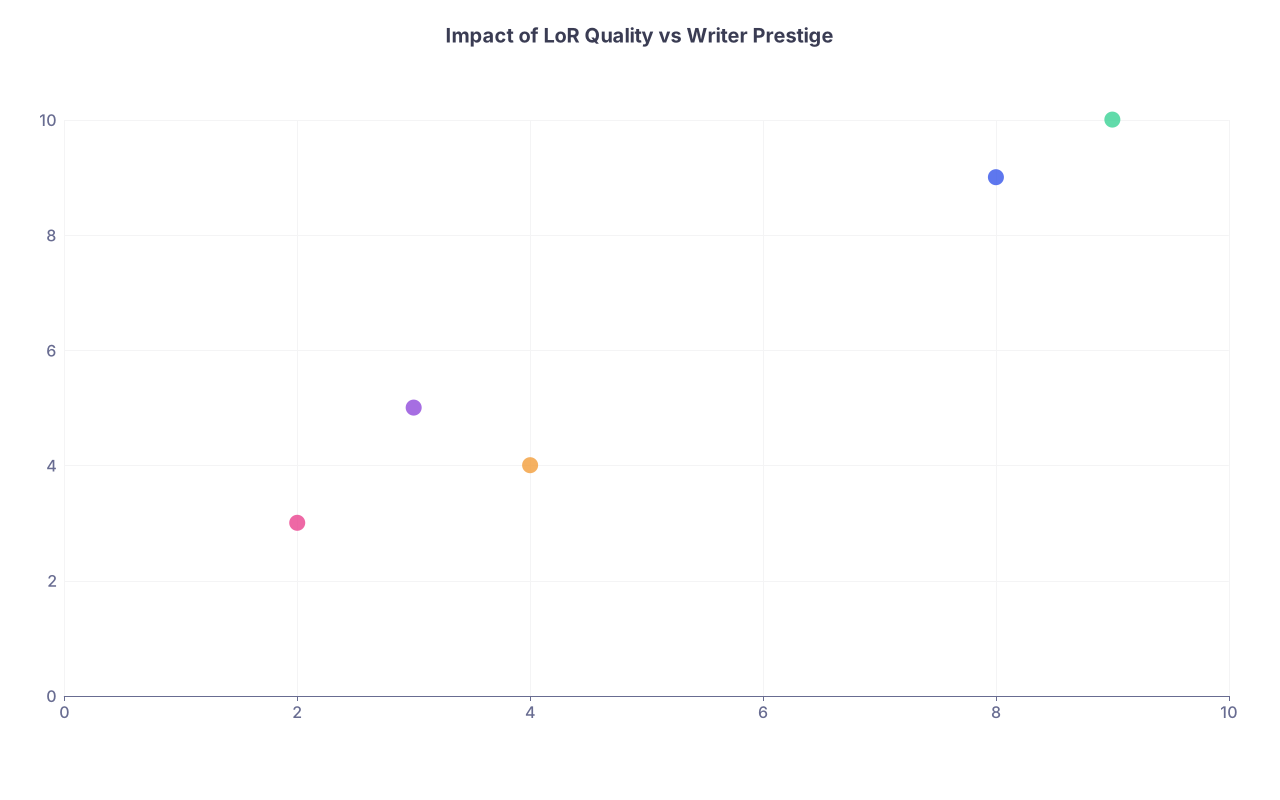
| Category | Value |
|---|---|
| High-detail, mid-name | 8,9 |
| Generic, big-name | 3,5 |
| High-detail, big-name | 9,10 |
| Generic, mid-name | 4,4 |
| Weak, big-name | 2,3 |
(Think of x-axis as “letter detail/strength” and y-axis as “PD perceived impact” — detail wins.)
3. Give Them What They Need To Write Well
This does not guarantee a great letter, but it reduces the chance of a lazy one.
When they agree to write, send:
- Your CV
- Your personal statement draft
- A short “reminder” paragraph with: when you worked together, on what service, key cases or projects you did with them
Not a novel. One tight page max.
Why it matters: The easier you make their job, the more likely they are to include specifics instead of generic fluff. And specifics read as authenticity to PDs.
4. Be Strategic About Core vs Specialty Letters
Certain specialties care heavily about certain types of letters:
- IM, peds, FM: strong medicine letters are almost non-negotiable
- Surgery: at least one strong surgical letter, ideally from someone who saw you in the OR and on the wards
- EM: SLOEs basically run the show
- Competitive fields (derm, ortho, ENT): letters from known people in the field carry serious weight—but only if they’re actually strong
Don’t fill your LoR slots with random “nice” letters from unrelated experiences if it means bumping a solid, concrete clinical letter.
I’ve watched PDs in medicine say: “They have no strong IM letter. That worries me more than their Step score.”
Hard Truth: You’ll Never See The Letter, But You’ll Live With It
The most frustrating part for you is the opacity. FERPA or not, in most med schools the culture is: you waive your right to see letters, and nobody tells you if one of them was weak.
Behind closed doors, though, PDs are absolutely weighing those letters as heavily as any other part of your file, especially once you’re past basic score cutoffs.
So you have to play this game at the front end, before the letters exist.
Ask direct questions. Choose writers who actually know you. Prefer detail over prestige. And understand that “sloppy” is not neutral; it’s interpreted as a lack of real support.

| Step | Description |
|---|---|
| Step 1 | Choose LoR Writer |
| Step 2 | Ask for STRONG letter |
| Step 3 | Find better observer |
| Step 4 | Provide CV + summary |
| Step 5 | Letter Written |
| Step 6 | Increased application risk |
| Step 7 | LoR supports strong file |
| Step 8 | Did they work closely with you? |
| Step 9 | Hesitation or vague yes? |
| Step 10 | Vague/generic or sloppy? |