
You are three weeks from your ERAS certification date. You are staring at your Letters of Recommendation section. Three names listed. One letter in. Two “Not Started.” You refresh the page like that will somehow push your attendings to write faster.
You are asking the right question: How do you nudge them without sounding rude, desperate, or unprofessional?
Here is the fix. A clear protocol, exact email scripts, and what to do if they still do not send the letter.
Step 1: Get Your Timeline Straight (So You Do Not Sound Clueless)
Before you nudge anyone, you need to know your actual deadlines. “ASAP” is not a deadline.
There are three different clocks you should care about:

The three timelines that matter
ERAS Opening vs. Certification
- ERAS opens: You can start your application and assign letter writers.
- ERAS certification date: When you lock and send your application to programs.
- Programs see your app starting on/after that certification date. Letters can arrive after, but earlier is better.
Program “Deadline” vs. Reality
- Many programs list an “application deadline” (e.g., October 1).
- Reality: Competitive programs heavily review apps in the first 1–3 weeks after ERAS opens.
- Late letters do not automatically kill you, but they can delay your file being marked “complete.”
Your Personal “Nudge” Timeline
- Initial ask: 6–8 weeks before you want the letter submitted.
- First reminder: 2–3 weeks after the initial ask (or 3–4 weeks before you need it).
- Second reminder: 10–14 days before you need it.
- Final “I need a decision” message: 5–7 days before you must pivot to another writer.
If you are under 2 weeks from certification and still missing letters, you are now in damage-control mode. You need to be efficient and very clear.
Step 2: Diagnose the Situation (Not All Late Letters Are Equal)
Do not send the same email to everyone. Different problems need different nudges.
Ask yourself three questions for each letter writer:
How long ago did you ask them?
- Less than 2 weeks: This is early reminder territory.
- 2–6 weeks: Normal reminder.
- More than 6 weeks: You need a firmer, yet respectful, nudge.
What did they say when you asked?
- Strong yes: “I’d be happy to write you a strong letter.”
→ You can be more direct; they already committed. - Vague yes: “Sure, I can probably do that.”
→ You need to re-confirm their ability. - No clear answer / verbal only:
→ Treat this as a partial or weak commitment.
- Strong yes: “I’d be happy to write you a strong letter.”
What is your risk level if this letter never comes?
- Low risk: You already have 3 solid letters, and this is a “bonus.”
- Moderate risk: You have 2 letters, this is the third you want.
- High risk: This is your “home” letter or your only specialty-specific letter (e.g., your only EM SLOE, only surgery letter).
High-risk letters justify earlier and firmer follow-up, and, frankly, faster backup planning.
Step 3: The Professional Nudge Script That Works
Here is what you wanted: the nudge email.
I will give you three core scripts:
- Standard reminder (most common)
- Time-is-tight reminder
- “I need to know if you can still do this” reminder
You can copy–paste these and tweak them.
3.1 Standard Reminder (Polite, Clear, Low Drama)
Use this 2–3 weeks after your initial request, or ~3–4 weeks before you need the letter.
Subject lines that actually get opened:
- “ERAS Letter of Recommendation – Brief Reminder”
- “Residency LOR Reminder – [Your Name]”
- “Follow-up on Residency Letter – [Your Name]”
Script:
Dear Dr. [Last Name],
I hope you are doing well. I wanted to briefly follow up regarding the letter of recommendation for my residency applications that you kindly agreed to submit.
I plan to certify and submit my ERAS application on [date], and programs will begin reviewing applications soon after. If you are still able to write the letter, ERAS has you listed under my Letter Writers section, and you should have received an email with upload instructions from ERAS.
I have attached my updated CV and personal statement for your reference, as well as a list of the programs and specialties I am applying to. Please let me know if any additional information would be helpful.
Thank you again for your support and for taking the time to assist with my application.
Sincerely,
[Your Name], MS4
[School]
AAMC ID: [ID Number]
Why this works:
- You acknowledge they already agreed.
- You give them a date.
- You make it easy (reminding them ERAS already emailed them, and you attach materials).
- You stay respectful.
3.2 Time-Is-Tight Reminder (Deadlines Are Close)
Use this when you are within 10–14 days of your desired date, or you have already sent one reminder.
Subject:
- “Time-Sensitive: ERAS Letter of Recommendation – [Your Name]”
- “ERAS LOR – Approaching Deadline for [Your Name]”
Script:
Dear Dr. [Last Name],
I hope your week is going well. I wanted to send a quick, time-sensitive reminder about my residency letter of recommendation.
I plan to certify and submit my ERAS application on [date], and many of the programs I am applying to begin reviewing applications shortly after that. Having your letter included would be extremely helpful.
ERAS should have sent you a link to upload the letter directly. If it would be useful, I am happy to resend the ERAS request or provide any additional information such as my CV, personal statement, or a brief summary of my work with you.
I truly appreciate your time and support. Please let me know if you anticipate any difficulty submitting the letter by [soft deadline date – a few days before your real target].
Best regards,
[Your Name], MS4
[School]
AAMC ID: [ID Number]
Notice one key line:
“Please let me know if you anticipate any difficulty submitting the letter by [date].”
This gives them an easy out instead of ghosting you.
3.3 “I Need to Know If You Can Still Do This” Reminder
Use this if:
- You are 5–7 days from your hard internal deadline.
- You have already sent at least one reminder.
- This letter is important to your application.
Subject:
- “Urgent: ERAS LOR Confirmation – [Your Name]”
- “Quick Confirmation Needed – Residency LOR for [Your Name]”
Script:
Dear Dr. [Last Name],
I hope you are doing well. I wanted to follow up once more regarding the residency letter of recommendation I requested for my ERAS application.
I plan to certify and submit my application on [date], and I am finalizing my materials this week. I completely understand how busy this time of year can be, so I wanted to check whether you are still able to submit a letter on my behalf.
If your schedule no longer allows for this, I completely understand and would be grateful if you could let me know. That will allow me to make alternative arrangements without putting additional pressure on your schedule.
Thank you again for your time and for the opportunity to work with you on [rotation/clinic/service].
Sincerely,
[Your Name], MS4
[School]
AAMC ID: [ID Number]
You are doing three things here:
- Preserving the relationship.
- Creating a clear decision moment.
- Giving yourself permission to move on.
Step 4: What to Attach and Include (Make It Frictionless)
If you want a busy attending to complete a task, remove as much friction as possible.
Here is what you should provide with your reminder emails:
- Updated CV (PDF, labeled clearly:
Lastname_Firstname_CV_2025) - Personal statement draft (especially for the specialty they are writing for)
- ERAS ID and specialty/track you are applying into
- A short “reminder blurb” about your time with them:
- Rotation name and dates
- Specific cases or responsibilities that stood out
- Anything they commented positively on
Example of a short “reminder blurb” you can paste below your signature:
Brief summary for your reference:
- Rotation: Internal Medicine Sub-I, [Hospital], [Dates]
- Typical responsibilities: Pre-rounding on 4–6 patients, presenting on rounds, writing daily notes, cross-covering overnight with senior resident.
- Representative cases: Managed DKA admission with step-wise insulin transition; participated in goals-of-care discussion for patient with advanced CHF.
- Feedback: You mentioned you appreciated my organization and follow-up on complex discharges.
Most attendings will not use this verbatim. But it jogs their memory and saves them time. They appreciate that.
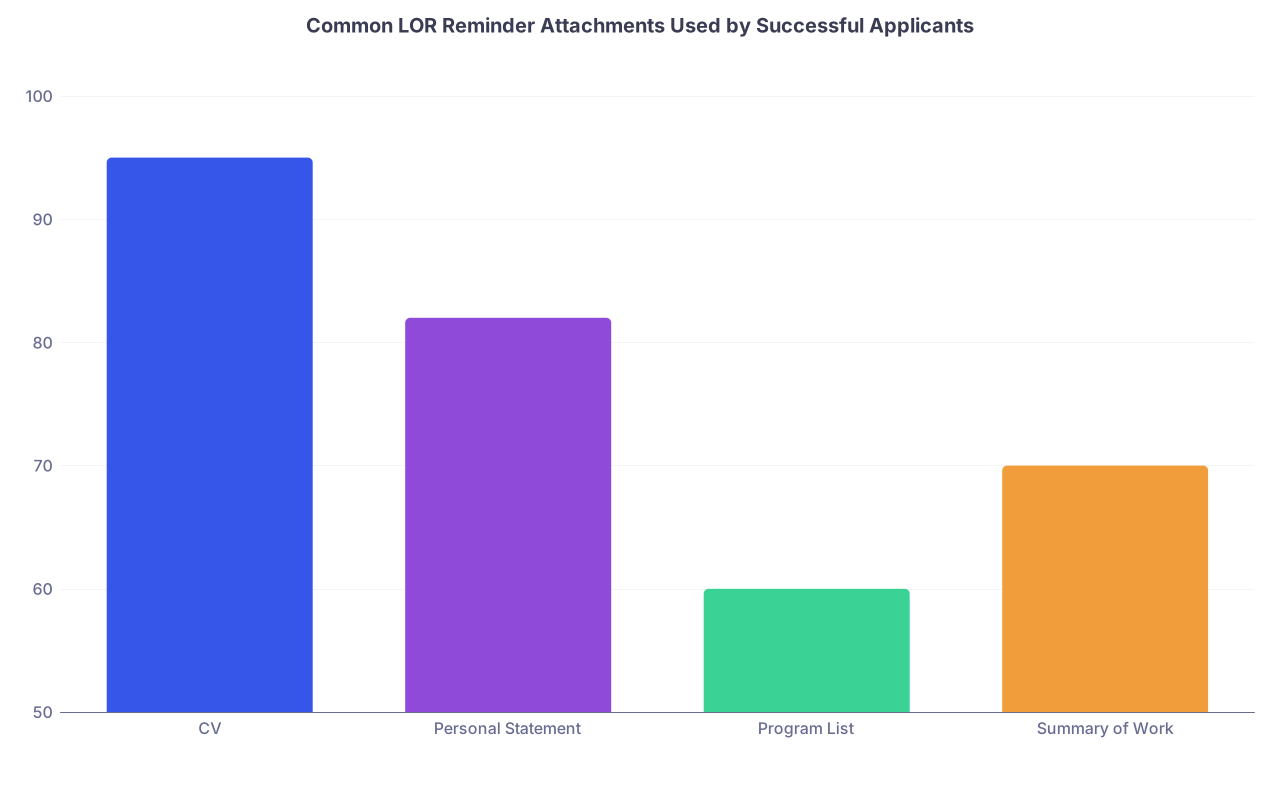
| Category | Value |
|---|---|
| CV | 95 |
| Personal Statement | 82 |
| Program List | 60 |
| Summary of Work | 70 |
Step 5: Escalation Protocol – When They Still Do Not Send It
Sometimes the letter just is not coming. Not because they hate you. Because they are buried, disorganized, or overcommitted.
Here is the stepwise approach I have seen work best.
5.1 Check the basics
Before you assume the worst:
- Confirm ERAS shows them as “Not Started” and not “Uploaded but not assigned.”
- Verify their email is correct in ERAS.
- Check your spam for ERAS system messages about failed delivery.
If in doubt, re-send the ERAS LOR request and mention that in your reminder email: “ERAS occasionally has delivery issues, so I have re-sent the letter request through the system today in case the original email did not reach you.”
5.2 Decide when to pivot
Set a clear internal cutoff. For most people:
- 3–5 days before your ERAS certification date: You must decide whether to move on.
- If this is your only letter in a required category (e.g., EM SLOE): Start lining up a backup even earlier.
Harsh truth: An on-time, “solid” letter from someone who actually submits is better than a theoretically “amazing” letter that never arrives.
5.3 How to ask for a backup letter on short notice
You will probably need someone who:
- Knows you decently well.
- Has a reputation for being responsive.
- Ideally has already written letters for others.
Typical options:
- Clerkship director
- Sub-I attending
- Research mentor
- Longitudinal clinic preceptor
Subject:
- “Time-Sensitive LOR Request for ERAS – [Your Name]”
- “Short-Notice Request – ERAS Letter of Recommendation”
Script:
Dear Dr. [Last Name],
I hope you are doing well. I am writing with a time-sensitive request regarding my residency application.
I am applying to [specialty] this cycle, and I am finalizing my ERAS application to certify on [date]. One of my previously planned letters of recommendation has been delayed, and I am concerned it may not be submitted in time.
Given our work together on [rotation/research/clinic] and your familiarity with my clinical performance, I was wondering if you might be willing and able to write a letter of recommendation for me on short notice. I recognize this is a significant request and completely understand if your schedule does not allow for it.
If you are able to help, I can send my CV, personal statement, ERAS ID, and a brief summary of my work with you immediately. I would be grateful for any support you can provide.
Thank you for considering this, and for your mentorship during my training.
Sincerely,
[Your Name], MS4
[School]
AAMC ID: [ID Number]
If they say yes, you send:
- CV
- Personal statement
- ERAS instructions
- Specific bullet points they can reference
Step 6: What If the Letter Arrives After You Submit?
You certified your ERAS application with only 2 of 3 letters in. The late attending finally uploads the third letter a week later.
Is it useless? No.
ERAS lets you:
- Assign letters to programs after submission.
- Programs see new letters when they refresh your file.
Will programs re-review your application the moment a new letter hits? Not always. But:
- Some do.
- Many will glance at new documents before offering interviews, especially early in the season.
Strategy:
- As soon as the letter appears, assign it to all relevant programs.
- No need to email every program obsessively; you will come off as high-maintenance.
- If it is a truly high-impact letter (e.g., department chair, big-name mentor), and it arrived significantly late, you can selectively email a few top-choice programs with a short note.
Example selective program email:
Dear [Program Coordinator/Program Director Dr. X],
I hope you are well. I am an applicant to your [specialty] residency program for this cycle (AAMC ID: [ID]). I wanted to share that an additional letter of recommendation from [Dr. Name, role] has now been uploaded to my ERAS application and assigned to your program.
I am very interested in [Program Name] given [1 specific, genuine reason], and I appreciate your time in reviewing my application.
Sincerely,
[Your Name]
Short. Respectful. No begging.

Step 7: Common Mistakes With Late LORs (And How To Avoid Them)
You are in the “Common Mistakes in Residency Applications” category, so let us be blunt.
Here are the big errors I see over and over:
| Mistake | Better Approach |
|---|---|
| Asking only 2 writers total | Ask 4–5, plan for 3–4 to come through |
| No clear deadline in the ask | Give a specific target date and context |
| Waiting until last week to follow up | First reminder 2–3 weeks after ask |
| Emotional or passive-aggressive emails | Polite, concise, deadline-focused |
| Relying on 1 “star” letter only | Diversify with multiple reliable writers |
The ones that hurt the most
Relying on one superstar, unreliable writer
- The big-name, world-famous department chair who never answers email.
- Nice to have. Terrible to rely on. Always have another solid, dependable writer.
Vague asks
- “Would you maybe be able to write something if you have time?”
That is not a real request. That is giving them an escape hatch.
- “Would you maybe be able to write something if you have time?”
-
- You must assume at least one letter will be delayed or never appear. Especially in big academic centers.
Getting emotional in writing
- You are stressed. I get it. But sending a guilt-trippy email (“I really need this or my career is over”) makes you look unprofessional.
- Keep your stress out of the email. Vent elsewhere.
Step 8: What You Should Say When You First Ask (To Prevent “Late” in the First Place)
A lot of this drama starts with a weak initial ask.
Here is the template you should use when you first ask for a letter, ideally near the end of a strong rotation.
In person or via email:
Dr. [Last Name], I have really appreciated working with you on [rotation]. I am applying to [specialty] this year and plan to submit my ERAS application around [date].
Would you feel comfortable writing a strong letter of recommendation on my behalf?
If they say yes, follow with:
Thank you very much. ERAS opens [date], and I am aiming to certify my application by [date]. Would you prefer I send you my CV and personal statement now, and I will also enter your name into ERAS so that you receive the upload link?
Notice:
- You explicitly ask for a strong letter. This gives them a chance to decline if they cannot support you.
- You give them timing and logistics up front.
Step 9: Handling This Without Burning Bridges
Last piece: the relationship.
You are going to see these people again. Some will sit on fellowship committees or job interview panels. So you have to walk the line: firm about what you need, respectful of their time.
Key rules:
- Never accuse. Use “I” language and neutral phrasing.
- Always express appreciation, even if the letter never arrives.
- If you pivot to another writer, you do not need to send a breakup email. Just move on.
- If they eventually send a letter (even late), send a brief thank-you note.
Example thank-you after confirmation that they uploaded:
Dear Dr. [Last Name],
Thank you very much for taking the time to write and submit a letter of recommendation on my behalf. I appreciate your support and the opportunity to have worked with you on [rotation/clinic/research].
I will keep you updated regarding my match results.
Sincerely,
[Your Name]
That is how you keep doors open.

| Step | Description |
|---|---|
| Step 1 | Ask for Letter 6-8 weeks before |
| Step 2 | Wait 2-3 weeks |
| Step 3 | Assign to Programs |
| Step 4 | Send Standard Reminder |
| Step 5 | Wait 1-2 weeks |
| Step 6 | Send Time-Is-Tight Reminder |
| Step 7 | Wait up to 1 week |
| Step 8 | Send Confirm/Decline Email & Ask Backup Writer |
| Step 9 | Letter Uploaded? |
| Step 10 | Letter Uploaded? |
| Step 11 | Still No Letter? |
FAQ (Exactly 4 Questions)
1. Is it acceptable to submit ERAS with fewer than 3 letters and let the rest arrive later?
Yes. Programs can see new letters as they are uploaded and assigned. Having 2 strong letters on time is better than holding your entire application because you are waiting for a third. For most core specialties, 3–4 total letters is ideal, but they do not all need to be present on day one. Just make a serious effort to get at least 2–3 in early, then assign the rest as they arrive.
2. How often is too often to remind a letter writer?
Once every 1–2 weeks is appropriate, with increasing specificity about timing as you approach your certification date. Daily or every other day is excessive and will annoy them. A good sequence: initial ask → 2–3 weeks later standard reminder → 10–14 days before your target, time-sensitive reminder → 5–7 days before, confirmation/decline email. If they do not respond after that, pivot.
3. Does it hurt my chances if a letter is dated after I submitted my application?
No. Many letters are written and uploaded after ERAS opens. Program faculty know this. What hurts your chances more is never having the letter or having too few total. The date on the letter is far less important than the content and timeliness relative to interview review periods.
4. Should I tell programs if a specific letter is delayed or missing?
Usually no. Programs are flooded with email and do not want detailed explanations about your letters. The only exception: if a very important letter (e.g., departmental chair, required SLOE) arrives significantly later and you are particularly interested in that program, a brief, single email notifying them that an additional letter has been uploaded is reasonable. Keep it to 2–3 sentences and do not sound apologetic or dramatic.
Open your email right now and write a single, clear reminder to the one letter writer you are most worried about. Use the “Time-Is-Tight” script, plug in your actual certification date, attach your CV and personal statement, and send it. You fix this one step at a time.