It is late January. You just uploaded your CV into ERAS to “get ahead.” You scroll through it and feel that familiar sinking feeling: it is long, cluttered, and somehow says nothing clear about who you are as a physician. Shadowing. Random volunteering. Research that goes nowhere. A couple of leadership things. It looks like 200 other applications you have seen.
Here is the problem: residency programs are not reading your CV looking for “everything you have ever done.” They are scanning for one thing:
A believable, coherent story about what kind of resident you will be.
If your CV is unfocused, it is not because you lack experiences. It is because the experiences are not organized around a narrative.
I am going to give you a system. Not vibes. Not “be authentic” nonsense. A concrete, repeatable process to:
- Strip your CV down to the essentials
- Identify the narrative that fits your real record
- Rebuild the experience section so every line pushes that story
You can do this in a weekend if you are ruthless.
Step 1: Stop Thinking “List” and Start Thinking “Story”
Most applicants treat the CV as a chronological dump:
- Whatever they did
- In the order they did it
- With inflated verbs
That is exactly how you end up with an unfocused document.
Programs are skimming and doing pattern recognition:
- Is this person research-heavy?
- Are they a teacher/educator?
- Systems/improvement oriented?
- Community health / advocacy?
- Leadership / administration?
They do not need one of these. They want to see a pattern that feels intentional.
So first mental shift:
Your CV is not a list of what you did. It is evidence supporting a claim about who you are as a junior physician.
The “Claim Sentence” Exercise
Before you touch a single bullet point, write one sentence:
“I am a __________ -focused future [specialty] physician who brings __________ and __________ to a residency program.”
Examples:
- “I am a systems- and QI-focused future IM physician who brings data-driven problem solving and team leadership to a residency program.”
- “I am a community-oriented future pediatrician who brings long-term patient relationships and bilingual communication skills to a residency program.”
- “I am a research-driven future neurologist who brings hypothesis-driven thinking and experience moving projects to publication to a residency program.”
If you cannot write that sentence convincingly for yourself, you are not ready to edit your CV.
You are going to use this sentence as a filter for every experience:
- Does this support or weaken that claim?
- Or is it just “stuff I did”?
Anything that does not help the claim either:
- Gets cut, or
- Gets demoted (shorter, fewer bullets, moved down)
Step 2: Audit What You Have (Brutally)
Print your current CV or dump your experiences into a doc. One line per experience. No bullets yet. Just:
- Title / Role
- Organization
- Dates
- 1-sentence description (even rough is fine)
Now you are going to categorize them.
The 5 Buckets System
Take a highlighter and sort every experience into one primary bucket:
Clinical / Patient-Facing
- Free clinics
- Student-run clinics
- Longitudinal preceptorships
- Medical mission trips (if legit, not tourism)
Research / Scholarly Work
- Bench, clinical, QI, educational research
- Posters, abstracts, publications
Teaching / Education
- TA roles
- Peer tutoring
- Curriculum development
- OSCE coaching
Leadership / Administration
- Committee roles
- Student government
- Organization president
- Project lead roles
Service / Community / “Other”
- Non-clinical volunteering
- Jobs
- Athletics, arts, hobbies (selectively)
Do not overthink it. Just put each thing where it mostly belongs.
Now, count. Where are your clusters?
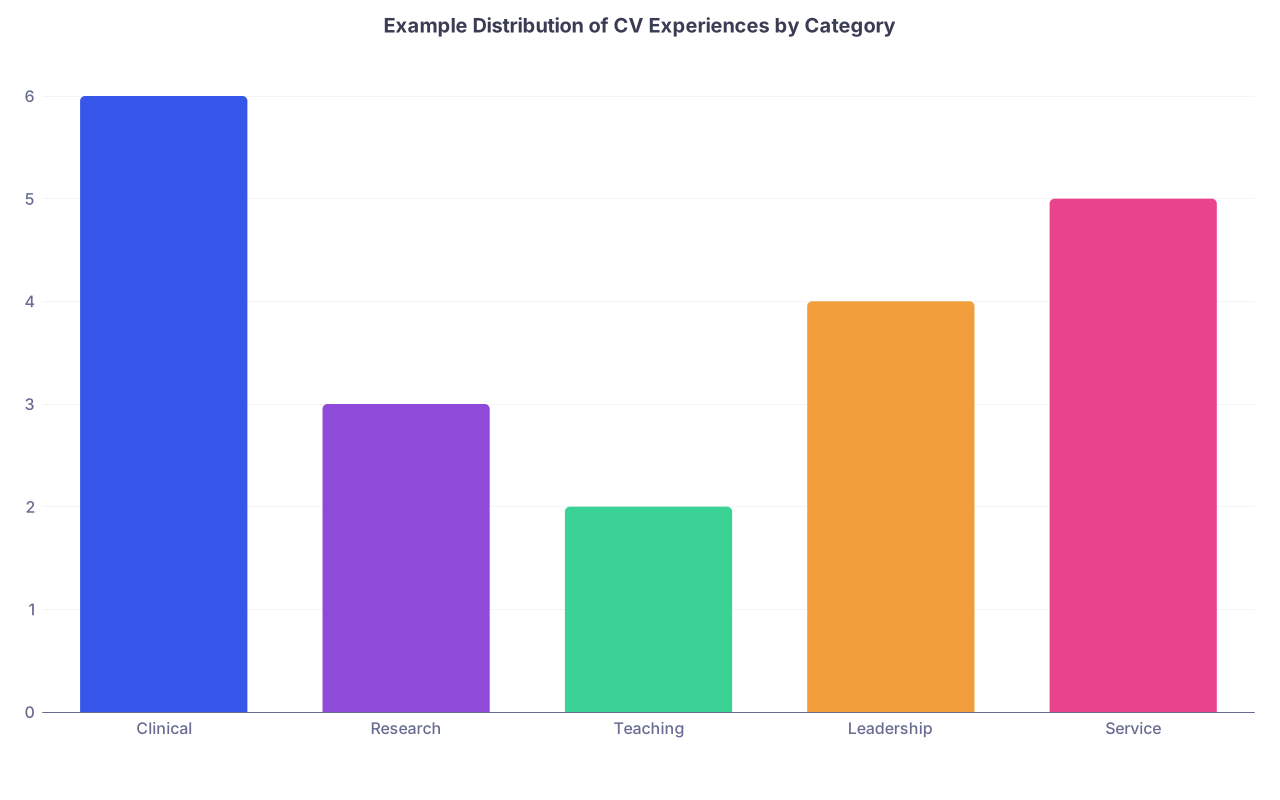
| Category | Value |
|---|---|
| Clinical | 6 |
| Research | 3 |
| Teaching | 2 |
| Leadership | 4 |
| Service | 5 |
This simple distribution tells you:
- What your record already emphasizes
- Where your emerging “angle” probably is (or should be)
- Where you are thin and should not pretend to be “that person”
If 60% of your experiences are research and you are trying to sell yourself as “deeply committed to primary care in underserved communities” with one free clinic stint… that will look fake.
Do not sell a story your CV cannot back up. You will get caught in interviews.
Step 3: Choose a Narrative Spine That Matches Reality
Based on your buckets, pick 1–2 “spines” your CV will revolve around. Not more.
Some common, legitimate spines:
- Research-forward applicant
- Community / primary care / continuity of care
- Systems / QI / operations
- Education / teaching
- Leadership / advocacy / policy
And these overlay on your specialty choice:
- Psych + community / severe mental illness advocacy
- Surgery + QI / efficiency, OR flow, safety
- EM + operations / systems / prehospital care
- OB/GYN + women’s health advocacy
Quick Reality Check
Ask yourself three questions:
- Where have I spent the most actual time?
- Where have I taken on increasing responsibility?
- Where do I have at least one concrete result (publication, program created, measurable impact)?
Your spine has to pass all three. If it does not, pick a different one.
If your distribution is even and messy (2–3 things in every bucket), you can still build a narrative, but you will frame it as:
- “Broadly engaged but with a lean toward X”
- Then spotlight X with your strongest experiences
Step 4: Rank, Cut, and Consolidate Experiences
Now you are going to ruthlessly reorganize.
A. Rank within each bucket
Within each category, assign a rank:
- A-tier: Strongest, deepest, most impactful
- B-tier: Decent, but not central to your story
- C-tier: Filler, minor, or redundant
A-tier typically has:
- Longer duration (≥ 6–12 months)
- Leadership or ownership
- Clear outcomes (posters, curriculum written, clinic expanded)
C-tier is:
- 1-day events
- Purely observational
- “Member” of 5 clubs, did nothing specific
B. Decide what actually belongs on the CV
Hard rule: More is not better. Clear is better.
You do not need:
- 5 separate “premed volunteer” positions from college
- Every single poster presentation separately if they are the same project
- 8 committees where you were just a name on an email list
You should:
- Combine similar low-yield roles
- Drop anything that adds no new information about who you are now
Example consolidation:
Instead of:
- Volunteer, Hospital X front desk
- Volunteer, Hospital X patient transport
- Volunteer, Hospital X book cart
Use:
- Volunteer, Hospital X – Patient Support Roles (3 positions combined under one heading with one or two smart bullets)
C. Align the order with your narrative spine
Within each major ERAS section (work, research, volunteer), order your experiences like this:
- A-tier experiences that support your spine
- Other A-tier
- B-tier that still add dimension
- Optional: 1–2 C-tier if they cover a unique part of you (e.g., varsity athletics)
Stop thinking “chronological purity”. The first thing they read should scream your narrative.
Step 5: Rewrite Bullets to Prove Your Story (Not List Tasks)
Clumsy CV bullets are all the same:
- “Responsible for…”
- “Worked with…”
- “Helped to…”
Programs skim those and forget you two seconds later.
You are going to write bullets that:
- Show action
- Show scale or scope
- Show impact
- Echo your narrative spine
The 3-Part Bullet Formula
Every bullet should answer:
- What did you do? (action)
- What was the scale/context?
- What changed because you did it? (impact)
Template:
Action verb + what you owned + how big / who with + with what measurable or concrete result.
Bad vs Better
Random volunteering:
- Bad: “Volunteered at student-run free clinic”
- Better (community/continuity spine):
“Coordinated longitudinal follow-up for ~40 uninsured patients in student-run free clinic, improving 3-month follow-up rate from 45% to 68% through reminder calls and appointment tracking.”
Research:
- Bad: “Worked on neurology research project, collected data”
- Better (research spine):
“Designed and executed retrospective chart review of 320 stroke admissions, identifying delayed thrombolysis patterns that informed protocol revision and abstract accepted at AAN annual meeting.”
Teaching:
- Bad: “Served as anatomy TA for first-year students”
- Better (education spine):
“Led weekly anatomy review sessions for 25 MS1s, incorporating low-fidelity simulations; session attendance correlated with 12% higher mean exam scores versus non-attenders.”
Notice the pattern: verbs, numbers, outcomes.
Mirror Your Narrative Language
Go back to your “claim sentence.” Pull key words and concepts and echo them (lightly) in your bullets.
If your claim is “systems- and QI-focused,” bullets should actually mention:
- Workflow redesign
- Protocols
- Efficiency metrics
- Error reduction
- Handoffs
- Throughput
Do not just say “quality improvement” with no evidence. Show it.
Step 6: Build a Coherent Structure That Feels Intentional
Now we rebuild the CV in a way that tells the story at a glance.
A. Decide what “type” of applicant you are showing
You can think in “profiles.” Here is an example table to make this concrete.
| Profile Type | Most Emphasized Buckets | Typical Spine Keywords |
|---|---|---|
| Research-Heavy IM | Research, Clinical, Leadership | Outcomes, publications, data |
| Community-Focused FM | Clinical, Service, Teaching | Continuity, underserved, longitudinal |
| QI/Systems EM | Clinical, Leadership, Research | Workflow, protocol, throughput |
| Educator-Peds | Teaching, Clinical, Leadership | Curriculum, mentorship, development |
| Advocacy-Psych | Service, Leadership, Clinical | Policy, stigma, outreach |
You are not picking a costume. You are picking the clearest reflection of what you have already done.
B. Within each ERAS section, impose a clear internal logic
For each major category (Work, Volunteer, Research, Teaching if separate), structure like this:
- Lead with the flagship experience that best expresses your spine
- Cluster related experiences together
- Move generic / filler to the bottom with minimal description
Example: Community-Focused FM Applicant – Volunteer Experiences
Street Medicine Outreach Team – Volunteer Coordinator
- 3 strong bullets (leadership, continuity, outcomes)
Student-Run Free Clinic – Care Coordinator
- 2–3 bullets (follow-up systems, underserved care)
Mobile Vaccination Clinics – Volunteer
- 1–2 bullets (scale, community reach)
Hospital Gift Shop Volunteer – Hospital X
- 1 short bullet or no bullet; just to show early sustained service
They can skim and see: “Oh, this person lives in the community/continuity space.”
C. Be consistent with style and tense
Sloppy CVs wobble:
- Mixed tenses
- Random capitalization
- Inconsistent bullet formats
You are not going to lose a spot over a comma, but you will look more serious if:
- Past experiences: past tense
- Ongoing roles: present tense
- Same verb style and structure across entries
Step 7: Tie CV, Personal Statement, and LoRs into One Narrative
An unfocused CV is often part of a deeper problem: every document tells a slightly different story.
You fix this by making your narrative spine the backbone of everything:
-
- 1–2 anchor experiences from your CV expanded into narrative
- Explicit connection of those experiences to residency and future goals
- Echo of key themes and even specific projects
-
- Choose letter writers who have seen you in the roles that match your spine
- Tell them directly: “I am emphasizing my X-focused work in Y; would you be comfortable commenting on that?”
-
- “Tell me about yourself” → hits the same 2–3 spine themes and experiences
If your CV screams “educator,” your PS is about your love for procedural specialties, and your letters focus on research grind… you look scattered.
Step 8: Common CV Mistakes That Kill Your Narrative (And How to Fix Them)
Let me be blunt about the usual offenders.
Mistake 1: Overweighting Premed Stuff
If you are at residency application time and half your CV is college:
- You look underdeveloped as a medical trainee
- It smells like you did not engage much in med school
Fix:
- Keep only premed experiences that are:
- Truly major (D1 athlete, Fulbright, major leadership)
- Directly reinforcing your current spine
Everything else: compress or delete.
Mistake 2: “Leadership” with No Actual Authority
“Member, leadership committee” means nothing if you did nothing.
Fix:
- If you keep a role, your bullets must show:
- Budgets
- People you supervised
- Decisions you owned
- Programs you initiated or significantly changed
If you cannot write that, demote that role and promote something else.
Mistake 3: Listing Every Research Poster Separately
You are not impressing anyone by spreading one project across six line items.
Fix:
- Group:
“Stroke Outcomes Project – Research Assistant / Co-Author”
Then in bullets include:- “Co-author on 2 posters (AAN 2023, ISC 2024) and 1 manuscript under review.”
Mistake 4: Inflated Language That Does Not Match Your Level
You were not “Directing clinical operations” as an MS2 in a free clinic. Reviewers know this.
Fix:
- Use strong but honest verbs:
- Coordinated
- Implemented
- Co-developed
- Led student team
- Streamlined workflow
They respect grounded, precise language more than obviously exaggerated titles.
Mistake 5: CV That Does Not Match What You Say in Interviews
This is where people get in trouble. They talk like they ran the hospital; their CV shows 3 hours/week volunteering.
Fix:
- Before interview season, read your own CV line by line.
- For each experience ask: “Could I talk about this for 3–5 minutes with specifics?”
- If not, trim or rephrase now.
Step 9: A Practical 2-Day Restructure Plan
If you are pressed for time, here is a simple Gantt-style overview to get it done in a weekend.
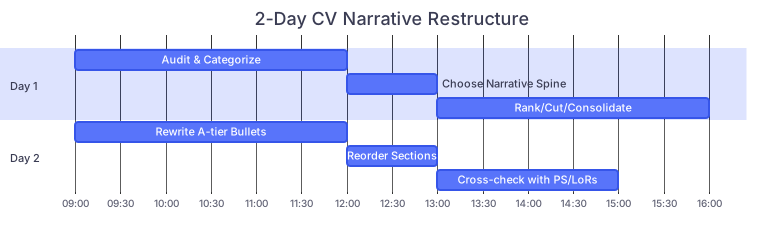
| Task | Details |
|---|---|
| dateFormat HH | mm |
| axisFormat %H | %M |
| Day 1: Audit & Categorize | a1, 09:00, 3h |
| Day 1: Choose Narrative Spine | a2, 12:00, 1h |
| Day 1: Rank/Cut/Consolidate | a3, 13:00, 3h |
| Day 2: Rewrite A-tier Bullets | b1, 09:00, 3h |
| Day 2: Reorder Sections | b2, 12:00, 1h |
| Day 2: Cross-check with PS/LoRs | b3, 13:00, 2h |
Day 1 is all about thinking and cutting.
Day 2 is rewriting and polishing.
Do not jump straight into editing bullets. You will just produce a more polished version of the same unfocused CV.
Step 10: Quick Example – From Messy to Narrative
Let me walk you through a stripped-down example.
Raw Experiences (Unstructured)
- Volunteer, Hospital gift shop (college)
- Shadowing, Orthopedic surgery
- Research assistant, cardiology lab (3 months)
- Student-run free clinic volunteer
- QI project on discharge summaries
- Peer tutor for MS1s (renal, cardio)
- Treasurer, Internal Medicine Interest Group
- Volunteer, homeless shelter meals
- Short-term global health trip, 1 week
- EM sub-I shift leader (informal peer role)
This is chaos as listed. No clear story.
Audit & Category Tally
- Clinical: free clinic, EM sub-I role, global health trip
- Research: cardiology lab, QI project
- Teaching: peer tutor
- Leadership: treasurer, EM sub-I informal leadership
- Service: gift shop, homeless shelter
Look closer:
- QI project + EM sub-I responsibility + discharge summaries = systems/operations angle
- Free clinic + homeless shelter = some community/continuity
- Research is short and weak (3 months, maybe no outputs)
So I would not sell this person as “research-focused.” That would be a lie.
Pick Spine
Spine: Systems- and communication-focused EM/IM applicant with strong interest in care transitions and underserved care.
Now re-rank:
- A-tier: QI discharge project, student-run free clinic, EM sub-I leadership, homeless shelter
- B-tier: peer tutor, IM interest group treasurer
- C-tier: cardiology research (short), gift shop, global trip (short duration)
Group, cut, and write bullets that prove that spine:
- QI project → metrics about discharge errors, handoff clarity
- Free clinic → continuity, follow-up systems
- EM sub-I → managing flow, communication with nurses, rapid sign-outs
- Homeless shelter → insight into barriers to follow-up at discharge
By the time a PD reads 30% of that CV, they already have the story:
“This person cares about transitions of care, high-functioning systems, and underserved patients.”
That is what you want.
Strategic Use of Visual Planning Tools (Optional)
If you are a visual planner, a quick chart of how much time you actually spent in each area can keep you honest.
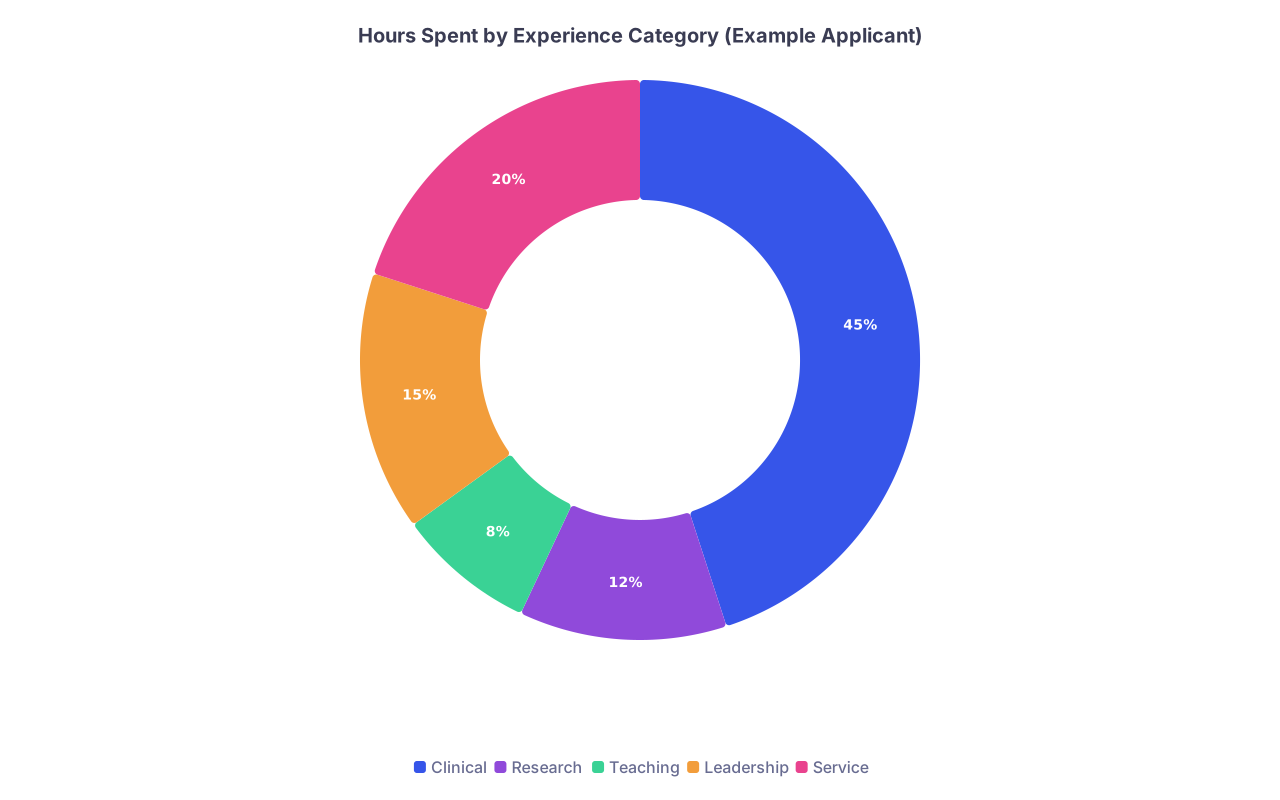
| Category | Value |
|---|---|
| Clinical | 450 |
| Research | 120 |
| Teaching | 80 |
| Leadership | 150 |
| Service | 200 |
If your doughnut looks 60% research and you are insisting on a “community-focused” story with 40 total hours in a free clinic, you know you are off.
And if you like mindmaps, sketching your narrative spine with branches for experiences can help:

This is overkill for some people, but if you are overwhelmed, a visual scaffold can make it concrete.
FAQ (Exactly 4 Questions)
1. Should I hide “weak” or short-term experiences completely?
Not necessarily. Keep them if they either:
- Fill a real gap (e.g., your only formal teaching experience), or
- Add a unique dimension (significant job, athletics, art, language)
But demote them: fewer bullets, lower position in the section, combined with similar roles. What you must not do is feature them as if they prove your core narrative.
2. How many total experiences is “too many” on a residency CV?
If your experiences are well-structured, 12–18 total across work, research, and volunteer is usually plenty. When people creep above 25, the CV almost always gets noisy and repetitive. Focus on depth: multi-year, progressive-responsibility roles beat five one-off activities in the same domain.
3. What if my experiences do not match the specialty I am applying to?
You do not need a “pure” specialty-matched CV, especially for less competitive fields. You do need an argument. Example: a student with lots of cardiology and some surgery exposure applying to anesthesiology can frame a spine around perioperative care, hemodynamics, and team-based acute care. Pull out the threads that make sense for the new field and emphasize those. Do not panic if you did not live in that department for two years.
4. Can I use different narratives for different specialties I apply to?
You can slightly adjust emphasis, but you cannot credibly maintain totally different personas in the same cycle. Programs will see through it. If you are applying to both IM and EM, for example, you might use one core spine (“acute care, systems, communication under pressure”) and lean slightly more inpatient/QI in IM applications and more resuscitation/flow in EM applications. Same core story, different angles—do not try to be a different person.
Key Takeaways
- Your CV must support a single, believable narrative spine, not act as a dumping ground.
- Choose that spine based on where you have actually invested time, responsibility, and produced outcomes.
- Rewrite and reorder every experience so that, when skimmed, your CV clearly answers: “What kind of resident will this person be, and why should we believe that?”