
The instinct to hide a weak experience on ERAS is usually wrong—but so is padding it with fluff.
Let me be blunt: a mediocre experience described well is better than a “meh” experience described in three vague lines. But some experiences are so trivial, irrelevant, or half‑baked that they should be left off entirely. The trick is knowing which is which.
This is where people screw it up. They either:
- List every shadowing hour and 2‑week club as if it were life‑changing, or
- Over‑prune and end up with an ERAS that looks oddly empty, raising more questions than it answers.
Here’s the real framework you should use.
The Core Question: Does This Experience Help My Story?
Forget “weak vs strong” as the first filter. Programs are not scoring each entry like an exam. They’re asking:
- Does this show maturity, responsibility, or growth?
- Does this explain how you’ve spent your time?
- Does it align with your stated interests or specialty?
- Does it support my belief that you’ll show up, do the work, and not be a headache?
If an experience—weak or strong—helps answer those questions, it probably belongs on ERAS. If it does not, you’re not “hiding” it by omitting it. You’re just editing.
Where applicants get stuck is with the middle ground: the 1–4 month research that went nowhere, the short‑term volunteer gig, the leadership role in name only, or the hobby you’re not actually serious about.
The right move depends on three things:
- Your overall application density
- The nature of the experience
- How honestly and succinctly you can present it
Let’s break those down.
When You Should Definitely Include a “Weak” Experience
Some experiences feel weak to you but are important context to a program director.
You should almost always include it (even briefly) if:
It explains time on your CV
Gap semesters, lighter years, or “nothing listed” blocks look worse than a modest experience:- Took a semester lighter for family reasons but had a small local volunteer role
- A summer when you intended to do research that fell apart, but you worked a non‑clinical job
A PD would rather see “I worked 25 hours/week at a retail job” than a mysterious blank.
It shows reliability and showing up consistently
That long‑term but simple volunteering gig—maybe just escorting patients, answering phones, or stocking supplies—might feel boring. It’s not.Programs like:
- 1–2 years with the same organization
- Weekly or monthly consistent involvement
- Any role where another adult trusted you to be there
Is it “prestigious”? No. Is it valuable? Yes.
It’s your only experience in a key domain
Think:- Only clinical volunteering outside of clerkships
- Only research exposure for a research‑leaning program
- Only teaching or mentoring experience when you’re applying to academic or education‑heavy programs
If it’s the only thing that checks that box, include it—even if it’s light.
It supports a theme in your personal statement
If you wrote about your interest in underserved care, global health, advocacy, or a specific patient population, and this experience is part of that arc, leave it in. Weak or not.It involved real responsibility, even if the title is unimpressive
Being “Volunteer Coordinator – Free Clinic” where you actually managed schedules and trained new volunteers is more compelling than “President – Big Fancy Pre‑Med Club” where you showed up four times a year to run meetings.
If an experience hits one of those categories, it usually deserves a brief, clear, honest entry.
When You Should Strongly Consider Leaving It Off
Other experiences are just noise. They don’t help your story; they dilute it.
You should usually omit:
Ultra‑short, purely observational stuff
Examples:- 6 hours of shadowing one afternoon
- A 1‑day health fair where you handed out brochures and never returned
- A “project” that was literally one group meeting with no follow‑through
If it’s under ~10–15 hours and not clearly connected to something important about you, skip it.
Resume‑padding roles with no substance
Classic offenders:- “Member” of 5 different med school interest groups where you just sat in on occasional lunch talks
- Title-only “committee roles” where you did not actually do anything meaningful
If you would struggle to write three specific bullet points about what you actually did, it probably should not be there.
Hobbies you don’t actually pursue
“Reading,” “working out,” “travel,” “music” slapped into the hobbies section with no specifics or depth makes you sound generic. If you can not talk about it for 2–3 minutes in an interview with examples, leave it out.Experiences that reflect poorly on professionalism if probed
If closer inspection leads to obvious red flags—very short time, left on bad terms, clearly unserious effort—then featuring it might hurt more than help.Omission is better than defending something half‑hearted.
Cases where you already have much stronger, similar experiences
If you did:- A robust 2‑year clinic volunteer experience, and
- A 3‑week unrelated one earlier that adds nothing new
The short one is expendable. Repetition bores readers.
The 15‑Second Test: How a PD Actually Looks at Your Entry
Most faculty reviewing ERAS don’t sit there analyzing every line. They skim hard.
They look at:
- Organization/role
- Dates and time commitment
- 1–3 concrete responsibilities or outcomes
If, in 15 seconds, your entry makes you look like someone who:
- Shows up
- Works well with others
- Takes responsibility for something
…then it’s doing its job.
If, in 15 seconds, your entry says “I’m desperately trying to fill space” or “I’m overselling something trivial,” then you’ve made things worse.

How Brief is “Brief”? (And What That Actually Looks Like)
“Include it briefly” does not mean: “Write three vague, cliché sentences.”
It means:
- 1 line for role and context
- 1–2 very specific bullets or short sentences
- No drama, no over‑selling, no fluff
Example of a weak but appropriate entry to keep:
Clinical Volunteer – Community Health Clinic
Dates: 08/2021 – 12/2021 | ~4 hrs/week
- Assisted with patient check‑in, room turnover, and basic administrative tasks.
- Communicated visit logistics to Spanish‑speaking patients using basic conversation skills.
Clean. Honest. Not impressive, but totally respectable.
Example of what not to do with a weak experience:
Health Fair Volunteer (One Day)
- Passionately served underserved populations and deepened my commitment to primary care.
- Coordinated complex workflows and multidisciplinary teamwork under high‑pressure conditions.
You handed out flyers for 3 hours. Don’t embarrass yourself.
The “Too Empty” Problem: When Omitting Looks Suspicious
There’s a point where cutting every weak experience backfires. Your ERAS can look oddly bare:
- Only 2–3 entries total
- No structured activities outside required coursework and clerkships
- Large unexplained gaps (6–12 months) with nothing listed
In those scenarios, you don’t need prestige; you need a believable picture of your life.
You should include modest experiences like:
- Paid non‑clinical work (retail, restaurant, tutoring, temp work)
- Family responsibilities that truly took time (caregiving, supporting a household)
- Short but real volunteer commitments
- Intramurals or serious sports/clubs if they were consistent
Programs are not only looking for “gold star” candidates. They want adults with real lives and real responsibilities.
| Scenario | Best Choice |
|---|---|
| Short, one-day health fair only | Omit |
| 4-month consistent clinic volunteering | Include |
| Gap semester filled with part-time work | Include |
| 2-week club membership, no role | Omit |
| Only research exposure, even if small | Include |
What About Weak Research? Include or Omit?
This one comes up constantly: “I did a research project that went nowhere. No pubs, no posters. Include or skip?”
Here’s the rule:
Include research if:
- You showed up consistently and did actual work (chart review, data collection, analysis, manuscript drafting), even if:
- The project stalled
- The PI never published
- Your name is middle author on a poster few saw
Omit research if:
- You went to 3 meetings, did no real work, and quietly disappeared
- Your name is on something you can not confidently explain or defend
- The project is so early that nothing concrete has happened and you’re guessing on future output
If you include “weak” research, keep the description factual:
“Assisted with retrospective chart review of patients with X condition; extracted clinical variables into a standardized database. Participated in weekly team meetings to review data quality and preliminary trends.”
That’s fine. Everyone in academic medicine has abandoned projects. No one cares that not every project turned into a JAMA paper.
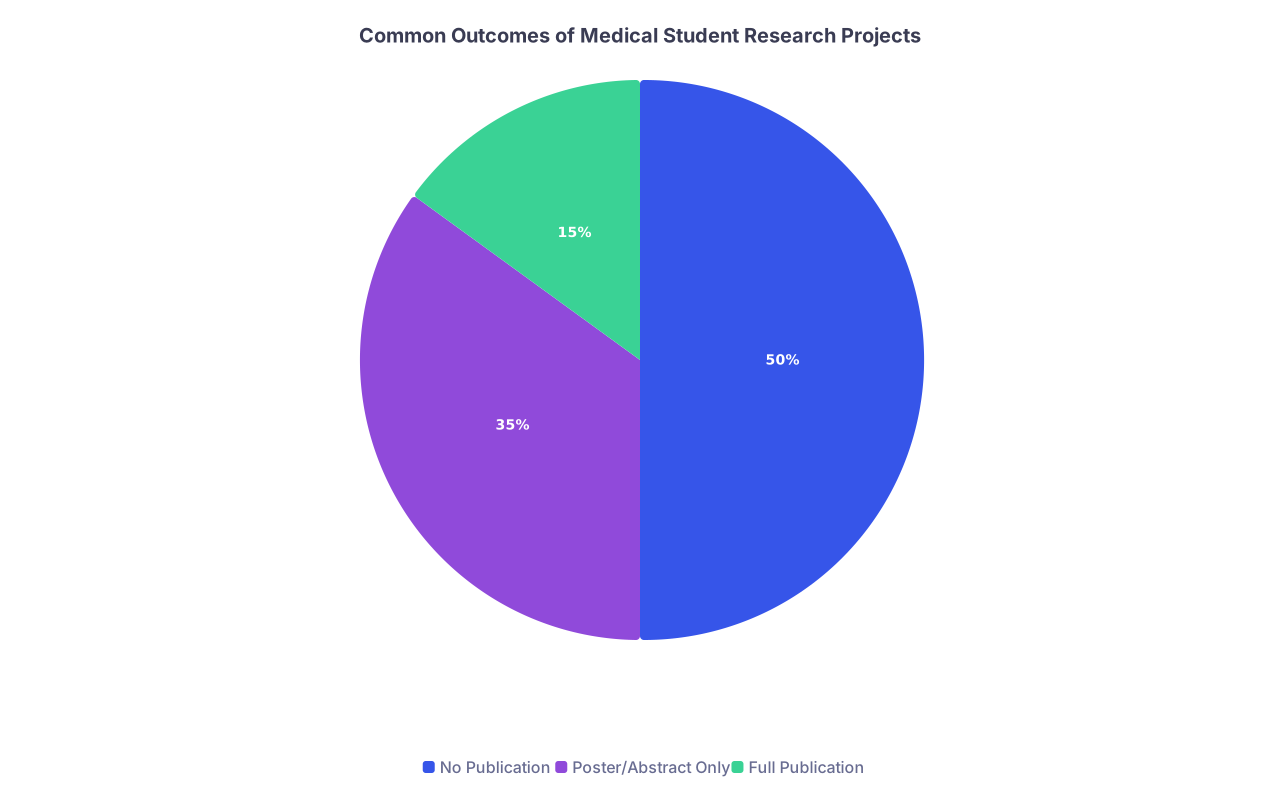
| Category | Value |
|---|---|
| No Publication | 50 |
| Poster/Abstract Only | 35 |
| Full Publication | 15 |
How Programs Actually Read “Weak” Experiences
Here’s what I’ve heard faculty say in actual file review meetings:
- “At least this person has been working or volunteering continuously.”
- “Nothing flashy, but pretty steady involvement through med school.”
- “I like that they’ve been helping support their family while in school.”
Compare that to:
- “This ERAS looks like they did literally nothing outside required rotations.”
- “Lot of titles, not a lot of substance in the descriptions.”
- “I’m not convinced they’ll show up for the less glamorous parts of residency.”
You’re not trying to impress everyone with every entry. You’re trying to avoid red flags and paint a picture of a functioning adult who participates in something beyond the minimum.
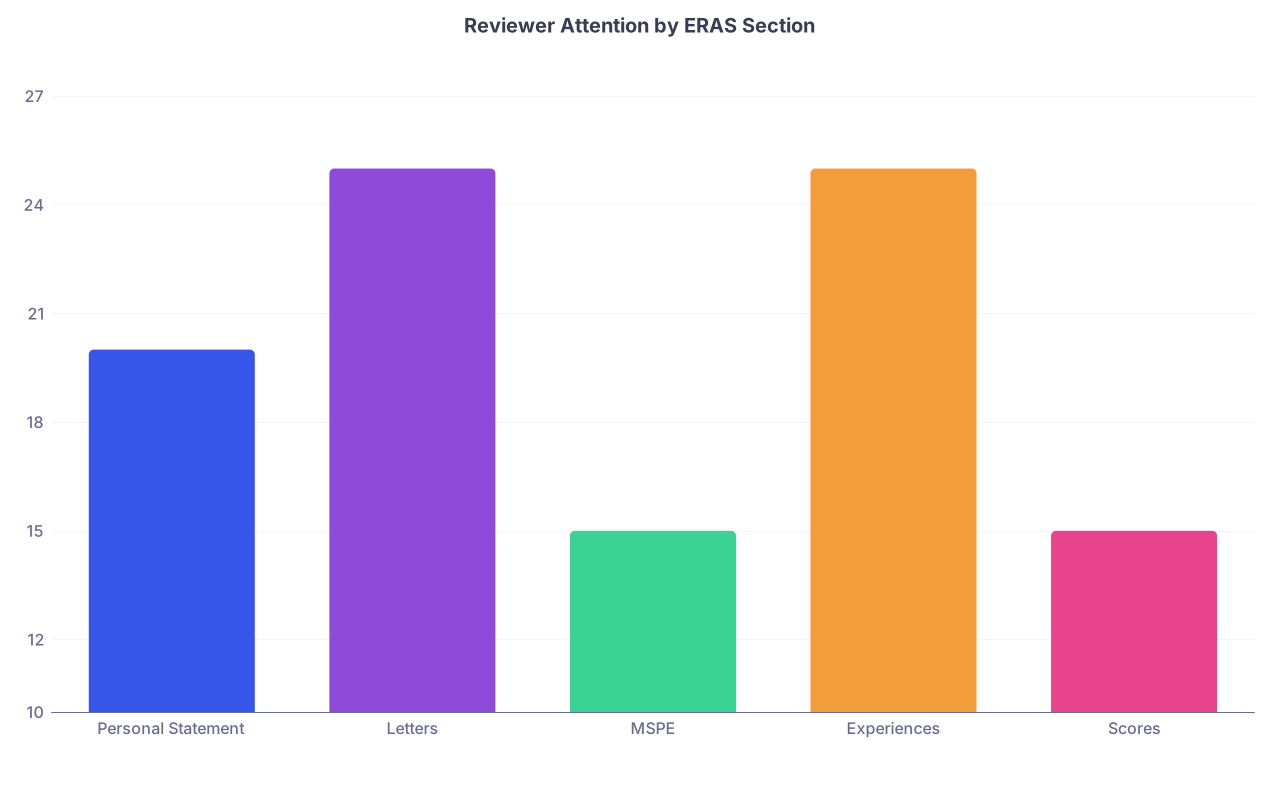
| Category | Value |
|---|---|
| Personal Statement | 20 |
| Letters | 25 |
| MSPE | 15 |
| Experiences | 25 |
| Scores | 15 |
How to Decide in Under 5 Minutes: A Simple Triage
If you’re stuck on whether to omit or include something, run it through this checklist:
Does this explain a visible gap or “empty” time period?
- Yes → Probably include
- No → Go to #2
Does this add a new dimension (clinical / research / teaching / service / leadership / real work)?
- Yes → Include, keep it brief
- No → Go to #3
Did I actually show up regularly and do something specific?
- Yes → Include if your app is otherwise light; omit if your app is already full
- No → Omit
If an interviewer asked, “Tell me about this,” would I feel:
- Comfortable and honest describing it → Safe to include
- Embarrassed or like I exaggerated → Omit
That’s it. Don’t overthink for hours.

| Step | Description |
|---|---|
| Step 1 | Questionable Experience |
| Step 2 | Include Briefly |
| Step 3 | Include Briefly |
| Step 4 | Omit |
| Step 5 | Explains Gap or Time Use? |
| Step 6 | Adds New Dimension? |
| Step 7 | Real, Consistent Work? |
| Step 8 | Application Already Dense? |
How Brief Inclusion Can Backfire (And How to Avoid That)
There are ways to shoot yourself in the foot even when you correctly decide to include something.
Common mistakes:
- Over‑selling minor experiences with grand language
- Copy‑pasting the same generic line across multiple entries (“Improved my communication and teamwork skills…”)
- Listing a bunch of 1–2 day activities to inflate the total count
Programs have radar for insecurity. A bloated Experiences section full of fluff screams, “I know my application is thin and I’m panicking.”
To avoid that:
- Write in plain language
- Use specific actions, not outcomes you can’t prove
- Keep weaker entries short—2–3 lines tops
- Let your stronger experiences carry the narrative weight

A Quick Word on Specialty Competitiveness
The more competitive the specialty, the more your “weak” experiences matter in aggregate.
For highly competitive fields (derm, plastics, ortho, ENT, neurosurgery):
- “Weak” research still matters because volume and continuity matter
- Demonstrated consistency in the specialty (interest group, shadowing, sub-I, small projects) is better than silence
- Omitting every less‑impressive thing can make you look one‑dimensional
For less hyper‑competitive but still selective fields (IM at strong academic programs, EM, anesthesia, radiology):
- Weak but consistent clinical or service roles still help
- They differentiate you from the purely transactional “did only what was required” student
You’re rarely punished for a modest, honest, clearly written experience. You are judged for overinflation and for big unexplained blanks.

Bottom Line: Omit or Include?
Here’s the answer you came for.
Include a “weak” experience if it:
- Explains how you spent your time
- Shows consistency or responsibility
- Adds a missing dimension (clinical, research, teaching, service, real work)
- Connects to your broader story or interests
Omit it if:
- It was truly trivial, one‑off, or title‑only
- You did almost nothing and can’t describe it honestly
- You already have stronger, similar entries and your ERAS is full
If you keep it, keep it short, specific, and honest.
A modest experience, clearly described, is not a liability. It’s part of a believable, human application.
That’s the bar. Not “Is this impressive enough for Harvard?” but “Does this make me look like a real, responsible person the program can trust at 3 a.m.?”