The residents who get auto-rejected are usually not the ones who think they did something wrong. They’re the ones who have no idea how many tiny professionalism red flags they just tripped.
Let me tell you what really happens on the other side of ERAS.
Program directors and coordinators spend weeks drowning in applicants that all “love the program,” all “value teamwork,” all “have a passion for patient care.” The only way to survive that pile is to filter fast. So yes: they will absolutely throw an otherwise decent application straight into the “hard no” pile over “small” professionalism issues.
Not because they’re petty. Because they’ve been burned before.
You’re not being evaluated just as a test score and CV. You’re being evaluated as a future colleague who can get a hospital sued, get a program cited, or make every call night miserable. And the things that make PDs nervous are often subtle, quiet, and never listed on any official website.
This is the stuff attendings talk about behind closed doors. The things that lead to: “I don’t care what their score is, I’m not dealing with that for three years.”
Let’s walk through the real red flags.
1. Sloppy Communication: The Fastest Way to Get Labeled “High Risk”
The biggest myth: professionalism is about “being nice” and saying “thank you.” Wrong. In residency selection, professionalism starts with basic reliability. And the first hint they get? How you communicate.
I’ve sat in rooms where PDs went through email screenshots like they were pathology slides. They notice everything.
The unforced errors in email
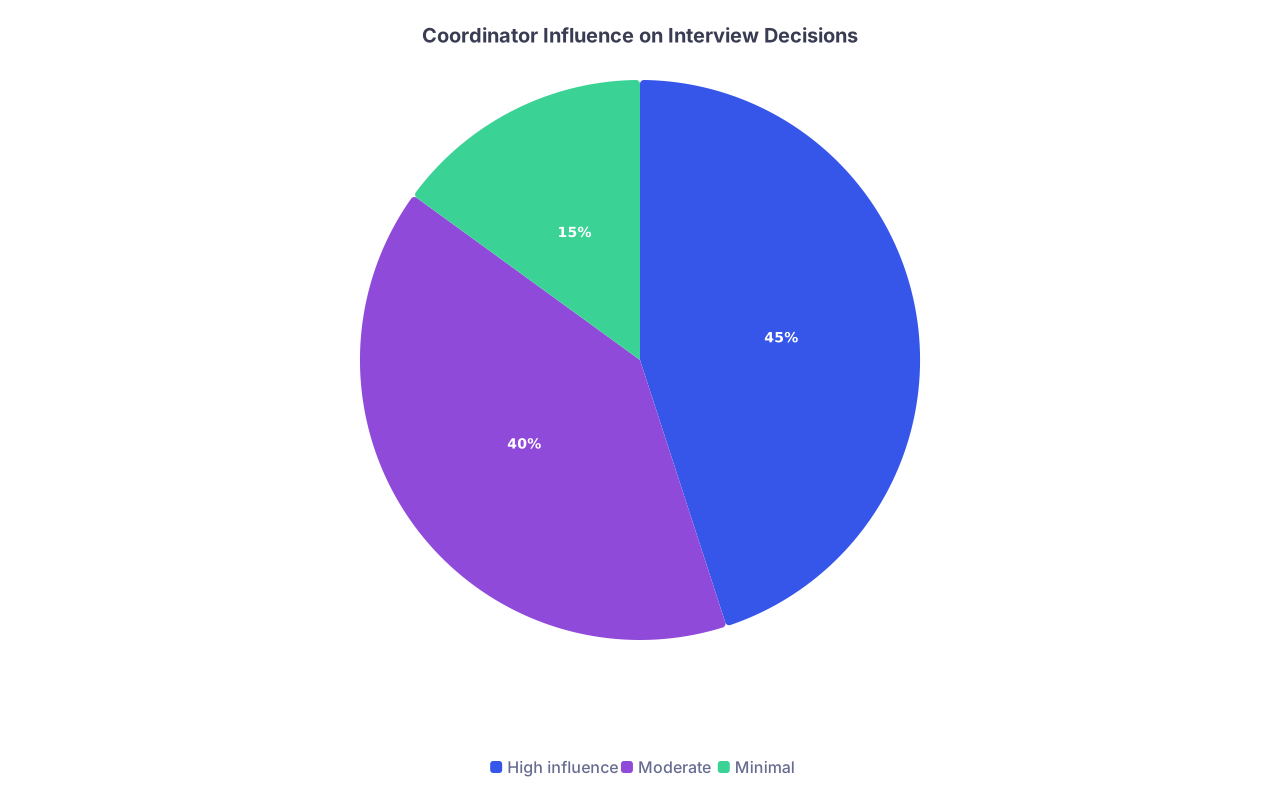
These are the types of things that trigger an instant “no” from PDs and especially from coordinators, who have more influence than you think:
Casual tone with no greeting.
“Hey, just wanted to ask if my letter got uploaded”
Translation in their heads: This person does not understand hierarchy or formality.Demanding or entitled follow-ups.
“I haven’t heard back and my other offers are expiring, please respond ASAP.”
One surgery PD I know at a midwest program literally said, “If they’re this pushy now, imagine them arguing about their vacation week.”Typos and sloppy grammar in short emails.
Nobody expects literature. But if your two-line email has three typos, they assume your notes and orders will be worse.Using the wrong program name or specialty.
“Thank you for considering my application to your Internal Medicine program” sent to an EM program.
I’ve watched PDs show this to the committee and laugh. Then click “reject.”
What they conclude is not “this person is careless once.” They conclude: “This is how they will chart. This is how they will talk to consultants. This is how they will communicate with risk management.”
| Category | Value |
|---|---|
| High influence | 45 |
| Moderate | 40 |
| Minimal | 15 |
You underestimate coordinators at your own risk. In many programs, if the coordinator says, “This one seems unprofessional,” that’s the end of your candidacy.
The “resend” and “nudge” problem
There’s a pattern PDs hate and talk about constantly at national meetings: repeated “polite” nagging.
You send an email. No response in 48 hours. You send a follow-up. Then another. You mark it “high importance.” You tag on “just bumping this to the top of your inbox.”
Here’s the ugly truth:
No one is impressed by your “advocacy for yourself.” They’re annoyed. They’re choosing between dozens of applicants. The one who keeps buzzing their inbox like a mosquito gets swatted.
The mental label you never see: needy, high-maintenance, not respectful of boundaries.
And yes, that can outweigh a decent application.
2. The Way You Talk About Other People
If you want to see a PD’s face change instantly, let an applicant start complaining.
What applicants forget is that narratives travel. Your MSPE, your letters, your dean’s comments, your interview responses, your casual hallway chatter during interview day — they all get stitched into a picture of how you handle conflict and hierarchy. And this is where many otherwise strong applicants get torched.
The subtle trash talk
Nobody is stupid enough to outright say “my school was terrible” or “my attending was an idiot” in an interview. But the polished version is just as toxic:
“I had some challenging experiences with certain attendings who weren’t very supportive.”
“We had a lot of instability in our leadership; it made learning harder.”
“Our administration wasn’t very responsive, so we had to advocate a lot for ourselves.”
PD translation: this person blames up the chain. When something goes wrong, it will be leadership’s fault, not theirs. They will write grievance emails. They might file hostile surveys. They will be a headache.
I watched one PD circle a phrase on their interview notes and just say, “Nope. Too much drama.” The phrase?
“She spoke about her home program’s ‘toxic culture’ four separate times.”
The applicant thought she was being honest and insightful. The PD heard: liability.
What ends up in your MSPE and letters
You think certain conflicts are buried. They are not.
Non-specific phrases in your MSPE are code. PDs know how to read it.
| MSPE Phrase | PD Interpretation |
|---|---|
| "Can be very passionate in advocacy" | Argumentative, pushes boundaries |
| "Benefits from clear expectations" | Needs constant supervision |
| "Improved over the course of clerkship" | Started poorly, possible attitude issues |
| "May be perceived as intense" | Difficult interpersonal style |
I’ve seen PDs go back to the MSPE after an interview and say, “Ah, this line makes sense now,” after someone spent 10 minutes diplomatically complaining about their home institution.
If you show even a hint of being a chronic complainer, that is almost always a hard no. Programs would rather take a slightly weaker applicant who plays well with others than a superstar who burns bridges.
3. Social Media and “It Was Just a Joke”
Here’s the part everyone underestimates: PDs and faculty absolutely look at social media, and the bar for what they consider “unprofessional” is lower than yours.
No, they’re not hunting you down like the FBI. But if you’re easily searchable, or if someone flags your account, or if your name gets Google’d out of curiosity, what they find can and does kill applications.
The posts that get forwarded
I’ve seen actual examples that ended up in PD group chats:
- Screenshot of an “anonymous” meme page post that was clearly from one specific med school, with the OP recognizable by timing and insider details. The post mocked a patient’s diagnosis.
- An Instagram story from a student in short white coat, badge visible, posting from the OR with some “funny” caption about “time to cut” and a knife emoji.
- Twitter arguments dragging attendings, specialties, or specific hospitals, even if no names mentioned. The tone alone is enough.
The classic rationalization from students: “But it doesn’t say my hospital or my patient’s name.” PDs don’t care. They care that you thought that was fine to put anywhere near public.
One PD at a strong IM program said it to me bluntly over coffee:
“If I see bad judgment online, that’s it. I’m not waiting to see that same judgment with a real patient.”

Your “private” accounts are not that private
Another uncomfortable truth: residents and med students at your own school sometimes forward things. The group DM you think is loyal and insulated? Less solid than you think.
And if a current resident at Program X messages the PD, “FYI this is your applicant,” with a screenshot of something dumb, that is usually game over.
Programs are not going to debate context with you. They will just silently move on. No feedback. No second chance.
4. Reference Checking: The Calls You Never Hear About
The biggest professionalism filter isn’t in ERAS at all. It’s in the quiet phone calls.
On paper you look fine. Decent scores, normal MSPE, no obvious disasters. But something feels a little off. A strange comment in a letter. An odd tone during your interview. That’s when PDs start dialing.
You will never know which calls were made. You’ll only see that you did not get an interview or you fell down the rank list. But behind that, this is often what happened.
Back-channel conversations
Here’s a typical script I’ve heard on speakerphone in PD offices:
“Hey, it’s Mike from [Program]. You had [Applicant] on your service, right? Anything I should know?”
And then there’s a pause. That pause is deadly.
Nobody wants to tank your career outright, so they phrase it gently. But PDs have learned how to parse “gentle.”
Phrases that kill applicants on these calls:
- “Very bright but needed a lot of reminders about deadlines.”
- “Great with patients, sometimes a little casual with staff.”
- “We had some conversations about appropriate boundaries with nurses / patients / classmates.”
- “I’d rank them, but I’d want to make sure they had strong supervision.”
That last one? I watched an EM PD hang up and say, “Okay, that’s a pass for us. Too much work.”
The “one person who doesn’t like you” problem
You might be thinking, “So if one attending doesn’t like me, I’m screwed?” Not exactly. PDs know there are personality clashes.
What worries them is patterns.
If your MSPE is vague, one letter is lukewarm, and a phone call is “hesitant,” that’s enough to move on. They have 600 other options. They’re not going to spend 20 minutes dissecting whether you were misunderstood.
Here’s the part applicants don’t get: they are not trying to sort “good people” from “bad people.” They’re sorting “low risk” from “maybe risk.” And any hint of professionalism concern, even secondhand, often throws you into the second bucket.
5. Interview Day: Micro-Behaviors That Sink You
Applicants over-focus on what they say when the faculty are in the room, and under-focus on how they carry themselves the rest of the time.
Interview days are a stress test. Your professionalism is being evaluated non-stop — and half the time, not by the people you think.
The staff test
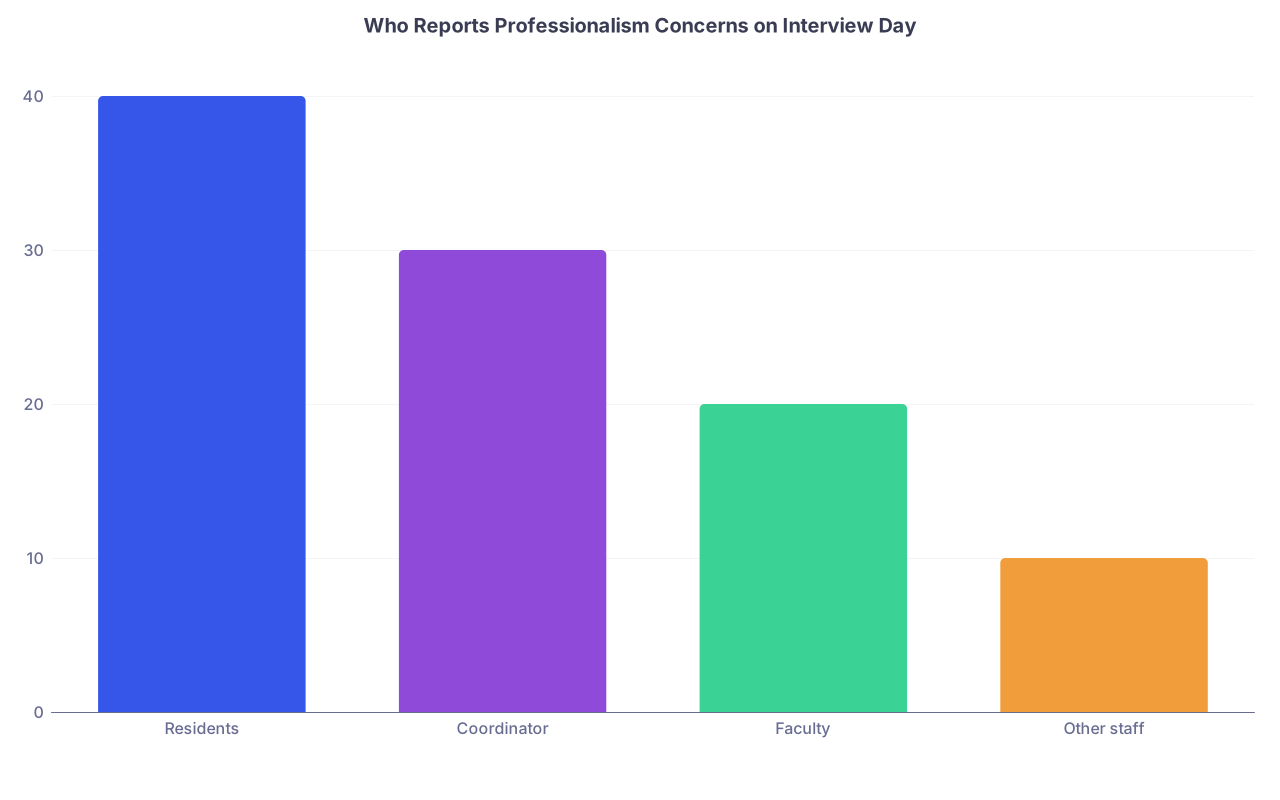
If you’re disrespectful to a program coordinator, front desk staff, residents, or even the person serving lunch, it will get back to the PD. Always.
I watched this play out in real time:
- Applicant arrived. Ignored the front desk greeting, didn’t introduce themselves, just said, “I’m here for the interview.”
- At lunch, they spoke only to faculty, turned their back toward the residents, barely glanced at the support staff who were cleaning up.
End of the day, the coordinator popped into the PD’s office and said, “Just so you know, he was kind of rude at check-in.” That applicant was done. Their interview scores didn’t matter anymore.
| Category | Value |
|---|---|
| Residents | 40 |
| Coordinator | 30 |
| Faculty | 20 |
| Other staff | 10 |
You think residents are your buddies. They’re also your evaluators. And some programs explicitly ask residents, “Would you want to take call with this person?” A single “absolutely not” can torpedo you.
Trying too hard vs being normal
There’s another quieter professionalism issue: over-familiarity.
Calling attendings by first names on interview day.
Over-sharing personal struggles in a way that feels like you’re trauma-dumping on strangers.
Making edgy jokes about burnout or suing hospitals or “toxic” work environments.
One anesthesia PD put it bluntly:
“If I feel like I’m talking to a friend at a bar instead of a trainee, I get nervous. It means they don’t see the lines.”
That’s what professionalism really is in this context: knowing where the lines are. Not being perfect. Just showing that you understand boundary, tone, and context.
6. Application Content That Quietly Screams “Risk”
Now to the parts you probably obsess over: the written application. But you’re worrying about the wrong things.
You fixate on “should I say passion or commitment?” while PDs are scanning for one thing: anything that smells like poor judgment, unreliability, or drama.
Personal statements with landmines
You’ve heard the advice: “Be vulnerable. Tell your story.” Yes. But there’s a line between honest and concerning.
I’ve seen statements that PDs passed around as cautionary tales:
- Overly graphic descriptions of patient deaths, including details that would horrify a family member reading it. The PD’s question: “If this is what they write in an application, what will they say on social media?”
- Long rants about how the system is broken, how attendings are burned out, how older physicians don’t understand younger generations. Some truth? Maybe. But PDs fear future conflict, not essays about your insights into systemic failure.
- Essays centered on personal mental health or substance issues presented in a way that doesn’t clearly show stability, insight, and appropriate treatment.
Here’s the nuance: PDs are not automatically biased against people with mental health histories. But they are absolutely wary of unresolved instability. If your statement raises questions like “Are they ready for residency?” instead of “They’ve clearly grown from this,” you’re in trouble.
Red flag CV content
There are quieter application entries that set off alarms:
- “Leadership” roles that are clearly inflated; PDs know what real responsibility looks like.
- Multiple short, unexplained gaps paired with vague explanations in interviews (“just some personal stuff”).
- Research with big claims that don’t match your actual role when probed.
On interview day, when you can’t coherently explain a project you listed as “primary author,” you’re not just tagged as “embellished.” You’re tagged as untrustworthy. And that’s a professionalism issue, not an academic one.

7. The “Too Busy for Basics” Candidate
One of the most common quiet hard-nos: the applicant who is always just a little late, a little last-minute, a little disorganized. They rarely see themselves as unprofessional. They see themselves as “busy high achievers.”
PDs see something else entirely.
Deadlines and delays
Programs pay attention to:
- How long it takes you to respond to interview invites.
- Whether you follow the instructions for confirming or declining.
- Whether you wait until the last 24 hours to cancel or reschedule repeatedly.
I watched a coordinator open an email from an applicant cancelling the morning of interview day with: “Sorry something came up, thanks anyway.” No explanation, no apology, no recognition that they just wasted a slot.
Coordinator looked at me and said, “You think we’re going to offer them an alternate date?” We both knew the answer.
The quiet judgment: If they’re this casual about our time before we’ve even met, what will they be like with call schedules, clinic templates, and consults?
The “I’m just bad at email” myth
You’d be stunned how many students shrug and say this to faculty. “I’m just not great with email.” Or, “I’m really bad with time management but I’m working on it.”
That’s like telling a surgeon you’re “just not great with anatomy.” You’re confessing that you lack a core professionalism skill and framing it as a personality quirk.
No PD wants to be your time-management coach. They want you to show you can meet basic expectations without handholding.
8. How PDs Actually Keep Score on Professionalism
Here’s the part you never see: the mental and sometimes literal scoring systems that reduce “professionalism” into a few yes/no decisions.
Some programs formally rate professionalism based on:
- MSPE comments
- Interview behavior
- Resident feedback
- Coordinator impressions
- Any documented concerns from your school
Others do it informally. But either way, if you cross a certain threshold, there’s no discussion. You’re just out.

| Step | Description |
|---|---|
| Step 1 | Review ERAS Application |
| Step 2 | Reject |
| Step 3 | Check Letters & CV |
| Step 4 | Offer Interview |
| Step 5 | Interview Day Observations |
| Step 6 | Rank List Consideration |
| Step 7 | Any MSPE / Dean Red Flags? |
| Step 8 | Concerns About Reliability or Behavior? |
| Step 9 | Resident/Staff Concerns? |
Notice something? Once “concerns” enter the picture, almost nobody fights hard to rescue you. There are too many clean applicants. No PD walks into the rank meeting saying, “I know everyone thinks this person might be trouble, but I’d really like to take a chance.”
That just does not happen.

If You Remember Nothing Else
Keep it simple.
First, professionalism is not about being perfect; it’s about showing you understand boundaries, respect, and reliability in small, boring ways. Sloppy emails, casual tone, last-minute cancellations, and subtle complaining tell PDs exactly who you are under pressure.
Second, everyone around you during this process is an evaluator: coordinators, residents, front desk, letter writers, even informal references you do not know were called. One poorly chosen comment or pattern of “minor” issues can and does turn into a quiet hard no.
Third, PDs aren’t looking for reasons to save borderline professionalism candidates. They’re looking for reasons to avoid risk. Make yourself the easy choice: serious but not stiff, respectful without being fake, and above all, reliable. That’s who gets ranked.