It is 11:47 p.m. You are post‑call, half‑awake, and you finally sit down to email a program director you really care about. You type fast, hit send, and go to sleep feeling productive.
The next morning you re‑read what you wrote.
You called the PD by the wrong title. You misspelled the program name. Your signature still says “MS3” from last year. And you cc’d a resident using their personal Gmail that you found online.
You will not get a direct email back saying, “We decided not to interview you because your email looked sloppy and unprofessional.” They just quietly move on. I have seen this more times than I like.
This is the problem with email etiquette errors in residency applications: programs rarely tell you they noticed, but they notice.
Let me walk you through the landmines so you do not step on them.
1. Treating PDs and Coordinators Like Your Group Chat
The first and worst category: tone.
You are not texting a friend. You are writing to the people who control whether you get an interview slot. Yet every year I see:
- “Hi there!” with no name
- Emojis or exclamation‑mark overload
- “Hey Dr. Smith! Just checking in :)”
- No greeting at all, just “I was wondering if…”
Red flags for programs:
- Too casual = lack of professionalism.
- Too familiar = lack of boundaries.
- Too abrupt = lack of respect.
How to avoid this mistake
Use a formal but human structure:
Greeting:
- “Dear Dr. [Last Name],” for PDs and faculty
- “Dear Ms./Mr. [Last Name],” for coordinators (if you are not sure, “Dear [First Last Name],” is safer than guessing wrong)
Tone:
- Complete sentences
- No slang, no emojis
- Avoid “Hey,” “Hi there,” “Yo,” “Hey guys”
Example that will not embarrass you later:
Dear Dr. Nguyen,
I hope this message finds you well. My name is [Name], a fourth‑year medical student at [School], applying to your program this cycle. I am writing to inquire about…
Does it sound a bit stiff? Good. You are not going for charming. You are going for competent and safe.
2. Sloppy Subject Lines That Get Ignored
You know who triages your message first? Often the coordinator, looking at a flood of unread emails.
Bad subject lines I have actually seen:
- “Question”
- “Application”
- “Hi”
- “[no subject]”
- “ERAS”
These make your email easy to ignore or lose.
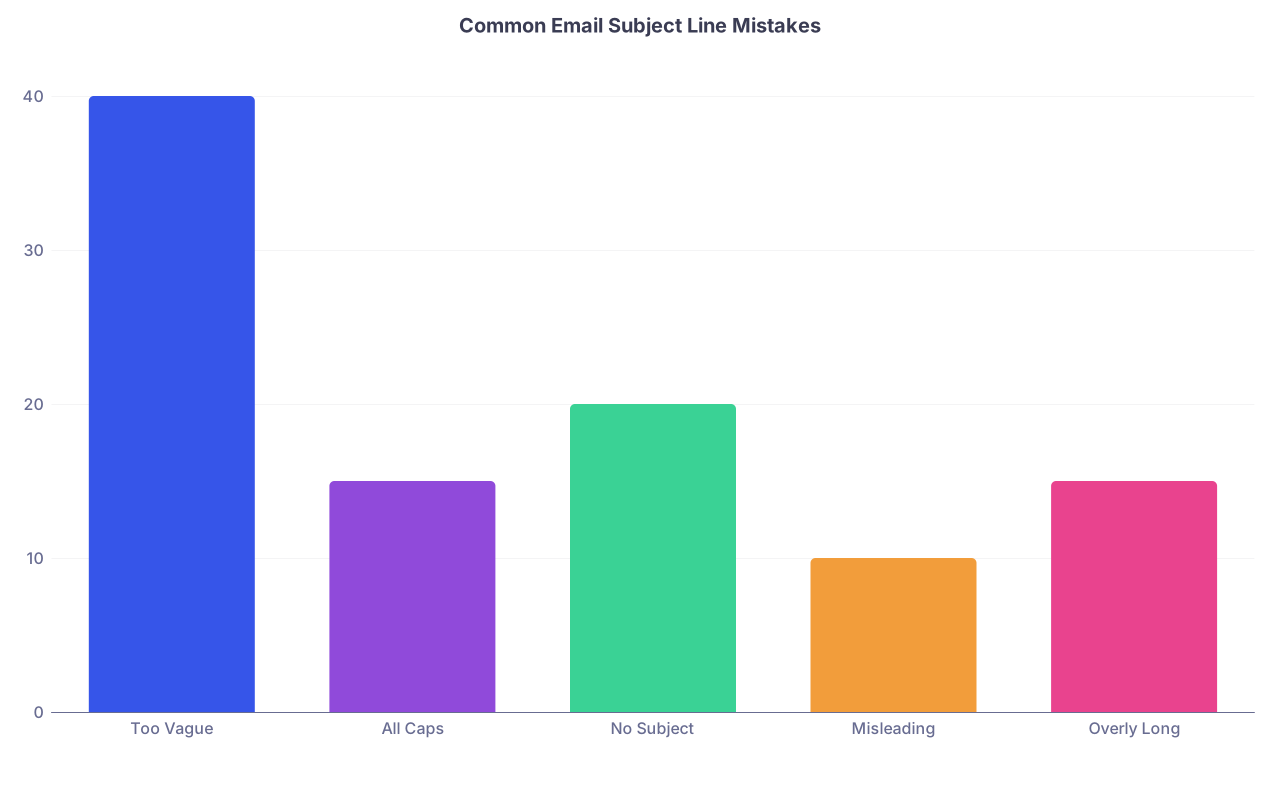
| Category | Value |
|---|---|
| Too Vague | 40 |
| All Caps | 15 |
| No Subject | 20 |
| Misleading | 10 |
| Overly Long | 15 |
How to avoid this mistake
Your subject line should:
- Identify you
- State your purpose briefly
- Be easily searchable later
Examples:
- “ERAS Application – [Your Name], [AAMC ID] – Interview Question”
- “Visiting Student – [Your Name] – Rotation Dates Inquiry”
- “Update – [Your Name], ERAS [ID] – New Step 2 CK Score”
Do not write an essay in the subject line. Do not use all caps. Do not use “URGENT” unless it is truly time‑sensitive (and almost nothing you send is).
3. Failing the “Name, Title, Program” Test
Getting names and details wrong is the fastest way to look careless.
Common errors that quietly sink you:
- “Dear Program Director,” when their name is on the website
- “Dear Dr. Johnson,” when they are Dr. Jackson
- Using the wrong program name or city because you copy‑pasted from another email
- Addressing the coordinator by first name only when you have never met them
Programs interpret this as: you do not care enough to check.
The copy‑paste trap
You will send many similar emails. You will be tempted to copy and paste the same text.
The usual mistake: you edit everything except the greeting or the program name. So you email “Dear Dr. Patel” to a program whose PD is Dr. Lopez. Or you write, “I am particularly interested in your program at [Different City].”
I have sat in rooms where people read those aloud and then delete the applicant from serious consideration. It is not cute. It is not harmless.
How to avoid this mistake
Before sending, confirm three things:
Name – check spelling and title on:
- Program website
- ERAS listing
Program name – exact wording:
- “Internal Medicine Residency Program – [Institution]”
- Do not abbreviate unless they do (e.g., “MGH” is fine; “Presby” is not always)
Location – no mixing up institutions or cities.
Make a quick pre‑send checklist:
- Greeting: correct name and title?
- Body: correct program name and city?
- Any other institution mentioned? Correct?
It takes 30 seconds. Saves you interviews.
4. Over‑Emailing, Under‑Emailing, and Terrible Timing
Your timing and frequency also send a message.
Here is the mistake pattern I see every year:
- Applicant emails once before ERAS opens asking to be “kept in mind.”
- Emails again the day ERAS opens.
- Emails again a week later asking for an update.
- Emails the PD directly, bypassing the coordinator, when they do not get an answer.
Now you are on the wrong radar.

| Step | Description |
|---|---|
| Step 1 | Need to Email Program |
| Step 2 | Email Coordinator |
| Step 3 | Email PD or generic program email |
| Step 4 | Wait. Do not re-send yet. |
| Step 5 | Send concise follow-up |
| Step 6 | Purpose? |
| Step 7 | Already emailed recently? |
When you should email
Reasonable situations:
- You have a specific, non‑Googleable question about their process or requirements.
- You have a significant update (Step score, honor, publication) and the program accepts updates.
- You have not heard about an interview and it is late in the season, and your school advisor thinks a brief interest email is appropriate.
- You need to clarify missing documents, eligibility, or rotations.
Unreasonable situations:
- You want to pressure them for an invitation.
- You want to know your exact rank on their list.
- You want feedback on why you did not get an interview.
- You feel anxious and just “want to check in.”
How often is too often?
As a rule:
- Initial email: fine.
- If you must follow up:
- Wait 7–10 days at minimum.
- One follow‑up is reasonable.
- A second follow‑up is only defensible in truly time‑sensitive cases (visa deadlines, etc.).
Anything beyond that looks desperate and high‑maintenance. No program wants a resident who will email this aggressively about schedule requests, evaluation timing, or vacation swaps.
5. Writing Novels No One Will Read
Another huge mistake: long, rambling, self‑centered emails.
Imagine 300 applicants doing this.
Examples I have seen:
- 800‑word life stories to PDs explaining every detail of their childhood adversity.
- Massive explanations of every low grade and score in one email.
- Multi‑paragraph arguments about why they are a perfect “fit” for the program.
Here is the truth: long walls of text get skimmed or skipped. Especially by coordinators already overwhelmed with logistics.
How to avoid this mistake
Good program emails are:
- Short
- Focused
- Easy to parse in under 30 seconds
Structure you should follow:
- Greeting
- One‑line intro (who you are)
- 1–3 short sentences with the specific reason you are writing
- Clear ask (if there is one)
- Thank you + signature
Example:
Dear Ms. Rivera,
My name is John Lee, a fourth‑year medical student at Rutgers applying to your Internal Medicine program this cycle. I am writing to ask whether your program accepts updated Step 2 CK scores after ERAS submission.
If so, could you please advise on the best way to send this information?
Thank you very much for your time and assistance.
Sincerely,
John Lee
AAMC ID: 12345678
That is it. Clear, polite, and quick to read.
6. Being Weird About Boundaries and Familiarity
Another category that gets applicants quietly blacklisted: inappropriate familiarity or over‑personalization.
Things that make PDs and coordinators uncomfortable:
- Using first names without any existing relationship (“Hi Sarah,” to a coordinator you have never met).
- Referencing their social media activity.
- Mentioning that you saw them on Doximity / LinkedIn / some random podcast and then over‑analyzing their career.
- Trying to build an artificial “bond” over superficial similarities (“We both love hiking and coffee!!”).
Residency selection is a professional relationship first. Programs are looking for reliable colleagues, not instant friends.
How to avoid this mistake
Err on the side of formal distance unless:
- You have met in person and they explicitly told you to use first names.
- This is a resident you rotated with and you had a clear peer interaction. Even then, keep email tone professional.
Signs your email is crossing the line:
- You are trying to be charming or funny.
- You are oversharing personal details that are not directly relevant to your question or application.
- You are making them your therapist.
Talk to PDs and coordinators the way you would talk to an attending in front of a patient’s family. Respectful, measured, and on topic.
7. Ignoring the Coordinator (or Worse, Being Rude)
You know who programs actually trust? Their coordinators. Every year, PDs ask: “How was your experience with this applicant?”
If you are rude or dismissive to the coordinator, it gets remembered.
Common red‑flag behaviors:
- Demanding tone: “I need you to send…” “You have not responded to my last email…”
- Impatience: following up aggressively after 24–48 hours.
- Bypassing them and going straight to the PD for things the coordinator handles (interview date changes, logistics, missing documents).
- Treating them like a clerk instead of a colleague.
| Situation | Best Contact |
|---|---|
| Interview date change | Coordinator |
| Missing document / ERAS status | Coordinator |
| Clarifying eligibility requirements | Coordinator first |
| Expressing strong program interest | PD or program email |
| Significant application update | PD + CC coordinator |
How to avoid this mistake
Basic rules:
- Default: email the coordinator for logistical and administrative questions.
- CC the PD only when it clearly involves selection / interest / major updates.
- Phrase requests, not demands:
- “Would it be possible to…”
- “Could you please let me know…”
And do not forget the obvious but often skipped part: say thank you. Coordinators are often handling dozens of applicants at once. Showing appreciation costs you nothing and buys goodwill.
8. Dangerous Content: What You Say That You Should Not
Sometimes the problem is not how you write, but what you put in the email.
Here are content mistakes that leave bad impressions:
Trashing other programs:
“I did not feel your competitor valued education.”
Programs will assume you will someday talk about them that way too.Oversharing personal issues in detail: Detailed mental health history, family conflicts, legal problems. These should go through proper application channels or advisors, not cold emails.
Arguing about decisions:
- “I was surprised to not receive an interview given my scores.”
- “I believe I deserved more consideration.”
That reads as arrogant and unaware.
Bringing up rank lists: Hinting or saying where you will rank them before or after interviews in a way that pressures them.
How to avoid this mistake
Use email for:
- Clarifying information
- Sharing relevant, concise updates
- Expressing interest briefly and honestly
Not for:
- Emotional processing
- Complaints
- Negotiation games
If you feel tempted to vent, write it in a Word document. Do not send it.
9. Amateur Formatting and Unprofessional Signatures
A lot of applicants overlook how the email actually looks.
Red flags:
- No signature at all
- Signature with outdated title (still says “MS2” or wrong school)
- Cutesy quotes or jokes under your name
- Fonts in multiple colors or sizes
- No identifying information (PD has to hunt for who you are)
What your signature should include
Keep it clean, plain text, and complete:
- Full name
- Current status and institution
- AAMC ID
- Contact info (email, phone)
Example:
John M. Lee
Fourth‑Year Medical Student, Rutgers New Jersey Medical School
ERAS AAMC ID: 12345678
[email protected] | (555) 123‑4567
That is it. No inspirational quotes. No social media handles. You are not building a brand. You are trying not to look careless.
10. Not Proofreading Like Your Career Depends on It (Because It Does)
The number of emails I have seen with obvious spelling and grammar errors is depressing.
Common mistakes:
- Typos in the first line
- “You’re program” instead of “your program”
- Misspelled institution names (“John Hopkins,” “Colombia University”)
- Missing words, half‑edited sentences from rushed revisions
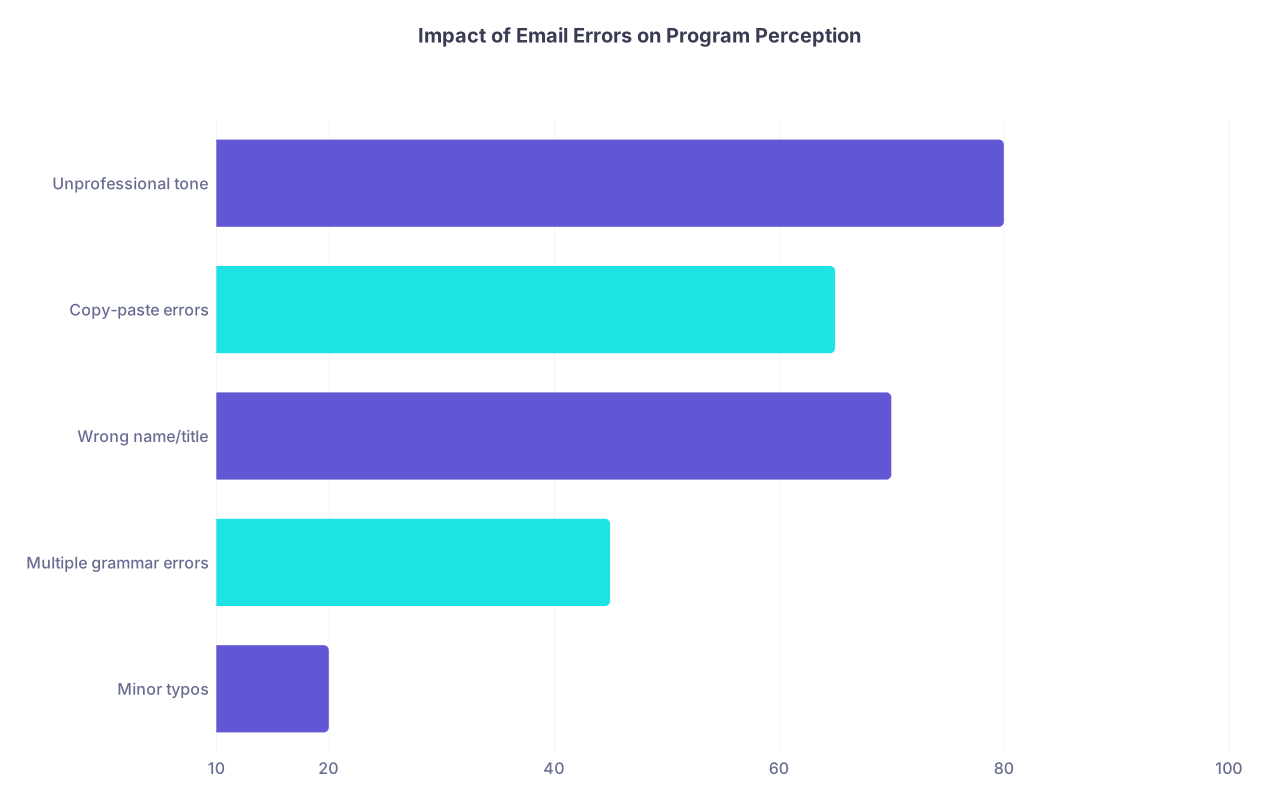
| Category | Value |
|---|---|
| Minor typos | 20 |
| Multiple grammar errors | 45 |
| Wrong name/title | 70 |
| Copy-paste errors | 65 |
| Unprofessional tone | 80 |
Programs will not reject you solely for one typo. But patterns of sloppiness, especially combined with other weak points, absolutely influence marginal decisions.
How to avoid this mistake
Do not trust your eyes immediately after drafting. Quick routine:
- Write the email.
- Step away for five minutes.
- Read it out loud to yourself.
- Check:
- Names / titles
- Program / institution
- Dates / numbers
- Tone: any emotional language? Any passive‑aggressive edge?
If you are sending something higher‑stakes (e.g., a post‑interview thank you that matters to you), consider:
- Draft in Word or Google Docs.
- Use spellcheck.
- Ask a friend or advisor to take a 30‑second glance.
Is that overkill for a “simple email”? Yes. That is why most people will not do it. Which is exactly why your clean emails will stand out.
11. Thank‑You Emails and Updates: Subtle Ways to Mess Up
You can also mess up after an interview.
Common mistakes:
- Sending the exact same generic thank‑you email to every program (“Your program is an excellent fit…” with nothing specific).
- Writing a thank‑you email that is actually a pressure email (“I will rank you very highly if offered a position”).
- Over‑updating: every minor poster, abstract, or club position becomes a new email.
Safer patterns
Thank‑you emails:
- Short
- Specific (mention one thing you genuinely appreciated about the day)
- No rank list promises or manipulative language
Example:
Dear Dr. Rao,
Thank you again for the opportunity to interview with your Internal Medicine program on January 10. I especially appreciated our discussion about your residents’ involvement in quality improvement initiatives and the supportive environment you described.
I remain very interested in your program and grateful for your time.
Sincerely,
[Name]
Updates:
- Combine changes into fewer, meaningful messages.
- Only send for significant updates: new score, major publication, key honor/award.
If you are sending updates every other week, you look anxious and disorganized.
FAQ (Exactly 4 Questions)
1. Is it ever appropriate to email a PD directly instead of the coordinator?
Yes, but selectively. Email the PD (or a generic program email) when your message is primarily about your candidacy or your interest: a concise expression of strong interest, a significant application update, or a brief follow‑up late in the season if your advisor believes it is reasonable. For logistics, scheduling, ERAS document status, or routine questions, go to the coordinator first. If in doubt, send to the coordinator and let them loop in the PD.
2. Can a single bad email really cost me an interview?
One mildly clumsy email probably will not. A clearly unprofessional, rude, or sloppy message absolutely can, especially if you were on the margin to begin with. Programs use every available data point to decide who seems safe to bring into their system. An email that screams poor judgment or disrespect can move you from “maybe” to “no” very quickly.
3. Should I send thank‑you emails to every interviewer and the coordinator?
You do not have to, and not doing so will not automatically hurt you. But if you send them, they must be brief, specific, and professional. One email to the PD and one to the coordinator is plenty for many programs. If you write to individual interviewers, avoid obviously copy‑pasted content and do not imply any ranking promises.
4. What if I realize I made a mistake after sending an email (wrong name, typo, etc.)?
If it is a minor typo, let it go. Do not spam them with corrections. If you misaddressed the PD or used the wrong program name or city, a short follow‑up can help: “Dear Dr. X, I apologize for the mis‑typed greeting in my previous message. I meant to address you correctly as Dr. X. Thank you for your understanding.” Then stop. Over‑apologizing draws more attention to the error than it deserves.
Key Takeaways
- Your emails to PDs and coordinators are part of your application, not a side channel. Treat them with the same care.
- The most damaging mistakes are subtle: wrong names, pushy tone, over‑emailing, and sloppy content that suggests poor judgment.
- Keep every message short, precise, respectful, and error‑checked. Boring and professional beats memorable and risky every single time.