
Your ERAS Experience section can make you look dishonest even when you are not lying.
I have watched extremely qualified applicants lose interview offers because their Experience entries felt padded, exaggerated, or evasive. Not because programs proved fraud. Because the tone, structure, and details raised quiet red flags in the minds of reviewers who have seen thousands of applications.
Let me be blunt: program directors are far more worried about dishonesty than low hours or modest accomplishments. They can work with “average but honest.” They cannot work with “impressive but untrustworthy.”
You are not just listing activities. You are building (or breaking) credibility line by line.
This is where people blow it.
1. Inflated Hours That Scream “No Way This Is Real”
The fastest way to look dishonest is wildly unrealistic hours.
You know the type of entry:
- “Clinical volunteer – 1,500 hours”
- “Research assistant – 2,000 hours”
- “Teaching assistant – 1,000 hours”
- All during medical school. With full-time clerkships. And Step studying. Right.
Faculty will not calculate with a spreadsheet. They eyeball it. If your hours do not pass the sniff test, they assume either you are careless with numbers or you are comfortable stretching the truth.
Both are bad.
Common hour-padding mistakes
Counting every possible minute since the beginning of time
“Member, organization X, 2015–2024, 1,200 hours.” But your involvement was a few events per year. That is membership, not a part-time job.Double-counting the same time block
Shadowing listed as both “shadowing” and “clinical volunteering.” Or a paid scribe job counted again as “research” because charts were reviewed.Retroactive inflation
You did 3 months of something during a preclinical summer, but you list the entire 4-year span as active and choose hours like you did it continuously.Perfectly round, suspicious numbers
“1,000 hours,” “2,000 hours,” for multiple activities. This looks like guessing, not tracking.
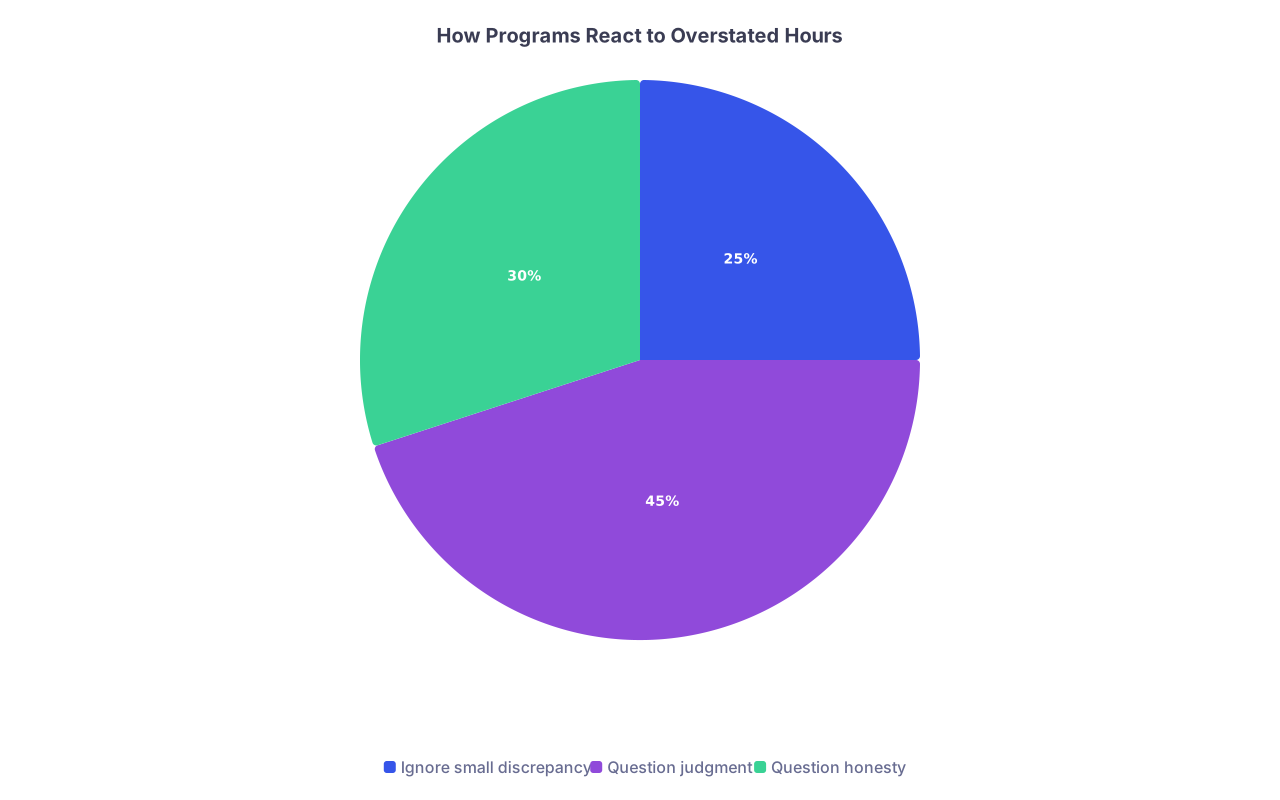
| Category | Value |
|---|---|
| Ignore small discrepancy | 25 |
| Question judgment | 45 |
| Question honesty | 30 |
How to avoid the “fake hours” trap
Use conservative, defensible estimates.
- Start from actual time blocks: “4 hrs/week, roughly 40 weeks = 160 hours.”
- Round modestly, not aggressively: 163 → 160, 287 → 275.
- If the hours were heavily front-loaded (e.g., summer only), do not span 4 years as if it were continuous. Put realistic start/end dates and reflect intensity in the description.
Red flag phrase in your own mind: “Well, if I add everything and round up a bit…”
If you are talking yourself into the number, it is probably too high.
And remember: no one rejects you for 120 hours instead of 200. They do quietly doubt you for 800 when the schedule says 300 is the ceiling.
2. Vague, Buzzword-Heavy Descriptions That Sound Like Filler
Another way to look dishonest: describing an activity like a brochure instead of like something you actually did.
Programs read the same fluff constantly:
- “Was responsible for patient care in a fast-paced environment.”
- “Demonstrated leadership, teamwork, and communication skills.”
- “Participated in multidisciplinary collaboration to improve outcomes.”
These could describe anything from a world-class project to restocking bandages twice a month. When nothing concrete is there, reviewers assume you are hiding how limited your role actually was.
The padding pattern
I see this over and over:
- Grand, abstract claims
- No numbers, no scope, no specifics
- Lots of verbs like “assisted,” “involved in,” “exposed to”
- Fancy language for a very small job
Example of obviously padded wording:
“Played a vital role in enhancing patient outcomes by collaborating with an interdisciplinary team and taking the initiative to improve clinic flow.”
Translation in a reviewer’s head: “Sat at the front desk and occasionally roomed patients.”
Fix it with specific, modest detail
Concrete > dramatic.
Bad:
“Led numerous quality improvement initiatives to enhance patient care.”
Better:
“Reviewed 50+ charts over 3 months to track rates of A1c checks in diabetic patients; helped present results at a resident noon conference.”
Notice what this does:
- Gives scale (50+ charts)
- Sets time frame (3 months)
- States your role (reviewed, helped present)
- Does not pretend you single-handedly transformed the hospital
You do not need to sound spectacular. You need to sound believable.

3. Title Inflation: Calling Yourself What You Weren’t
Nothing poisons trust faster than a grandiose title that does not match reality.
Some favorites I have seen:
- “Principal Investigator” for a med student who joined a faculty member’s ongoing project
- “Clinic Director” for a volunteer who ran sign-in and organized supplies
- “Lead Instructor” for someone who gave two review sessions
- “Founder & CEO” of a club with five friends and one event
Here is what faculty do: they ask themselves, “Would my institution ever give this role to a student?” If the answer is no, they discount everything that follows.
Common title mistakes
Adding “Co-” or “Lead” to make it impressive
If no one formally called you “co-director,” do not invent it.Using business-style titles in academic settings
“CEO,” “Chief Operating Officer of tutoring program.” This looks juvenile unless you truly ran a substantial organization with money, contracts, and reporting.Mislabeling research roles
You were a sub-I on a small part of a project. Calling yourself “PI” is not a gray area. It is just wrong.Taking faculty titles for yourself
If an attending is “Course Director,” you are not the “Student Course Director” unless there is official documentation.
Safe, honest alternatives
Use language that accurately reflects your contribution without shrinking it.
- “Student coordinator”
- “Student leader”
- “Project liaison”
- “Small group facilitator”
- “Organizing committee member”
And if you truly founded something, say so plainly:
“Founder, Student-Run Dermatology Interest Research Group (8 active members, 3 projects).”
That lands much better than “CEO, DermStudent Innovations LLC” for what was essentially a GroupMe and a spreadsheet.
4. Stuffing the Section With Micro-Activities To Look “Loaded”
You do not win points for the longest ERAS activity list. You do lose credibility for clutter.
The problem is piling in every one-off event and meaningless role to appear busy:
- “Volunteer, flu shot clinic (1 day)”
- “Participant, health fair (1 afternoon)”
- “Attendee, journal club (2 sessions)”
- “Shadowed Dr. X (8 hours)”
One or two of these, fine. A dozen or more, and your file screams: “Desperate for volume.”
Programs think in terms of signal vs noise. Too much noise and they start ignoring all of it.
Signals that you are padding
- Many activities have 5–20 hours
- Dozens of overlapping minor roles instead of a few sustained ones
- Repetition: multiple entries describing almost identical work at different sites
What this tells a reviewer:
- You might be exaggerating importance to compensate for thin core experiences.
- You do not understand what matters clinically or professionally.
- You like checking boxes more than committing.
How to clean this up
Combine similar micro-activities into one entry
“Community health outreach events (health fairs, vaccination drives, BP screenings), ~35 total hours across 5 events over 2 years.”Cut the trivial stuff
An 8-hour shadowing day with nothing notable learned does not need its own line. If it was formative, talk about it briefly in another entry or your personal statement.Prioritize sustained involvement
A single 200-hour clinic role beats ten 10-hour events, every single time.
| Pattern Type | Characteristics |
|---|---|
| Strong | 6–10 entries, mostly 80–400 hours each |
| Padded | 15–25 entries, many under 20 hours |
| Strong | Clear roles, progression, ownership |
| Padded | Many “member,” “attendee,” “participant” |
| Strong | Few, meaningful clinical experiences |
| Padded | Scattered, micro-volunteering |
If you look at your list and you feel overwhelmed, imagine a program director at 11:30 pm on the 120th application of the day. They will not be kind to padding.
5. Timeline and Overlap That Do Not Make Sense
ERAS reviewers do basic time math in their heads, even subconsciously. If your experiences create an impossible life, they will not assume you are superhuman. They will assume something is off.
Common problems:
- 2–3 “20 hours/week” roles all overlapping with full-time rotations
- Amazing research output (multiple papers) with minimal listed hours
- “Full-time” job plus “40 hours/week volunteer” at the same time
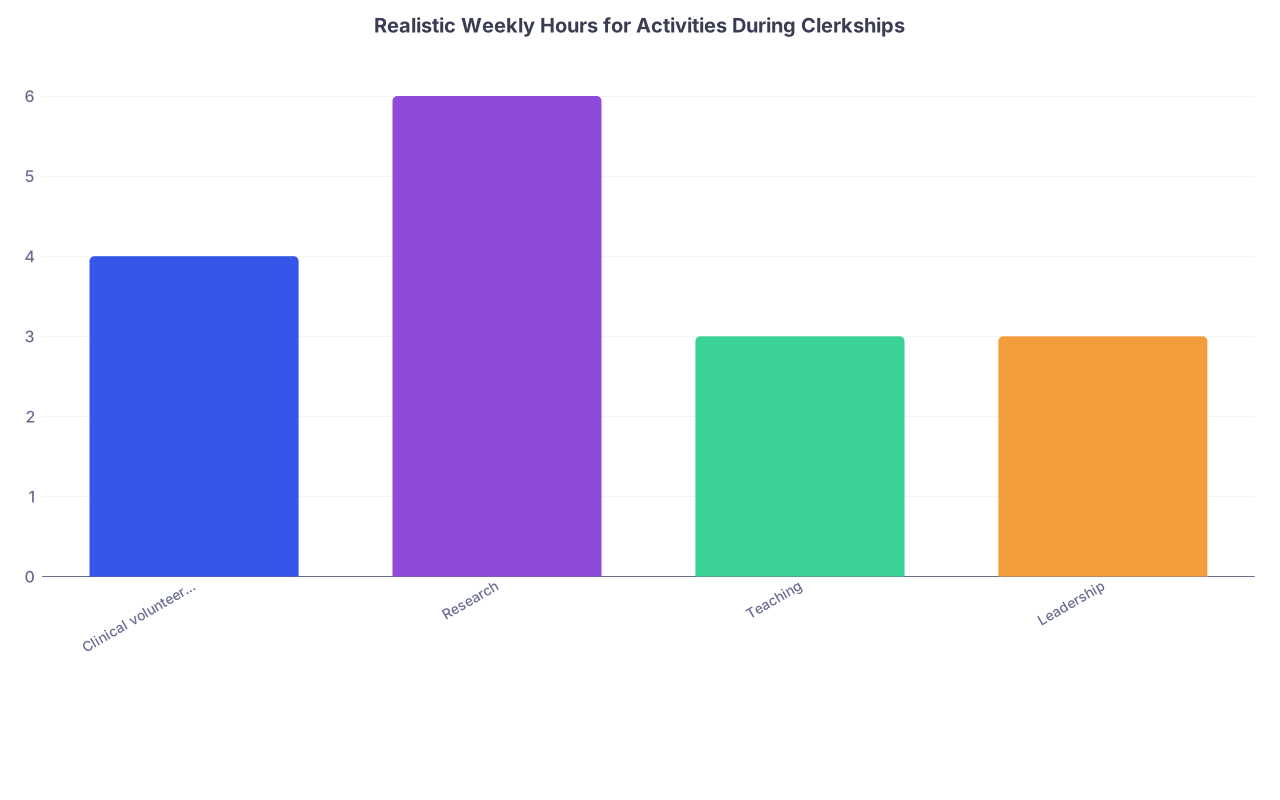
| Category | Value |
|---|---|
| Clinical volunteering | 4 |
| Research | 6 |
| Teaching | 3 |
| Leadership | 3 |
No one expects perfect accuracy, but they do expect plausibility.
Typical red-flag scenarios
The 80+ hour week every week
If your combined listed time (clerkships + jobs + research + volunteering) routinely exceeds what an adult could reasonably do, people notice.Time-warped productivity
“80 hours of research” but 3 first-author papers and 2 national presentations. Either the hours are underestimated or the outputs exaggerated. Either way, something does not line up.Undefined gaps filled later
You had a period where you struggled or took leave. That is fine. But pretending you were working full throttle during those times, while your transcript or MSPE tells a different story, creates a trust problem.
How to protect yourself
- Be conservative with weekly hour estimates, especially during clerkships. 3–5 hours/week of consistent volunteering during rotations is believable. 15–20 is usually not.
- Check for impossible overlap: if you list a full-time summer job at 40 hours/week and 30 research hours/week simultaneously, you need to explain one as flexible/variable or adjust.
You do not need to be perfect; you need to be internally consistent.
6. Over-Claiming Impact, Under-Describing Process
Programs are allergic to applicants who act like everything they touched turned to gold.
Warning signs:
- “Revolutionized clinic flow…”
- “Dramatically improved patient adherence…”
- “Significantly reduced readmission rates…”
All with no baseline, no follow-up data, and no real methodological description.
The problem is not having impact. The problem is claiming impact without evidence or scale.
Example of over-claiming
“Developed and implemented a new discharge protocol that significantly reduced 30-day readmission rates.”
What this triggers in a reviewer’s mind:
- Where is the data?
- Who analyzed it?
- Do 3 months on a sub-I truly “develop and implement” institutional protocols?
Now, try this instead:
“Contributed to a resident-led project on discharge instructions for heart failure patients by creating a one-page summary sheet and piloting it with ~15 patients over one month; results were presented at resident QI conference.”
This sounds real. Limited scope, clear role, honest outcome.
You are allowed to say “we do not have formal outcome data yet.” That will not hurt you. Faking significance will.
7. Language That Accidentally Hints at Dishonesty
Sometimes you give yourself away with your phrasing more than your facts.
Phrases that read as evasive or suspicious:
- “Was given the title of…” (usually used before an inflated title)
- “Personally in charge of…” (unnecessary defensiveness)
- “Single-handedly responsible for…” (no, you were not)
- “Countless hours…” (lazy, imprecise, looks like padding)
- “Various responsibilities including…” followed by generic tasks and no specifics
Also, watch for over-the-top self-praise:
- “Extraordinary”
- “Exceptional”
- “Unparalleled”
- “World-class”
Nobody believes it. Academics barely tolerate “excellent,” and even that is rare outside letters.
Use plain, factual language. Let the reader infer your strengths from the work, not the adjectives.
8. How to Make Your Experience Entries Look Honest and Solid
Let me give you a simple mental checklist before you submit.
For each entry, ask:
- Could I defend these hours in a detailed conversation?
- Would a reasonable person believe I held this title at my level?
- Does the time frame overlap logically with the rest of my life?
- Is my description specific enough that someone could picture what I actually did?
- Did I avoid dramatizing impact beyond what I can truly support?
If you cannot answer “yes” to all five, fix it.
Here is a simple structure that tends to work:
- One sentence: what the position was and where.
- One to two sentences: what you actually did, with concrete tasks.
- Optional one sentence: what you learned or how you grew, briefly and humbly.
Example:
Student volunteer at free primary care clinic serving uninsured patients. Roomed patients, took vitals, updated medication lists, and observed resident-supervised visits 3–4 hours/week over 2 years (~220 hours). Gained early exposure to chronic disease management, especially diabetes and hypertension.
This is unimpressive on paper? No. This is exactly the kind of grounded experience that convinces programs you understand real clinical work.

| Step | Description |
|---|---|
| Step 1 | Draft Experience Entry |
| Step 2 | Reduce/justify hours |
| Step 3 | Adjust title |
| Step 4 | Add concrete tasks/scale |
| Step 5 | Dial back claims |
| Step 6 | Entry likely safe |
| Step 7 | Hours realistic? |
| Step 8 | Title appropriate? |
| Step 9 | Specific description? |
| Step 10 | Impact overstated? |
FAQs
1. My school never tracked volunteer hours. How do I avoid looking like I am guessing?
Estimate using simple math and be visibly conservative. For example: “Volunteered 2–3 hours per week for 30 weeks/year over 2 years (120–150 hours, reported as 120).” That kind of transparency makes reviewers relax. They see the thought process and the choice to under-claim rather than exaggerate.
2. I listed a role as “co-director” but it was never formally written that way. Is that dishonest?
If no one ever used that title for you in emails, on a website, or in official materials, then yes, it risks looking dishonest. Change it to “student leader,” “student coordinator,” or “organizing committee member.” You keep the substance of your work without the title arms race that programs are tired of seeing.
3. I have a lot of short activities. Should I delete them or combine them?
Combine similar short activities under a single, honest umbrella entry and focus on the pattern rather than each event. For example, instead of five separate 8–10 hour events, create “Community health outreach events (~45 hours total across 5 events over 2 years).” Cut the truly trivial or redundant items. Depth, continuity, and clarity beat sheer count every time.
Remember three things.
First, unbelievable hours and titles do more damage than modest, accurate ones.
Second, vague, buzzword-heavy descriptions look like you are hiding how small your role really was. Specific, limited, honest beats grand and fuzzy.
Third, internal consistency—time, roles, and impact that line up—is what convinces programs you are trustworthy. Protect that above everything else.