
Red Flag Phrases in LoRs: Language That Signals Concern to Committees
Letter writers rarely say “this resident is unsafe.” They say it in code.
If you do not understand that code, you will misjudge your application’s strength, pick the wrong letter writers, and get blindsided when programs quietly move you down their rank lists.
Let me break down the language that actually worries committees, how they read between the lines, and what you can do about it before it torpedoes your Match.
How Committees Really Read Letters
Selection committees do not read letters as “stories.” They read them as data with subtext.
Most programs have some version of this mental framework when they scan a letter:
- How strong is the overall signal?
- Are they using “top-box” language or hedged language?
- Are there coded red flags about professionalism, safety, or reliability?
- Is the writer damning with faint praise?
And they do this fast. On a busy review night, an experienced PD can skim a letter in 15–30 seconds and pick up every red flag phrase without consciously trying. They have seen hundreds, sometimes thousands, of letters. Patterns are burned in.
Before we get into the specific phrases, you need to understand three contextual rules:
Context matters: specialty and culture.
“Quiet” in a psych applicant is not the same as “quiet” in an EM applicant. But excessive hedging is bad everywhere.Who is writing?
- A program director or clerkship director using cautious language is much more concerning than a community preceptor with softer standards.
- An assistant professor who routinely writes effusive letters but is oddly neutral for you? That is data.
Comparative language is king.
Committees look for where you sit relative to peers: “top 5%,” “one of the best I have worked with,” versus “adequate” or “meets expectations.” Those comparative phrases can make or break the interpretation of the rest.
The Big Three Red Flag Domains
Almost every damaging phrase falls into one of three buckets:
- Clinical competence and safety
- Work ethic, reliability, and teamwork
- Professionalism and interpersonal behavior
I will walk through specific red-flag phrases in each category, how committees interpret them, and what they actually signal about your performance.
1. Clinical Competence & Safety Red Flags
Programs will tolerate a lot. But not unsafe or unteachable.
Here is the sort of language that triggers concern:
a. Hedged competence
Phrases like:
- “With appropriate supervision, they are able to manage most common clinical scenarios.”
- “Given time, they can formulate a reasonable differential.”
- “With guidance, they can usually arrive at an appropriate plan.”
- “Once prompted, they are able to recognize and address critical issues.”
Translation: not ready for the typical level of independence expected of an intern in this specialty.
When a PD reads “with appropriate supervision,” they hear: do not let this person near sick patients alone at 3 a.m.
b. Slower-than-peers learning
- “They benefit from additional time to synthesize information.”
- “Improved steadily with ongoing feedback.”
- “Continues to work on integrating data into a cohesive assessment and plan.”
- “Will need continued support to develop confidence in independent patient management.”
These are mild-to-moderate academic concerns. The student is not failing, but not keeping up with the middle of the pack.
One that really makes people pause:
- “Although initially struggling, they ultimately achieved a satisfactory level of performance.”
“Ultimately” and “satisfactory” in the same sentence is code for “if the rotation were longer at this standard, they might not have passed.”
c. Knowledge gaps and weak exam skills
- “Knowledge base is still developing.”
- “Basic medical knowledge is adequate.”
- “Demonstrated sufficient understanding of core concepts.”
- “Appropriate for their level” without any superlative or positive qualifier.
“Adequate” and “sufficient” are poison words if used as the main descriptor. Committees expect letters to be at least mildly enthusiastic for a candidate you chose to support. When the strongest word is “adequate,” people notice.
d. Concerns about judgment or safety
Here is where PDs really start worrying:
- “Should seek help promptly when unsure.”
- “Will benefit from close supervision early in training.”
- “Occasionally required reminders about appropriate escalation of care.”
- “With more experience, their clinical judgment will improve.”
- “At times, has difficulty prioritizing critically ill patients or recognizing decompensation.”
These are near-fatal in emergency medicine, anesthesia, surgery, critical care–heavy fields. In less acute specialties, you might survive one such phrase if the rest of the letter is outstanding and specific. But it will absolutely lower your rank.
If you ever hear a faculty member say, “I am not sure you are ready for unsupervised overnight call” — you cannot afford that person’s letter.
2. Work Ethic, Reliability, and Team Red Flags
Programs can work with someone a bit slower if they show up, work hard, and are great with the team. They will not rank someone who is unreliable, lazy, or creates extra work.
a. Reliability / follow-through
Watch for:
- “Generally reliable.”
- “Usually completes assigned tasks.”
- “Can be counted on when expectations are clearly spelled out.”
- “Over time, became more consistent in following through.”
Those adverbs — “generally,” “usually,” “over time” — are red flags. They signal the writer has seen enough inconsistency that they will not just say “reliable.”
Stronger, worse signals:
- “Occasionally needed reminders to complete documentation.”
- “Sometimes required prompting to follow up on results.”
- “Will need support to prioritize tasks and complete them in a timely manner.”
Committees read this as: you create more work for interns, seniors, and attendings. Hard pass for many programs.
b. Work ethic / initiative
Damning phrases here:
- “Shows interest when engaged.”
- “Is receptive to learning opportunities presented to them.”
- “Participates in care when asked.”
- “Meets expectations for effort.”
- “Is present and completes the required work.”
This is code for: passive, not self-driven, not someone who leans in. Programs need residents who take initiative, not ones who act like visiting observers.
More bluntly negative:
- “At times, appeared less engaged during quieter periods.”
- “Could increase initiative in seeking out learning opportunities.”
- “Will benefit from greater ownership of patient care.”
One or two mild lines like this in an otherwise powerfully positive letter might not sink you. But stack it with anything else questionable, and you fall below the line.
c. Time management / organization
Another subtle but lethal cluster:
- “With support, can manage multiple patients.”
- “Still developing skills in managing competing demands.”
- “Occasionally needed help prioritizing tasks on busy days.”
- “Will benefit from continued growth in efficiency.”
These are especially problematic in high-volume specialties (IM in a busy academic center, EM, surgery). Programs know intern year is chaos. If you already look disorganized as a student, they worry what you will look like with 10 patients and a pager.
3. Professionalism & Interpersonal Behavior Red Flags
This is where programs are the least forgiving. They would rather take a slower learner who is humble and reliable than a brilliant jerk or someone with professionalism issues. Always.
a. Communication and “fitting in with the team”
These phrases look harmless to applicants. They are not.
- “Generally gets along with the team.”
- “Interacts appropriately with staff and peers.”
- “Accepts feedback.” (with no modifiers like “eagerly”)
- “Communicates adequately with nursing and other team members.”
These are “nothing nice to say” phrases. If the letter writer really liked you, they would say “exceptional teammate,” “trusted by nurses,” “sought out by peers,” “outstanding interpersonal skills.” “Adequate” or “appropriate” suggests you were fine, not great, and possibly there were some awkward dynamics the writer is being polite about.
Stronger red flags:
- “At times, communication style could be perceived as abrupt.”
- “May need to be mindful of tone when under stress.”
- “Occasionally struggled to integrate feedback into daily practice.”
- “Can be quiet on rounds and may need to speak up more consistently.”
That last one — “quiet” — is context dependent. If it appears alongside strong descriptors elsewhere (“outstanding knowledge, excellent documentation, loved by patients, somewhat quiet on rounds”), committees will not panic. If it is the only adjective, it reads as “socially awkward, does not engage.”
b. Professionalism, boundaries, and conflict
This is where the alarms really go off:
- “Had an isolated professionalism concern which has since been addressed.”
- “Required feedback related to timeliness / documentation / dress code / phone use.”
- “After feedback, showed some improvement in punctuality.”
- “Was involved in a misunderstanding with staff that required faculty intervention.”
- “Needed reminders to maintain professional boundaries with patients / staff.”
These phrases are extremely damaging. Programs are under relentless scrutiny for resident professionalism. Nobody wants to import a known problem.
Even softer versions, like:
- “Will continue to benefit from mentorship in professional development.”
That can be fine if embedded in an otherwise stellar letter that clearly explains growth. But if it stands alone as the only “growth” comment, people wonder what exactly happened.
c. Attitude and humility
Harmless-looking but dangerous:
- “Confident in their knowledge.” (with no “appropriately” in front)
- “Comfortable sharing their opinions.”
- “Strong personality that comes through on team.”
- “Advocates strongly for their views.”
Depending on the writer and the rest of the letter, this can be neutral. But if the person is known to be very careful in how they criticize, this kind of phrasing is often their polite way of saying “a bit arrogant,” “argues too much,” or “does not know when to stop talking.”
More explicit concern:
- “At times, could be more receptive to feedback.”
- “Will benefit from continued development of insight into own limitations.”
- “May need to work on accepting supervisory decisions when there is disagreement.”
These are major red flags. They scream trouble when the trainee is sleep-deprived and stressed.
Classic “Damning with Faint Praise” Patterns
Not all red flags are direct concerns. Some are patterns of what is not said and how the writer avoids commitment.
Here are patterns that committee members pick up immediately.
1. The “Neutral Superlative” Letter
Example structure:
- “I am pleased to write this letter on behalf of X.”
- “X completed their internal medicine rotation on our service.”
- “They arrived on time, completed their notes, and were respectful to patients and staff.”
- “In summary, I believe X will be a fine resident.”
Notice what is missing:
- No comparative language (“among the best,” “top,” “outstanding”).
- No specific patient stories or concrete examples.
- Everything is literal bare minimum: showed up, did the work, did not offend anyone.
If you see “fine resident,” “good candidate,” “solid resident” in a sea of generic adjectives, that is not a strong letter. That is a lukewarm reference.
2. The Overly Descriptive but Noncommittal Letter
This is the letter that reads like a rotation summary, not an endorsement.
- Long paragraphs describing the hospital, the patient population, and the structure of the rotation.
- Very detailed list of duties: “X pre-rounded on patients, presented on rounds, followed up on tests, and communicated with families.”
- In the “summary” paragraph, you get: “Overall, X met the expectations of the rotation.”
Programs know this trick. Writers who do not want to criticize but also do not want to endorse strongly will pad with neutral description. The entire letter could apply to any random student who passed. That is a silent red flag.
3. The “Growth but No Destination” Letter
Growth narratives can be powerful if they end with a clear statement of arrival: “By the end of the rotation, they were functioning at the level of an intern.”
The concerning pattern looks like this:
- “Initially struggled with time management but improved over the course of the month.”
- “Early on, needed reminders to follow up on tests, but this lessened with feedback.”
- “Worked on being more proactive in patient care; I am confident they will continue this trajectory.”
Notice: did they actually reach competence? Or did they just start improving from a low baseline? That ambiguity is not accidental. It is the writer refusing to say “this person is ready.”
How Programs Weigh Red Flag Phrases
Not all red flags are equal. A single mildly concerning phrase in an otherwise glowing letter is survivable. Multiple, consistent signals across letters? That is a problem.
| Red Flag Type | Typical Impact on Application |
|---|---|
| Mild hedging in one letter | Slight caution, rarely fatal |
| Multiple hedged phrases in same letter | Significant downgrade, lower on list |
| Explicit professionalism concern | Major red flag, possible screen-out |
| Safety/judgment concern | Often fatal in acute care specialties |
| Neutral/faint praise from PD/CD | Strong negative signal |
And yes, committees correlate this with the rest of your file:
- Low or barely passing clerkship grades + hedged letter = strong concern.
- Step scores at or below cutoff + neutrality in letters = easy rejection in competitive fields.
- Strong scores and research + professionalism concerns in letters = still huge risk. Many will not touch it.
To make this more concrete:
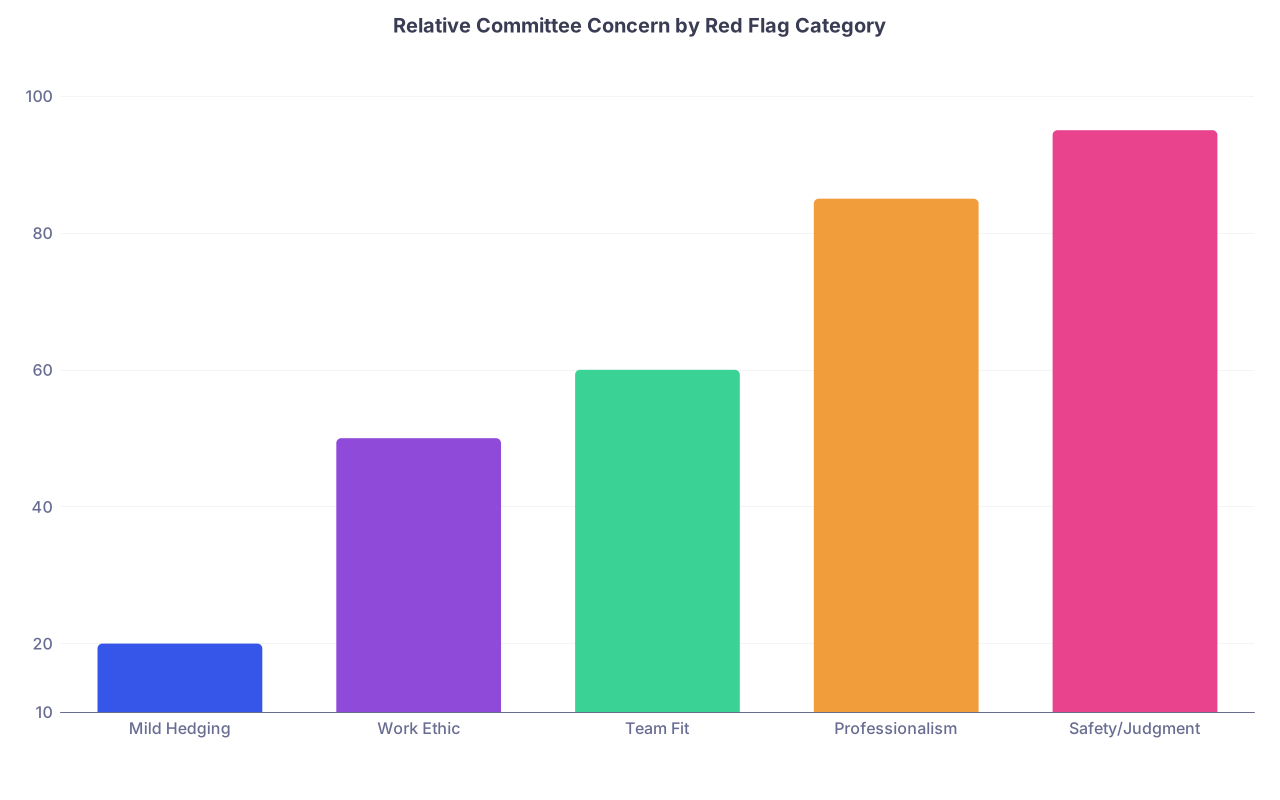
| Category | Value |
|---|---|
| Mild Hedging | 20 |
| Work Ethic | 50 |
| Team Fit | 60 |
| Professionalism | 85 |
| Safety/Judgment | 95 |
Scale: 0 = no concern, 100 = near-fatal. Safety and professionalism routinely top the list.
How to Avoid Red Flag Phrases Before They Happen
You cannot rewrite someone’s letter. But you have more control than most students think.
1. Be ruthless in letter writer selection
Do not chase big names who barely know you. Choose people who can genuinely say “one of the best.”
Strong choices:
- Attendings who have seen you handle stress, take ownership, respond to feedback.
- Faculty who have directly supervised you for at least 3–4 weeks (or longitudinally).
- People who have written strong letters for others and told you so explicitly.
Avoid:
- Anyone who gave you a marginal pass or barely-passing grade.
- Attendings who said, “You’re doing fine,” but never anything stronger.
- Faculty who seem cool or distant, or who write very short eval comments. That same detachment often shows up in letters.
And yes, you should explicitly ask:
“Do you feel you can write me a strong, enthusiastic letter for [specialty]?”
If they hesitate, pause, or downgrade to “supportive” or “positive” without “strong,” back away. I have seen too many students ignore a hesitant facial expression and then get their only mediocre letter from that person.
2. Address known weaknesses early
If you had:
- A professionalism incident
- A marginal evaluation for clinical skills
- Feedback about being quiet, disorganized, or defensive
You do not hide and hope. You fix behavior, seek fresh rotations with clean evals, and ideally get letters that explicitly describe improvement and current strength.
A very different signal is:
- “Earlier in training, X struggled with time management, but on this rotation they consistently managed a large census efficiently and independently. They now function at or above the level expected of an intern.”
That kind of growth narrative reassures committees. The key is the clear endpoint: “now functions at or above…”
3. Manage the logistics and timing
You want letters from your best rotations, not the easiest ones.
Some practical points:
- Front-load critical rotations in your chosen specialty so you can identify strong advocates early.
- If your core clerkship comments are mediocre, do not rely heavily on that clerkship director. Look for sub-I letters where you redeemed yourself.
- Give letter writers concrete material: your CV, personal statement draft, and a brief bullet list of patients or cases that highlight your strengths. That nudges them toward specific, positive examples instead of vague filler language.
Reading Between the Lines in Your Own Letters (Carefully)
Nowadays, many institutions let students see some or all evaluation comments. You will not always see the full LoR text (and you should still waive formal access in ERAS), but you may get a pretty good proxy from your end-of-rotation feedback.
Patterns to watch:
- Repeated phrases like “adequate,” “meets expectations,” “quiet,” “be more proactive.”
- No superlatives anywhere despite solid performance.
- Vague positives: “nice,” “polite,” “pleasant to work with” with no mention of clinical skill or ownership.
If you are seeing that repeatedly, you have a branding problem on the wards. You are coming across as safe but forgettable. That is exactly the kind of student who ends up with neutral letters that hold them back.
You fix that not with more test prep but with:
- Deliberately taking more ownership of patient care.
- Showing up early, volunteering for work, closing the loop on tasks.
- Asking for mid-rotation feedback and then visibly changing behavior.
One mid-rotation conversation worth having:
“I want to make sure I am on track to earn a letter that says I can function at an intern level in this specialty. What specific things should I be doing more or less of over the next two weeks to reach that bar?”
Most students never phrase it this directly. The ones who do usually improve fast — and attendings remember that.
How Committees Talk About These Letters
I will give you a flavor of the behind-the-door commentary, because it will calibrate your sense of how brutal this can be.
You will hear:
- “This PD letter is pretty lukewarm. Nothing terrible, but no top-box language.”
- “Any concerns about professionalism?” (everyone scans letters specifically for this)
- “This one says, ‘needs close supervision initially.’ For EM? No thanks.”
- “I do not like this ‘sometimes required prompting to complete tasks.’ We have enough fires; we do not need to babysit.”
- “Two letters mention issues with communication style. I am not touching that in this climate.”
On the flip side, if there is a growth narrative that lands well:
- “They had a rough third year but look at this sub-I letter — PD says they are functioning at intern level now. I am okay moving them up.”
Notice the pattern: committees are not hunting for perfection. They are hunting for risk. Red flag phrases are risk signals. Enough of them, and you fall below the risk tolerance threshold.
Visualizing the “Letter Risk Profile”
To bring this together, imagine a committee member mentally plotting you against three key risk domains when reading your letters:

If any one of those branches lights up in red from specific phrases, your application becomes “high-risk.” If two or three do, you are functionally out at many programs.
What To Do If You Suspect a Bad Letter
You will not often know for sure. But if:
- An attending gave you a barely passing grade.
- You had open conflict or a professionalism issue with them.
- Their written feedback was clearly negative or heavily hedged.
Do not ask them for a letter. That letter will not “soften with time.” They will write what they think, and because they feel duty-bound to be honest with colleague PDs, they will not sugarcoat the key concerns.
If the damage is already done (for example, you asked early, then later learned the evaluation was poor), you have limited options:
- If you have a strong, trusted advisor (PD, APD, dean), you can quietly ask whether that specific letter is helping or hurting. In some systems, they will give you guidance like “you probably do not want to use that one for all programs.”
- You can add more, better letters later in the season to dilute the impact, especially from sub-Is where you excelled. Strong specialty letters can partially overshadow a neutral core letter.
- You cannot pull an already-submitted letter from programs that have downloaded it. So the real move is prevention, not cure.
Final Words: The Real Takeaways
Committee members do not read your letters the way you do. They hunt for coded language, hedging, and patterns of concern.
Three key points to leave with:
- Phrases like “adequate,” “generally reliable,” “with supervision,” and “met expectations” are not neutral. They are mild red flags when used as the strongest praise in a letter.
- Professionalism and safety concerns in letters are often fatal. Even one such phrase can drop you off many rank lists, regardless of scores and research.
- You control more than you think. Choose letter writers who truly know and advocate for you, fix behavioral issues early, and seek rotations where you can generate clear, strong, example-rich letters that say what committees actually want to see: safe, reliable, proactive, and ready to function as an intern.