
Most ERAS experiences are boring, confusing, or both—and they quietly sink otherwise strong applications.
Let me break down exactly where applicants go wrong and how to fix it.
1. Misunderstanding What the Experiences Section Actually Does
The biggest mistake is conceptual: treating the ERAS experiences like a mini-CV instead of a curated, clinical narrative.
Program directors do not read your ERAS the way premed committees read AMCAS. They skim. Fast. They are hunting for:
- Evidence you understand the specialty’s day-to-day reality
- Proof you show up, do work, and do not create drama
- Signals of maturity, judgment, and reliability
- A few “hooks” that make you memorable in 5–10 seconds
What they are not looking for:
- An exhaustive list of every shadowing hour from college
- Ten versions of “I am passionate about helping others”
- Fluffy leadership titles with no impact behind them
You must stop thinking “How do I include everything I have done?” and start thinking “How do I make it insanely easy for a tired PD to see why I am safe, capable, and worth interviewing?”
That mental shift alone will help you avoid half the traps I am about to outline.
2. Formatting Traps That Make You Look Less Competent
Trap 1: Walls of Text in the Description Box
The classic offender: a 1,020-character gray blob with no line breaks.
ERAS technically allows you up to 1,020 characters per description. That is a ceiling, not a target. When you cram everything into one massive paragraph, here is what actually happens on the receiving end:
- Faculty skip it. Their eyes bounce off.
- They assume you cannot communicate clearly under constraints.
- They miss your key contributions buried in sentence 4.
A cleaner structure works better:
- 2–3 short paragraphs OR
- 1–2 short sentences + 2–4 tight bullet points
For example, instead of this:
I worked as a clinical research assistant in the Department of Cardiology at XYZ Hospital where I was responsible for enrolling patients in multiple clinical trials, coordinating study visits, obtaining informed consent, and collecting and entering data. Through this role, I developed strong communication skills by interacting with a diverse patient population and collaborating with physicians and nurses. I also participated in weekly research meetings where I presented preliminary findings and contributed to study design discussions. This experience reinforced my interest…
Do this:
Prospective clinical research assistant in the Cardiology Department focused on heart failure trials at XYZ Hospital.
Key responsibilities:
• Screened and enrolled >120 patients into 3 concurrent trials; obtained informed consent under attending supervision.
• Coordinated study visits and ensured >95% follow-up completion via phone and in-person reminders.
• Managed REDCap database entry for ~2,000 data points with regular QA checks.
• Presented interim enrollment and retention data at weekly lab meetings.
Same content. Completely different readability and credibility.
Trap 2: Inconsistent Formatting Across Entries
Another subtle killer: each entry looks like it was written by a different person.
Common inconsistencies:
- Random capitalization (Hospital vs hospital vs HOSPITAL)
- Switching between first person and telegraphic style
- Different tense usage for current roles in each entry
- Some entries with bullets, some with giant paragraphs, some with sentence fragments
Does this matter? To a PD who is screening 500 applications, yes. Inconsistency reads as carelessness.
Pick a style and stick with it:
- Tense:
- Current roles → present tense (“manage,” “coordinate,” “assist”)
- Past roles → past tense (“managed,” “coordinated,” “assisted”)
- Person: Either first person implied (“Manage clinic flow…”) or full-sentence past tense (“I managed clinic flow…”). I prefer the telegraphic style because it is tighter and faster to read.
- Headings: If you use mini-headings like “Responsibilities:” or “Impact:”, use them consistently in similar roles.
You are selling professionalism. Clean, consistent presentation is part of that.
Trap 3: Misusing the “Most Meaningful” (Top Experiences) Designation
ERAS gives you the option to highlight up to ten entries as “most meaningful.” People abuse this constantly.
Typical mistakes:
- Marking 10/10 entries as “meaningful” because “they all matter to me”
- Tagging a 2-day premed shadowing from college because it “changed my life”
- Highlighting overlapping or redundant experiences (three variations of “hospital volunteer”)
You are signaling priority. When everything is “most meaningful,” nothing is.
A better rule set:
- 3–6 “most meaningful” entries is usually ideal.
- At least half should be directly relevant to your target specialty:
- Rotations in that field
- Research in that field
- Longitudinal clinical work with similar patient population
- Reserve “transformative” language for things that actually shaped your path in concrete, demonstrable ways.
If you highlight something, the description needs to justify it. Not with feelings. With outcomes, growth, or responsibility that would matter to a clinician.
3. Content Traps: What You Choose to List (and What You Leave Out)
Trap 4: Overloading with Premed-Era Activities
You are not applying to college. You are not applying to med school. This is residency.
Still, I routinely see ERAS experiences like:
- Volunteer, Food Bank (2013–2014)
- Shadowing, Community Family Medicine (2012)
- Undergraduate Tennis Club Member (2011–2013)
Two questions program faculty actually ask each other when they see this:
- Did this student peak at age 19?
- Did they not do much during medical school?
You can include a few premed things if:
- They are major commitments (e.g., 2+ years as a paramedic, Teach for America, full-time scribe work).
- They set up a coherent story that continues into medical school (e.g., global health work that continues in med school global health projects).
But if you are filling your ERAS with college extracurriculars because you have thin medical school activity, that is a red flag you should address head-on by strengthening your final year or using your personal statement wisely—not by padding the experiences section.
Trap 5: Listing Every Single Rotation as an “Experience”
Unless you did something significantly beyond what every other student did, your core clerkships are not “experiences.” They are the minimum.
The trap:
Students try to boost their application by listing “Internal Medicine Clerkship,” “Surgery Clerkship,” “Pediatrics Clerkship” etc. as separate entries with generic blurbs. This adds zero value and wastes space and reader attention.
Exceptions where a rotation might justify an entry:
- You had a substantial role beyond typical student duties (e.g., formal QI leadership within the team, ongoing research project born from that rotation).
- You did an away rotation in your chosen specialty at a specific institution that matters for your application and you want to highlight particular outcomes, relationships, or projects.
Otherwise, let your MSPE and transcripts speak for your rotations. Use the Experiences section for things that differentiate you.
Trap 6: Over-emphasizing Leadership Titles with No Substance
“President, Dermatology Interest Group”
“Vice President, Surgical Society”
“Founder, Future Physicians for Global Equity”
Fine. But leadership in name only is transparent.
If the description sounds like:
Organized several lunch talks for medical students interested in dermatology and coordinated with faculty speakers.
You are not impressing anyone. That is basic logistics.
To justify leadership entries, you need:
- Scope: Numbers, budget, scale, reach.
- Change: What improved because you were there?
- Ownership: What did you build, fix, or rescue?
For example:
President, Dermatology Interest Group
• Expanded membership from 15 to 70+ students by restructuring events into hands-on skills workshops (dermoscopy, cryotherapy simulation).
• Secured $4,000 in departmental funding and industry sponsorship to support 3 new annual events and a student research stipend.
• Developed a structured faculty mentorship program pairing 25 students with 14 dermatology faculty, resulting in 9 new student-faculty research collaborations.
See the difference? That reads like actual responsibility, not a padding tactic.
4. Description-Level Traps: How You Talk About What You Did
This is where most people lose points fast.
Trap 7: Vague, Generic, Emotion-Heavy Descriptions
If your descriptions rely on phrases like:
- “I had the opportunity to…”
- “I was exposed to…”
- “I gained a passion for…”
- “I learned the importance of…”
You are wasting characters.
Program directors and faculty are concrete thinkers. They want to know three things:
- What did you actually do?
- How well did you seem to do it?
- What, if anything, came out of it (impact, product, skill, insight)?
Compare:
I learned the importance of clear communication with patients from diverse backgrounds and developed my interest in internal medicine.
versus:
Conducted 150+ standardized discharge teaching encounters on a general medicine service; iteratively adapted explanations for patients with limited literacy or English proficiency.
The second one implies maturity, repetition, pattern recognition, and patient exposure without ever saying “I’m passionate about communication.”
Trap 8: Overstuffing with Jargon and Buzzwords
On the other side, some students write as if they are submitting an NIH biosketch and hope the vocabulary will carry them.
Example of overkill:
Leveraged interprofessional collaboration to optimize evidence-based care delivery models and improve quality metrics through robust data-driven interventions.
This says nothing.
Translate buzzword salad into real English:
- Who were you working with?
- Doing what specific task?
- What changed because of your work?
Better:
Worked with a multidisciplinary team (pharmacist, nurse manager, attending) to redesign the discharge medication reconciliation process for a 24-bed cardiology unit, reducing average med list errors per patient from 3.1 to 1.4 over 3 months.
Still professional. Far more credible.
Trap 9: Turning Every Entry into a Personal Statement
Another frequent issue: attempting to inject “why I love X specialty” into every single experience, especially if tangentially related.
Example:
This experience confirmed my desire to pursue internal medicine because I enjoyed synthesizing complex patient presentations…
By the third time a reviewer reads that line from you, they stop believing any of it.
Your personal statement and, to some extent, your “most meaningful” experiences can carry your motivation narrative. The rest should be straightforward and descriptive, with only light interpretation when necessary.
Use interpretation sparingly, and only when you can tie it to observable behavior:
Repeatedly taking responsibility for following up on critical pending labs taught me to anticipate next steps in patient care and to think one step ahead of the team.
That is concrete reflection. It is not a melodramatic origin story.
5. Specialty-Specific Misalignment Traps
Here is where strong applicants quietly lose interviews: their experiences do not match what the specialty actually values.
Trap 10: Writing the Same Way for Surgery, Psych, Derm, and FM
Different fields care about different signals.
| Specialty | High-Value Signals | Common Misalignment |
|---|---|---|
| General Surgery | Grit, procedural exposure, team reliability, QI | Too much general community service, no OR substance |
| Internal Medicine | Longitudinal patient care, clinical reasoning, research | Purely short, episodic volunteerism |
| Psychiatry | Communication depth, longitudinal relationships, empathy in action | Vague “interested in stories” with no concrete roles |
| Emergency Medicine | Volume, multitasking, team communication under pressure | Only lab research and minimal ED or acute care exposure |
| Dermatology | Research productivity, attention to detail, aesthetics | Tons of general volunteer work, almost no derm-specific work |
Some examples of misalignment:
- Applying to surgery with experiences dominated by fundraising events and child tutoring, with one 4-week sub-I and no procedural or QI responsibilities noted.
- Applying to psychiatry with four research entries in basic science and almost nothing that involves real human interaction beyond “leader of soccer club.”
- Applying to EM with zero ED experience (scribe, tech, volunteer) and primarily tutoring and lab work.
Can you still match? Sure. But you are making your life harder.
The fix:
For each target specialty, include at least:
- One clearly clinical experience in a relevant environment (clinic, ward, OR, ED, psych unit, etc.).
- Evidence of the “soft traits” that field cares about, expressed through actions, not adjectives.
- If applicable, at least one research or QI experience that ties into the field, even tangentially.
6. Timing, Gaps, and Overlaps: Subtle Red Flags
Program directors look at your experiences timeline for patterns. They are trying to see if there were long periods where you did very little, or if you are hiding something.
Trap 11: Big Unexplained Gaps
Six-month nothing-burgers between graduation and M1, or between M3 and M4, stand out.
You do not need to overshare personal medical details or family crises, but you also cannot leave yawning blank spaces and hope no one notices.
Examples of reasonable, concise gap entries:
Family Care Responsibilities (Non-clinical)
• Provided full-time caregiving for ill family member for 4 months between M2 and M3 while coordinating medical appointments and home care services.
or
Independent Board Study
• Dedicated six months to full-time preparation for USMLE Step 1 following a leave of absence; worked with academic support services and improved practice scores from the 5th percentile to the 40th percentile.
You are showing you were doing something, not just playing video games for 6 months.
Trap 12: Unrealistic Time Commitments
Another quiet credibility killer: claiming 40 hours/week for 4 different roles over the same time period.
Faculty notice. They calculate.
Be honest and realistic with hours and weeks. If you truly did something full-time, make sure other overlapping entries reflect that with part-time or occasional hours.
If your ERAS looks like you were:
- Full-time student
- 30 hrs/week researcher
- 20 hrs/week scribe
- 15 hrs/week volunteer
…someone will either not believe you or assume you are wildly bad at estimating time.
7. Presentation Mechanics: Small Things That Add Up
These are small, but they accumulate into an impression of sloppiness or polish.
Trap 13: Sloppy Grammar, Typos, and Abbreviations
You do not need to sound like you are writing for the NEJM. But you do need to look like an adult professional.
Common problems:
- Site-specific shorthand that means nothing outside your institution (“HIMMS,” “CPC,” “Blue Team”)
- Unexplained abbreviations for procedures or tools that are not universal
- Typos in basic words like “responsible,” “collaborated,” “attending”
A quick pass by someone outside your school—ideally in your target specialty—can catch institutional jargon you do not recognize anymore.
Rule of thumb:
If an attending in another state would not understand the abbreviation, either expand it at first mention or skip it.
Trap 14: Inflated or Misleading Titles
Do not call yourself:
- “Co-investigator” if you were a research assistant entering data and consenting patients.
- “Lead clinician” if you were a student in a free clinic supervised by an attending.
- “Director” of anything that is just you and two friends.
Faculty know what typical student roles look like. Overinflating hurts credibility more than it helps your ego.
You can still describe substantial responsibility without lying:
Primary student coordinator for a weekly free clinic under attending supervision; managed 6–8 student volunteers per session and ensured appropriate attending coverage.
Clear, accurate, and shows leadership.
8. Strategic Use of Limited Space: What to Prioritize
You do not need to describe everything in maximal detail. You will simply exhaust your reader.
Strategic priorities:
Deep detail for:
- Experiences highly relevant to your specialty
- Longitudinal commitments (1+ year)
- Roles where you had real responsibility or created change
Moderate detail for:
- Short but intense clinical roles (sub-Is, away rotations, short research internships)
- Leadership positions with defined outcomes
Minimal detail for:
- Brief or older experiences that are included for timeline completeness but not central to your narrative
Trap 15: Equal Weight for Unequal Experiences
Students often give:
- 1,000 characters to a 2-day conference they attended
- 300 characters to a 2-year clinical research position
That is backwards.
If an experience is minor but you need to include it (for continuity or context), be ruthless:
Attendee, National Internal Medicine Conference
• Participated in 3 days of sessions on heart failure management, medical education, and health equity.
That is enough. No need to pretend it changed your life.
Reserve heavy detail for the work that actually shows who you are as a future resident.
9. A Quick Process That Avoids Most Traps
Let me give you a simple sequence that I have seen work repeatedly for applicants:

| Step | Description |
|---|---|
| Step 1 | Brain-dump all experiences |
| Step 2 | Select 10-18 core entries |
| Step 3 | Assign Most Meaningful to 3-6 key entries |
| Step 4 | Draft descriptions with actions & impact |
| Step 5 | Check specialty alignment |
| Step 6 | Clean formatting & consistency |
| Step 7 | External review by mentor |
Step-by-step:
- Brain-dump every potentially relevant activity from M1 onward (and only a few premed items).
- Select 10–18 entries that actually matter and tell a coherent story.
- Tag 3–6 as “most meaningful” based on relevance, responsibility, and growth.
- For each, write:
- 1–2 sentences of role + setting + scope
- 2–4 bullets of concrete actions + outcomes
- Look across the whole set and ask:
- Does this look like someone my specialty would want?
- Is there redundancy I can cut?
- Standardize formatting: tense, bullet style, capitalization.
- Get one specialty mentor and one non-specialty, detail-oriented friend to read for substance and clarity.
10. Concrete Before/After Example
Let me show you what all this looks like in practice.
Weak Version
Title: Volunteer, Free Clinic
Description:
I volunteered at a student-run free clinic serving underserved patients. I took histories, presented to attendings, and helped with patient education. This experience taught me the importance of caring for vulnerable populations and inspired my interest in internal medicine. I also worked with other students and learned about teamwork and communication in a clinical setting.
Problems:
- No scale (how many shifts, how many patients?)
- Generic reflection (“importance of caring for vulnerable populations”)
- No sense of specific responsibilities or growth
Stronger Version
Title: Student Volunteer, Community Free Clinic
Weekly student-run evening clinic serving uninsured adults with chronic disease.
• Completed focused H&Ps for ~5 patients per shift, then presented succinct assessments and plans to supervising attendings.
• Took responsibility for medication reconciliation and follow-up planning, including scheduling labs and referrals.
• Led development of a standardized patient education handout for hypertension in English and Spanish, now used at all weekly clinics.
• Over 18 months, volunteered at ~45 clinics, building longitudinal relationships with several patients with diabetes and heart failure.
This version:
- Quantifies commitment
- Shows specific clinical skills
- Includes a discrete, tangible product (handout)
- Hints at longitudinal care—very relevant for IM, FM, etc.
Notice there is no generic “this taught me…” sentence. The actions speak for themselves.
11. Visualizing Where You Are Overweight or Underweight
Sometimes applicants are heavily skewed without realizing it. A simple mental “pie chart” of your experiences helps.
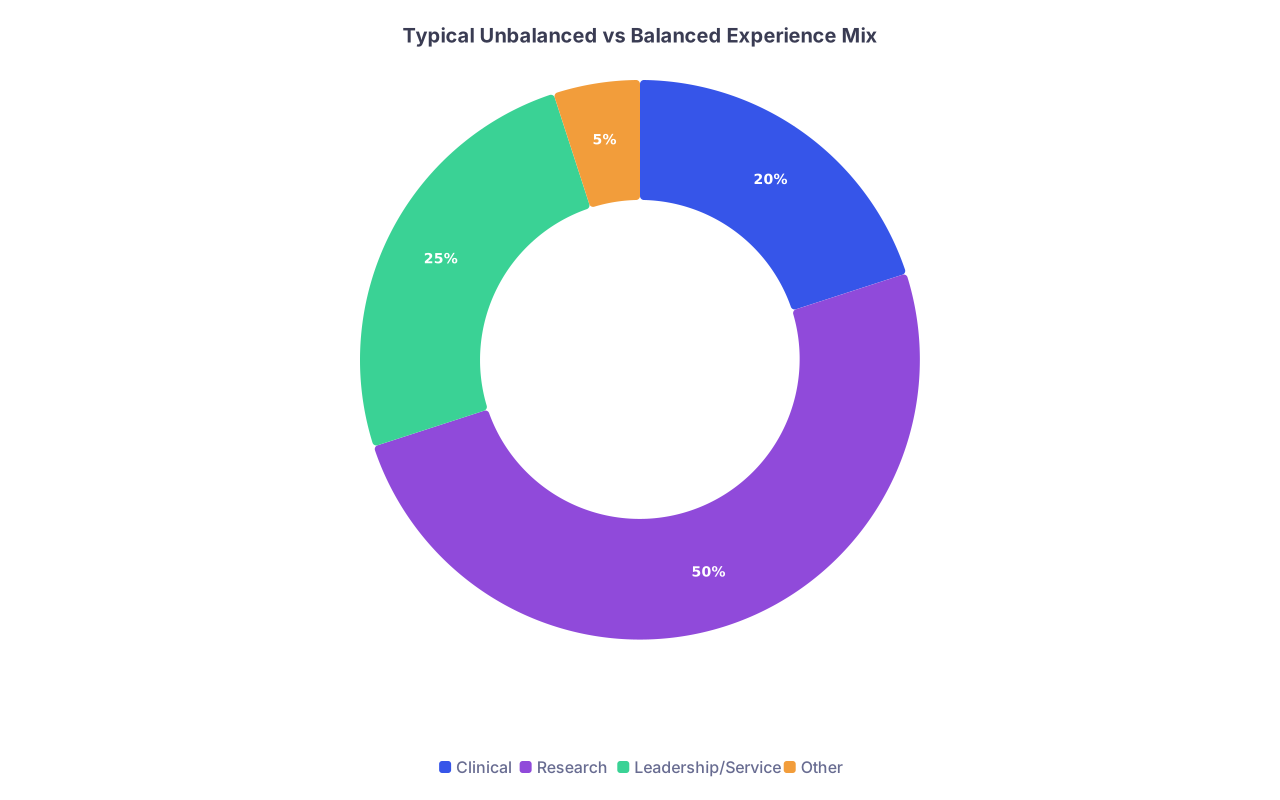
| Category | Value |
|---|---|
| Clinical | 20 |
| Research | 50 |
| Leadership/Service | 25 |
| Other | 5 |
In many unsuccessful applications for competitive specialties (derm, rads, ortho), I have seen something like:
- 50% research
- 20% clinical
- 25% leadership/service
- 5% random other
That might work for some programs. But if your clinical exposure to the field is token, your descriptions need to compensate by being unusually strong and concrete. Otherwise, you look like a lab person trying to be a doctor as an afterthought.
A more balanced profile for, say, internal medicine might be closer to:
- 40–50% clearly clinical
- 20–30% research/QI
- 20–30% leadership + service
You cannot fix content you never did, but you can at least avoid overemphasizing the wrong things in your descriptions.
Final Takeaways
Three points to keep front and center:
- The ERAS experiences section is not a scrapbook. It is a curated, clinical story. Prioritize relevance, responsibility, and clarity over sheer volume.
- Most traps are either formatting (walls of text, inconsistency, gaps) or content-related (vagueness, misalignment with specialty, inflated roles). Fixing them instantly makes you look more competent.
- Concrete actions and outcomes beat emotional statements every time. If a tired faculty member can skim your entries and clearly see what you did and why it matters, you are ahead of most of your competition.