
Only 11–15% of residency applicants with documented professionalism concerns in their MSPE match into their top three choice programs.
Let me be blunt: inconsistent professionalism narratives across your CV, letters of recommendation, and MSPE are one of the fastest ways to turn a “maybe” into a “no” during residency selection. Not because programs are unforgiving. Because inconsistency screams “risk.”
I want to walk you through what actually happens when your file hits a committee table and the pieces do not line up. Then how to fix, mitigate, or at least contain the damage.
1. How Programs Actually Read Your Professionalism Story
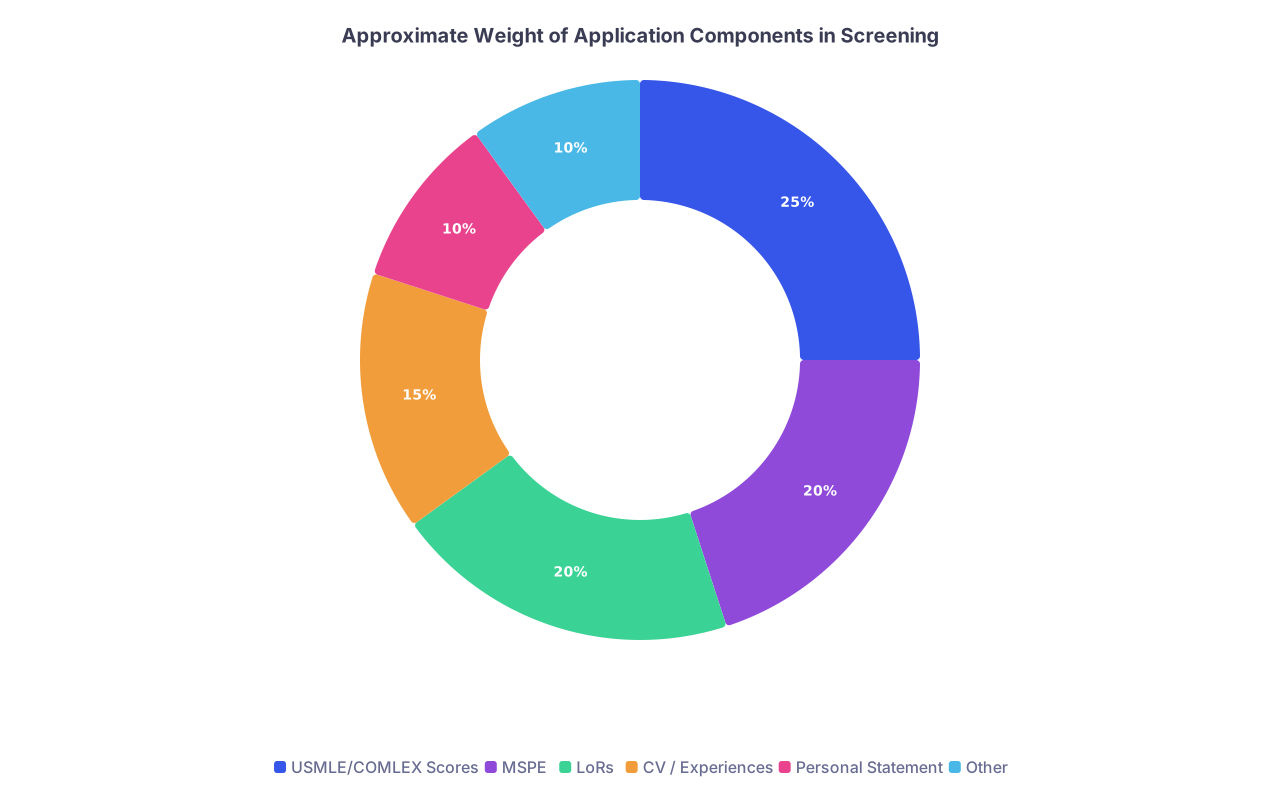
| Category | Value |
|---|---|
| USMLE/COMLEX Scores | 25 |
| MSPE | 20 |
| LoRs | 20 |
| CV / Experiences | 15 |
| Personal Statement | 10 |
| Other | 10 |
Here is the reality of many selection meetings. People do not start by reading your personal statement. They start with:
- USMLE/COMLEX scores (if used)
- MSPE (with special attention to any “concerns” section)
- Letters of recommendation (especially from known faculty)
- CV / ERAS Experiences
Then they cross-check. Very quickly. And they are not looking for perfection. They are looking for coherence.
What “professionalism” actually means to programs
In residency selection, professionalism is code for:
- Reliability: Do you do what you say, when you say?
- Integrity: Are you honest when things go wrong?
- Insight: Do you recognize your limitations and own your mistakes?
- Collegiality: Are you safe for the team? Or are you a headache?
So when a PD or APD sees one professionalism red flag, they immediately start asking: “Is this a one-off, or is this a pattern?” That is where discrepancies between CV, MSPE, and LoRs start killing your chances.
2. The Most Common Professionalism Misalignments (And Why They Raise Eyebrows)

I will break down the exact patterns that make faculty lean back in their chairs and say, “Something is off here.”
2.1 Missing or sanitized professionalism events on your CV
Scenario I see regularly:
- MSPE: Mentions a “professionalism concern” during third-year surgery—chronic tardiness requiring formal counseling, remediated.
- CV: Lists the same surgery clerkship with “Honors” and glowing bullet points; zero mention of remediation, no sign of any interruption.
- LoR from surgery faculty: Completely silent about professionalism, focuses solely on fund of knowledge.
What this reads like to a program:
- The student is minimizing or hiding the issue.
- The institution had to disclose, which means it was serious enough.
- No evidence of reflection or growth → unresolved risk.
Not including the remediation itself is fine; ERAS CV does not have a “Remediation” line item. The problem is when you present that rotation as unblemished excellence in your narrative and personal statement while the MSPE is clearly documenting a professionalism intervention.
2.2 LoRs that contradict the MSPE tone
Different but equally damaging pattern:
- MSPE: “Student had difficulty with professional behavior related to communication with staff and peers. Required meeting with the student affairs office. Subsequently improved.”
- LoR from same institution / same service: “This student is one of the most professional and mature students I have worked with. No concerns whatsoever.”
Program reaction: “So which is it?”
Faculty talk to each other. They know institutional styles. If one document is unusually glowing while the dean’s letter is cautiously worded, they wonder:
- Did the writer actually know the student well?
- Is the letter inflation compensating for a known weakness?
- Is the school trying to “balance” a required professionalism disclosure?
Mismatched tone is as problematic as mismatched facts.
2.3 Dates and gaps that silently expose problems
Professionalism issues often correlate with:
- Leaves of absence
- Extended time to graduation
- Repeated clerkships
- Sudden change in site for a core rotation
If your CV collapses those gaps (e.g., you “smooth” dates to look continuous) while the MSPE clearly shows an interruption or extended timeline, you have a credibility problem before anyone even reads the LoRs.
Programs understand life happens—illness, family issues, even burnout. But if you try to erase the gap, they assume the worst: suspension, probation, or professionalism discipline.
2.4 Overstated roles that conflict with faculty descriptions
Example I have seen almost word-for-word:
- CV: “Led quality improvement project in the ICU; implemented new handoff protocol across the unit.”
- LoR from ICU attending: “Student assisted with data collection on a QI project led by our residents.”
You just went from “leader” to “note-taker.” And that reads as a professionalism issue: inflation, lack of honesty, inability to accurately represent your contribution.
Exaggeration itself is a professionalism concern. Many PDs rank that on par with a minor documentation incident.
3. How Programs Triage Professionalism Discrepancies

| Step | Description |
|---|---|
| Step 1 | Application Reviewed |
| Step 2 | Standard review |
| Step 3 | Search for pattern |
| Step 4 | Single contained issue |
| Step 5 | High-risk file |
| Step 6 | Consider with caution |
| Step 7 | Lower on rank list |
| Step 8 | Case-by-case discussion |
| Step 9 | Screen out or rank very low |
| Step 10 | Any professionalism mention in MSPE? |
| Step 11 | Discrepancy between MSPE, CV, LoRs? |
| Step 12 | Evidence of growth? |
| Step 13 | Strong advocate on faculty? |
Programs do not have infinite time. Most run something like this mental algorithm:
Any professionalism mention in the MSPE?
If yes, they pause. That file is no longer “routine.”Do the CV and LoRs confirm or contradict the MSPE?
- Consistent story + clear remediation → maybe still interview.
- Conflicting or evasive narrative → often quietly dropped.
Is there evidence of growth and insight?
Personal statement, “adversity” essay, or advisor comments that own the issue and show change can save you. Silence usually cannot.Is there an internal champion?
If a trusted faculty member emails the PD: “I know this student, the issue is genuinely resolved,” your file gets a different kind of attention.
Discrepancy pushes you from “risky but maybe redeemable” into “too much work to decipher.” Remember, they have hundreds of applications where the story is straightforward.
4. The Main Discrepancy Types and How To Handle Each
| Discrepancy Type | Risk Level | PD Interpretation |
|---|---|---|
| MSPE mentions event, CV silent | High | Hiding or minimizing issue |
| CV exaggerates role vs LoR description | High | Integrity / honesty concern |
| Dates/gaps differ between documents | High | Suspected discipline/LOA |
| MSPE neutral, LoR vague or lukewarm | Medium | Quiet concern, under the radar |
| MSPE suggests growth, PS ignores it | Medium | Poor insight / lack of reflection |
| Different tone between LoRs | Medium | Inconsistent behavior / variable performance |
4.1 When your MSPE has a professionalism hit but your CV is “clean”
You cannot edit the MSPE. That ship has sailed. What you can control:
- Strip the CV of obvious spin. Avoid superlatives like “outstanding,” “exceptional,” “model student” on a rotation where an issue was documented.
- Use neutral, factual language for that experience: tasks, skills, outcomes.
- Address the professionalism event once—thoughtfully—in your personal statement or a separate short “context” statement if your school allows it.
What you do not do:
- Pretend the issue never happened.
- Make self-serving claims that directly contradict the dean’s letter (e.g., “Always praised for punctuality” after a tardiness write-up).
4.2 When your LoR ignores or contradicts the professionalism narrative
If you already have those letters, the fix is limited. What you can still do:
- Choose which letters you actually send. If one is out of sync with the MSPE in a way that makes you look dishonest or “too perfect,” you may be better off not using it, even if the writer has a big name.
- Balance the narrative in your personal statement. Acknowledge the professionalism event and show humility and learning. That reframes any “too glowing” LoR as someone seeing your best side, not as evidence of dishonesty.
If you have not collected letters yet, be explicit with your writers:
- “My MSPE will include a professionalism comment about [X]. I have worked hard to address this. If you feel comfortable, I would appreciate if you could briefly mention how I performed professionally on your service now.”
That way the letter confirms that whatever happened is not a chronic trait.
4.3 When dates, gaps, or LOAs do not line up
Fix this immediately. Sloppy date games look like lying.
- Make the CV dates match exactly what appears in your MSPE.
- Use ERAS’s “Education interruptions” or “Additional Information” space to briefly explain any gap or extended training: one or two honest, non-dramatic sentences.
Example:
“Took a personal leave of absence from Jan–Jun 2023 for health reasons, fully resolved. Returned to full clinical duties July 2023 and completed all remaining requirements on schedule.”
Programs do not need your full medical or personal history. They do need a plausible, consistent explanation.
5. Proactive Strategy: Building a Coherent Professionalism Story
This is where most students fail—they get reactive instead of structuring an intentional, consistent story across documents.
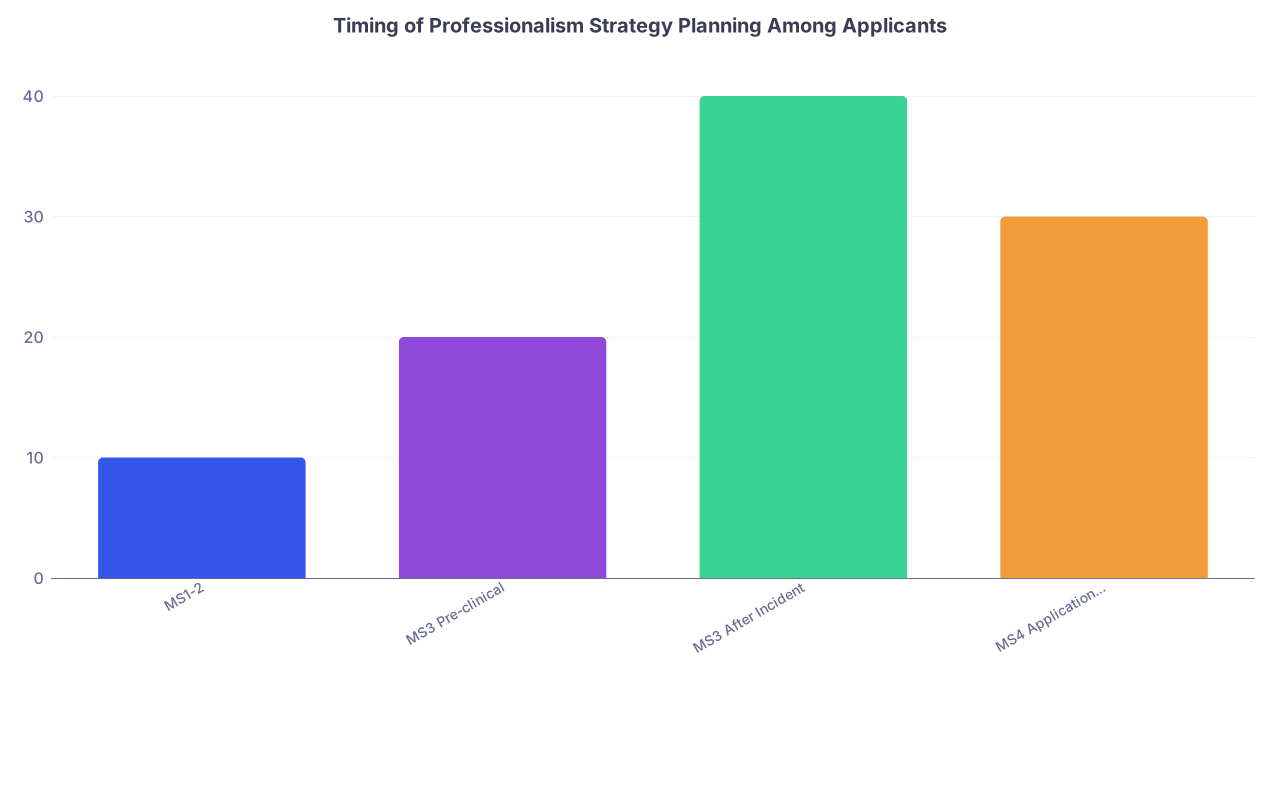
| Category | Value |
|---|---|
| MS1-2 | 10 |
| MS3 Pre-clinical | 20 |
| MS3 After Incident | 40 |
| MS4 Application Season | 30 |
Most people only start thinking about professionalism documentation after an incident. That is late, but not too late.
5.1 Before letters and MSPE are finalized
If you know a professionalism event is on your record:
- Meet with your dean or student affairs before MSPE drafting. Ask directly:
- “How will this be described?”
- “Is there space to include my remediation and improvement?”
- Request that any remediation outcomes or positive later feedback be included. Many deans are open to balanced language if they can justify it.
Then, pick LoR writers who actually witnessed you after the incident. You want at least one letter that can credibly say, “This student functions as a reliable, mature member of the team now.”
5.2 Writing your CV with discipline
Your CV should read as:
- Precise
- Factual
- Undramatic
Red flags:
- Overclaiming leadership (“Led,” “Directed”) when you were clearly junior.
- Inflated titles for roles that do not exist (“Chief Student Coordinator of…” for a casual volunteer activity).
- Achievement language that contradicts known problems (e.g., “Recognized for professionalism” with no supporting specifics).
Translate experiences into concrete, verifiable contributions:
Instead of:
“Implemented new ICU communication protocols and trained staff.”
Use:
“Contributed to development of ICU handoff checklist; presented pilot data to unit leadership.”
Still strong. Not dishonest.
5.3 Personal statement: where you show insight, not excuses
If your professionalism issue is significant enough to appear in the MSPE, ignoring it in the personal statement makes you look unaware or evasive.
The right way to address it:
- Briefly name it without dramatic detail.
- Take clear responsibility. No passive voice. No blaming.
- Describe what you changed in your behavior or systems.
- Connect that growth to why you are safer and better now as a trainee.
Wrong:
“Due to miscommunications and unfair expectations, I was written up for professionalism, which was very frustrating.”
Better:
“During my third-year surgery rotation, I received formal feedback about repeated tardiness and incomplete pre-rounding. I initially felt defensive. Over time, I realized my time management and communication with the team were not at the level expected of a physician. I began arriving early, using structured checklists, and proactively confirming expectations with residents. My subsequent rotations reflected these changes, and I have not had further professionalism concerns.”
Programs respect that kind of ownership.
6. Repairing Damage If You Already Have Discrepancies
Maybe you are reading this after your MSPE was locked and letters are uploaded. The inconsistencies are baked in. You still have levers.
6.1 Identify exactly where the inconsistencies are
Do a brutal side-by-side comparison:
- MSPE professionalism section
- ERAS experiences and dates
- All LoRs (get copies if your school permits)
- Personal statement draft
Look for:
- Divergent descriptions of the same event or role
- Date mismatches
- Tone paradoxes (MSPE cautious, one LoR absurdly glowing)
- Missing explanations of gaps or repeats
Name each discrepancy. Then decide: Can I fix it (edit), contextualize it (PS or additional info), or just avoid amplifying it (choosing different letters)?
6.2 Use interviews to align the narrative
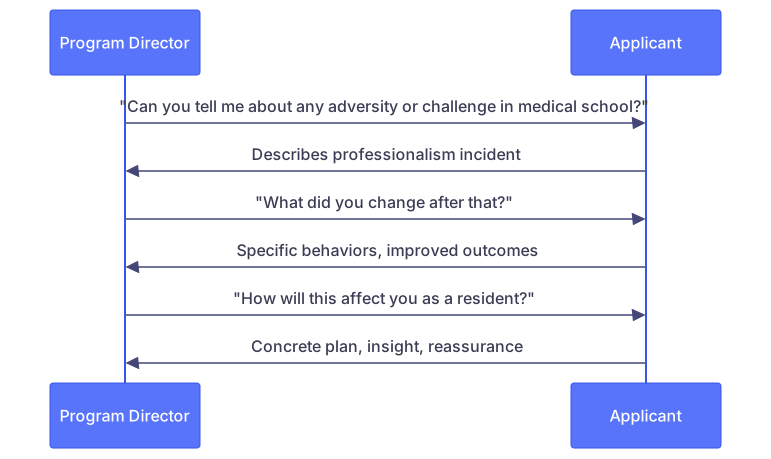
If you get an interview with known professionalism/discrepancy issues, assume someone will ask about it explicitly or implicitly.
Bad approach:
- Vague references “I had some challenges but I learned a lot.”
- Blaming rotation, school, or one “unfair” evaluator.
- Contradicting what is written in the MSPE.
Effective approach:
- Start with: “You will see in my MSPE that…”
- Describe the same event using the same key facts as the MSPE.
- Fill in what the documents cannot show: reflection, changed behavior, and concrete subsequent success.
- Show how this has changed your approach to communication, documentation, or teamwork.
The goal is not to erase the concern. It is to turn it into evidence of resilience and capacity for growth.
6.3 Strategic program selection
Brutal truth: Some programs will not touch any professionalism concern. Others are more nuanced.
You improve your odds by:
- Applying more broadly, including community and mid-tier academic programs that regularly work with non-traditional or non-linear trainees.
- Looking for programs where leadership explicitly mentions second chances, holistic review, or supporting students with challenges (ask upperclassmen; they know).
But none of that helps if your application looks dishonest or inconsistent. Consistency buys you a chance. Inconsistency gets you filtered before anyone weighs your potential.
7. Final Checks: Preventing Self-Inflicted Professionalism Damage
Before you certify and submit ERAS, run a final, focused audit. Not for typos. For professional integrity.
Ask yourself:
- Do all dates match across CV, MSPE, and any institutional transcripts?
- Are any roles or titles likely to sound exaggerated to someone at my institution?
- Does my personal statement acknowledge the same reality described in my MSPE, where relevant?
- Do I have at least one letter that reflects who I am after any professionalism issue?
If the answer to any of those is “no,” you still have time to adjust your narrative—even if you cannot change the MSPE.
FAQ (Exactly 6 Questions)
1. If my MSPE mentions a professionalism concern, do I have to address it in my personal statement?
If the concern is more than a vague “needed additional feedback,” yes, you should address it briefly. Programs will see it. Ignoring it signals lack of insight. One short, honest paragraph owning the issue and describing growth is far better than total silence.
2. What if my school’s MSPE feels harsher than what actually happened?
You usually cannot rewrite the MSPE, but you can ask for clarification or balanced wording before it is finalized. Bring concrete evidence of improvement: later evaluations, emails, or remediation completion. If the final MSPE still feels harsh, use your personal statement and LoRs to demonstrate that the behavior has changed and that later performance was strong.
3. Should I avoid asking for a LoR from a rotation where I had professionalism issues?
If the issue was unresolved or the attending clearly did not trust you, yes, avoid that writer. However, if you remediated and later worked with the same team successfully, a letter describing your improvement can be powerful. It shows the concern was real but not permanent.
4. How bad is it if my CV slightly exaggerates my role compared with the LoR?
“ Slight” exaggeration rarely looks slight to programs. When a letter says “assisted with data collection” and your CV says “led and implemented,” that is a character issue, not a style choice. Align your CV with what a reasonable faculty member would agree you actually did. Err on the side of underclaiming, not overclaiming.
5. Will a single professionalism blip automatically keep me from matching?
Not automatically. I have seen students with a single, well-explained professionalism event match into solid programs, including competitive ones, when everything else was strong and the story was consistent. What devastates applications is a pattern of concerns or clear attempts to minimize or distort the record.
6. If my documents already conflict, is it better to explain more or stay vague?
More—but disciplined—explanation is better than vague hand-waving. Name the issue, match the basic facts in the MSPE, and focus 80% of your explanation on what changed afterward. Over-disclosing emotional detail or blaming others will hurt you. A concise, factual, responsibility-focused explanation will not.
Key points:
- Programs care less that you made a professionalism mistake and more that your CV, LoRs, MSPE, and narrative all tell the same honest story.
- Exaggeration, missing gaps, and contradictions across documents read as new professionalism problems—integrity issues—on top of whatever is already in your record.
- You cannot rewrite your past, but you can present a coherent, accountable, and mature professionalism story that keeps you in serious consideration instead of on the discard pile.