
The most common match mistake is not being “too weak” for a specialty. It is ranking too few programs for your actual competitiveness.
The hard numbers: how many ranks do you really need?
Let me be blunt. The average unmatched U.S. senior in a competitive specialty did not lose because of one bad interview or a typo in ERAS. The data from NRMP is very clear: they simply did not rank enough programs for their risk profile.
Look at what the NRMP’s “Charting Outcomes in the Match” and “Results and Data” reports show, year after year. For U.S. MD seniors:
- By about 12–14 ranks in most core specialties, the probability of matching is already >95%
- But that statement hides a dangerous detail: that curve assumes you are an average matched applicant for that specialty
If you are below-median on Step 2, or below-median on research for that field, or you have a red flag, your personal curve shifts right. Meaning: you need more ranks to reach the same probability of matching.
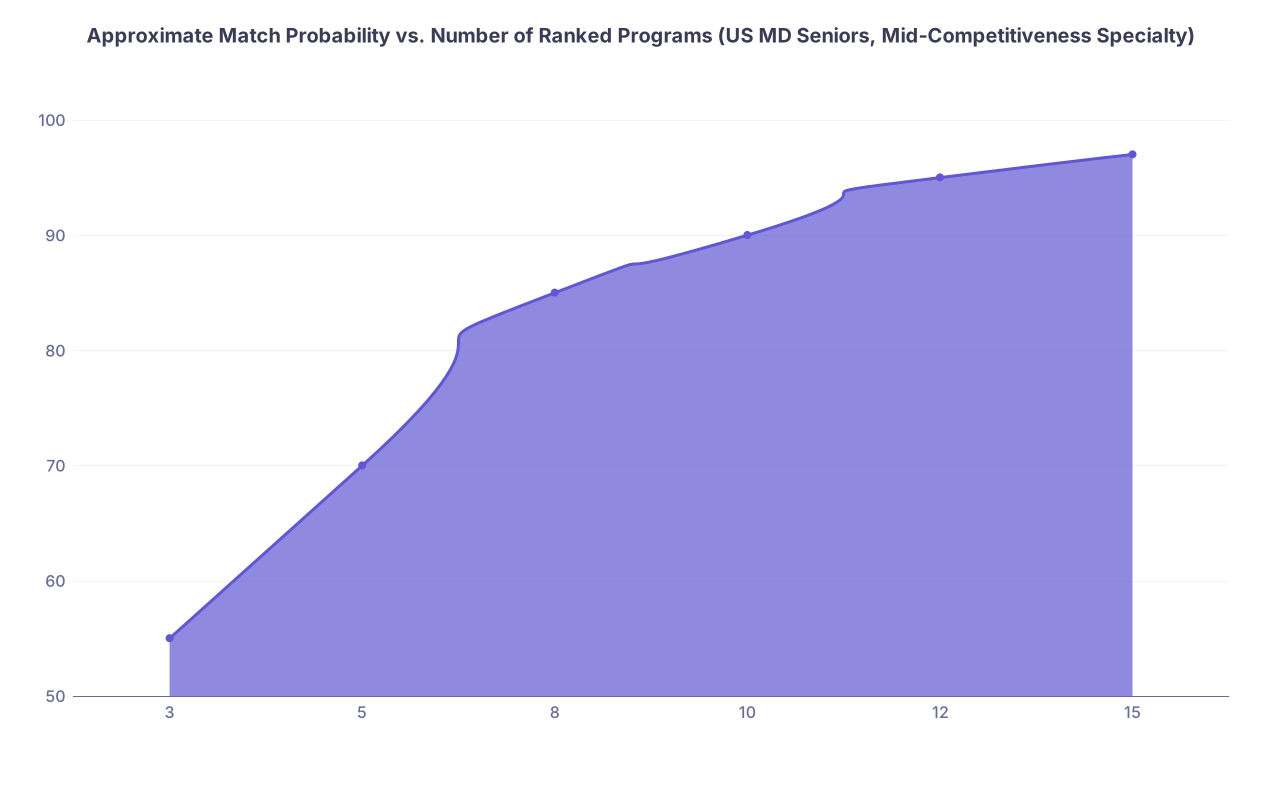
Let’s ground this in some approximate, rounded numbers that mirror the NRMP trend lines.
| Category | Value |
|---|---|
| 3 | 55 |
| 5 | 70 |
| 8 | 85 |
| 10 | 90 |
| 12 | 95 |
| 15 | 97 |
The curve is classic: steep gains from 3 to 8, then diminishing returns beyond about 12. That shape shows up across Internal Medicine, Pediatrics, Psychiatry, even General Surgery, with shifts depending on competitiveness.
The mistake people make is using that “average curve” when they are not actually average for that specialty.
Competitiveness tiers: where you sit changes the threshold
You cannot talk about “how many programs is enough” without stratifying specialties. The data behaves differently by competitiveness.
I tend to think in four tiers, based on fill rate, applicant-to-position ratio, and historical unmatched rates for U.S. seniors.
| Tier | Example Specialties | Fill Rate (US+IMG) | US MD Unmatched Risk |
|---|---|---|---|
| 1 – Ultra | Derm, Plastics, Ortho, ENT, Neurosurg | 98–100% | High (15–30%+) |
| 2 – High | Anesth, EM, Gen Surg, Urology, Rad Onc | 95–99% | Moderate (8–15%) |
| 3 – Moderate | IM, Peds, Psych, OB/GYN | 95–99% | Lower (4–8%) |
| 4 – Lower | FM, Path, Neuro, PM&R | 90–97% | Lowest (2–6%) |
These are rough ranges, but the pattern is stable: Tier 1 has many more qualified applicants than spots. Tier 4 occasionally has unfilled spots.
You then overlay your profile on top of that:
- Above average: ≥75th percentile for that field on Step 2, meaningful research or strong letters in-field
- Average: near the median for matched applicants
- Below average: below median Step 2 or weaker in-field profile, or a notable red flag
Now we can talk about data-driven thresholds instead of vague advice.
Data‑driven rank list thresholds by tier
These are approximate “safer” minimums for U.S. MD seniors if the goal is ~95%+ probability of matching somewhere in that specialty. They are deliberately conservative:
Tier 1 (Derm, Plastics, Ortho, ENT, Neurosurg):
- Above average: 18–22 ranks
- Average: 22–28 ranks
- Below average: 28–35+ ranks
Tier 2 (Anesth, EM, Gen Surg, Urology, etc.):
- Above average: 14–18 ranks
- Average: 18–22 ranks
- Below average: 22–28 ranks
Tier 3 (IM, Peds, Psych, OB/GYN):
- Above average: 10–12 ranks
- Average: 12–15 ranks
- Below average: 15–20 ranks
Tier 4 (FM, Path, Neuro, PM&R):
- Above average: 8–10 ranks
- Average: 10–12 ranks
- Below average: 12–15 ranks
If you are DO, IMG, or have significant red flags, shift those numbers up by about 20–40%.
Do people match with fewer ranks than this? Yes. Every year someone matches Ortho with 10 ranks. That does not make it smart strategy. It means they were on the right side of probabilities and program preferences aligned.
The probability problem: why “I have 8 strong programs” is still risky
Here is the core misunderstanding: applicants behave as if each rank is a sure thing if “the interview went great.” The data says otherwise.
The NRMP’s matching algorithm favors applicants, but program rank lists matter. If a program ranks you 20th for 10 spots, you are not matching there if their top 10 all want them. That is not pessimism; that is just simple combinatorics.
A useful mental model is to treat each program as having some individual probability of matching you. Let’s be charitable and assume your average probability of matching at any one program on your list is 10–15%. That is pretty good.
The probability of not matching at any program is then roughly:
- If p = probability of matching at a given program
- n = number of programs
- Probability of no match ≈ (1 − p)^n
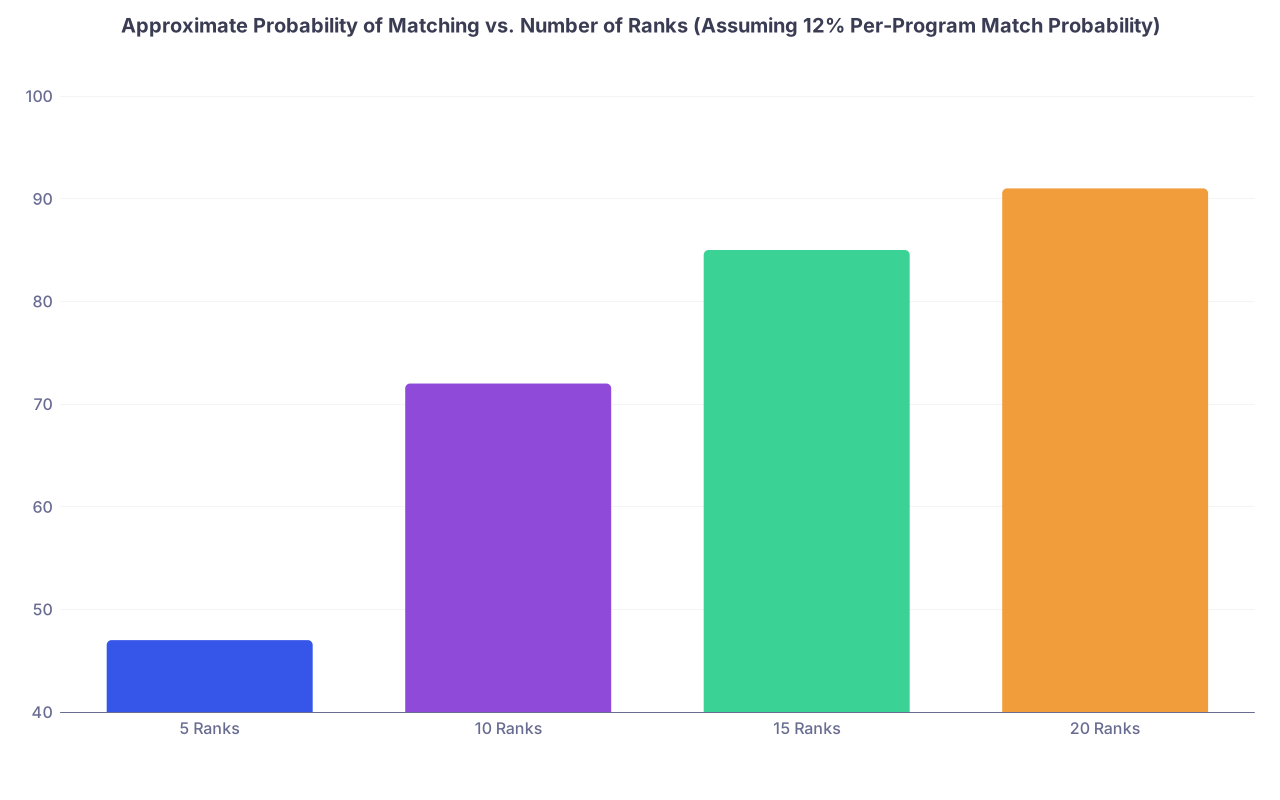
Let’s play that out for p = 0.12 (12% per program, which is actually generous in many competitive fields):
- 5 programs: (0.88)^5 ≈ 0.53 → ~47% chance of matching
- 10 programs: (0.88)^10 ≈ 0.28 → ~72% chance of matching
- 15 programs: (0.88)^15 ≈ 0.15 → ~85% chance of matching
- 20 programs: (0.88)^20 ≈ 0.09 → ~91% chance of matching
Notice how going from 5 to 10 ranks nearly halves your odds of going unmatched. That is why the early part of the NRMP curve is so steep.
Now layer on reality: your per‑program probability is not constant. Some rank you highly; some barely rank you. Your actual curve is messy. But the general pattern holds: small rank lists dramatically increase the variance in outcomes.
| Category | Value |
|---|---|
| 5 Ranks | 47 |
| 10 Ranks | 72 |
| 15 Ranks | 85 |
| 20 Ranks | 91 |
The data shows the same story across NRMP reports: unmatched rates plummet as list length increases, especially from 1–10 ranks. Yet every year I see people in Tier 1 and Tier 2 fields submitting 8–10 ranks and acting surprised when they SOAP.
Specialty‑specific patterns: where people under‑rank most
Some fields have persistent cultural myths that actively push people to under‑rank. I will call a few out.
Dermatology and Plastics
These are classic Tier 1 ultra‑competitive specialties. Applicants routinely:
- Apply to 60–80 programs
- Interview at 10–15
- Then rank only 8–10 because “I only liked these”
The data reality: U.S. MD seniors in Derm and Plastics often need:
- 20+ ranks for >90% odds of matching, even among solid applicants
- Below‑median candidates arguably need 25–30+ ranks or a serious parallel plan
Ranking 8–10 in Derm is basically betting your entire career on a coin flip disguised as prestige.
Orthopedic Surgery and ENT
I have watched multiple U.S. MDs with solid but not stellar stats:
- Step 2 in the 240s
- A couple of ortho/ENT letters
- 10–12 interviews
Then they rank 10–11 programs total, all in bigger cities, and act as if that is enough because “the interviews went really well.”
Orthopedics and ENT have consistently higher unmatched rates than IM, FM, Psych. The safer play here:
- Strong applicants: aim for ~18–22 ranks
- Borderline: 25–30 ranks or a carefully structured backup (e.g., preliminary surgery + research year with a real pipeline, not fantasy)
Emergency Medicine and Anesthesiology
These are volatile in recent years. EM especially has swung from over‑demand to relative oversupply in some cycles, but applicants still anchor to older advice.
What the numbers show:
- In softer cycles, stronger candidates match EM with shorter lists, but variance is huge across geography
- Anesthesia has become more competitive again in several regions
If you are average for these fields:
- 15–20 ranks is “responsible”
- Under 12 ranks as an average candidate is playing with fire
Do people still match EM or Anesthesia with 8–10 ranks? Yes. That does not make it wise risk management.
Internal Medicine and Family Medicine
Here is where people get complacent.
IM and FM fill lots of positions and are less cutthroat, but there is a sharp divide between community programs, mid‑tier university, and top academic powerhouses.
What I see all the time:
- Applicants with mid‑range stats ranking only 6–8 “academic IM” programs in high‑demand cities
- FM applicants ranking 7–10 programs all within a 1–2 hour driving radius
The NRMP data consistently show:
- U.S. MD seniors in IM or FM with ≥12–15 ranks have very high match rates
- Risk spikes mainly when rank lists drop below 8–10, or are geographically constrained to a single competitive city/region
If you insist on narrow geography, you must compensate with more total ranks in that area.
The psychology behind under‑ranking
Nobody wakes up and says, “I want to submit a dangerously short list.” They drift into it.
Patterns I hear almost verbatim every season:
- “I only want to be in [X big city].”
- “I did not like the vibe at half my interviews.”
- “I would rather SOAP than spend 3 years miserable.”
- “My advisor said 8–10 ranks was fine for someone like me.”
Here is what the data analyst in me hears:
- You are filtering your already small sample size even further
- You are conflating slight preference differences with intolerable conditions
- You are heavily overweighting first‑impression “fit” over actual career outcomes
- You are relying on anecdotal advisor experience instead of current match data
Match data does not care if you did not vibe with the resident who was post‑call and grumpy on interview day. The algorithm sees a binary: did you rank the program, and did they rank you?
This is not a plea to rank every program you hated. It is a suggestion to re‑calibrate what “unacceptable” actually means:
- True deal‑breakers: abusive culture, egregious duty hour violations, serious safety concerns, catastrophic training deficiencies
- Not deal‑breakers: middling call room, ugly hospital, non‑ideal city, resident who seemed tired, cafeteria is bad
You can survive a less‑than‑perfect program. You cannot practice independently in a specialty you never matched into.
Building a data‑sane rank list: a practical framework
Here is a simple, blunt framework I use when I walk people through rank lists.
Step 1: Identify your tier and position
- What specialty tier are you in (1–4)?
- Are you above‑average, average, or below‑average for matched applicants in that specialty based on Step 2, research, and letters?
Once you have that, map yourself to the earlier table of safer rank thresholds. That gives you a numeric target range.
Step 2: Get an honest per‑program probability sense
This is fuzzy, but you can roughly stratify programs on your interview list:
- High‑probability: strong connection, great interview feedback, home program, heavy interest in your niche
- Medium: standard solid interview, no obvious red flags
- Low: felt generic, ultra‑competitive name brand, few interview spots, or you sensed lukewarm interest
You should not try to game exact odds, but you can see the problem quickly:
If your list is 10 programs and, realistically, 6–7 of them are low‑probability reaches, your overall match probability is far below what the raw “10 ranks → ~90%” curves suggest.
Step 3: Run the “regret test”
I ask applicants one question:
“If you go unmatched and are sitting in the SOAP list, would you feel stupid that you did not add Program X or Y to your rank list?”
If the honest answer is yes, rank them. Even if the call rooms were ugly. Even if the city was not your top choice.
The only programs you should leave off are those where, even in a SOAP or reapply scenario, you would still refuse to go. That bar is higher than most people initially set.
Common rank list errors by risk profile
Different types of applicants make characteristically different mistakes. The data patterns are predictable.
Strong applicants
- Error: Over‑filtering for prestige and location.
- “I only ranked academic programs in coastal cities.”
- They end up with 8–12 ranks max, all medium‑probability or worse because those brands attract every strong candidate nationwide.
Data‑sane adjustment:
- Keep your top‑tier choices, but add 4–6 “solid but less flashy” programs in reasonable locations. That small change often moves you from 80–85% match probability toward 95%+.
Average applicants
- Error: Using strong‑applicant thresholds.
- Internalizing stories like “My friend matched Gen Surg with 10 ranks” without noticing that friend had 260+ and publications.
Data‑sane adjustment:
- If you sit near the median for your field, move into the middle of those threshold ranges, not the bottom.
- Example: Average EM applicant → aim 18–20 ranks, not 10–12.
Below‑average or red‑flag applicants
- Error: Acting as if more applications early on compensate for a short rank list later.
- “I applied to 80 programs and got 7 interviews, that should be enough if I just rank them.”
If you only turned 7 interviews into ranks, no amount of front‑loading ERAS helps. Your only lever at ranking time is: Do I rank all 7 or not?
Data‑sane adjustment:
- Rank every program that is not a total deal‑breaker. You already know you are in a lower‑probability situation; cutting your limited options further is sabotage.
Geography and couples match: multipliers on risk
Two big amplifiers of under‑ranking risk:
- Strong geographical restriction
- Couples Match
The NRMP data is unforgiving on this. Couples need longer lists, often dramatically so, because now the algorithm is matching pairs of positions.
Rough guidance from prior NRMP couples data:
- Many couples only reach ~90–95% match probability with combined rank combinations in the 25–30+ range
- That does not mean 25–30 programs each, but rather 25–30 pairings (A at X / B at Y)
If you are couples matching in a Tier 1 or Tier 2 field and both of you are trying to stay in the same major metro area with 8–10 ranks each, the probability math is ugly. You are squeezing the sample space down to something the algorithm cannot rescue.
Same with solo applicants dead‑set on one city. Ranking 8–10 programs all in the Bay Area or NYC is not the same as 8–10 spread across the country. The applicant pool is denser, programs are more selective, and many academic centers are flooded with local applicants.
The bottom line: under‑ranking is a preventable, data‑visible error
Three takeaways if you want to avoid the most quietly destructive mistake in the Match:
- Your personal “safe” number of ranks depends on both specialty competitiveness and your standing within that specialty. Average curves from NRMP only protect average applicants.
- The biggest risk zone is 5–10 ranks in any field more competitive than Family Medicine, especially if you are not a clearly above‑average candidate. That is where the probability of going unmatched is much higher than people think.
- Rank every program that you would not be genuinely unwilling to attend even in a SOAP or reapply scenario. Prestige, minor vibe issues, and non‑ideal cities are poor reasons to take on a dramatically higher risk of not matching at all.