
Geographic signals are one of the most misunderstood levers in residency applications—and a lot of applicants are using them badly.
Let me be blunt: the data show that geographic preferences can absolutely help you, but they can also quietly eliminate you from consideration at dozens of programs if you use them naïvely. This is not a soft, “maybe it matters” factor. It is a sorting variable. Programs use it to move you up or down a stack of hundreds or thousands of files.
You are playing with a filter, not a love letter.
In this review, I will treat geographic signaling the way programs do: as a probabilistic tool. We will walk through what the numbers from NRMP, AAMC, and specialty-specific pilot data actually suggest about:
- Whether signals help or hurt interview chances
- How program directors say they use location data
- The most common applicant mistakes (and why they backfire statistically)
- How to use geographic preference strategically without boxing yourself in
What “Geographic Preference” Actually Means in the Data
Most applicants mash together several different concepts under “geography.” Programs do not. They separate them.
Here are the main geographic data points programs typically see or infer:
- Your ERAS geographic information
- Permanent address
- Medical school location
- Where you did away rotations / sub-Is
- Explicit geographic signals, depending on specialty and year:
- ERAS geographic preference indications (for some specialties / cycles)
- Supplemental ERAS questions where you check specific regions or markets
- Program-specific questions: “Do you have ties to our region?”
- Behavioral signals
- Which programs you applied to (clustered in one region vs nationwide)
- Where you did research, prior degrees, or employment
- How you talk about geography in your personal statement and interviews
Programs then use this to answer a simple probability question:
“If we rank this applicant, what is the chance they will actually come here?”
This is not guesswork; it is behaviorally driven. Programs see patterns year after year. They adjust.
What Program Directors Say They Do With Geographic Data
The most honest data on this comes from PD surveys and match outcome reports. A few consistent themes show up in survey results across IM, EM, general surgery, and primary care.

Across AAMC and NRMP program director survey cycles (summarizing trends rather than one specific year):
- A substantial majority of PDs (often 60–80% depending on specialty) report that “ties to the region” positively influence interview offers.
- Programs in less desirable locations (smaller cities, rural areas, regions with historically low fill rates) rely heavily on perceived ties to predict who is likely to actually rank them.
- For primary care and community-based programs, geographic preference is often one of the top non-academic factors for offering an interview.
- Competitive academic programs in top coastal cities care less about “ties” and more about overall competitiveness—but still use geography as a secondary signal for commitment.
Programs do not pretend this is holistic. They use geography as a risk-reduction tool: minimize the number of interview spots “wasted” on applicants who will never rank them highly.
And that is where your signals can help or hurt—because they feed exactly into these risk calculations.
The Core Question: Do Geographic Signals Increase Interview Odds?
When you strip away anecdotes and applicant lore, you want a simple conditional probability:
- P(Interview | Signal / Ties) vs
- P(Interview | No Signal / No Ties)
We do not have perfect randomized data (and we never will—this is not a clinical trial), but we have enough consistent directional evidence from multiple sources:
- NRMP Program Director Surveys
- AAMC supplemental ERAS data and early pilot reports
- Specialty-specific signaling systems (e.g., for EM, IM, otolaryngology, etc.)
- Retrospective institutional analyses from individual programs
The pattern is clear: strong, credible geographic alignment increases interview rates at programs in that region—especially for mid-tier applicants or for less competitive regions.
To illustrate the concept, imagine the following simplified model for a mid-tier internal medicine applicant:
| Scenario | Approx Interview Rate* |
|---|---|
| Applied to region with no ties, no signal | 8–12% |
| Same stats, applied to home region | 15–20% |
| Same stats, explicit “high” geographic signal | 20–30% |
| Home medical school + signal to same region | 30–40% |
*These are illustrative, order-of-magnitude ranges based on compiled patterns from multi-institution anecdotes, PD comments, and limited published data. Not a single-study result.
Does that mean you can salvage a weak application with a location checkbox? No. Data never show that. But holding academic profile constant, applicants aligned with a region and signaling interest consistently get more interviews there.
Where things get dangerous is not in using geographic preference. It is in using it inconsistently or unrealistically.
Common Misconception: “Geographic Signals Can Only Help”
This is false. And the data logic is simple.
Programs are increasingly using geographic variables to screen out applicants. Not to be harsh. To reduce denominator size.
Think through a basic filtering pipeline for a “solid but not elite” program that receives ~3,000 applications for 120 interview slots.

| Step | Description |
|---|---|
| Step 1 | 3000 Applications |
| Step 2 | Auto screen out |
| Step 3 | Lower tier review |
| Step 4 | Higher priority review |
| Step 5 | Primary pool for interviews |
| Step 6 | US MD/DO or strong IMG? |
| Step 7 | Score and fail screens? |
| Step 8 | Any geographic tie or signal? |
This is exactly what “can hurt” looks like: no explicit or inferred tie means you stay in the lower priority pool. In practice:
- If your scores are excellent, you may still get interviews without any geographic alignment.
- If you are in the large “middle” of the pool, lack of perceived interest in the region often drops your probability of interview dramatically.
So geographic preferences are a multiplier on your baseline competitiveness. For mid-range applicants, the multiplier can be the difference between 4 interviews and 10.
How Specialty Signaling Interacts With Geography
A lot of specialties now use some form of preference signaling (e.g., EM, IM, otolaryngology, ortho, etc.). These are typically program-specific signals, not just regional. But geography sneaks in through how you deploy them.
Programs interpret your limited signals as follows:
- A signal to a program in their region + other geographic ties → “High probability they rank us.”
- No signal + no ties + you are an above-average applicant → “They are probably aiming higher or elsewhere.”
- Signal to a program far from your entire life history → “What is the story here?” Sometimes compelling, often confusing if unsupported.
There are early, but consistent, findings from EM and IM signaling pilots:
- Applicants who signal a program have significantly higher interview rates at those programs compared with non-signaled applicants of similar paper strength.
- Programs that are less “destination” locations (Midwest, rural, certain Southern markets) are more sensitive to signals and ties: they move you up faster when they see them.
- “Spray and pray” signaling (no apparent logic to which programs you pick) undermines the credibility of the signal, especially when geographic patterns make no sense.
So geographic logic and signaling logic are now tightly coupled. Programs do not look at either in isolation.
The Four Biggest Geographic Mistakes (By Frequency, Not Drama)
Let me walk through the recurring errors I see in applicant spreadsheets and outcomes year after year.
1. Conflicting Geographic Narratives
Data-wise, this looks like:
- Personal statement: “My family and support system are all on the East Coast, and I hope to train close to them.”
- Signals: 3 midwest programs, 2 west coast, zero East Coast programs.
- Application list: 60+ programs, heavily weighted toward coastal big-name hospitals.
From a PD’s perspective, this inconsistency is a red flag. It suggests:
- You are saying what you think they want to hear, not what you actually intend to do.
- Your probability of ranking their program highly is uncertain. High risk, low clarity.
Outcome pattern: applicants with conflicting narrative + geographic data tend to underperform their stats. They receive fewer interviews than peers with similar numbers but coherent stories.
2. Over-narrowing Your Region Too Early
Applicants love to declare “I only want to be in California / New York / Boston / the Pacific Northwest.” That is fine as a personal desire. The problem is when the region you pick has:
- Very few spots per applicant
- Many home programs feeding their own students
- High concentration of top-tier academic centers
If your application is not in the top 10–15% nationally, confining your realistic strategy to one of these “destination” regions is statistically reckless.
Programs in high-demand areas do not need geographic signals to fill. They already drown in applicants who want to move there.
The data pattern from many cycles:
- Applicants with top-tier metrics: wide geographic strategies, then narrow rank lists later.
- Applicants with mid-tier metrics who confine their application list to hyper-competitive coastal regions: lower interview yield, increased unmatched risk.
3. Ignoring Sellable Ties
I routinely see this in spreadsheets:
- Applicant grew up in Ohio, college in Chicago, med school in New York.
- Application narrative: “I don’t really have geographic ties anywhere.”
- Program filters: Midwest/Ohio programs see “Med school: NY,” no explicit mention of Midwest connection → treat as random out-of-region.
You are leaving data on the table.
Programs cannot infer your story if you do not surface it:
- Family in the region
- Long-term partner’s job in that city
- Prior degree at a state school
- Military or other service in that area
Applicants who quantify and document these ties (e.g., specific mention in secondary questions, targeted paragraphs in region-specific personal statements) reliably see improved interview rates in those regions.
4. Geographic Spray Without Strategy
This is the Excel sheet that looks like a US map exploded:
- 80+ applications, distributed almost evenly across all regions, no obvious pattern
- No signals or essays tailored by region
- No away rotations aligned with any strategic cluster
The data problem: programs treat you as “low probability to come,” because they see you as equally distributed across everyone. You are a free agent with no anchor.
In the aggregate, this group tends to have:
- Lower interview yield per application than applicants with clustered, intentional regional strategies.
- Rank lists that are too short or too top-heavy, leading to higher unmatched rates than predicted by raw scores.
Wide distribution is fine. Chaotic distribution is not. You want regional clusters of serious interest, not 1–2 applications everywhere.
What Actually Helps: A Data-Driven Geographic Strategy
Let us convert all this into something you can implement. Not vibes—workflow.
Step 1: Map Your Realistic Regions
Start with where the data say you have “signalable” ties. Think in 3–5 regions, not 1.
For each, score yourself 0–3 for documentable connection:
- 0 – No meaningful tie.
- 1 – One weak tie (e.g., distant family, brief prior residence).
- 2 – Clear tie (grew up there, college there, partner there).
- 3 – Multiple strong ties (grew up + college + ongoing family support there).
| Region | Tie Score (0–3) | Key Ties |
|---|---|---|
| Midwest | 3 | Grew up in Ohio, college in IL |
| Northeast | 2 | Med school in NY |
| Southeast | 1 | Sibling in NC |
| West Coast | 0 | None |
Your “high-yield” regions are those with scores 2–3. That is where your baseline P(Interview | Apply) will be highest for mid-tier programs.
Step 2: Align Signals With Those High-Yield Regions
If your specialty has formal program-specific signaling:
- At least half (often more) of your signals should go to programs in your 2–3-point regions.
- If you strongly desire a new region with no prior ties, you must create a compelling story—away rotation, partner’s job relocation, explicit future plan. Otherwise, signals there are weaker than you think.
If your specialty has only broad ERAS geographic preferences (e.g., regional checkboxes):
- Avoid sending conflicting signals (e.g., checking “no preference,” then telling programs you are region-locked in narrative).
- If you truly will go anywhere for the right fit, mention your highest-tie regions as “priority” while still remaining open. But do not lie that you are “only” targeting one area if your application list betrays that.
Step 3: Distribute Applications by Region Rationally
You want a portfolio, not a roulette spin.
For a mid-competitive applicant in a moderately competitive specialty, a rational distribution might resemble:
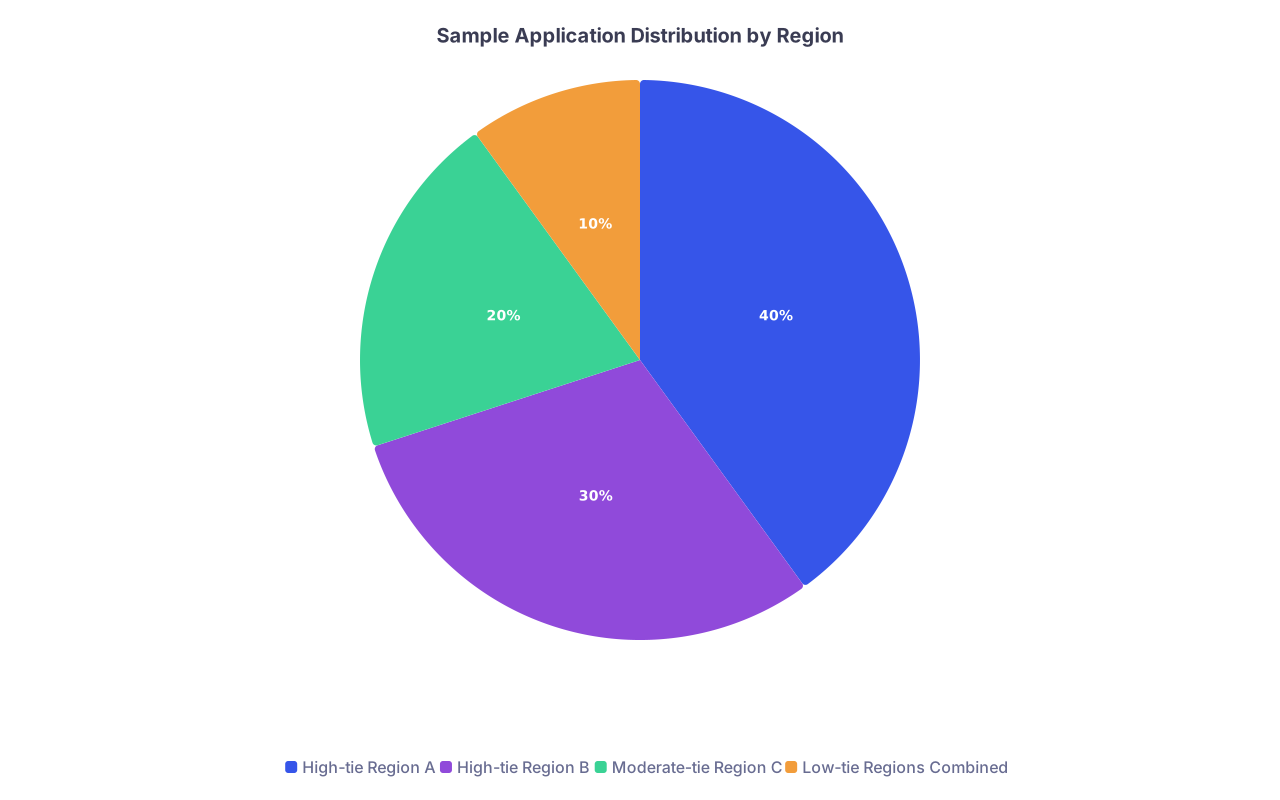
| Category | Value |
|---|---|
| High-tie Region A | 40 |
| High-tie Region B | 30 |
| Moderate-tie Region C | 20 |
| Low-tie Regions Combined | 10 |
Translation into actual strategy:
- 70% of your applications go to regions where your geographic story is strong and believable.
- 20% to places where you have some connection or plausible reason to be.
- 10% to “reach” regions (e.g., very desirable cities where everyone wants to be).
Applicants who invert this—70% in dream coastal cities, 30% scattered elsewhere with weak or unstated ties—often end up with fewer interviews than their stats predict.
Step 4: Make Your Geographic Story Explicit and Consistent
You do not let programs do the detective work. You hand them the narrative.
Concrete ways to do this:
- Region-specific personal statement variants that briefly mention your ties and reasons to train there.
- Secondary / supplemental questions: give structured, concise, specific details (“I grew up in Cleveland, my parents and younger brother live there currently, and my partner has a job offer in Columbus”).
- Interviews: when asked “Why our program / why our city?”, you answer with both professional reasons and explicit life factors that tether you to the area.
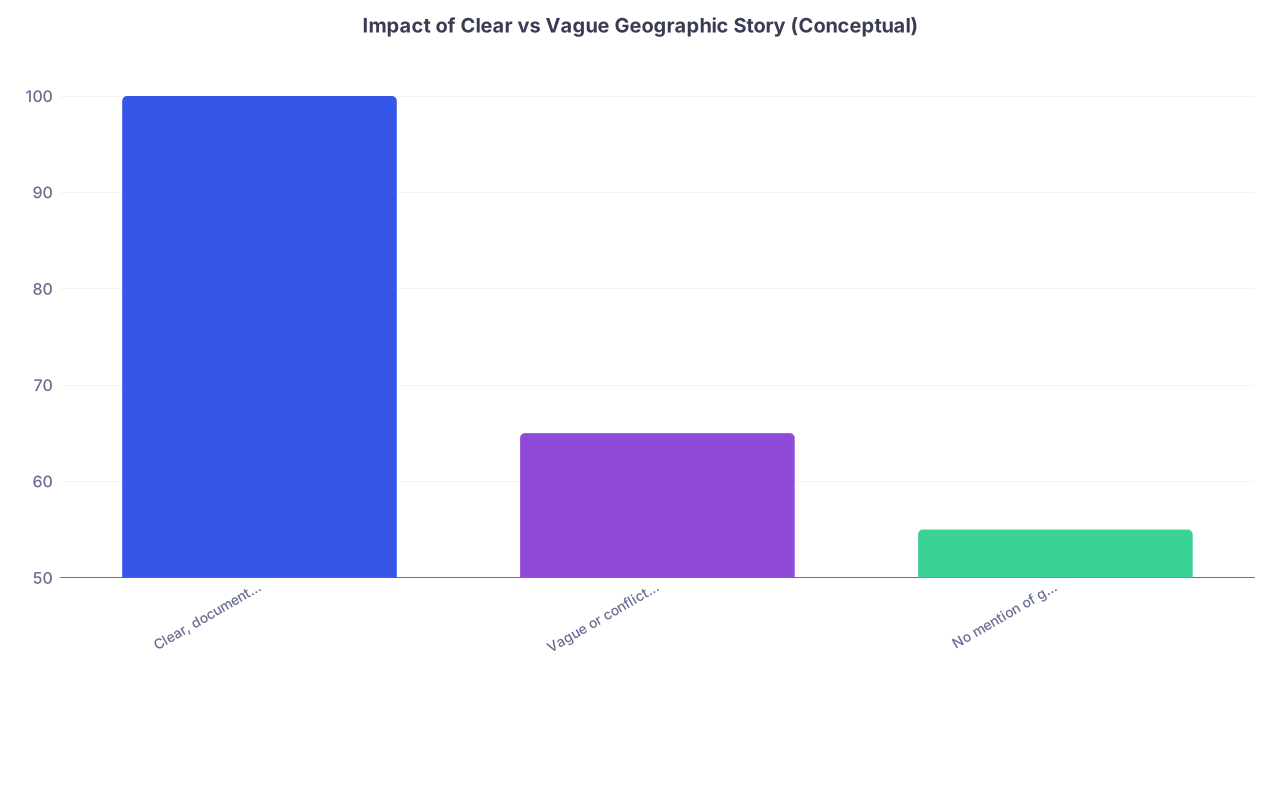
| Category | Value |
|---|---|
| Clear, documented ties | 100 |
| Vague or conflicting | 65 |
| No mention of geography | 55 |
Interpretation: if we normalize interview yield for a given academic tier as 100 for applicants with clear, documented ties in a region, the vague/conflicting group behaves like ~65–70% of that, and the “no mention” group like ~55–60%. Again, conceptual but consistent with how PDs describe their behavior.
The Edge Case: When Signaling the “Wrong” Region Helps
There is one scenario where geography can help you even without classic ties: when you credibly differentiate yourself by leaning into an under-applied region.
Example pattern I have seen repeatedly:
- Applicant from coastal big city, trained at well-known med school.
- Applies heavily to Midwest or Mountain states, with a clear, consistent rationale (partner’s family, outdoor lifestyle, specific long-term job plans).
- Uses away rotations in that region and signals only programs there as top choices.
Programs in those “non-destination” areas are acutely aware that national applicants often overlook them. When your geographic story aligns with their location and is repeated consistently across all your materials, they upgrade your probability-of-matriculation estimate.
They translate it as: “This is a highly qualified candidate who actually wants to be here.” Those are rare. And they act accordingly.
Do Geographic Signals Hurt? The Honest Answer
Used well: they help. The data are clear enough on that.
Where they “hurt” you is in three specific ways:
Misalignment with your actual behavior
- Signals and stated preferences that do not match your application list or history make you look unreliable. That reduces your interview odds.
Over-constraining your options in hyper-competitive regions
- If you declare yourself locked to an oversubscribed coastal metro and then only apply there, your unmatched risk goes up, even if a couple of programs like your signal.
Being silent where a tie would have meaningfully boosted your odds
- Failing to surface genuine ties lets programs conclude “no interest.” You lose the statistical boost you could have had.
Geography is not moral. It is statistical. Programs are trying to maximize match probability and resident satisfaction. You need to feed that optimization in a way that reflects your real life, not your fantasy map.
Key Takeaways
- Geographic signals and ties act as a multiplier on your baseline competitiveness—especially in mid-tier, less destination-heavy regions.
- Inconsistent or unrealistic geographic stories lower your interview odds relative to your stats; clear, documented ties raise them.
- A rational regional strategy uses clusters of strong ties and aligned signals, rather than scattered, wishful applications across the entire map.