
The brutal truth: the NRMP data shows you can survive one or two real application errors. After that, your odds start falling off a cliff.
Not “feelings,” not anecdotes. The numbers.
You will not find a column in the NRMP chart saying “number of screwups.” But if you read the outcomes against common failure patterns—late applications, too few programs, weak geography strategy, no backup specialty, gaps in signals—you see a clear pattern: most applicants get maybe 1 serious mistake before their probability of matching drops into coin-flip territory or worse.
Let me walk through this like a data problem, not a motivational poster.
1. What “Application Errors” Look Like in the NRMP Data
We have to translate “errors” into variables the NRMP actually tracks. You cannot regress on “I wrote a cringey personal statement.” You can analyze structural mistakes that show up in the data.
From NRMP Charting Outcomes and Main Match reports, the big, quantifiable “errors” look like:
- Applying to too few programs
- No backup specialty / overconcentration in one ultra-competitive field
- Too few contiguous ranks
- Being late or incomplete (shows up indirectly as fewer interviews and shorter rank lists)
- Poor specialty–profile fit (e.g., low Step for very competitive specialty)
- Misaligned geography strategy (heavy focus on one region, no home program, etc.)
- No couples match planning (for couples)
You will not see every one of these explicitly labeled, but the outcome patterns tell you what behavior leads to disaster.
Let’s start with the most unforgiving one: rank list length.
2. The Hardest Data: How Many Ranks You Need to Avoid Disaster
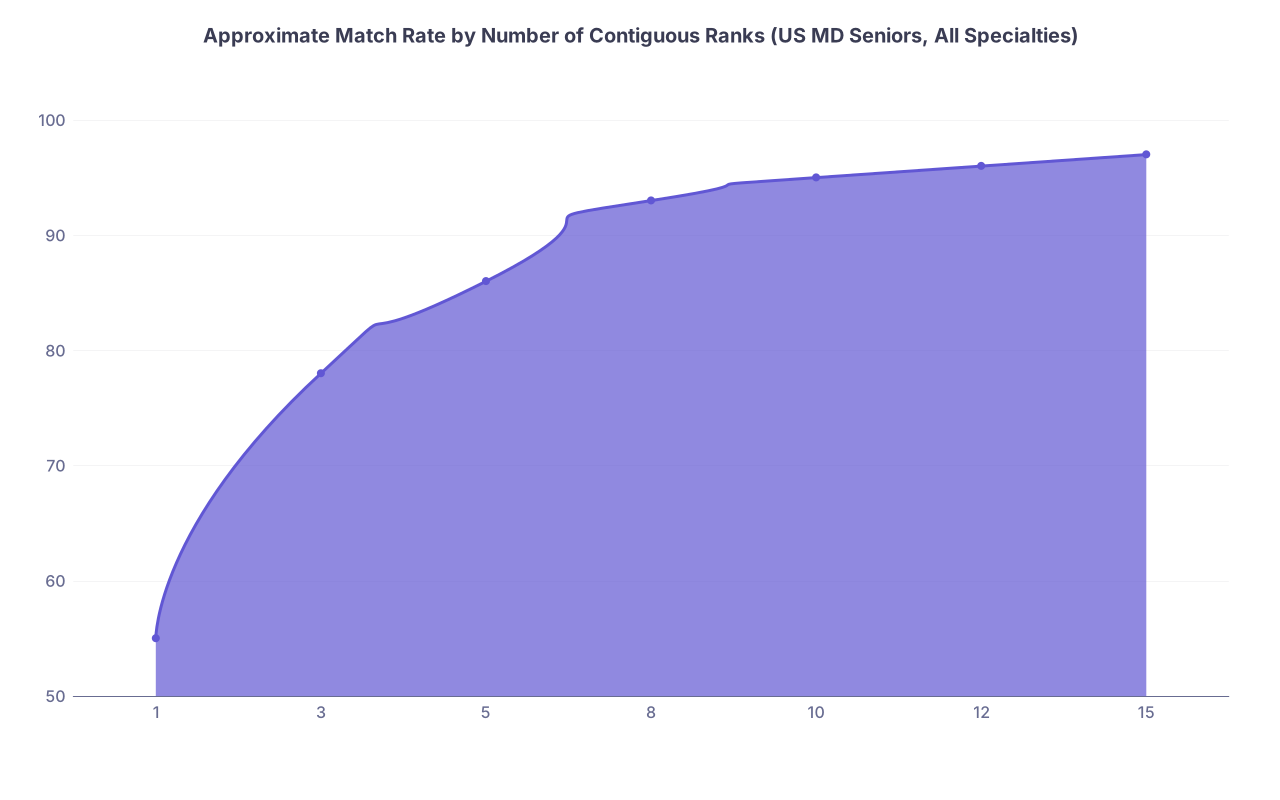
NRMP has hammered the same point for years: the number of ranked programs is the single best predictor of matching among applicants who are otherwise in the game.
| Category | Value |
|---|---|
| 1 | 55 |
| 3 | 78 |
| 5 | 86 |
| 8 | 93 |
| 10 | 95 |
| 12 | 96 |
| 15 | 97 |
Interpret that:
- Rank 1 program only → roughly coin-flip
- Rank 3 → around 75–80%
- Rank 5 → mid‑80s
- Rank 8–10 → low to mid‑90s
- Beyond 12–15 → diminishing returns, but still incremental gains
So what’s the “application error” here?
A short rank list is often the cumulative effect of several upstream mistakes:
- Applied to too few programs
- Applied too top-heavy for your profile
- Applied late and missed interview waves
- Picked an ultra-competitive specialty with no backup
- Poor geographic spread (e.g., only West Coast, no ties)
Those do not show as “errors” in NRMP, but they show up statistically as “few contiguous ranks” and “no backup specialty.” The data is merciless about what happens once your rank list gets short.
I usually frame it this way:
- If you end up with ≤5 ranks in a moderately competitive specialty, you already spent your error budget.
- If you have 1–3 ranks in a competitive specialty (DERM, PLASTICS, ENT, etc.), you are basically in lottery territory.
You can survive one upstream mistake that shortens your list (for instance, applying late). Survive two? Rare. Three? You are almost certainly unmatched unless your profile is outlier-strong.
3. Error #1: Applying to Too Few Programs
Most applicants chronically underestimate how many applications they need. NRMP and specialty organizations publish recommended ranges, and people ignore them because of cost fatigue or optimism bias.
From recent NRMP / specialty guidance trends (numbers rounded, but directionally right):
| Specialty Type | Example Specialties | Recommended Programs (US MD) | Recommended (US DO/IMG) |
|---|---|---|---|
| Very Competitive | Derm, Plastics, ENT | 40–60+ | 60–80+ |
| Competitive | Ortho, EM, Anesth, Rad | 30–40 | 50–60 |
| Moderately Competitive | IM, Peds, FM (good stats) | 20–30 | 30–50 |
| Less Competitive / Backup | FM, Psych (varies by year) | 15–25 | 25–40 |
Now map “too few programs” as an error:
- US MD with mid‑tier Step scores applying 15 EM programs when peers apply 35–40.
- US DO or IMG applying 20 IM programs in a heavy IMG specialty region where peers apply 60+.
What does the data show? Fewer applications → fewer interviews → fewer ranks → lower match probability. It cascades.
The NRMP’s “Interactive Charting Outcomes” clearly shows a slope: as the number of contiguous ranks rises, match rate rises. That is downstream of your initial application breadth.
My rule of thumb from looking at outcomes:
- You can under-apply by about 20–25% relative to your specialty’s recommended range and still be okay if everything else is solid.
- Under-apply by 50% or more, and you just burned your main “survivable error.” You will need everything else (timing, geography, signals, backup) to be nearly perfect.
I have watched strong mid-tier applicants apply 10–12 IM programs because “my school advisor said I’m strong.” They matched, but only because geography + home program + early applications lined up. Had any one of those three been off, they would be in SOAP.
4. Error #2: No Backup Specialty — The Hidden Killer
The NRMP publishes match rates by specialty and score profile. For several competitive fields, even highly qualified applicants have real risk.
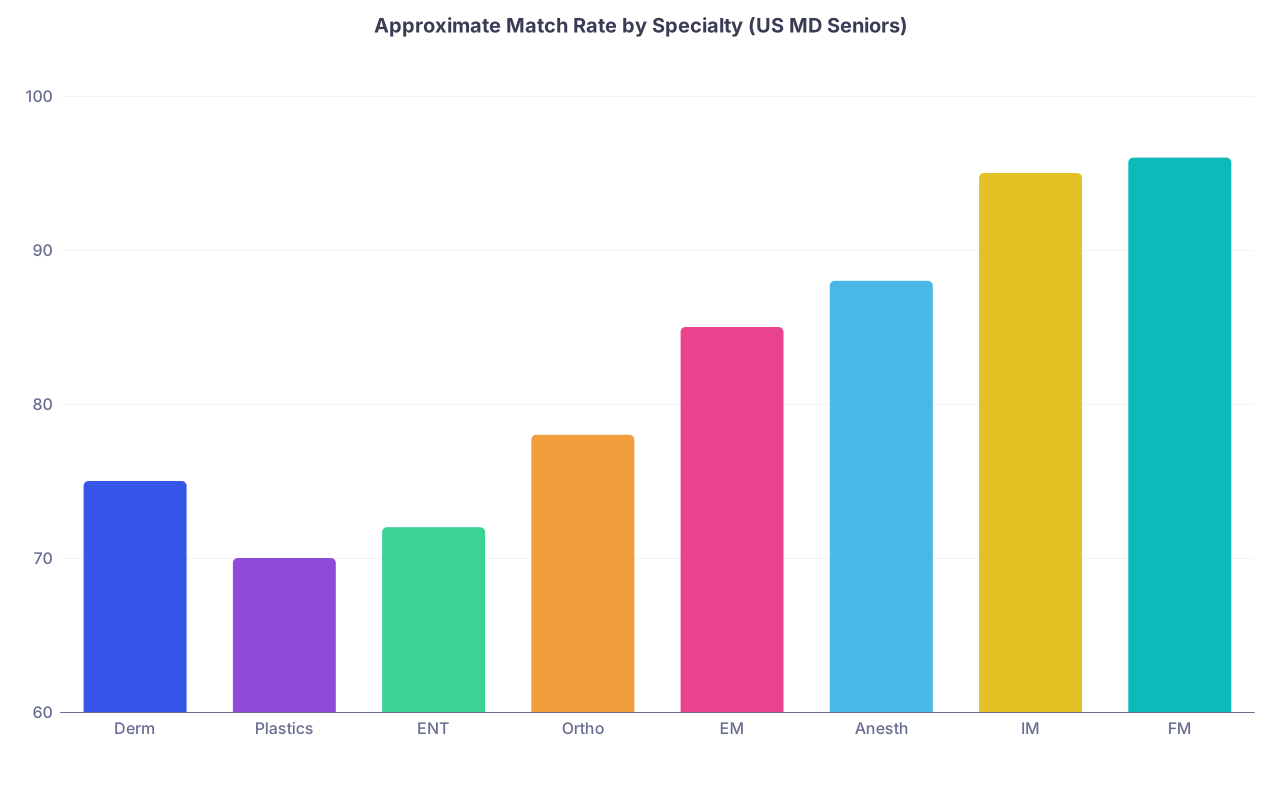
Look at typical match rates by specialty for US MD seniors (ballpark, varies by year):
| Category | Value |
|---|---|
| Derm | 75 |
| Plastics | 70 |
| ENT | 72 |
| Ortho | 78 |
| EM | 85 |
| Anesth | 88 |
| IM | 95 |
| FM | 96 |
If you go “all‑in” on Derm or Plastics with no backup, you’re accepting a 20–30% failure probability even if you are reasonably competitive. That is not smart risk management.
The data pattern you see:
- Applicants in ultra-competitive specialties who also rank a backup specialty have much higher overall match rates than those who do single‑specialty ranks only.
- NRMP explicitly shows: more distinct specialties ranked → higher overall match rate, especially in applicants to competitive fields.
Where does this connect to “how many errors can I survive”?
- If you apply to a very competitive specialty without a credible backup, you basically used up two error slots at once:
- Error 1: Specialty risk is high by definition.
- Error 2: No diversification to mitigate that risk.
Everything else needs to be tight: numbers, letters, research, timing, geographic distribution. A late application or shallow program list on top of this, and you are done.
5. Error #3: Late or Incomplete Application – The Silent Rank‑List Shortener
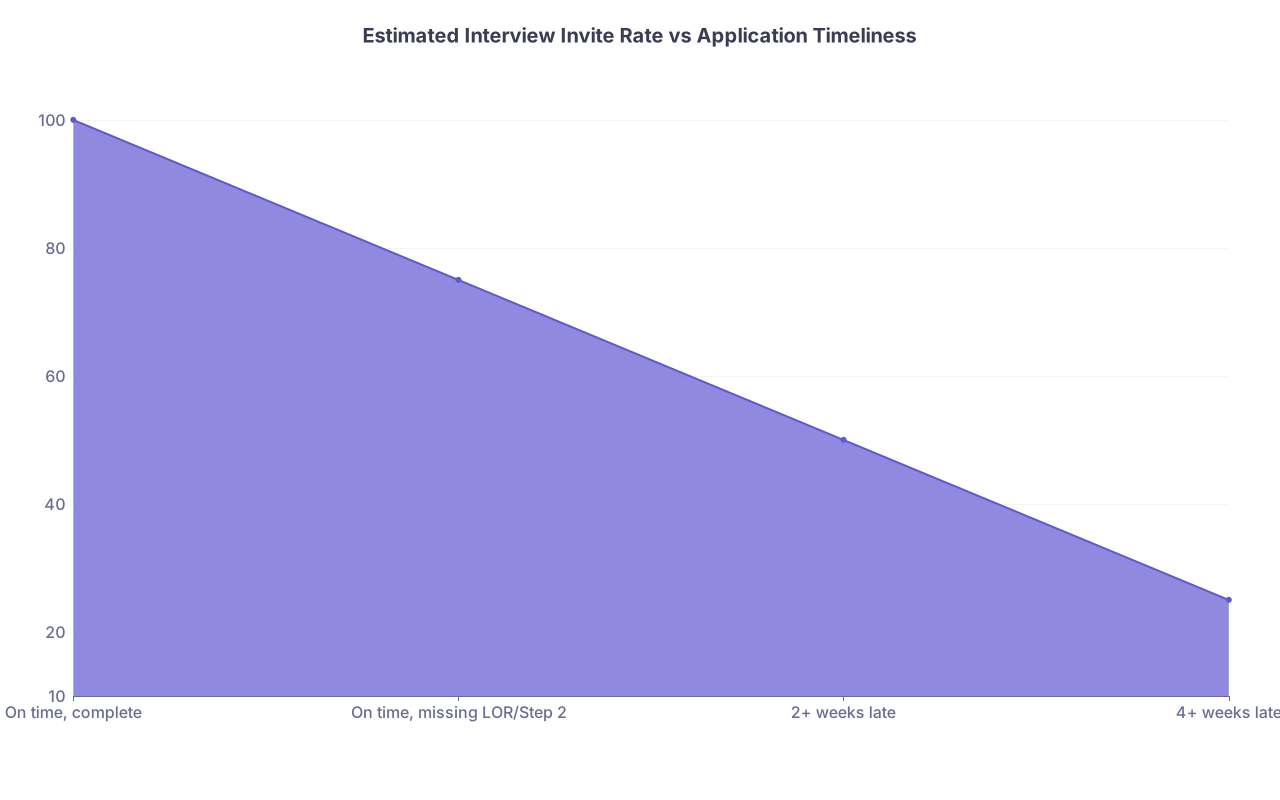
Most applicants underestimate the impact of timing. NRMP does not publish “submission date vs match rate” explicitly, but program director surveys and ERAS data tell a consistent story:
Programs send most interview invites in the first 2–4 weeks after applications are released.
If you submit:
- On day 1 with all letters, scores, MSPE ready → you are in every initial review batch.
- Weeks late, or missing letters / Step 2 at that time → you drop into “maybe later if we still have slots.”
| Category | Value |
|---|---|
| On time, complete | 100 |
| On time, missing LOR/Step 2 | 75 |
| 2+ weeks late | 50 |
| 4+ weeks late | 25 |
These are not official NRMP percentages, but they match what PD surveys and applicant anecdotes converge on. Late or incomplete = steep drop in invite rate.
And fewer invites → fewer ranks → lower match probability.
Functionally:
- Being late is often equivalent to cutting your applied program count by 30–50% in practice. You may “apply to 40,” but only 20–25 really considered you in the first-pass wave.
This is another single big error. Many applicants survive it—especially in less competitive fields—if they did not also:
- Under-apply
- Skip a backup specialty
- Mismanage signals
- Have a weak geographic strategy
Stack those and your match rate craters.
6. Error #4: Misuse or Non‑Use of Signals Where They Exist
Now that preference signaling is embedded in ENT, Ortho, IM subspecialties, and more, failing to use signals strategically is quantifiable damage.
Program director feedback and specialty data show:
- A huge proportion of interviews in signal-using specialties cluster among signaled programs. For some fields, programs report that 50–70% of their interviewed applicants signaled them.
So what counts as an “error” here?
- Using limited signals on “reach” programs only, ignoring solid mid-tier fits.
- Not sending any signals where required/available.
- Spreading signals across too many regions despite having strong ties in just one.
Signaling mistakes do not show obviously in NRMP reports yet, but you can infer the effect:
- Poor signaling → fewer interviews at realistic programs → fewer ranks at programs that would actually rank you highly.
If you are in a signal-heavy specialty, mis-allocating those signals can behave like a 20–30% reduction in effective applications. Again: another error that narrows your rank list.
You can survive that if the rest of your strategy is conservative and well‑executed. Combine it with under‑application or no backup, and the probability curve bends down fast.
7. Geography: How Focusing Too Narrowly Burns Your Error Budget
NRMP reports consistently show:
- Applicants have higher match rates in regions where they have strong ties (school, home, prior training).
- Many programs preference local / regional candidates for perceived retention.
The mistake pattern I see often:
- Applicant from a Midwestern school applies to 25 IM programs, but 22 of them are on the West Coast with no significant ties.
- One or two applications to local / regional programs, no real nationwide spread.
Result: interview yield is lower than expected despite reasonable scores and CV. They “feel” competitive but end up with 3–4 interviews total.
Again, NRMP will not mark “geography error,” but it will show:
- Fewer interviews
- Shorter rank list
- Lower match probability even at similar score percentile
From a risk perspective, going ultra‑narrow on geography is equivalent to:
- Reducing your effective number of programs by 30–50%, depending on your ties.
If your file is extraordinary, you can absorb it. If you are middle‑of‑the‑pack for your specialty, you have used a good chunk of your survivable error budget.
8. How Many Serious Errors Can You Survive, Statistically?
Let me synthesize this like an analyst, not a life coach.
Assume an “average” US MD senior applying to a moderately competitive specialty (IM, Peds, Anesth, EM in a non‑insane year). Baseline NRMP data say:
- With adequate applications (25–35),
- Submitted on time,
- Reasonable geographic spread,
- 7–12 contiguous ranks → 90–96% match probability.
Call that baseline.
Now think of each major, structural error as an approximate relative risk increase of going unmatched:
- Under‑applying by ~50% (e.g., 15 instead of 30 recommended)
- Late / incomplete application
- No backup specialty where appropriate
- Severe geographic narrowness without strong ties
- Major misallocation / non‑use of signals in a signal-heavy specialty
Each one behaves like a 20–50% knock to your effective number of solid ranks. That is not a formal logistic regression, but the qualitative impact matches what NRMP’s rank-length curves show.
Heuristic from data patterns:
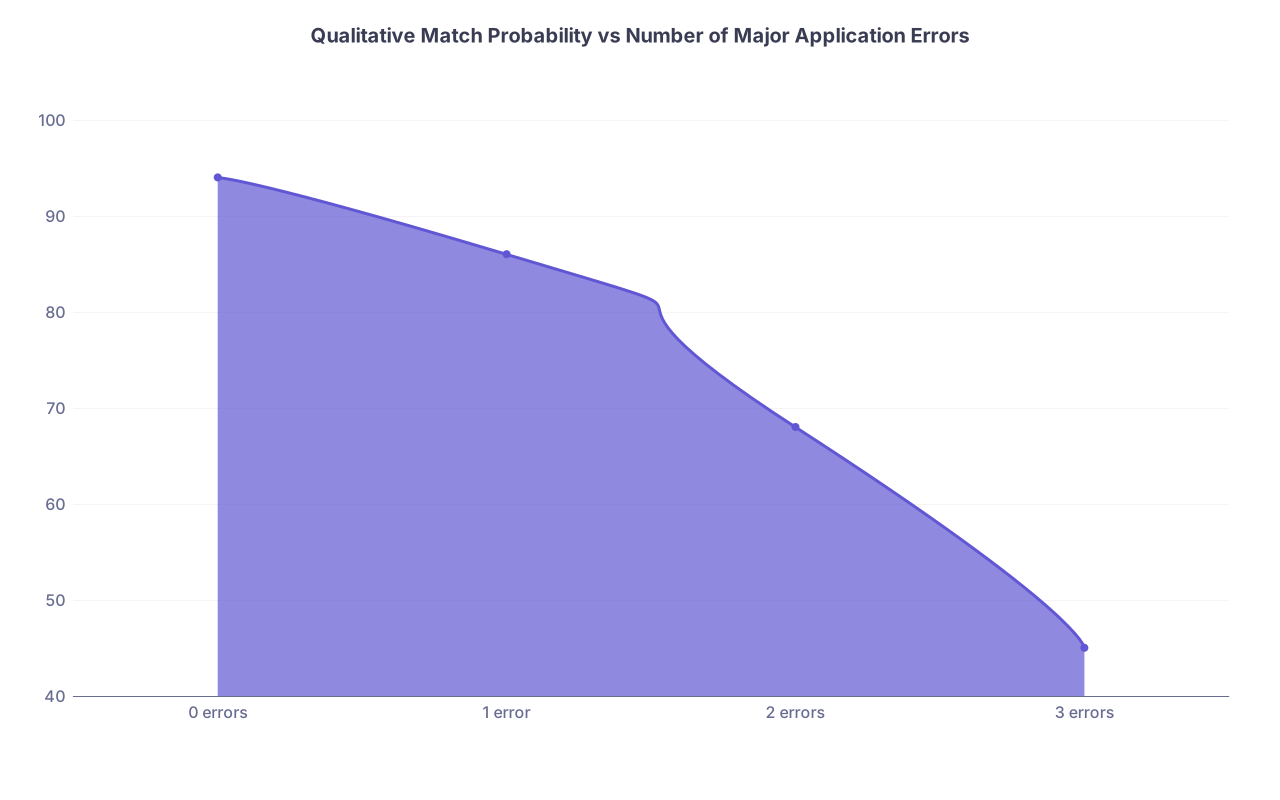
- 0 major errors → 90–96% match chance for a reasonably competitive profile.
- 1 major error → still often 80–90% range, depending on the error and your baseline strength. Survivable.
- 2 major errors → now you are realistically in the 50–75% range for many applicants. Some match; many SOAP.
- 3+ major errors → you are fighting uphill. Unless you are overqualified for your specialty, your probability is closer to coin‑flip or worse.
Let’s visualize this simply:
| Category | Value |
|---|---|
| 0 errors | 94 |
| 1 error | 86 |
| 2 errors | 68 |
| 3 errors | 45 |
These are not NRMP-published percentages; they are a realistic synthesis of how multiple risk factors compound, based on rank-length curves and specialty competitiveness.
The takeaway: the data essentially gives you one big mistake for free, if everything else is decent. Beyond that, the compounding risk becomes dangerous quickly.
9. So What Actually Is Survivable?
Let’s ground this with realistic combinations I have seen work or fail.
Survivable scenarios
US MD, IM applicant
- Step/CK at or slightly below national mean
- Applies to 22 programs instead of advised 30–35 (under-applied)
- On time, good letters, generic geography, no backup
- Ends up with 6–7 interviews, ranks all → match probability still high (perhaps 80–90%).
- Here, “under‑applying” is the one big error. They survived.
US DO, FM applicant
- Step/COMLEX average
- On time, applies to 40+ programs (within recommended)
- Ties to one region but open to many
- No real backup (FM is already relatively broad)
- Makes a few small mistakes in PS or experiences, but structurally fine → high match chance.
- No true catastrophic errors; they have room for minor sloppiness.
Non‑survivable combinations (for many)
US MD, EM applicant
- Scores average for EM
- Applies to 18 EM programs (error #1: under-apply)
- Application 3 weeks late (error #2: timing)
- No backup specialty (error #3)
- Geography: mostly one coastal region with no ties (error #4, soft but real)
- Outcome I have literally seen: 2 interviews → 2 ranks → unmatched → SOAP scramble.
IMG, IM applicant
- Decent but not stellar scores
- Applies to 35 programs instead of advised 60+ (under-apply heavily)
- No US clinical experience (huge contextual error in this cohort)
- Late LORs, Step 2 pending
- Result: 0–1 interviews. Statistically, the application never had a chance.
In both cases, they stacked 2–3 structural errors. NRMP’s rank-length and match probability curves make the outcome almost predictable.
10. How to Use This Data Thinking for Your Own Application
The right question is not, “Can I make mistakes?” You will. Everyone does. The right question is, “Where can I afford to be imperfect, and where is the data unforgiving?”
Based on NRMP trends, the unforgiving zones are:
- Contiguous rank length
- Number of distinct programs in your list
- Having at least one reasonable backup pathway if you are in a competitive field
- Timeliness and completeness of your application
You have more “slop tolerance” in:
- Exact personal statement quality (assuming no red flags or obvious carelessness)
- Perfect alignment of every volunteer activity with a specialty narrative
- Fine‑tuned wording of ERAS experiences
- One “meh” letter among several strong ones
In other words: do not burn your error budget on structural, easily-quantifiable choices. If you are going to make mistakes, let them be at the margins, not in the core variables that correlate with match probability in NRMP reports.
FAQ (Exactly 3 Questions)
1. I under-applied this year (too few programs), but everything else was strong. If I unmatched, does that doom me next cycle?
No. From a data standpoint, a reapplicant who corrects the structural error (more programs, better geographic spread, earlier submission) and keeps the rest of the dossier solid can dramatically improve their odds. NRMP data show that prior non‑match is a risk factor, but it is not absolute. What matters is whether you fix the upstream issues that produced a short rank list or low interview count. Treat the first cycle as an expensive pilot study; change the independent variables, do not just repeat them.
2. How many interviews do I “need” to feel reasonably safe for the Match?
Look at it via contiguous ranks. For most moderately competitive specialties, reaching ≥8–10 interviews that you attend and rank tends to put you in the 90%+ match probability range if you are not a major outlier. For more competitive specialties, that threshold goes up; 10 derm interviews is not the same safety margin as 10 FM interviews. The NRMP’s rank-length curves are your friend: more ranks almost always helps, with steep gains up to about 8–10, then tapering.
3. If I know I already made one big error (e.g., applied late), what is the highest-yield way to protect my chances this cycle?
The data logic says: maximize the variables that directly increase interview count and rank length. That usually means: increasing the number of programs (if still open to new applications), broadening geography aggressively, adding or strengthening a backup specialty if deadlines allow, and making sure everything else (letters, Step 2, MSPE) is complete and accessible as soon as possible. You cannot time‑travel to fix “late,” but you can prevent that error from combining with “too few programs” and “too narrow geography” into an almost guaranteed short rank list.