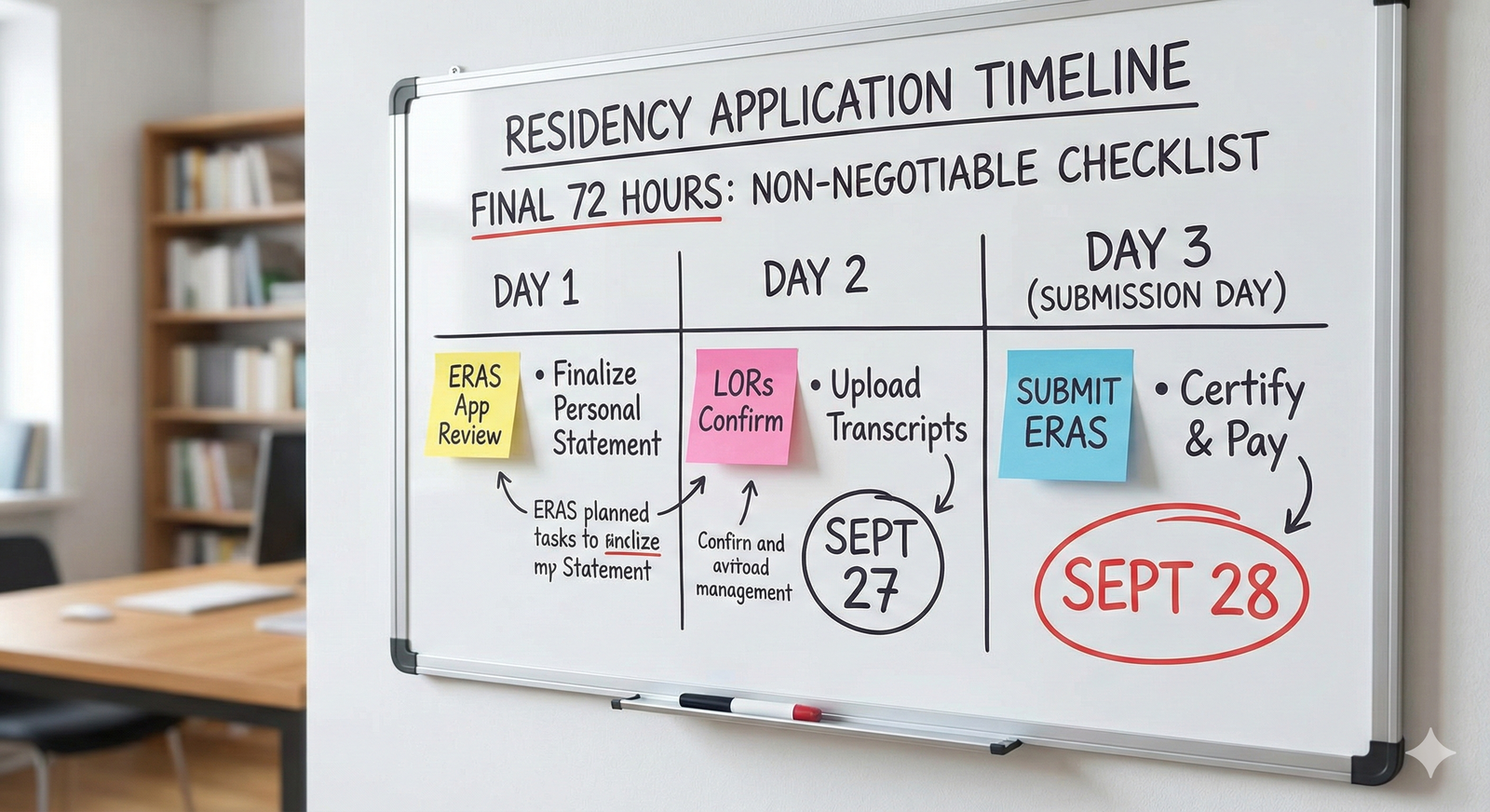
The most dangerous person in your application season is not you. It’s a confident advisor who is wrong.
If you’re reading this, you probably already have that pit in your stomach: your advisor’s guidance does not match what you’re seeing online, what recent grads are saying, or what your gut is screaming. You’re afraid they’re steering you off a cliff—but you also do not want to blow up the relationship, get labeled “difficult,” or lose institutional support.
Here’s how to course‑correct safely, protect your match chances, and still survive politically at your school or program.
Step 1: Get Very Clear On What Advice Feels “Off”
Do not just think “my advisor is bad.” That’s too vague. You need to know exactly what’s wrong so you can fix it.
Common red‑flag advice I’ve seen over and over:
- “You don’t need to apply broadly. Just 10–15 programs is enough for you.” (For EM or any competitive specialty? No.)
- “Do not bother with a backup specialty. It looks weak.”
- “You can skip Step 2 this cycle; just submit with Step 1.” (In 2024 and beyond, this is often flat‑out wrong for many specialties.)
- “Your personal statement is fine” when it’s clearly generic or cliché.
- “You don’t need a home sub‑I / away rotation in that specialty.”
- “You should not apply this year; just take a research year,” without concrete reasoning.
- “It’s too late to apply now” when it’s August/September and you’re still in the realistic window.
Write down, in one place, each specific piece of advice that worries you. For each, write:
- What they said
- Why it worries you
- What’s at stake if they’re wrong (e.g., “Could mean too few interviews”)
You’re building a risk list, not venting. This becomes your roadmap for what to double‑check.
Step 2: Quietly Reality‑Check With Hard Data
Before you confront anyone or change plans, you need receipts. Feelings are not enough. Programs and deans respond to numbers and norms.
Here’s where to go.
NRMP, AAMC, and Specialty‑Specific Data
Pull the official numbers:- NRMP Charting Outcomes in the Match
- NRMP Program Director Survey
- Specialty society guidelines (e.g., EMRA, AAIM, AANS, etc.)
- Your specialty’s application guide (many have PDFs or web pages outlining expectations)
You’re looking for:
- Average # of applications per matched applicant
- Interview counts correlated with match rates
- Common cutoffs for Step 2, number of LORs, home/away expectations
Recent Graduates 1–2 Years Ahead of You
These people are gold. They just did what you’re trying to do, under the same leadership culture.Ask targeted questions:
- “How many programs did you apply to with similar stats to mine?”
- “Did your advisor tell you to do anything you were glad you ignored?”
- “What did programs actually care about in interviews?”
- “Did you feel pressured to follow advice that didn’t fit your situation?”
Current Residents In Your Target Specialty
Especially at programs you’re aiming for. Message politely on email, Signal, or even Reddit/Discord when appropriate.Ask:
- “With a Step 2 of X and Y number of honors, how broadly would you recommend I apply?”
- “At your program, would applying without Step 2 be a problem this year?”
If multiple independent sources contradict your advisor, assume your advisor is wrong about that specific point—not necessarily about everything, but that issue is now suspect.
Step 3: Classify Your Situation: Strategy Bad, Or Politically Toxic?
There are two different problems that get lumped together as “bad advising”:
Strategically bad advice
They mean well, but their guidance is outdated, too generic, or based on their own ego. Example: “Back when I matched in 2004, we only applied to 12 programs…”Politically dangerous advisor
They’re dismissive, punitive, or retaliatory if students push back. Example phrases I’ve heard:- “If you don’t do what I say, don’t expect a strong letter.”
- “I’ve been doing this for 20 years; you’re overthinking it.”
- “People who second‑guess me usually regret it.”
You handle these two situations differently.
If it’s strategically bad but not toxic, you can be more direct and collaborative.
If they’re politically dangerous, your goal is: protect your record, nod politely, then quietly build an alternate support network and strategy.
Step 4: Build A Parallel Advising Team (Without Setting Off Alarms)
You need a second opinion structure. Think of it as your “shadow advisory board.”
Possible members:
- A young faculty member 3–7 years out of residency who still remembers the modern match
- A chief resident or senior resident in your target specialty
- A recent alum who matched into a similar tier specialty/program
- An official “career advising office” or dean at your school other than your main advisor
- For IMGs or DOs: someone from your background who successfully matched into your target specialty in the last 1–3 years
How to approach them without drama:
“Hi Dr. X, I’m getting ready for residency applications in [specialty]. I have a primary advisor but I’m trying to get a few perspectives from people who’ve matched more recently / work directly in this field. Would you be willing to look at my overall strategy for 15–20 minutes and tell me if there are any red flags?”
Most reasonable people will say yes. And they won’t assume you’re starting a war with your main advisor.
Step 5: Decide Where You Can Safely Ignore The Bad Advice
You do not need to fight every battle. Some bad advice is harmless; some is catastrophic.
Use this framework:
High‑stakes, silent rebellion:
Things that directly impact your match odds but don’t require your advisor’s approval or signature.Examples:
- Number and range of programs you apply to
- Whether you also apply in a backup specialty
- Taking Step 2 at a certain time (as long as you meet school requirements)
- Submitting your application early even if your advisor is “still editing” your personal statement
Medium‑stakes, partial alignment:
Areas where you can incorporate their advice partially without letting it dominate.Example: They want your entire personal statement to be about research; you know you need clinical content too. You can structure your essay to nod to their priority but still make it balanced.
High‑political‑risk, choose your words carefully:
Things that involve letters, official forms, or evaluations.Examples:
- Who writes your Chair letter
- Who you ask for LORs
- What’s written in your MSPE / dean’s letter
- Whether they sign off on away rotations or dual‑apply plans
In that last category, your strategy isn’t “ignore.” It’s “out‑maneuver without triggering retaliation.”
Step 6: How To Push Back Without Lighting Yourself On Fire
If your advisor is not an outright bully, you can often reshape the conversation.
A few scripts that work surprisingly well:
- On number of applications
“I’ve been reviewing NRMP data and talking to a few recent grads with similar scores. They all applied to around [X–Y] programs and felt that was necessary for a safe number of interviews. I’m leaning towards applying to [X] programs in [specialty], with a small backup list in [other specialty]. Does that seem unreasonable to you?”
You’re not asking permission. You’re asking if it’s unreasonable, which is harder to say “yes” to without sounding out of touch.
- On backup specialty
“I understand the concern that a backup can look like a lack of commitment. But looking at my Step 2 and class rank, I think it would be risky not to have a parallel option. My plan is to tailor my personal statements and emphasize my primary interest clearly in each. I’d really appreciate your help making sure the materials are strong for [primary specialty].”
You’re framing the backup as risk management, not disloyalty.
- On an essay you know is weak
“Thank you for your edits. After reading more sample statements from recent successful applicants, I’m realizing I may need a more personal narrative and clearer ‘why [specialty]’ section. Would you mind if I draft an alternate version that leans more into story, then get your thoughts on which one is stronger?”
You’re not saying they’re wrong. You’re offering them a choice between two.
If they shut this down aggressively (“No, just do what I said”), that’s useful data: it tells you to stop trying to fix things through them and start fixing things around them.
Step 7: Protect Your Letters And Institutional Support
Letters and MSPEs are where bad advisors can hurt you the most.
A few hard rules:
- Never assume someone who gives bad strategic advice also writes bad letters. Those are different skills. I’ve seen awful advisors write glowing, detailed letters—and “cool,” seemingly aligned mentors send two‑paragraph garbage.
- Whenever possible, see at least one of their letters to others (de‑identified is fine). Ask a PGY‑1: “Did Dr. X’s letter seem strong?” They’ll tell you.
If you suspect an advisor might write a lukewarm or hostage‑style letter:
Diversify your letter writers
Get strong letters from:- Attendings from sub‑Is who watched you work
- Research mentors who actually like you
- Course or clerkship directors outside your advisor’s orbit
Ask targeted, not generic
“Would you be comfortable writing me a strong letter of recommendation for [specialty/program types]?”
If they hedge—“I could write you a letter”—back away.If your advisor must write an institutional letter (e.g., Chair letter):
- Over‑prepare your CV and brag sheet with concrete examples and outcomes
- Offer a drafted bullet list of things you hope they’ll highlight
- Do not antagonize them directly about judgment calls unless it’s absolutely necessary
You’re trying to minimize the damage window: give them so much good raw material that even a mediocre writer has to say something decent.
Step 8: Fixing Specific Common Bad Advice Scenarios
Let’s go through concrete situations.
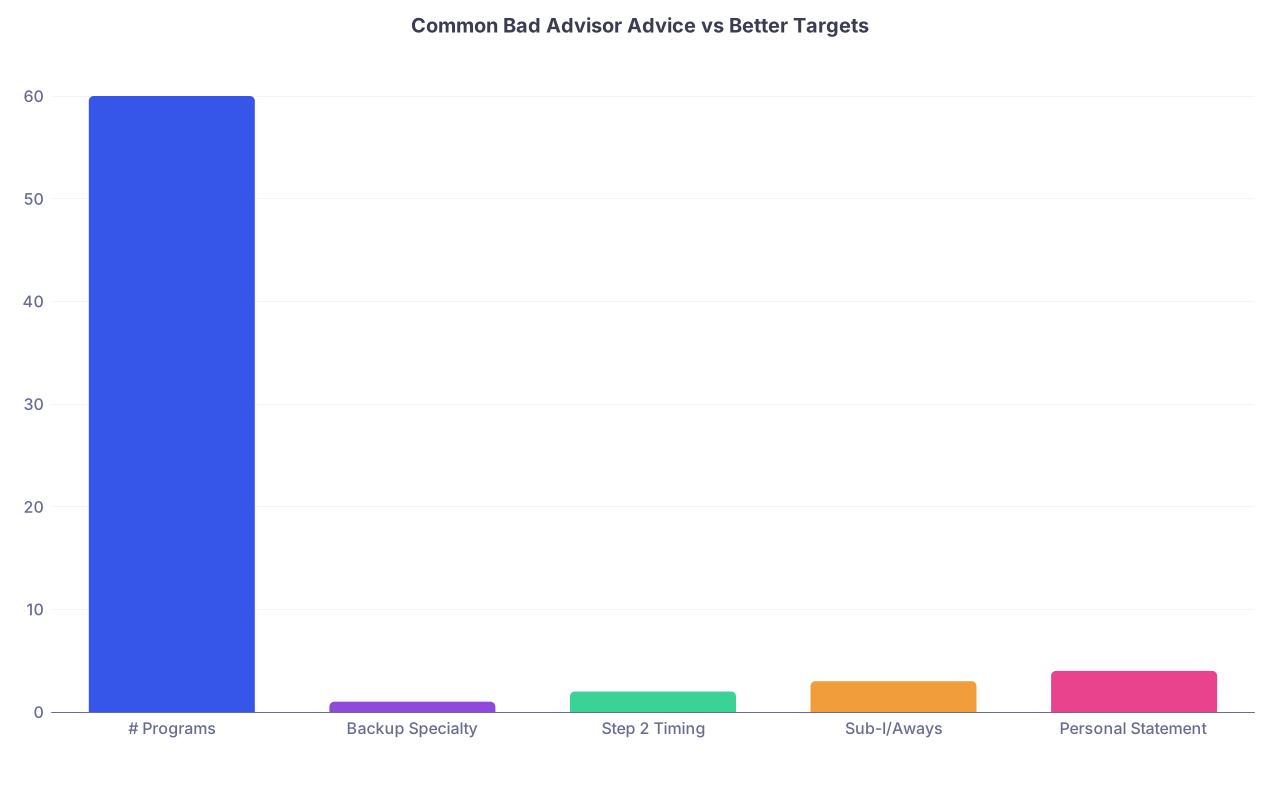
| Category | Value |
|---|---|
| # Programs | 60 |
| Backup Specialty | 1 |
| Step 2 Timing | 2 |
| Sub-I/Aways | 3 |
| Personal Statement | 4 |
Ignore the absolute numbers; this just anchors five key areas we’ll talk about.
1. “You’re strong—apply to 10–15 programs only.”
Reality: For most specialties, that’s suicide unless you’re a super‑star at a powerhouse school.
What to do:
- Look up how many programs recent grads with similar stats and specialty applied to.
- If they’re saying 15 and the data say 40–60, quietly apply to 40–60.
- You don’t need to volunteer your full list unless they specifically request it.
If they demand your list:
“I’m still finalizing my list as I hear back about programs where I might have inside connections or geographic fit. I expect it’ll be in the [X–Y] range.”
You’re vague on purpose.
2. “Don’t apply in a backup. It looks weak.”
For competitive fields (derm, ortho, plastics, ENT, neurosurgery, some rads, some EM regions), not having a backup with mid‑tier stats is dangerous.
What to do:
Decide if you can tolerate a no‑match and a re‑application year. Many cannot (loans, visas, family).
If not, choose a backup specialty that genuinely fits your interests and isn’t a random panic choice.
Tailor:
- Different personal statements
- Different LOR mixes
- Different program lists
Explain it as: “I’m fully committed to [primary], but based on my numbers and talking to recent grads, I think it’s prudent to have a realistic parallel path.”
3. “You can delay Step 2, it’s not that important now.”
Post–Step 1 pass/fail, Step 2 is the new sorting hat. Many programs will not interview you without it.
What to do:
- Check your specialty’s norms: Some explicitly say “We require Step 2 by rank list,” others by application.
- If your practice tests suggest a Step 2 > 230–240 (depending on specialty), taking it before applications is usually to your benefit.
- If your practice scores are significantly lower than Step 1, talk to someone else (recent grads, residents) about whether to delay.
If your advisor insists you delay but your data and contacts say “Take it early,” follow the data, not their ego.
Step 9: Document Your Decisions (Quietly)
This part most students skip, then regret when something goes wrong.
Keep a simple running document (not on your school’s shared drive):
- Summary of each major piece of advice
- Who you consulted for second opinions (names/dates)
- What data you used (NRMP tables, program websites, emails)
- The decision you made and why
Two benefits:
- If someone later accuses you of “going rogue,” you can calmly say, “Here’s the reasoning I used and who I consulted.”
- It keeps you from second‑guessing decisions mid‑panic.
Does it sound excessive? Maybe. But one email where a dean backs you up because you were methodical can literally save your career.
Step 10: If The Relationship Is Truly Toxic, Protect Yourself
Sometimes it’s worse than “bad advice.” It’s manipulation, retaliation, or harassment dressed up as mentorship.
Red flags:
- Threats about letters or MSPE content
- Humiliation in meetings for asking reasonable questions
- Blocking access to rotations or research unless you obey
- Punishing other students who sought second opinions
If this is you, you’re not just “course‑correcting advice.” You’re doing damage control.
Steps:
Stop arguing in real time. Nod, take notes, say “I’ll think about that.” Do not give them emotional fuel.
Escalate sideways, not up (at least at first):
- A trusted assistant dean
- Ombuds office
- Another department’s faculty advisor
- A resident rep on the GME committee
Keep contemporaneous notes: Dates, quotes, what was said, witnesses.
Focus on minimum necessary contact: Use email where possible; be factual and concise.
Sometimes the quiet strategy is: preserve the relationship just enough to get through this cycle, while you let other mentors and letters carry your application.
Step 11: Sanity‑Check Your Entire Application Strategy Without Them
Take one evening and, without thinking about your advisor at all, build your ideal plan based on:
- Your actual stats (Step 1 status, Step 2, clerkship grades, AOA, research)
- NRMP and specialty‑specific data
- 2–4 trusted recent grads or residents’ input
- Your honest risk tolerance (re‑apply vs match somewhere, anywhere)
Write down:
- Primary specialty
- Whether you’ll dual‑apply or not
- Target number range of programs per specialty
- Must‑have geographic or personal constraints
- Step 2 timing (if not taken yet)
- Who your 3–4 core letter writers will be
- When your personal statements will be final and out of your advisor’s hands
Then compare this to what your advisor has been pushing. Wherever there’s a serious mismatch, decide if:
- You can safely ignore them (applications volume, backup plans)
- You need to smooth talk but still go your own way (essays, program types)
- You need to bring in a higher‑level person to override them (rotation approvals, formal policies)

| Step | Description |
|---|---|
| Step 1 | Uneasy About Advisor Advice |
| Step 2 | Gather Data & Second Opinions |
| Step 3 | Follow With Minor Adjustments |
| Step 4 | Build Parallel Advising Team |
| Step 5 | Decide What To Quietly Ignore |
| Step 6 | Collaborative Pushback Scripts |
| Step 7 | Minimize Contact & Escalate Sideways |
| Step 8 | Execute Your Own Strategy |
| Step 9 | Document Decisions & Match |
| Step 10 | Advice Truly Bad? |
| Step 11 | Advisor Toxic? |
Quick Reality Checks: What’s Normal vs. Bad Guidance
| Situation | Normal Advisor Response | Concerning Advisor Response |
|---|---|---|
| You ask about dual applying | Discusses pros/cons, data | Shames you, calls it disloyal |
| You show NRMP data | Engages, maybe adjusts advice | Dismisses data out of hand |
| You want more programs | Helps refine list | Forbids it or mocks you |
| You seek second opinion | Encourages more input | Gets defensive or angry |
| You ask for strong letter | Is honest either way | Avoids answer, pressures obedience |
If your experience lines up mostly with the right column, you’re not “too sensitive.” You’re dealing with bad advising culture.
FAQ (Exactly 3 Questions)
1. Will programs find out if I ignored my advisor’s strategy?
Generally no, unless your advisor explicitly tells them or writes something in your MSPE implying you were noncompliant. Most advisors are not going to tank their own reputation over a student disagreeing about the number of programs or a backup specialty. What programs see are your scores, grades, letters, personal statements, and MSPE—not your internal drama. Protect the tone of your interactions, keep them professional, and they’re unlikely to air dirty laundry.
2. What if I followed bad advice already and it’s late in the cycle?
Course‑correcting late is still better than doing nothing. If you applied too narrowly, you can:
- Add more programs (yes, even in October/November, some spots are unfilled and interviews are still going out).
- Strengthen your signals to specific programs: emails, updates, interest letters, faculty outreach.
- Prepare for a potential SOAP or re‑application with a clear plan: Step 2 retake if needed, mini‑research project, extra sub‑I in backup specialty. Own the mistake as a data‑driven correction, not a moral failing.
3. How do I evaluate if an online community’s advice is better than my advisor’s?
Look for receipts and context. Good online advice cites NRMP data, recent match experiences, and clearly states what specialty and applicant type it applies to (US MD vs DO vs IMG, competitive vs middle‑of‑the‑pack vs struggling). Bad online advice is vague, absolute, or based on a single anecdote. If an r/Residency thread, specialty Discord, or SDN post lines up with official data and what recent grads at your school report, it probably beats your advisor’s “back in my day” story.
Bottom line:
- Do not let one person’s outdated or ego‑driven advice dictate your match fate.
- Build a quiet, data‑driven, parallel strategy team and selectively ignore bad guidance.
- Protect politics just enough to get strong letters and institutional support—while still doing what the numbers, and your future, actually demand.