It’s mid-September. You swore you were going into general surgery. Your CV screams surgery. Your away was surgery. Your letters are from surgeons who literally wrote things like “He will be an outstanding future surgeon.”
And now your ERAS application is sitting open, with “Internal Medicine” selected as your specialty.
You’ve switched. For your sanity. For your family. For your board score. Whatever the reason, you’re now staring at an application that feels like a Frankenstein monster of your old life and your new plan. You’re wondering:
“Is this going to look completely incoherent?”
“Are programs going to think I’m not serious?”
“Do I have time to fix this?”
You do. But if you are not careful, you will send out an application that screams one thing while you say another. That’s the mixed‑signal trap. And program directors hate it.
Let me walk you through how to clean this up, fast, and what to stop doing right now.
First: Get Clear On Your Story (Before You Touch ERAS Again)
Do not start editing documents blindly. You’ll just create more mismatched pieces.
You need one clear, believable narrative that answers a PD’s silent question:
“Why are you applying to this specialty now, and can I trust you’re committed to it?”
Sit down and force yourself to answer, in 3–5 sentences, on a blank page:
- What specialty did you originally pursue?
- What changed? (Trigger event, rotation, personal experience, health, whatever it was.)
- Why does this new specialty fit you better? Specifically. Not “I like it more.”
- Why are you switching now and not earlier?
- What are you doing to catch up and show commitment?
Write this as if you’re explaining it to a program director in a calm, honest conversation. No drama. No overselling.
Example:
“I entered fourth year planning for general surgery. I completed a sub‑I and an away in surgery and received strong mentorship there. During those months, I realized that what I enjoyed most was the complex medical optimization of patients and longitudinal decision‑making, more than the OR itself. A subsequent acting internship in internal medicine confirmed that I was more engaged and effective in that environment. I made the decision to pivot to internal medicine in August. Since then I’ve added additional medicine electives, sought mentorship from IM faculty, updated my letters, and focused my application exclusively on internal medicine programs.”
That’s clean. That makes sense. No melodrama.
Once you’ve got that paragraph? Everything else in your application needs to stop contradicting it.
Where Mixed Signals Hide In Your Application
Mixed signals are not “I did surgery research and now I’m applying to IM.” That’s fine. People change.
Mixed signals are contradictions. Things that make a PD think, “So… are you still trying for the other field?”
Here’s where I see people screw this up most often:
- Personal statement content and tone
- MSPE / Dean’s letter and school-specific wording
- Letters of recommendation (wrong specialty, wrong emphasis)
- Experiences descriptions and “future goals” blurbs
- Program signals / geographic choices that don’t match the story
- Applying to two specialties from one account without cleaning all the docs
We’ll go piece by piece.
Personal Statement: Kill the Old Specialty Ghosts
If you only fix one thing, fix this.
Your personal statement is the fastest way to either:
- Convince them the switch makes sense
- Or confirm for them that you’re lost and not serious
Here’s the mistake pattern I see:
- Weak, generic “I always loved medicine” paragraph
- One line about “recently deciding” or “I also became interested in X”
- 80% of the essay still feels written for the old specialty
If you switched late, your PS must do three things clearly:
- Show you understand the specialty you’re now applying to
- Explain the pivot without sounding flaky or confused
- Point your experiences toward this new field
Do not:
- Trash-talk your old specialty (“too malignant,” “too intense”)
- Blame people (“My advisor forced me toward surgery”)
- Over-explain (“Since childhood I…” then five paragraphs of life story)
Do:
- Use 1–2 sentences to nod to your prior path
- Spend most of the essay on what draws you specifically to the new field
- Use concrete clinical examples in the new specialty
Bad mixed-signal example (for a late switch from EM to FM):
“I spent most of medical school preparing for emergency medicine, and my experiences in the ED taught me how much I value acute care. However, I have also come to appreciate continuity of care and outpatient medicine, and I am therefore applying to family medicine.”
This sounds like someone who still wants EM and is “settling” for FM as a backup.
Cleaner version:
“During my first three years, I was preparing for emergency medicine and pursued multiple ED rotations. I learned to rapidly assess undifferentiated patients and manage acute conditions under pressure. Over time, I found myself increasingly dissatisfied with the lack of follow‑up and long‑term relationships. I wanted to know what happened after discharge, to be the physician who saw patients before and after their ED visits. A family medicine rotation in May finally put language to that feeling. I recognized that my favorite encounters were the ones involving multi‑problem visits, preventive care discussions, and family dynamics. Family medicine offers the continuity, breadth, and relationship‑based care that align with how I want to practice.”
That sounds like a decision, not a scramble.
Letters: Stop Sending The Wrong Signals
Letters can absolutely kill you if you reuse the wrong ones.
Here’s the blunt truth: if your strongest letters are from your old specialty and they scream that specialty in every paragraph, they will confuse programs in your new field.
PDs are used to reading coded language. “He will be an excellent surgeon” in a letter going to anesthesiology looks… off.
You have three categories of letters:
- Letters clearly written for your old specialty (heavy specialty language)
- Neutral letters (core clerkship, medicine sub‑I, advisors, etc.)
- Letters written for your new specialty
Your priority:
- Get at least 2 letters that are clearly appropriate for the specialty you’re now applying to (3 if possible in surgical fields).
- Use neutral letters to fill the rest.
- Only include old-specialty letters when:
- They’re outstanding; and
- The writer is describing general clinical excellence, work ethic, etc., not just “future neurosurgeon.”
If you have to reuse an old‑specialty letter, here’s what you do:
- Email the writer, own the switch, and ask if they’re still comfortable supporting you for the new field.
- If they offer to update the letter for the new specialty, that’s gold. Take it.
- Do not assume they are happy to have their “future orthopedic surgeon” letter attached to a psychiatry app. That makes them look clueless too.
If you’re really late (September/October) and worried, you still ask. I’ve seen attendings turn around updated letters in 48 hours if they like you. Others won’t. That’s fine; then you demote that letter or drop it altogether.
Experiences Section: Reframe Without Lying
You’re not going to erase your old specialty interest from your past. You shouldn’t. But you can reframe.
The mixed-signal version of experiences looks like this:
- Activity title: “Future Surgeon Interest Group President”
- Description: “Organized OR shadowing and M&M case reviews to pursue a career in surgery.”
Then your next activity says, “I am passionate about psychiatry.” That’s whiplash.
You’re allowed to acknowledge the old identity, but the descriptions should highlight transferable skills and broader themes.
Take an example: you were “Orthopedic Surgery Interest Group President,” now you’re applying PM&R.
Old description (too narrow):
“Led ortho interest group to gain exposure to orthopedic surgery, develop OR skills, and prepare for a career as an orthopedic surgeon.”
Better reframed description:
“Led a multidisciplinary musculoskeletal interest group that connected students with faculty in orthopedics, PM&R, and sports medicine. Organized case conferences on joint injuries, chronic pain, and functional rehabilitation. Coordinated shadowing for students interested in the full continuum of musculoskeletal care.”
You did not lie. You widened the frame. And now it doesn’t contradict applying to PM&R.
Audit every experience with two questions:
- Does this description directly contradict my new story?
- Can I rewrite this to emphasize skills, populations, or themes relevant to my current specialty?
If an activity is hopelessly tied to the old identity and you have enough other content, you can downplay it or even drop it from your “most meaningful” choices.
MSPE/Dean’s Letter: You Can’t Fully Control It, But You Can Manage The Damage
Your MSPE may have a line like:
“Initially planned a career in obstetrics and gynecology.”
Or worse, your school letter writer might have gushed about your ENT away rotation.
You probably cannot rewrite this. But you can preempt the confusion in your personal statement and interviews.
If your switch happened after the MSPE was finalized:
- Make that explicit in your PS: “I made the decision to change specialties after the MSPE was submitted and after completing additional time in [new specialty].”
- Mention timeline clearly. PDs understand the document freeze dates.
- Ask your dean / advisor if there’s any allowed addendum (some schools will add a brief update if you switched fields very late—most will not, but it’s a five-minute email to find out).
Do not waste emotional energy panicking over a sentence you cannot change. Just make sure the rest of your application answers the “why the switch?” question cleanly.
Applying To Two Specialties: How To Do It Without Looking Sloppy
If you’re trying for two specialties (for example, IM and neurology; FM and psych; anesthesia and prelim surgery), this is where mixed-signal errors explode.
The mistake: people try to use 70% of the same application for both and just change the personal statement.
Programs talk. PDs can see your entire app. Letters, MSPE, experiences. If you’re applying two fields, you must compartmentalize:
- Separate personal statements for each specialty.
- Ideally, separate letter sets tailored to each field.
- Experience descriptions written neutrally enough that they don’t scream one field.
You cannot avoid programs noticing you applied elsewhere. That’s fine. What you can avoid is looking lazy.
Worst look:
- Applying IM and EM.
- Using the same letters (all EM attendings).
- For IM: PS says “I love longitudinal care.”
- Then they see all your experiences are EM‑centric and your EM PS says you want “fast‑paced acute care with no clinic.”
They will feel like your “IM interest” is just a backup plan. And they’re not wrong.
If you must dual‑apply:
- Have at least one letter from a core attending in each specialty
- Make sure your CV has real contact with each field (rotations, electives, something)
- Do not mention both specialties in the same personal statement. Ever.
Program Signaling & Application Strategy: Align With Your New Story
A lot of late‑switch applicants send mixed signals just by where and how they apply.
Look at your pattern honestly:
- You’re applying to 80 programs in your old dream specialty and 15 in your “safer” new choice.
- You sent all your signals (if your specialty uses signaling) to the old field.
- You used away rotations only in the old field.
That reads as: “I still mainly want the old specialty, but I’m hedging.”
If your decision is truly to switch, commit on paper:
- Normal / aggressive number of programs in the new field
- Maybe a small residual set in the old specialty if you absolutely must, but understand PDs can smell that
- Use preference signals, if available, on the field you actually want now
To be very blunt: if you switched late but your application volume still overwhelmingly favors the first field, don’t expect programs in the second field to prioritize you.
| Scenario | Main Field Apps | Secondary Field Apps | Comment |
|---|---|---|---|
| True full switch | 60–80 | 0–10 | Best for clarity |
| Dual-apply but committed to new field | 50–70 | 20–30 | Possible but tricky |
| Still clinging to old field | 20–30 | 60–80 | New field will doubt commitment |
Timeline Reality Check: How Late Is “Too Late”?
Let me be clear: people successfully switch as late as September and still match. I’ve seen it every year.
But what you do in the 2–4 weeks after the switch matters a lot.
Here’s how your time should roughly break down once you’ve decided to pivot:
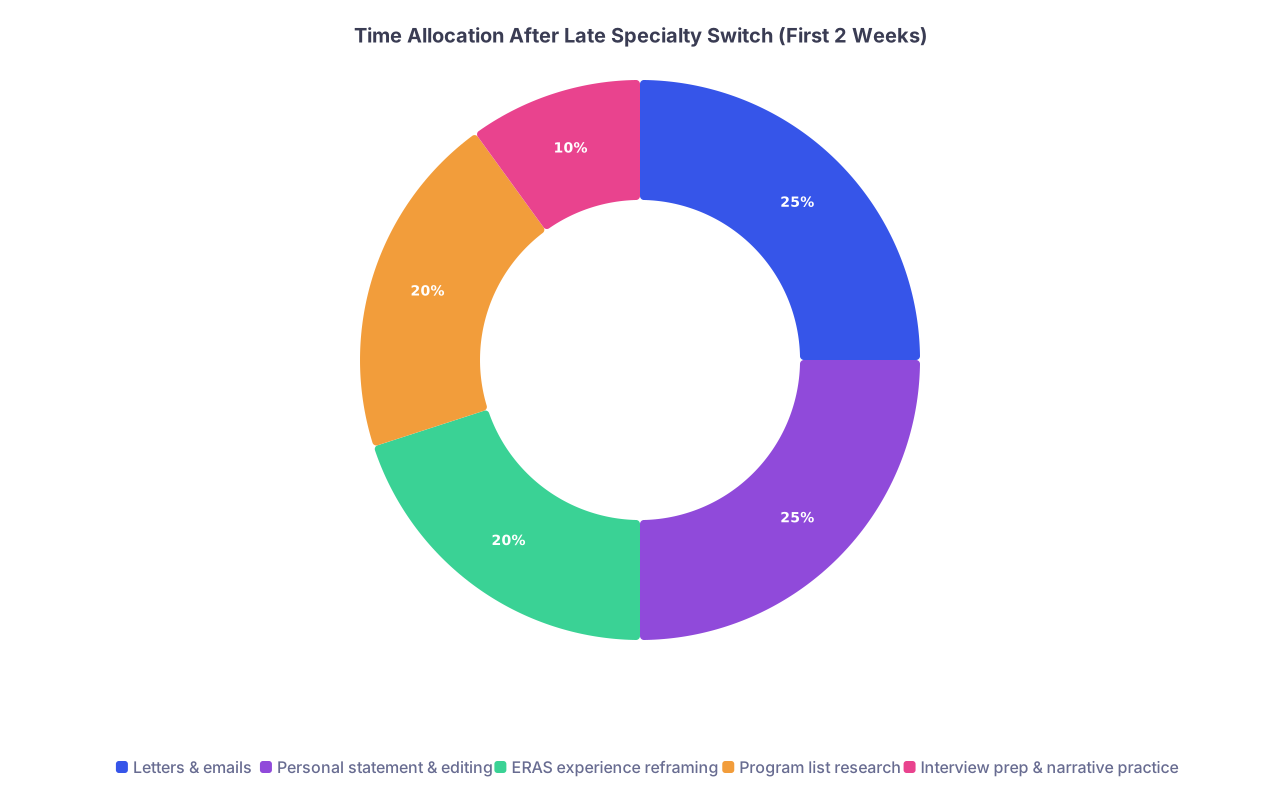
| Category | Value |
|---|---|
| Letters & emails | 25 |
| Personal statement & editing | 25 |
| ERAS experience reframing | 20 |
| Program list research | 20 |
| Interview prep & narrative practice | 10 |
If you’re in October or later:
- Still switch if you’re sure. Do not force yourself into a field you hate just because you started earlier.
- Expect that you may need a more generous program list, including community and less competitive programs.
- Strong, honest explanation becomes even more critical. PDs accept late insight; they do not accept vague flailing.
What To Say In Interviews Without Sounding Flaky
If you’ve cleaned your documents but then ramble in your interview, you undo all of it.
Expect some version of: “I see you originally had an interest in [old specialty]. Can you tell me about your decision to apply to [new specialty]?”
Your answer should hit four beats, calmly:
- Acknowledge the original path.
- The key experiences that sparked doubt / reevaluation.
- The positive reasons you’re drawn to the new field (not just negatives of the old one).
- Concrete steps you took once you decided.
Example for someone who switched from surgery to IM:
“Yes, I went into fourth year expecting to become a surgeon. I did a sub‑I and an away in general surgery and learned a lot, especially about perioperative care. During those months I noticed that the parts of my day I enjoyed most were pre‑op optimization and complex medical management on the floor, not the OR itself. I missed the broader differential diagnosis and long‑term relationships I’d found in earlier medicine rotations. So I did an internal medicine acting internship in July/August to test that feeling. I found I was more engaged, more energized, and received strong feedback. After that, I decided to redirect my application fully to internal medicine. Since then, I’ve worked with IM mentors, updated my letters, and focused my applications exclusively on programs where I can grow as a general internist.”
Notice there’s no apology. No “I’m so sorry I changed my mind.” Adults change careers. It’s fine. Own it.
Pitfalls I See Every Year (That You Can Still Avoid)
Let me just list a few recurring self‑inflicted wounds:
- Keeping your CV header “Orthopedic Surgery Applicant” when you’re applying PM&R.
- Uploading the wrong personal statement to the wrong program type.
- Forgetting that preliminary/transitional year programs will also see your story.
- Having your email signature say “Future Cardiothoracic Surgeon” while applying anesthesia.
- Mentioning your “lifelong dream of pediatrics” in one paragraph and “lifelong interest in emergency medicine” in the next. Lifelong doesn’t survive multiple fields. Drop that word.
- Using words like “fallback,” “backup,” or “less competitive” in any spoken or written context about your new specialty. Ever.
Do a cringe‑check on all your public‑facing materials:
- Email signature
- ERAS photo file name (not “surgery_app_photo_final3”)
- Any attached CVs you send outside ERAS
- LinkedIn or public profiles if PDs might see them
Clean them so they reflect your current choice, or at least don’t contradict it.
A Simple Fix‑Order Checklist
Once you’ve committed to the switch, here’s the sequence I’d use to avoid mixed‑signal landmines:

| Step | Description |
|---|---|
| Step 1 | Decide to switch |
| Step 2 | Write clear 3-5 sentence narrative |
| Step 3 | Draft new personal statement |
| Step 4 | Email potential letter writers |
| Step 5 | Reframe ERAS experiences |
| Step 6 | Review MSPE and anticipate questions |
| Step 7 | Adjust program list & signaling |
| Step 8 | Check for leftover references to old specialty |
| Step 9 | Practice 2-3 versions of your switch story |
You do not have time to obsess over fonts, minor word choices, or exotic formatting. You do have time to fix obvious contradictions and present one coherent story.
What You Should Do Today
Open your personal statement and highlight every sentence that mentions your “previous” specialty, directly or indirectly.
For each one, ask:
- Does this support my new story, or undermine it?
If it undermines it, rewrite or delete that sentence today. Then send the new draft to one person you trust (mentor, advisor, recent resident) with a single question:
“Does this make my switch feel intentional and committed, or like a backup move?”
You fix that first. Then you move to letters and experiences. One piece at a time, but all pushing in the same direction.