
You are two weeks from your ERAS submission date. Your CV is solid, your personal statement is finally not embarrassing, and you are refreshing your email every five minutes waiting for that “Letter uploaded to ERAS” notification from your so‑called “strong” letter writers.
Then the first LoR gets released to you after the cycle (or you hear about it indirectly from a program coordinator): three paragraphs, your name misspelled twice, and the attending writes, “I did not work extensively with this student but…”
That letter did not help you. It hurt you.
Let me walk you through the mistakes that get applicants quietly screened out because of their letters of recommendation. These are preventable. But only if you stop assuming “any letter is better than no letter.” That myth has burned a lot of applicants.
1. Choosing the Wrong Letter Writers
This is the foundational error. If you choose poorly here, nothing else really fixes it.
Mistake: Prioritizing title over relationship
You chase the “big names”: department chair, program director, nationally known researcher. Except you barely worked with them. They barely remember you. So you get:
- Vague, generic language
- Obvious form-letter structure
- Zero concrete examples of your performance
Program directors can smell this in seconds. They read hundreds of LoRs every year. They know the difference between “This is my real trainee” and “Some student I barely know asked me for a letter.”
Red flag phrases they notice:
- “Although my direct contact with the applicant was limited…”
- “I did not have the opportunity to observe…”
- “In the brief time I interacted with…”
- “Based on my limited experience with…”
These are death sentences in competitive specialties. And they absolutely hurt you in any specialty if you stack several of them.
What to do instead:
Pick people who:
- Actually supervised you hands-on (attendings on a month-long rotation, research PI you worked with closely, clinic preceptor who saw you week after week).
- Can tell specific stories about you.
- Already speak well of you to others. If you cannot imagine them defending you in a meeting, they should not be writing your letter.
If your choice is:
- Famous chair who barely remembers you
vs. - Mid-career attending who worked with you every day and liked you
The second is almost always the better letter. Do not get seduced by titles.
Mistake: Asking people who are lukewarm about you
You know that attending who constantly gave you “Meets expectations” on your evals, said very little feedback, and did not seem particularly impressed? Do not ask them for a letter. Hoping they will magically become enthusiastic in writing is delusional.
An honest attending who is not excited about you will write a “damning with faint praise” letter, like:
- “Reliable and punctual.”
- “Gets along with team members.”
- “Will be a solid resident.”
Program directors read that as: “Not a problem, but not special. Backup candidate.”
Protect yourself: Ask this question explicitly:
“Would you feel comfortable writing me a strong letter of recommendation for residency?”
Say the word “strong.” Out loud.
Watch their face. Listen to the pause. A hesitant “Sure, I guess” is a no. A real supporter says, “Absolutely” without hesitation, or starts listing your strengths instantly.
If they hedge, thank them and do not follow up. You are not obligated to use every attending you ask.
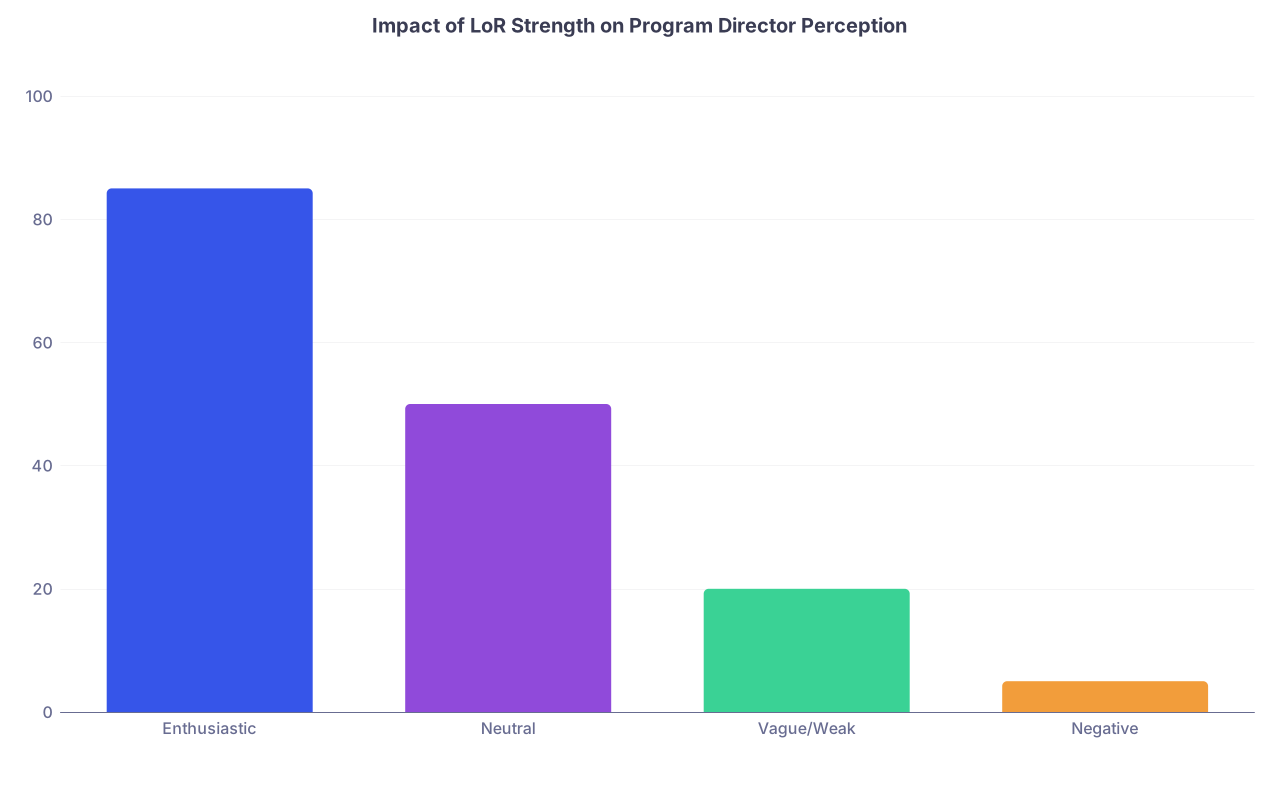
| Category | Value |
|---|---|
| Enthusiastic | 85 |
| Neutral | 50 |
| Vague/Weak | 20 |
| Negative | 5 |
(Approximate percentage of program directors who say each letter type makes them more likely to interview the applicant.)
2. Getting Letters That Are Vague, Generic, or Template-Like
You might think, “As long as it is positive, I am fine.” Wrong. Generic positivity is almost as bad as mild negativity.
Mistake: Letters with no specific behaviors or examples
A real, helpful LoR sounds like someone who actually watched you work. A weak, unhelpful one sounds like it could be copy‑pasted for any medical student.
Program directors absolutely flag letters that look like this:
“The applicant is hardworking, punctual, and a team player. They were always eager to learn and showed compassion to patients.”
That sentence could describe 90% of applicants. It tells nothing.
What they want to see:
- A specific difficult patient interaction you handled well
- Evidence of your reliability (e.g., you came in on days off to follow patients)
- Examples of you taking initiative
- How you responded to feedback
- Comparisons to peers: “Among the top 10% of students I have worked with in the last 5 years”
Common generic language red flags:
- “Good medical knowledge” without any qualifiers
- “Shows potential” (translation: not there yet)
- “Will do well with continued supervision”
- “Improved over the course of the rotation” with no details
These are code phrases. Experienced PDs know exactly what they mean.
How to avoid getting a generic letter
You cannot write the letter. But you can arm your writer so they are not guessing.
Give them:
- An updated CV
- Your personal statement
- A 1‑page “brag sheet” with:
- 3–5 specific patients or cases you handled on their service
- Examples of initiative (QIs, teaching, extra work)
- Any feedback they gave you that you acted on
Then say something like:
“I know you are busy, so I put together these examples to jog your memory about my time on the rotation. If it is possible to include specific cases or how I compared to peers, that would really help my application.”
You are not telling them what to say. You are making it easier for them to remember why you were worth writing for.
3. Missing Specialty‑Specific or Required Letters
You would be shocked how many otherwise competitive applicants blow this part.
Mistake: Not having the right type and number of LoRs
Every specialty and many programs have preferences:
- Internal medicine: usually want 2–3 clinical IM letters, often from inpatient rotations
- Surgery: at least 1–2 letters from surgeons who saw you in the OR and wards
- EM: SLOEs (Standardized Letters of Evaluation) are mandatory for most programs
- Pediatrics, OB/GYN, psych: typically want at least one letter from that specialty
If you apply to EM without SLOEs: massive red flag. You look either unadvised or unprepared. Same for applying to competitive specialties with only one mediocre specialty letter and the rest from random pre-clinical faculty.
| Specialty | Strong Expectation | Major Red Flag |
|---|---|---|
| EM | 1–2 SLOEs | No SLOE at all |
| Surgery | 2 surgical letters | Only medicine letters |
| IM | 2 IM inpatient letters | Only research / preclinical |
| OB/GYN | At least 1 OB/GYN | Zero OB/GYN letters |
| Psych | At least 1 psych | Only non-psych letters |
Mistake: Submitting non-clinical letters that do not count
The “Research Only” letter trap. You spent a year in a lab, PI loves you, and they write a glowing letter. That can be very helpful. But it does not replace:
- Required SLOEs for EM
- Core specialty letters for surgical fields
- Strong inpatient letters for IM
A research letter should be an extra letter, not your only strong letter. Programs want to know how you function on the wards, with patients, with teams. Pipetting skills do not answer that.
4. Timing Disasters: Late, Rushed, or Last-Minute Letters
You underestimate how long attendings take to write and upload letters at your own risk.
Mistake: Asking too late
You finish a great rotation in May. You think, “I will ask in August when ERAS opens.” By August, that attending has:
- Worked with 20+ other students and residents
- Forgotten half of your patient cases
- Started a new research project, new leadership role, and is more busy than before
So you get a generic, shorter letter. If they remember to write it at all.
Or they write, “I worked with [FirstName?] during a recent rotation…” because they forgot your last name.
Better pattern:
- Ask for letters within 1–2 weeks of finishing a strong rotation.
- Even if ERAS is not open, they can write and save the letter, or you can remind them later.
Then, remind them politely 4–6 weeks before you need it uploaded:
“Just a quick reminder about the letter you kindly agreed to write for my internal medicine residency application. ERAS opens on [date], and I plan to certify around [date]. Please let me know if you need any additional information from me.”
If they start ghosting you, assume that letter may never appear. You need backups.
Mistake: Submitting with obviously missing letters
Programs notice if:
- You list 4 intended letters, and only 2 are ever uploaded.
- Your home specialty program did not write for you at all.
- You applied to EM with “SLOE pending” that never actually shows up.
Missing expected letters often raises one question: “Did someone refuse to write for this person?” That is not a question you want on a PD’s mind.
Have more potential letter writers than you strictly need. That is your insurance.
5. Letters That Quietly Signal Concerns
This is the part applicants rarely see. There is a whole language of “code red” phrases in LoRs that tell PDs you are risky.
I have sat in ranking meetings where one sentence in a letter torpedoed a candidate’s position.
Mistake: Ignoring “faint praise” and coded negative language
These are the kinds of lines that drop you down the rank list:
- “With ongoing supervision, I expect the applicant will become a competent resident.”
- “Has shown significant improvement.” (Unless explicitly framed as a success story.)
- “Did not stand out compared to peers.”
- “Occasional issues with time management but receptive to feedback.”
- “Would benefit from continued development of clinical reasoning.”
Program directors are not guessing. They read this language all the time. They know this means: performance concerns.
Mistake: Letters that contradict your narrative
If your personal statement sells you as “mature, composed, and dependable,” and then a letter says:
“At times, the applicant struggled with stress during busy call nights.”
That inconsistency will not be ignored.
Similarly, if you spin a professionalism issue as “a one-time misunderstanding later resolved,” and a letter lightly hints at “professional growth after an incident,” programs will assume the worst.
You cannot fully control what they write, but you can:
- Avoid asking for letters from anyone who had serious concerns about you.
- Address any documented issues honestly in your application, so letters do not blindside the reader.
6. Process Mistakes: How You Ask and How You Follow Up
This part sounds trivial. It is not. The way you approach attendings affects how much effort they put into your letter.
Mistake: Asking in a lazy or transactional way
Examples of bad approaches:
- Emailing: “Hey Dr. X, could you upload a letter for my residency app? ERAS should have sent you something.”
- Catching them as they are walking out of the hospital: “Can you write me a letter?”
- Not providing ANY supporting materials
If you look disorganized or passive when asking, do not expect them to work hard on your behalf.
Better approach:
- Ask in person if possible, near the end of a rotation when they know your work.
- Use clear language: “Would you feel comfortable writing me a strong letter of recommendation for [specialty] residency?”
- If they agree, follow up with:
- CV
- Personal statement draft
- Brief bullet list of cases / contributions on their service
- A clear deadline
You are trying to make their job easier. Because if they are busy, they will default to a shorter, generic letter unless you give them reasons not to.
Mistake: Not checking instructions or waiving your right incorrectly
Programs take the LoR process somewhat seriously. They expect you to:
- Waive your right to see the letter (this signals that the letter is more likely to be candid).
- Use correct ERAS processes and forms.
- Not submit obvious “family friend” or biased letters unless explicitly allowed.
If you do not waive your right:
- Some letter writers will tone down negative comments.
- Some programs view non‑waived letters as less credible.
I have seen PDs literally say, “He did not waive his right? Weird,” and move on to the next applicant with a raised eyebrow.
Unless there is an extremely compelling reason, you should waive your right.
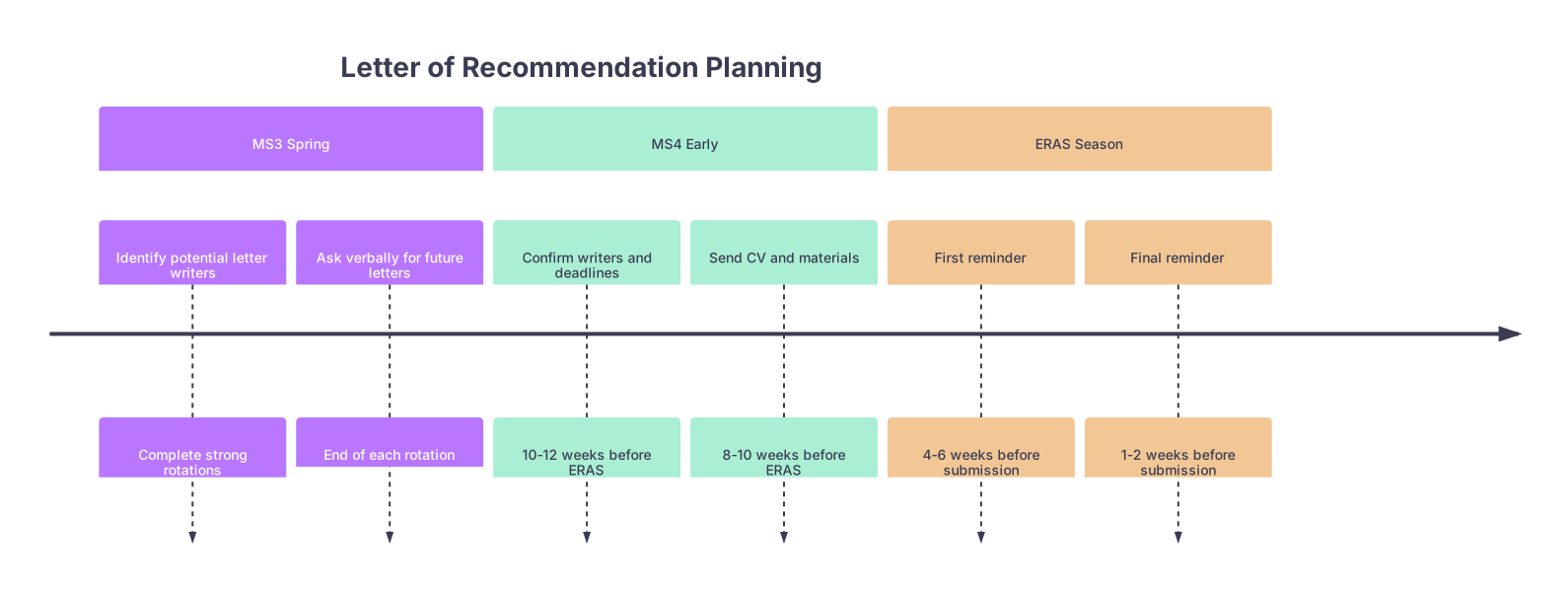
| Period | Event |
|---|---|
| MS3 Spring - Identify potential letter writers | Complete strong rotations |
| MS3 Spring - Ask verbally for future letters | End of each rotation |
| MS4 Early - Confirm writers and deadlines | 10-12 weeks before ERAS |
| MS4 Early - Send CV and materials | 8-10 weeks before ERAS |
| ERAS Season - First reminder | 4-6 weeks before submission |
| ERAS Season - Final reminder | 1-2 weeks before submission |
7. Red Flags Specific to Certain Situations
Some situations make LoRs even more scrutinized. If this is you, you need to be smarter than average.
Switching specialties late
If you started as surgery and suddenly apply to psychiatry, and your strongest letter is from a cardiothoracic surgeon who writes:
“I was surprised to hear the applicant plans to pursue psychiatry.”
That is a red flag.
Programs will question your commitment and judgment.
If you switch specialties:
- Get at least one very strong letter from someone in your new specialty, even if it means doing a late away rotation or home rotation.
- Ask your non-specialty writers not to undermine your new path. They do not need to lie, but they can avoid “I am surprised” language.
Prior academic or professionalism problems
If you have:
- Course failures
- Remediated clerkships
- Professionalism write-ups
Your letters matter even more. They can either:
- Confirm that you have truly improved and function at the level of your peers
or - Quietly signal lingering concerns and sink your chances
You cannot control everything, but you can:
- Choose letter writers who supervised you after the problem and saw concrete improvement.
- Directly ask them to comment on your growth if they feel comfortable:
“Given my past remediation, if you feel comfortable briefly addressing how you have seen me grow or improve since then, that would really help programs understand where I am now.”
If they look uncomfortable, do not push. Pick someone else.
8. The Myth of “More Letters = Better”
One more trap.
Some applicants think, “I will upload the maximum allowed for every program. More must be better.”
Not exactly.
Mistake: Flooding programs with mediocre extra letters
If ERAS allows 4 letters per program and you have:
- 2 truly excellent, detailed, specialty-appropriate letters
- 1 generic preclinical faculty letter
- 1 weak, vague research letter
You do not need all 4. Those last two can dilute the impact of the strong ones. PDs will read what is in front of them. They will not magically ignore the weak letter.
Use the best letters. Not the maximum number.
If a program allows 4 and you only have 3 good ones? Submit 3.
FAQ (Exactly 4 Questions)
1. Is a bad or generic letter worse than having fewer letters?
Yes. A generic or faint‑praise letter can absolutely hurt you more than having one fewer letter, especially in competitive specialties. If your choice is between submitting a clearly weak, non‑specific letter and going with a slightly lower number of strong letters, choose fewer but stronger.
2. Can I ask a letter writer to show me the letter before they upload it?
In most systems, the expectation is that you waive your right to see the letter. That is what programs are used to and what many PDs trust more. You can technically ask, but many faculty will refuse, and it can create awkwardness. If you are that worried about what they will write, you probably should not be asking them for a letter.
3. What if my home program in my chosen specialty will not give me a letter?
That is a red flag, and programs know it. If your home specialty leadership refuses or “does not have time” to write for you, you need to compensate with very strong letters from away rotations and other faculty in that field. You should also talk to an advisor you trust (ideally outside that department) to understand whether there are concerns about your performance you are not seeing.
4. How many total potential letter writers should I line up?
More than you think. Aim for at least 1–2 extras beyond what you plan to use. So if you want to submit 3–4 letters per program, have 5–6 attendings who have agreed to write. Some will be late, some will write weaker letters, and some may never upload. Extras give you options so you do not end up forced to use a mediocre letter.
Key points, then stop:
- The wrong letter writer can quietly kill an otherwise strong application; choose people who know you well and are genuinely enthusiastic.
- Vague, generic, or faint‑praise letters raise serious red flags; specific examples and clear comparisons to peers are what help you.
- Plan early, over‑recruit letter writers, and do not submit a letter just because you have it—submit it because it strengthens your case.