
Two weeks before rank lists were due, a student emailed me a single line: “I think one of my letters is killing my application.” She’d replayed every interaction with that attending for months, trying to decode whether their vague, lukewarm comment meant her whole match was doomed.
If you’re reading this, I’m guessing you’re in that same mental loop right now. Staring at ERAS. Replaying an awkward eval. Wondering, “Did I just hand my future to someone who doesn’t even like me?”
Let’s talk about it. Honestly. Because the fear around “bad letters” is huge—and the reality is a lot more nuanced than the horror stories on Reddit.
First: Is Your Letter Actually “Bad”… Or Just Not Glowing?
Most of us catastrophize anything less than “top 1% student of my career.” If an attending didn’t promise to name their firstborn after you, you assume the letter is negative.
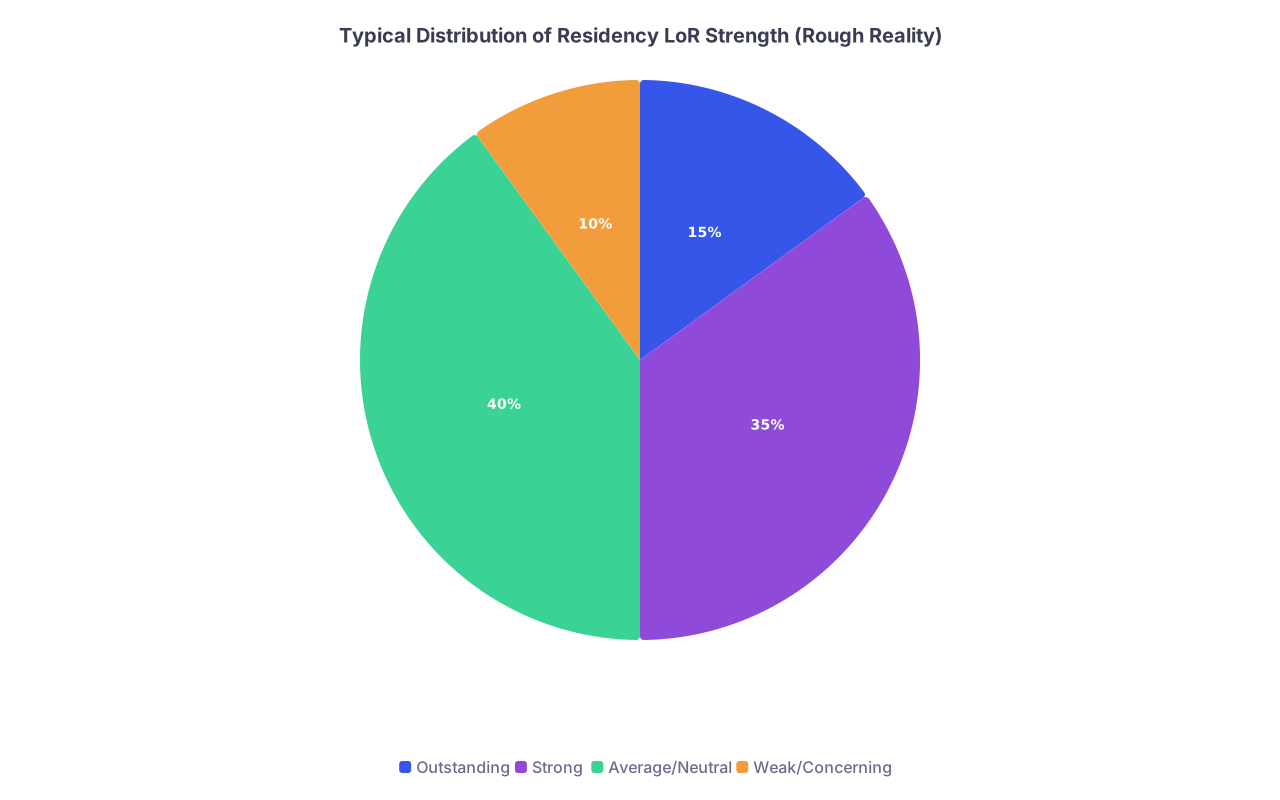
Here’s the ugly truth: most letters are… fine. Not amazing, not terrible. Just vanilla.
| Category | Value |
|---|---|
| Outstanding | 15 |
| Strong | 35 |
| Average/Neutral | 40 |
| Weak/Concerning | 10 |
That bottom slice—the genuinely weak or concerning letters—is a lot smaller than people think. But your brain automatically throws you into that 10% because that’s what anxiety does.
Ask yourself what’s actually making you suspicious:
- You never saw the letter and the attending was kind of cold
- Your clinical eval from them had some “meets expectations” instead of all “exceeds”
- You heard a rumor: “Dr. X writes harsh letters”
- They said something vague like, “I’ll write you a letter, but I only describe what I observe”
None of that automatically means your LoR is negative. It might mean it’s just… bland. And bland is not great, but it’s not a match death sentence either.
The only time I really worry is when:
- An attending directly tells you they can’t write you a strong letter, or
- You had clear conflicts, professionalism issues, or major performance problems with them
If that’s not you, you’re probably spiraling over something that’s more “meh” than “malicious.”
Can One Weak or Negative Letter Sink Your Match?
Short answer: alone, rarely. In context, sometimes.
I know that’s not comforting yet, so let’s break it down.
Programs are looking at your entire file, and different pieces carry different weight. Roughly—this is not perfect, but it’s reality:
| Component | Relative Impact |
|---|---|
| Board scores (if used) | High |
| Clinical grades | High |
| Interview performance | High |
| Personal statement | Medium |
| Letters of Rec (set) | Medium |
| Research/Activities | Medium-Low |
Letters are one part of the middle of that table. Important, yes. But not usually the single lever that decides everything—unless they’re clearly toxic.
Here’s how different scenarios tend to play out:
Scenario 1: One average letter, others strong
Impact: Mild.
Programs basically average them in their heads: “Two strong letters, one generic. Ok, typical.” This might matter more at hyper-competitive places but usually won’t kill you across the board.
Scenario 2: One clearly weak/negative letter, others strong
Impact: Variable, specialty-dependent.
- In competitive specialties (Derm, Ortho, Plastics, ENT, etc.), this can be a real problem at some programs. A letter that hints at professionalism issues, poor teamwork, or attitude is a big red flag.
- In less cutthroat fields, if everything else looks excellent and the other letters are glowing, some programs will shrug and say, “Odd, but maybe a bad fit with that attending.”
Scenario 3: Multiple lukewarm/mediocre letters
Impact: Bigger.
This doesn’t scream “bad person.” It screams “no one is truly excited to work with this applicant.” That hurts more than a single suspicious letter because it suggests a pattern.
But your situation? You’re worrying about one letter that might be off. That’s different.
How Programs Actually Read Letters (Versus How We Imagine It)
We picture PDs hunched over every sentence, psychoanalyzing adjectives. Reality: they’re tired, flipping through lots of files quickly, looking for signals.
They scan for:
- Superlatives: “Top 5%,” “One of the best I’ve worked with”
- Specific examples: “Handled a crashing patient with poise,” “Took initiative to…”
- Red flags: “with guidance,” “at times needed reminders,” “struggled with time management initially”
They also weigh:
- Who wrote it (big names, PDs, chairs, well-known educators)
- How long they’ve known you
- The pattern across all letters

No one is sitting there thinking, “This student is dead to me forever because one attending said ‘solid’ instead of ‘outstanding.’”
What freaks them out more:
- Mentions of unreliability (“occasionally late,” “needed reminders about deadlines”)
- Hints of personality issues (“had difficulty accepting feedback,” “interactions with staff were at times strained”)
- Concerns about patient safety or judgment
That kind of stuff can tank you at specific programs. But again, that’s if it’s explicitly there—not just in your head.
Did You Waive Your Right to See the Letter? Now You’re Extra Anxious
You clicked “waive” on ERAS because everyone told you to. And now it feels like you basically mailed a blindfolded, sealed grenade to programs.
Here’s the thing: waiving is standard. Not waiving often raises more suspicion than any hypothetical weak letter.
Waiving means:
“I trust my writers enough that they’ll be honest. I’m not curating them after the fact.”
The best way to avoid problems before letters are written is what you already know but maybe didn’t do:
- Ask: “Would you feel comfortable writing me a strong letter?”
- Watch their reaction—enthusiastic vs. hesitant
- Only use the ones who respond clearly positive
If you didn’t ask that and just kind of mumbled, “Can you write me a letter?” and they said “Sure”… yeah, that uncertainty sucks. But it still doesn’t automatically equal “negative.”
Signs Your LoR Might Actually Be Problematic
Let’s not sugarcoat. There are warning signs that make me nervous when applicants tell me their story:
- The attending explicitly said, “I’m not sure I can write you a strong letter,” and you used it anyway
- You had documented professionalism issues with them (formal remediation, write-ups, etc.)
- They clearly didn’t like you: snide comments, tense conversations, direct negative feedback
- You were pulled from patient care or had big conflicts with nurses/staff on that team
If this sounds uncomfortably close to your situation, then yeah, I’d worry more about that letter. Not in a “your career is over” way, but in a “this could absolutely hurt at some programs” way.
If that’s the case, your most important question is: Did you have alternatives and still chose this writer?
If yes, that’s a fixable but unfortunate mistake. If no (small school, limited rotations, personality clash with required letter-writer) — then your job becomes damage control, not self-destruction.
What You Can Do Now If You Already Submitted ERAS
You’ve clicked submit. It’s out there. You can’t unsend the letter.
So. What’s left?
1. Stop rewriting history
You can’t go back and swap letters. So spending hours analyzing hypothetical word choices from an unseen letter is just self-torture.
Your time is better spent:
- Nailing interview prep
- Improving your communication and professionalism so programs see current you, not whatever that letter says
- Strengthening future letters (for SOAP, reapplication, or prelim/transition year plans if needed)
2. Add strong signals elsewhere
If you’re still in the season where you can influence things:
- Get additional letters uploaded (yes, even after initial submission) if your specialty/program count allows
- Ask for a letter from someone who genuinely adores you—sub-I, research PI, PD, chief, etc.
Programs don’t have to read all of them, but when they see multiple strong ones, they’re more likely to treat an odd/mediocre one as an outlier.
3. Own your narrative in interviews
If you know you had a rocky rotation with a likely letter-writer, be ready—with tactful, honest framing if it ever comes up. Something like:
“Earlier in clinicals I struggled with [specific issue—time management, prioritization]. I got direct feedback on that, and since then I’ve done X and Y to improve. On my later rotations, attendings commented that [concrete positive change].”
You’re not saying “Dr. Smith is awful and wrote me a bad letter.” You’re saying, “I learned, adapted, and here’s proof.”
How Often Does a Single Bad Letter Truly Kill a Match?
I’ve seen it matter in about three patterns:
Hyper-competitive specialties + so-so overall application
You’re already borderline on scores, research, or school prestige. Add a weak/suspicious letter, and you slide from “maybe” to “no.”Negative letter aligns with other concerns
Your dean’s letter hints at professionalism issues, and then a LoR subtly backs that up. Programs will believe the pattern.Small specialty/program where everyone knows the writer
If a well-known faculty member in that niche writes a clearly negative letter, that can travel further than you want.
But if your stats are solid, rotations mostly went well, and every other letter is good/strong? A single not-great one often just pushes you a notch lower on some lists, not into oblivion.
| Category | Value |
|---|---|
| Highly Competitive | 80 |
| Moderately Competitive | 50 |
| Less Competitive | 25 |
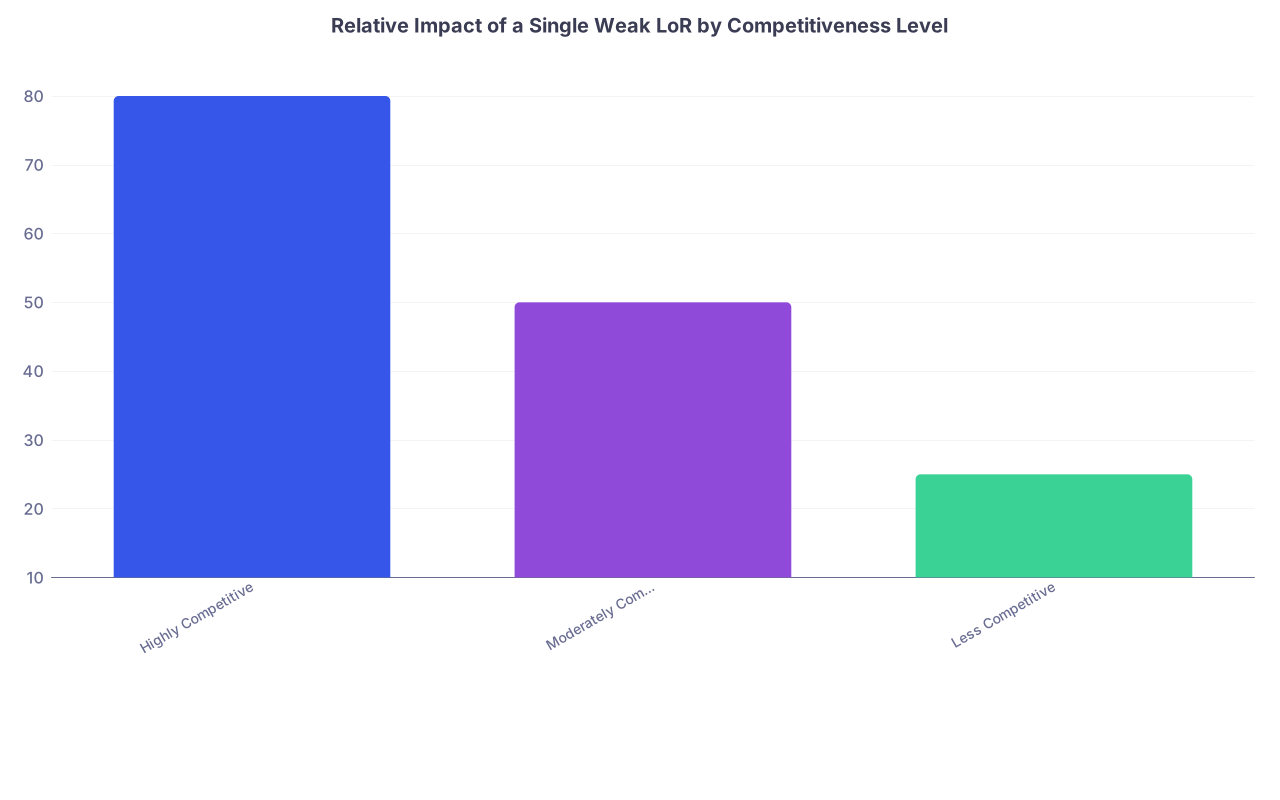
(Think of those numbers like “how much programs care about a weak letter,” not match probability. The more competitive the field, the less margin for weirdness.)
Planning for Worst-Case Without Destroying Yourself
You’re the type who likes to know the worst-case scenario upfront so you can brace for it. Fair.
Worst-case, if you really have a damaging letter and it does hurt:
- You get fewer interviews than you hoped
- You match at a less competitive program or in a different region than you wanted
- You don’t match, and you need a backup plan: prelim year, research year, reapply
Is any of that fun? No. Is it career-ending? Also no.
People reapply and match. People SOAP into prelim spots, then re-apply successfully. People switch specialties. All the time. No one puts that on Instagram, but it happens constantly.

| Step | Description |
|---|---|
| Step 1 | Apply with Possible Weak LoR |
| Step 2 | Interview & Rank Programs |
| Step 3 | Prepare for SOAP/Backup |
| Step 4 | Start Residency |
| Step 5 | Complete Year & Reapply |
| Step 6 | Strengthen App & Reapply |
| Step 7 | Get Enough Interviews? |
| Step 8 | Match? |
| Step 9 | SOAP or Reapply |
You are not one PDF away from your life being permanently ruined. Even if that PDF is not as kind as you wish it were.
What You Can Do Today To Feel Less Powerless
Because the worst part of all this is the helplessness, right? You already submitted. The letter is invisible. Programs are reading it while you sit there refreshing your email.
So, today, pick one concrete move:
Identify your strongest advocate
Who actually loves working with you? Email them and say something like:
“I’m very grateful for the mentorship you’ve given me. If there’s ever an opportunity where a call or email from you might help support my residency application, I’d be incredibly grateful.”
Sometimes those quiet advocacy calls help more than any letter.Tighten your interview answers
Open a document and write out answers to:- “Tell me about a time you received constructive feedback.”
- “What’s an area you’ve worked to improve?”
- “How would your attendings describe you as a resident?”
Make sure your answers show growth, insight, and humility—especially if you had a rocky rotation.
Make a reasonable Plan B
If you’re in a very competitive specialty, outline what you’d do if you didn’t match: prelim, TY, research, second specialty. Clarity calms anxiety. Unknowns fuel it.Stop doomscrolling anonymous forums
You will always find someone saying, “I didn’t match because of one bad letter.” You will never see the whole truth. Close the tab.
FAQ: Weak or Negative LoR Panic
1. Should I ask the writer if my letter was positive after they submitted it?
No. That ship has sailed, and asking now puts them in an awkward spot with zero benefit to you. Before they write it, yes—ask if they can write a strong letter. After it’s in ERAS, don’t poke the bear.
2. Can I ask my dean’s office or advisor if they heard anything about my letters?
You can ask if any concerns have been raised about your application in general. Some schools get quiet feedback; most don’t. But don’t expect them to break confidentiality or show you the letters. At best, you’ll get vague reassurance.
3. If I suspect a truly damaging letter, can I remove it mid-cycle?
Practically speaking, no. Once it’s been assigned and programs have downloaded it, it’s out. In future cycles, you can absolutely choose not to reuse that letter. For this cycle, your focus has to shift to: strong interviews, additional good letters (if allowed), and backup planning.
4. How do I prevent this from happening again if I have to reapply?
Be ruthlessly selective with letter-writers. Only choose attendings who:
- Gave you clear, positive feedback
- Seemed to actually like teaching you
- Respond enthusiastically to “strong letter” requests
And ask explicitly: “Do you feel comfortable writing a strong, supportive letter for my application?” If you sense hesitation, thank them and choose someone else.
Open your list of letter-writers right now and be honest with yourself: who would go to bat for you hardest today? If you’re still early enough, get one more strong letter from that person. If you’re not, spend that energy sharpening your interview story so programs see the real you—not whatever your anxious brain imagines is in that letter.