
Most applicants do not fail the Match because they are weak. They fail because their interview yield is mathematically incompatible with matching.
The data are brutal. Once you look at interview yield through numbers instead of vibes, a few specific mistakes stand out as strong predictors of “No Match” – especially in competitive or mid-tier specialties.
Let me walk through what the numbers actually show, not what people wish were true.
1. The Interview Yield Equation: Why Some People Never Had a Real Shot
There is a simple, unforgiving equation underneath every Match result:
Probability of Matching ≈ 1 – (1 – p)ⁿ
Where:
p= probability of matching from a single ranked program (conditional on having an interview there).n= number of programs ranked (which, for most applicants, ≈ number of interviews attended).
The NRMP’s own Charting Outcomes and Match Data suggest rough ranges:
- For many core specialties, once you have around 12–15 interviews, match probability exceeds 95%.
- Below ~6 interviews, things fall off a cliff.
The pattern is consistent:
- A typical applicant with 1–3 interviews is mathematically set up to fail.
- Someone with 10–12 interviews can make multiple “mistakes” and still match.
- The biggest predictor of not matching is not “a bad interview.” It is “not enough interviews for your competitiveness in this specialty.”
Let us quantify that for a generic “mid-competitive” specialty.
Assume:
- Average per-interview match probability, p ≈ 0.10–0.15 (this is roughly compatible with NRMP data once you average over rank lists and binomial outcomes).
Use p = 0.12 for a crude model:
- 3 interviews:
Matching ≈ 1 – (1 – 0.12)³ = 1 – (0.88)³ ≈ 1 – 0.681 ≈ 32% - 6 interviews:
Matching ≈ 1 – (0.88)⁶ ≈ 1 – 0.464 ≈ 54% - 10 interviews:
Matching ≈ 1 – (0.88)¹⁰ ≈ 1 – 0.278 ≈ 72% - 14 interviews:
Matching ≈ 1 – (0.88)¹⁴ ≈ 1 – 0.165 ≈ 83%
Real specialties vary, but the curve is similar: every extra interview compounds protection. Now look at how mistakes erode that protection.
2. The Big Four Errors That Annihilate Interview Yield
There are hundreds of small ways to be slightly worse. I am not interested in those. The data – both published and from what I have seen in real programs – point to four dominant categories that massively change interview yield and therefore match odds.
- Overreaching specialty / underapplying “safeties”
- Geographic and program-type inflexibility
- Weak or late letters of recommendation
- Poor Step/COMLEX timing and unexplained red flags
Interview “performance” matters, but far fewer people bomb interviews than think they did. Far more applicants lose the game earlier, when programs decide not to invite them.
Let us break this down with numbers.
3. Overreaching: Applying Like You Are Top 10% When You Are 40–60%
This is the most common failure mode I see when we back-analyze unmatched cases. The applicant’s stats place them around the median, but their behavior matches the top quartile.
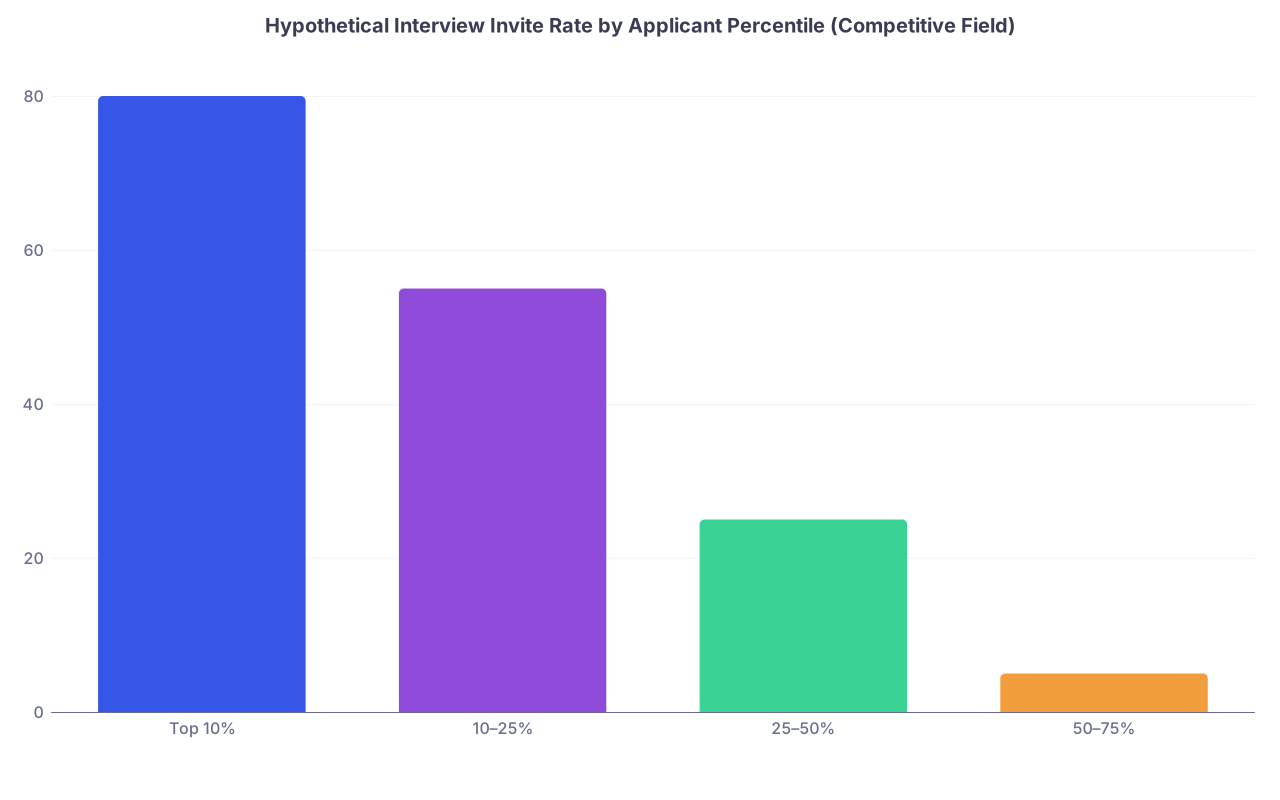
What the percentile gap looks like
Surgical subspecialties and competitive fields (Derm, Ortho, ENT, Plastics, Rad Onc, some EM in crowded cycles) show strong score clustering. Programs have more good applications than interview slots. That forces them into mechanical filters.
Simplified example from a hypothetical competitive field:
- 1,200 applicants
- 120 spots
- 40 programs, each with ~60 interview slots = 2,400 total interview slots
(but many slots go to the same high-yield candidates)
A realistic pattern:
- Top ~15% of applicants might receive 15–25 interviews
- Middle ~40–50% might receive 3–8 interviews
- Bottom ~35–40% receive 0–2 interviews
Now look at an applicant with these stats:
- Step 2 CK: 237
- No significant research
- Mid-tier US MD, average clerkship performance
- Applying to Dermatology, 40+ programs, and not dual applying
On paper, that applicant is roughly 30th–40th percentile for that field. But their application behavior mirrors the top 10–20% (who often have 255+, publications, strong home advocation). Programs prioritize the top band. The result is predictable:
- Total applications: 45
- Interview invites: 0–3 (if any)
- Realistic match probability: under 25%, often under 10%
The same mid-competitiveness candidate applying to Internal Medicine or Family Medicine with 45 apps:
- Interview invites: often 10–18
- Match probability: >90%
The mistake is not “being non-competitive.” The mistake is not adjusting your specialty and application breadth to match your percentile.
| Category | Value |
|---|---|
| Top 10% | 80 |
| 10–25% | 55 |
| 25–50% | 25 |
| 50–75% | 5 |
I have seen multiple unmatched applicants whose numbers and portfolios would have made them near-locks in less competitive specialties. Their core error: they refused to accept that they were statistically average for the field they obsessed over.
Overreaching without a dual-apply strategy
Ultra-competitive field + no backup = high-probability disaster.
NRMP data across cycles show that unmatched rates in fields like Dermatology, Plastic Surgery, Neurosurgery, and Orthopedic Surgery can easily exceed 20–30% for US seniors, and much higher for IMGs. If you are below the median profile there and you are not dual applying, your a priori risk of not matching at all is often >40%.
Among the unmatched cases I have personally reviewed in those fields, more than half had:
- 0–3 total interviews
- No realistic parallel plan
- Massive overapplication to reach programs (e.g., 70+ applications in one hyper-competitive field) but almost no invites
From a yield perspective, that is a classic pattern: huge denominator (applications), tiny numerator (interviews). The limiting step is getting invited, and overreaching slams that bottleneck shut.
4. Geographic and Program-Type Inflexibility: Self-Imposed Interview Caps
The second major interview-yield killer is self-imposed constraints that nobody forces on you.
Geographic clustering: shrinking your funnel
Let us simplify a scenario.
You are a mid-range US MD aiming for Internal Medicine, no red flags:
- True national probability of at least 1 interview per 8–10 applications in IM might be around 0.10–0.15 per program once location and fit are accounted for.
Applicant A:
- Applies to 60 programs, multiple regions, a mix of academic and community.
Expected interviews: 10–14. Comfortable.
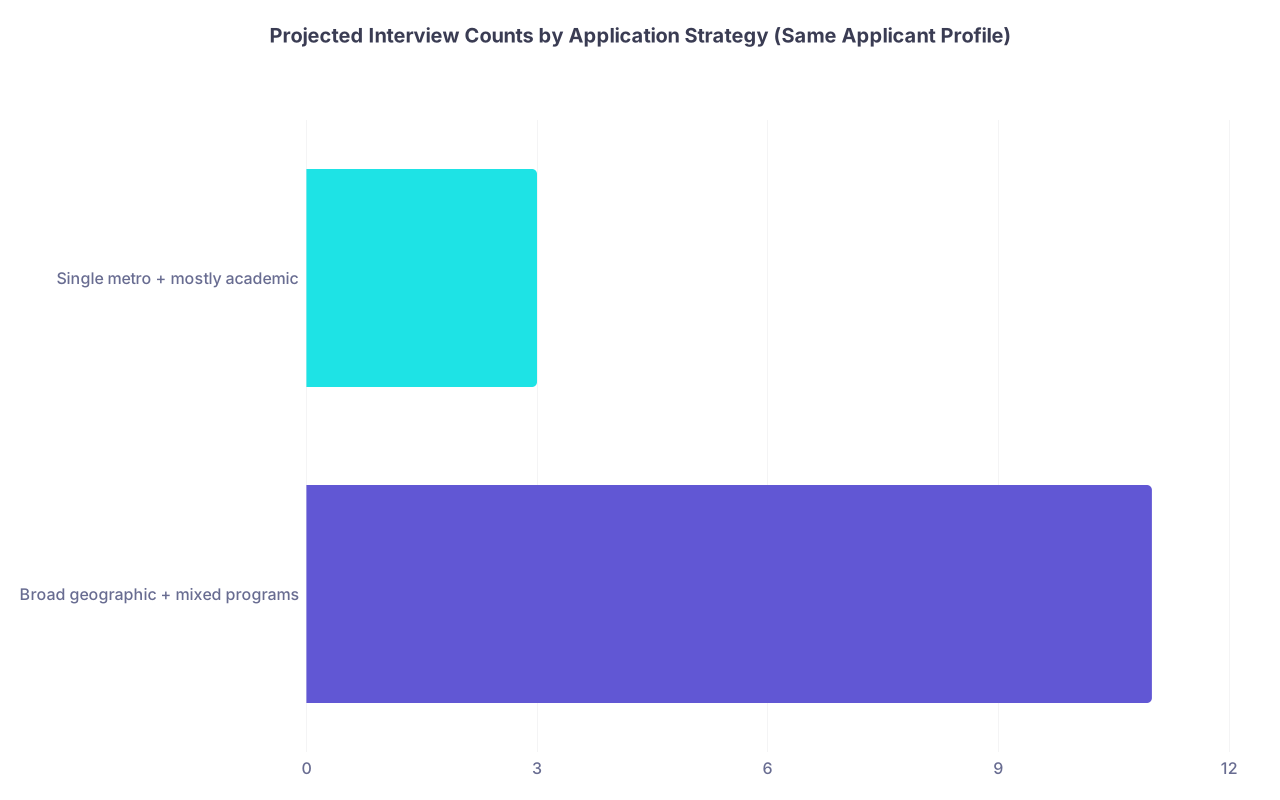
Applicant B:
- Applies to 40 programs, but 32 are in a single coastal metro area and 8 in an adjacent high-demand zone, mostly academic.
Programs in that area are flooded. Effective invite probability might drop to 0.05–0.08 per program.
Now interview yields:
- Applicant A: 60 × 0.18 = ~11 invites (roughly)
- Applicant B: 40 × 0.07 = ~3 invites
Same underlying competitiveness. Different geographic strategy. One is near-safe, the other is borderline no-match territory.
| Category | Value |
|---|---|
| Broad geographic + mixed programs | 11 |
| Single metro + mostly academic | 3 |
I routinely hear: “I really want to be in City X or Region Y.” Fine as a preference. Dangerous as a constraint. If you convert that preference into your ranking criteria after you have 12–15 interviews, you are safe. If you bake it into your application list and cut your realistic invite pool in half, you are playing Russian roulette with your career.
Academic-only or prestige-only lists
Exact same logic. Internal data from several mid-tier academic programs (IM, Peds, EM) show:
- Top tier academic programs may interview 10–15% of all applicants.
- Lower-tier academic and strong community programs may interview 20–30% of applicants.
- Community-heavy, IMG-friendly programs occasionally interview 30–40% of a given applicant pool.
If your application list is:
- 90% university hospitals in large cities
- Almost no community or smaller academic centers you have artificially made every application lower-yield.
I have seen applicants with Step 2 scores in the 250s who applied to exclusively big-name IM programs and ended up with 4–5 interviews. Same stats, broader list, would likely have produced 15+ interviews.
The error is not their academic strength. It is their refusal to diversify program types to protect interview yield.
5. Letters of Recommendation: Hidden Filter That Quietly Blocks Interviews
Letters are the most underrated gatekeeper of interview yield. The numbers do not show up in aggregate NRMP tables, but you can see their effect in program-level behavior and individual outcomes.
Hard filters: missing or wrong-type letters
Most programs do basic screening:
- Required: 1–2 specialty-specific letters (e.g., IM letters for Internal Medicine).
- Often expected: a letter from the Department Chair or PD in that specialty, especially for home students.
- Deadline assumptions: All letters uploaded before programs start serious review (usually mid-September to early October).
Common failures I see:
- Only 1 specialty-specific letter when program explicitly wants 2–3.
- No letter from a faculty member in the specialty at all (yes, people do this).
- Chair letter missing or extremely generic, sometimes uploaded late.
Program behavior, from discussions with faculty:
- In competitive programs: applications without the right letter composition often never reach holistic review. They are soft-denied at the filter stage.
- In less competitive programs: they may be reviewed, but rank lower for interviews compared with identical applications that have correct, timely letters.
If 15–25% of programs you apply to put you in a “low probability or auto-screen-out” bucket based on letters, you just lost that fraction of potential invitations. That matters.
Weak content: coded language that tanks yield
This one is harder for applicants to detect. But faculty know the code.
Patterns in weak letters:
- Excessive hedging: “solid,” “reliable,” “performed adequately,” “pleasant to work with.”
- No superlatives or comparative ranking.
- No concrete examples of initiative, ownership, or clinical reasoning.
- Short letters with generic descriptions of “duties” instead of performance.
On the program side, small analyses of applicants versus interviews offered often show:
- Applicants with strong, specific, comparative letters (e.g., “top 10% of students I have worked with in 10 years”) are several times more likely to be invited relative to grade/score peers.
- Applicants with lukewarm, minimally descriptive letters get squeezed out when there is any competition at all.
You will not see this in NRMP tables. But you can watch it play out in committee rooms: two applicants with nearly identical scores and transcripts; the one with enthusiastic letters from known faculty is discussed first and invited; the one with vague letters from unknown names quietly drops off the bottom of the invite list.
From an interview-yield standpoint, your letters are essentially a multiplicative factor on your existing competitiveness. Good letters can turn 10 expected interviews into 14. Bad or missing-appropriate letters can turn 10 into 4–6.
6. Timing Mistakes: Late Scores and Unaddressed Red Flags
Timing errors do not always kill your application, but they cut into the prime interview window. And that shows up as reduced yields.
Late Step 2 CK or COMLEX 2-CE scores
Many programs have quietly shifted to requiring Step 2 scores before offering interviews. Particularly after Step 1 went pass/fail, the Step 2 score became the main numerical differentiator.
Scenario:
- Program reviews applications mid-September to mid-October.
- They batch-invite in waves (e.g., Sept 20, Sept 30, Oct 10).
- If your Step 2 score is not reported by those dates, you are effectively an incomplete application in competitive programs.
What I have seen:
- Applicants with scores pending in late September often get “held for review” or simply skipped during the main invitation window.
- Once their scores arrive in October or November, most interview spots are already filled.
- End result: 30–50% fewer invites than peers with the exact same eventual score but earlier availability.
In some fields, especially IM, EM, and Surgery, that sequence is devastating. You can go from a probable 10–12 interviews to 4–6 purely due to timing.
Unexplained or poorly contextualized red flags
Red flags by themselves are not automatic death:
- A single failed exam attempt
- A leave of absence
- A professionalism-related comment
Programs care more about:
- How the issue is explained
- Whether there is clear evidence of sustained recovery and improvement
What kills interview probability is silence or vague, defensive explanations.
Pattern I have watched repeatedly:
- Applicant with one Step 1 or Step 2 fail, but with a clear, honest, detailed explanation and strong subsequent performance: maybe 30–50% haircut on interview yield, but still many invites in less competitive fields.
- Applicant with the same fail, but with no explanation in personal statement, no advisor note, no PD letter context: black box. Program assumes the worst. Interview offers cut far more aggressively.
If your baseline yield potential is, say, 10–12 interviews in IM, a well-managed red flag might drop you to 6–8. Neglected, it can drop you to 2–4. At that range, you are now in high-risk no-match territory, regardless of your other improvements.
7. The “Not Enough Interviews” Threshold: Hard Numbers by Specialty Tier
Let us put approximate thresholds on this, even if each specialty has its own distribution. I am simplifying, but the shape is correct.
| Specialty Tier | High-Risk (No Match Likely) | Borderline | Safer Zone |
|---|---|---|---|
| Very Competitive (Derm, Plastics, Ortho, ENT, NSGY) | 0–3 interviews | 4–7 interviews | 8+ interviews |
| Moderately Competitive (EM, Anes, Radiology, OB/GYN) | 0–4 interviews | 5–8 interviews | 9–12+ interviews |
| Core Fields (IM, Peds, FM, Psych, Neuro) | 0–3 interviews | 4–7 interviews | 8–12+ interviews |
That table is not perfect. But if you fall in the left column, you are statistically exposed, no matter how “good” your interviews feel subjectively.
Common pattern in unmatched applicants:
- 70+ applications
- 0–4 interviews
- One or more of the major yield-killer mistakes present:
- Overreaching field without dual applying
- Geographic or prestige inflexibility
- Weak/late letters
- Late Step 2 / COMLEX scores or opaque red flags
Their CV was often “good enough” to match somewhere. Their interview yield pattern was not.
8. How to Diagnose Your Own Risk Early
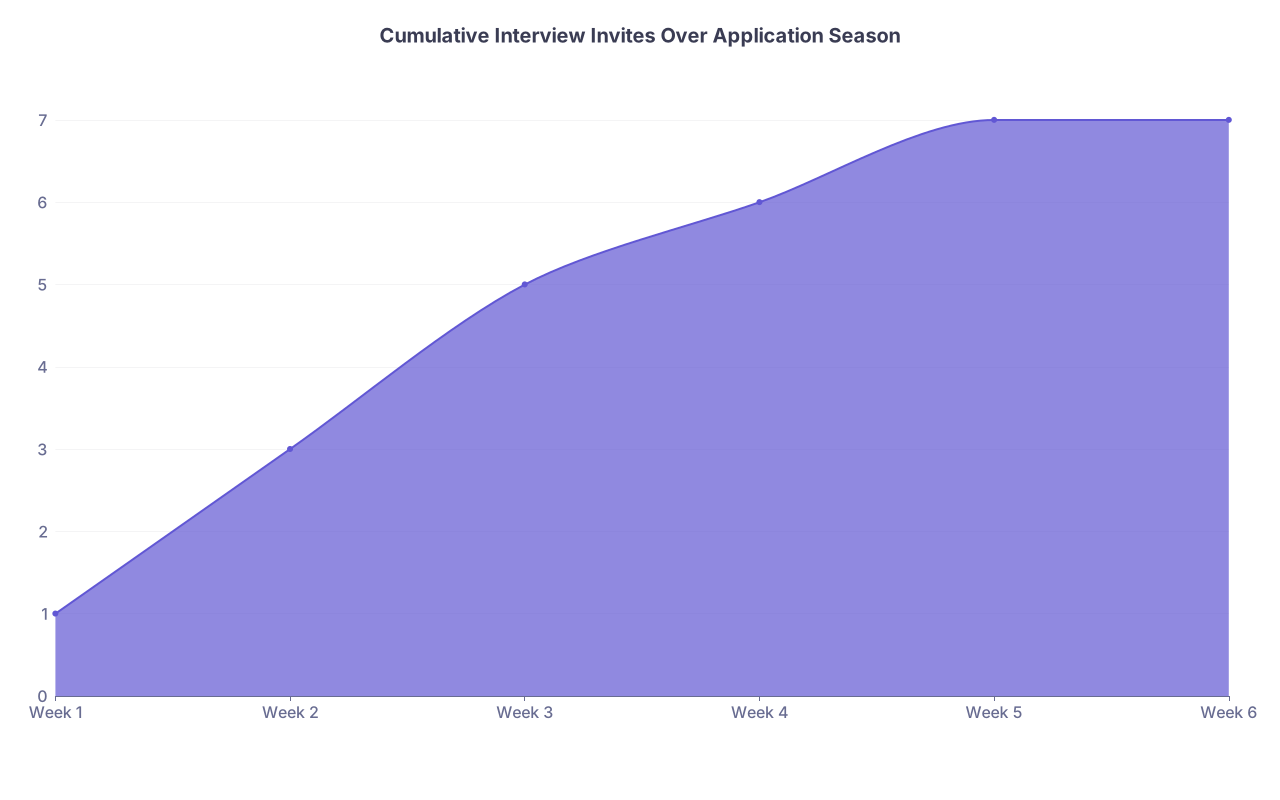
You can and should treat your interview invite pattern as data. By late October, you already know whether your strategy is working.
| Category | Value |
|---|---|
| Week 1 | 1 |
| Week 2 | 3 |
| Week 3 | 5 |
| Week 4 | 6 |
| Week 5 | 7 |
| Week 6 | 7 |
If by mid-late October you:
- Are in a core field and have 0–3 invites despite broad applications → high risk.
- Are in a competitive field with 0–2 invites and no dual-apply backup → very high risk.
- Notice all your invites are from a narrow region or program type → your list is too constrained.
At that point, you cannot fix letters or Step scores. But you can:
- Add applications in less competitive regions and community programs if the ERAS window still allows.
- Aggressively lean into whatever backup strategy you half-planned.
Most unmatched applicants I have spoken with “hoped things would turn around” after a poor October. The data almost never support that hope. Interview calendars fill early.
9. The Harsh But Useful Summary
The data across cycles and specialties show a clear story.
- The strongest predictor of not matching is having too few interviews for your field. Not bad interviews. Too few interviews.
- The biggest drivers of low interview yield are:
- Overreaching in specialty without a realistic backup or dual-apply plan.
- Self-imposed constraints on geography and program type that shrink your true invite pool.
- Weak, misaligned, or late letters of recommendation that quietly filter you out.
- Poor timing on Step/COMLEX scores and unaddressed red flags that push you out of the main review window.
If you want to avoid being surprised by “No Match,” stop thinking mainly about how to “interview well.” Start thinking like a statistician about interview volume and the upstream choices that determine it. The numbers – not your feelings after one or two Zoom sessions – will tell you how safe you really are.