
The blunt truth: being too honest about specialty switching can hurt you just as much as not honest enough.
If you’re asking “How honest should I be about specialty switching on my application?”, it means you’ve already done the mental gymnastics: flirted with one field, committed to another, maybe even applied once and are reapplying in a different specialty. Programs will notice. The real question is how you control that narrative, not whether to mention it.
Let me walk you through how program directors actually think about this, what to say, what not to say, and how to avoid the classic self-sabotaging mistakes.
How Programs Really See Specialty Switching
First, get out of your own head and into theirs.
Program directors worry about three things with switchers:
- Are you going to quit or transfer out after PGY-1?
- Are you using our specialty as a “backup” or consolation prize?
- Is there a red flag (performance, professionalism, personality) hidden behind the switch?
They are not usually morally offended that you “changed your mind.” Most of them did too at some point. What they hate is risk they can’t assess.
So your job is to:
- Show that your switch is thoughtful, not impulsive.
- Demonstrate you actually understand the target specialty.
- Prove you’ll stick and be happy there.
That’s the frame for how honest to be.
When You MUST Explicitly Address the Switch
You do not always need a confessional essay. But sometimes you absolutely do.
You must address the switch clearly if:
- You previously applied to a different specialty through ERAS, or
- You’ve already completed or started another residency, or
- Your transcript / MSPE / letters scream another specialty (e.g., all ortho rotations and letters, now applying psych), or
- You have a withdrawn match / prior contract.
If any of those are true and you don’t mention the switch, programs assume the worst: that you’re hiding something, got pushed out, or are just tossing applications randomly.
In those situations, you should:
- Acknowledge the prior pathway.
- Give a concise, mature explanation.
- Pivot quickly to why the new specialty fits you better and now.
Notice what’s not on that list: you don’t need to dissect every transient interest you ever had (liking both IM and EM as an MS2 doesn’t require a saga).
How Honest Is “Too Honest”?
Here’s the line: be honest about your history and your reasoning, but do not overshare your doubts.
Bad honesty looks like this:
- “I’ve always struggled to decide between multiple specialties.”
- “If I don’t match here, I’ll probably try X or Y next year.”
- “I didn’t really enjoy my time in [prior field], and I’m still figuring out what fits me best.”
- “I thought I wanted derm for lifestyle and pay, but didn’t get interviews so I’m applying to IM.”
Those statements are true for many people. But they scream: “I still don’t know what I want and might leave.”
Good honesty is specific, time-limited, and ends in conviction:
- “Early in medical school I strongly considered surgery, which is why I pursued multiple surgical electives and research. During my sub-internship in internal medicine, I realized I was more drawn to longitudinal patient relationships and complex medical decision-making. Since then, I’ve focused my efforts on internal medicine and am confident this is where I’ll build my career.”
Notice the difference?
You’re allowed to have changed your mind. You’re not allowed (on paper) to still be changing it.
How to Explain a Specialty Switch Without Tanking Your Application
Here’s the practical structure that works.
1. Own the timeline briefly
Two to three sentences. Max.
Example:
“I entered medical school convinced I’d pursue orthopedic surgery. I sought out early ortho exposure, completed an away rotation, and participated in an orthopedics research project. During my fourth-year medicine sub-internship, my priorities shifted.”
That’s enough context. You don’t need a memoir.
2. Identify the turning point
Not “I just felt different one day.” Programs want something credible:
- A specific rotation
- A mentor conversation
- Longitudinal clinic exposure
- Real experience with the work/lifestyle/patient population
Example:
“On my inpatient medicine sub-internship, I realized that what energized me most wasn’t the operative day, but the diagnostic workup, optimization, and long-term management of patients with complex comorbidities.”
You’re showing this wasn’t random. It was triggered by experience.
3. Reframe, don’t trash, the prior specialty
This is where people blow it. They insult the field they’re leaving.
Avoid statements like:
- “I realized I hate surgery.”
- “Radiology felt too boring and isolated.”
- “EM was too chaotic and the patients were difficult.”
Instead, go with:
- “While I valued my surgical experiences, I found myself more engaged by…”
- “I respect the field of radiology, but I missed direct, ongoing patient interaction and bedside decision-making.”
Never forget: the person reading this often has friends in that specialty. Sometimes spouses.
4. Show commitment to the new specialty with receipts
Do not just say “I realized I loved internal medicine.” Show what you did after that realization.
This is where most applicants underperform. They sound like they changed their mind last week.
You want 2–4 concrete demonstrations:
- Electives in the new specialty (especially sub-I or away)
- New or continued research aligned with the field
- Volunteer work or QI related to that population or setting
- Mentorship or advising from faculty in the new specialty
- Updated letters from leaders in the new field
Spell it out:
“Following that realization, I reorganized my fourth-year schedule to include two additional medicine electives and a nephrology rotation, joined a QI project on reducing readmissions for heart failure, and sought mentorship from Dr. X in the internal medicine department, who has strongly encouraged my pursuit of this field.”
Now the switch looks like a decision plus action, not just vibes.

How Much Detail Should Go in Each Part of the Application?
You have several levers: personal statement, ERAS experiences, supplemental questions, and interviews. Use each correctly.
Personal statement
If you’re a clear switcher, you should address it once, cleanly, in the statement. Rough structure:
- 1–2 paragraphs: what draws you to the new specialty (this part should look exactly like a non-switcher’s statement).
- 1 short paragraph: acknowledge previous path and turning point.
- Rest: evidence you understand and belong in the new specialty; what you’ll bring.
Do not make the whole statement about “my journey figuring out what I want.” That’s self-focused and doesn’t reassure anyone.
ERAS experience descriptions
Here’s where people out themselves by accident.
If half your activities are “Orthopedic Surgery Research” and “Ortho Interest Group President” and you’re applying to FM, you must frame them strategically:
- Highlight transferrable skills: teamwork, procedural comfort, clinical reasoning, QI.
- Tie back to your current specialty where possible.
For example, instead of:
“Led orthopedic outcomes study on ACL reconstruction techniques.”
Try:
“Led outcomes study on ACL reconstruction techniques, which deepened my interest in functional recovery, rehabilitation, and longitudinal follow-up—elements I now value in family medicine.”
You’re not pretending you didn’t do ortho. You’re showing how that experience matured your understanding of what work you actually want.
Supplemental ERAS / program questions
Some programs literally ask: “Have you ever applied to another specialty or matched elsewhere?” You answer those truthfully. Always.
For open-ended questions like “Why this specialty?” keep the switch explanation short and positive. Don’t rehash your entire history; focus on why you belong here now.
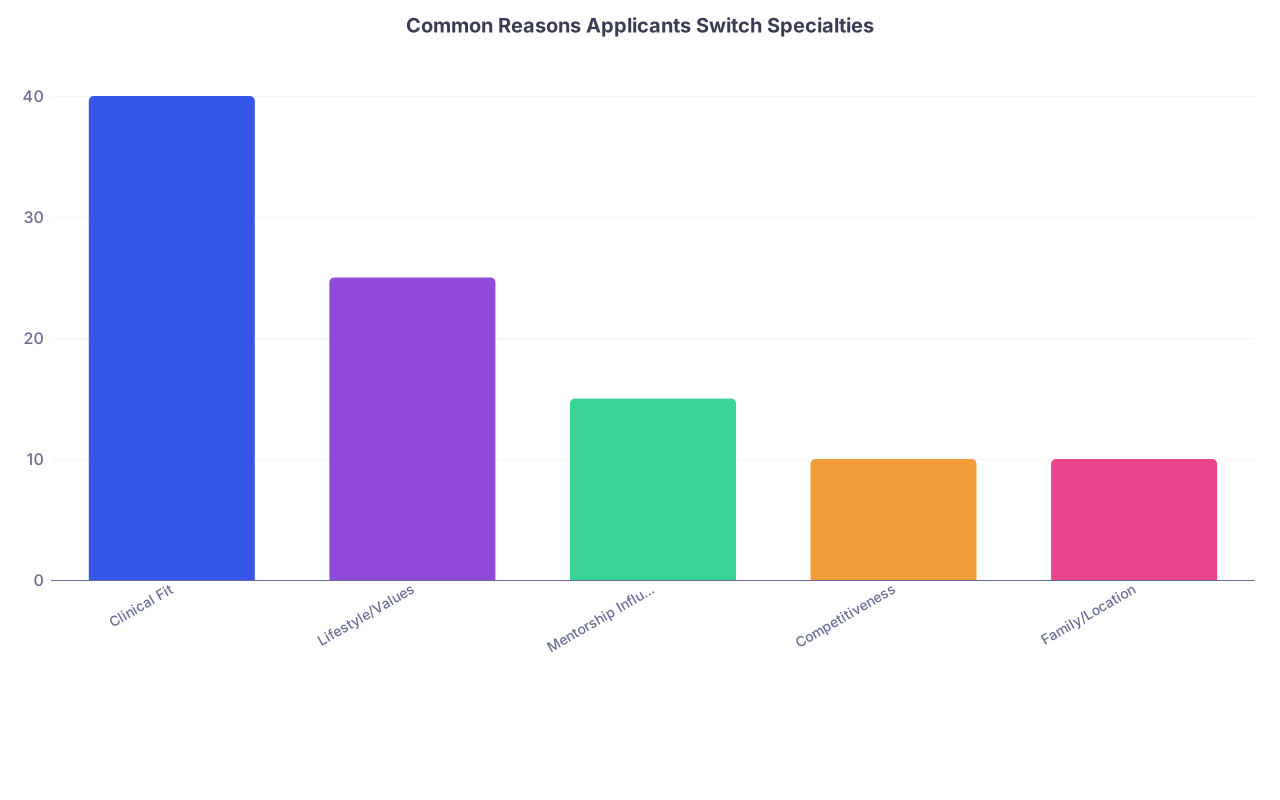
| Category | Value |
|---|---|
| Clinical Fit | 40 |
| Lifestyle/Values | 25 |
| Mentorship Influence | 15 |
| Competitiveness | 10 |
| Family/Location | 10 |
What If You Already Started Another Residency?
Different ballgame. You’re no longer just a “specialty switcher”; you’re a contract-breaker or transfer.
Programs will ask three questions:
- Did you leave for a good reason?
- Did you leave professionally?
- Will this happen again?
Good reasons (when well-documented):
- Genuine mismatch discovered despite good performance
- Family or geographic needs that made the prior program unsustainable
- Health issues now stabilized, with clear plan for the future
- Clear shift to a specialty that actually fits your skills and interests better
Red-flag reasons (unless honestly confronted and backed by strong letters):
- Major professionalism issues
- Failed to progress or repeated remediation
- Abrupt resignation without adequate notice
You must:
- Get at least one honest, supportive letter from someone at the prior program.
- Be prepared to explain in 1–2 tight paragraphs what happened, what you learned, and why this will not repeat.
- Avoid blaming individuals or trashing the prior program.
In your personal statement, it’s usually one focused paragraph, then pivot to how your experiences in the prior residency will make you better in this new field.

| Step | Description |
|---|---|
| Step 1 | Switched or considering switch? |
| Step 2 | Address clearly in personal statement |
| Step 3 | Explain in PS + interviews; get prior program letter |
| Step 4 | Brief explanation in PS |
| Step 5 | Focus PS on current specialty; no long switch story |
| Step 6 | Previously applied to another specialty? |
| Step 7 | Prior residency started? |
| Step 8 | Transcript/letters strongly favor other specialty? |
Mistakes That Quietly Kill Specialty Switchers
Let me be blunt about the most common unforced errors.
Being vague.
“I realized my true passion was…” with no timeline, no trigger, no concrete changes. Vague = suspicious.Sounding like you gave up, not chose.
“I didn’t get interviews in X, so I decided to apply to Y.” Even if that’s partly true, you never say it like that on paper.Leaving your application split-brained.
CV and letters scream EM; statement screams psych; no bridge between them. Programs do not have time to guess your story.Overemphasizing lifestyle.
Yes, lifestyle matters. No, your statement should not lead with “better hours” or “more predictable schedule.” It makes you look disengaged from the work itself.Contradicting yourself across applications.
Telling Program A your “lifelong dream is neurology” and Program B your “lifelong dream is psychiatry.” People talk. And some programs share faculty.Excessive confession in interviews.
Sharing every doubt, backup plan, or contingency you’ve ever considered. You’re interviewing, not debriefing with your therapist.

How to Talk About This in Interviews Without Wrecking Yourself
You will be asked: “So tell me about your path to [specialty].”
Use a simple structure:
- Past interest (brief): “Early in training I was very focused on [prior field] because…”
- Exposure and re-evaluation: “During [specific experience], I recognized that the aspects I found most fulfilling were actually more aligned with [new specialty]—specifically…”
- Deliberate decision: “I stepped back, talked with mentors in both specialties, and realized that [new specialty] is where my strengths and interests align best.”
- Evidence and commitment: “Since then I’ve done [X rotations, Y projects, Z mentoring] to make sure this is the right fit—and those experiences have just confirmed that this is where I see myself long term.”
Then stop talking. Do not start listing all the other fields you almost chose.
If directly asked, “Have you applied to other specialties before?”, answer truthfully and then transition:
“Yes, I applied to [prior specialty] during the last cycle. While I was successful in getting [interviews/position], through those experiences and further clinical exposure, I recognized that my long-term interests and day-to-day satisfaction align better with [current specialty]. That’s why I’ve focused my efforts entirely here this cycle.”
Short, factual, calm.

FAQ: Specialty Switching and Honesty
1. Should I explicitly say I applied to another specialty last year in my personal statement?
If your previous application is reasonably obvious (same school, same PDs, letters, or transcript trail), yes—one concise paragraph is better than radio silence. If it’s less traceable but programs ask directly in supplemental questions or interviews, you answer honestly there even if your statement is more focused on the new specialty.
2. What if I initially chose a more competitive specialty and now I’m switching—will they assume I’m settling?
They might, unless you give them a better story. You do not frame it as “I couldn’t match derm so I chose IM.” You frame it as “My experiences in X clarified that what I actually want is [specific aspects] that are fundamental to IM.” Then back it with new rotations, projects, and strong field-specific letters. The more you show actual engagement, the less it looks like consolation.
3. My letters are all from my old specialty. Is that a problem?
It’s a problem if all your letters are from the old field. You should get at least 2 strong letters from faculty in your new specialty, even if that means doing late electives or asking for updated letters. You can still include 1 letter from the previous field if it speaks to your work ethic and clinical ability, but your primary identity in the application must match the specialty you’re applying to.
4. Can I mention lifestyle or burnout as part of why I’m switching?
You can touch on it, but very carefully and never as the headline. Saying “I learned that I need a field where I can sustain my energy and be present for patients long-term” is acceptable. Saying “I wanted better hours and less call” makes you look disengaged and high-risk for future dissatisfaction. Focus on positive fit—how the new specialty lets you practice in a way that brings out your best.
5. Do programs look down on people who changed their minds late in med school?
Not inherently. What they distrust is disorganized decision-making and ongoing uncertainty. If you decided late but then acted decisively—rearranged electives, sought mentorship, got field-specific letters, and can clearly articulate why this field fits—they’re usually fine with that. A late but well-thought-out decision beats an early but shallow one.
6. How do I handle a switch if I had performance issues in the prior specialty?
You cannot hide those; programs will see transcripts, MSPEs, and sometimes hear back-channel information. You acknowledge the issues briefly, explain what you’ve changed (study strategies, time management, asking for help sooner), and present clear evidence of improved performance, ideally in the new specialty. You also need at least one letter writer who can vouch that you’re ready and safe for residency in the field you’re applying to.
7. Is it ever okay to not mention my past interest in another specialty at all?
Yes—if it never reached the level of a formal application, didn’t significantly shape your CV toward that other field, and won’t confuse the reader. Almost everyone “considered” other specialties as an MS2 or early MS3; that doesn’t need to be in your statement. You mention a switch only when the previous interest is visible enough that silence looks like hiding.
Key points to keep in your head:
- You owe programs honesty about your history, not a running log of every doubt.
- Specialty switching isn’t fatal; unexplained, poorly framed switching is.
- Your story must end in conviction: “This is where I’m going,” not “I’m still deciding.”