
Last November, I watched a selection committee freeze on one application. Perfect Step scores. Strong letters. Honors in almost everything. Then someone quietly said, “What’s this one-year gap between M2 and M3? No explanation.” The room shifted. Voices got tighter. The file that should have been an automatic interview suddenly became a 10-minute debate.
Here’s the part nobody tells you: it’s not the gap, the withdrawal, or the leave that kills you. It’s the silence around it. The missing story. And committees are very, very suspicious of silence.
Let me walk you through how they actually read this stuff behind closed doors—what worries them, what reassures them, and how you can stop a minor red flag from turning into a quiet rejection.
How Committees Really Read Your CV
On paper, it looks objective: dates, rotations, exam scores, leadership positions. In the room, it’s anything but. Committees are scanning for risk.
They’re asking three questions on every application:
- Can this person do the work? (ability)
- Will this person show up consistently? (reliability)
- Are we going to regret taking a chance on them? (risk)
Gaps, withdrawals, and leaves hit question 2 and 3 like a punch. Your scores tell them about ability. Your timeline tells them about reliability and risk.
Here’s what actually happens. Someone on the committee has your application open on ERAS or Thalamus. They scroll through your CV and timeline, then they stop. You see heads tilt. Someone says:
- “Why did they step out for eight months here?”
- “Anyone see an explanation for this leave?”
- “They withdrew from two clerkships—what happened?”
If the answer is “I don’t know,” your file gets mentally downgraded. Not always rejected, but moved from “safe, easy yes” to “maybe, if we have room.”
The mistake most applicants make is thinking: “If I don’t bring it up, maybe they won’t notice.”
They always notice.
Gaps: What Committees Assume Before You Explain
A “gap” is any unexpected hole or delay in your trajectory:
- Break between undergrad and med school
- Year off during med school
- Extended time between Step exams
- Repeating a year
- Months-long blank space on your CV
The gap itself is not the problem. Unexplained or suspiciously framed gaps are.
Here’s what committee members quietly assume when there’s no clear explanation:
- Substance use or impairment
- Academic or professionalism probation
- Failure of a major exam or course then quietly remediated
- Disciplinary action, Title IX issues, or ethics violations
- Serious mental health crisis with poor follow-through
Is that fair in every case? No. Does it happen in every committee room I’ve sat in? Yes.
Now compare that to what they think when a gap is clearly explained, consistently, across your MSPE, CV, and personal statement (if needed):
- “Took a structured research year with funding” → highly favorable
- “Family caretaker responsibilities, returned and performed well” → neutral to slightly positive if performance after is strong
- “Medical/mental health leave, treated appropriately, stable since returning” → neutral if the story holds together and later performance is solid
The committees are risk-averse, not heartless. They just won’t gamble when they don’t know what they’re gambling on.
Withdrawals: The Quiet Red Flag You Underestimate
Students obsess about fails. Committees obsess about withdrawals.
I’ve heard this phrase more times than I can count: “I care more about the pattern of withdrawals than a single failure.”
Why? Because a failure followed by successful remediation says: you struggled, you worked, you finished. A withdrawal without context can whisper: you bolt when things get hard, or worse—something serious happened and we’re not being told.
Typical withdrawal scenarios that show up:
- Withdrew from a clerkship mid-rotation
- Dropped a research position or dual degree
- Withdrew from Step 1/Step 2 exam dates more than once
- Withdrew from an away rotation after confirming
What they’re looking for is pattern and trajectory. One withdrawal, explained clearly, and followed by consistent completion of future obligations? Usually fine. Multiple withdrawals across different contexts? That’s when the “risk” alarm goes off.
Here’s the internal calculus in a PD’s head:
- “If they walked away from two rotations already, what happens when they’re on night float and it gets rough?”
- “Are we going to be dealing with schedule drama all year?”
- “Is there a professionalism issue buried somewhere?”
If you have multiple withdrawals and you do not control the narrative, the committee will write one for you. And you probably won’t like their version.
Leaves of Absence: What You’re Afraid to Say vs What Committees Actually Want
Leaves of absence are where students make the most self-sabotaging mistakes.
You’re terrified:
“If I admit it was for mental health, they’ll never rank me.”
“If I say it was burnout, they’ll think I’m weak.”
So you write vague nonsense like “personal reasons” or “time away to pursue interests,” and then the MSPE hints at more, and now it looks like you’re hiding something. That’s worse than a clean, direct explanation.
Inside the room, this is how it really sounds:
Faculty Member A: “LOA M2→M3, 9 months, states for depression, treated, returned, no further concerns, passed everything since.”
Faculty Member B: “Ok, seems stable now. Performance is fine since coming back. Not a problem for me.”
Versus:
Faculty Member A: “LOA listed as ‘personal reasons.’ MSPE says ‘student received support and returned to full-time study.’ No diagnosis, no clear reason.”
Faculty Member B: “What are we not being told?”
Faculty Member C: “I’d rather not take the risk when we have plenty of clean files.”
See the difference?
The committees don’t need your full psychiatric narrative. They do need three things, always:
- A clear category (medical, mental health, family, research, personal hardship)
- Evidence of appropriate treatment or resolution if it was medical/mental health
- Proof you’ve been stable and high-functioning since returning
You’re not applying to a monastery. Half the attendings on those committees have either taken SSRIs themselves or watched a colleague burn out. They’re not shocked by leaves. They’re wary of denial and minimization.
What Signals “Risk” vs “Resilience”
Let me show you how they actually differentiate the same type of event.
| Scenario Type | Committee Interpretation |
|---|---|
| Unexplained 8-month gap | High risk, likely concern for professionalism or impairment |
| Clearly explained medical leave with strong return | Neutral, sometimes even positive for resilience |
| Multiple unexplained withdrawals | Pattern of unreliability, scheduling risk |
| One withdrawal with specific, consistent explanation | Usually low concern |
| Research year with publications | Positive, especially for academic programs |
Now, let’s talk specifics.
A gap plus:
- Strong letters explicitly endorsing reliability
- Clean performance before and after
- No vague language in MSPE
→ Often ends up neutral. The risk box gets unchecked.
A leave for mental health plus:
- You acknowledge it succinctly, without melodrama
- You make it clear you got treatment and have been stable for X years
- Your later performance is consistent and strong
→ Quietly accepted. Sometimes even respected.
A leave or gap plus:
- Vague language (“personal time,” “reset,” “time away”)
- Hints in the MSPE about “professionalism support,” “concerns,” or “growth area”
- Multiple schedule changes, remediations, or absences afterward
→ That application dies in committee. People won’t say it out loud, but you’ll see it in their faces: “Too much smoke.”
The Biggest Mistakes Applicants Make With Gaps and Leaves
I’ve seen the same self-inflicted wounds over and over again.
1. Hoping Nobody Notices
They notice. The timeline is one of the first things the sharp reviewers scan. When something doesn’t fit the standard 4-year med school flow, they flag it.
If you do not give a clear, consistent explanation, you’re forcing them to speculate. They always assume the worst. Not because they’re jerks, but because they’ve been burned before.
2. Over-sharing or Under-sharing
Two opposite mistakes:
- Under-sharing: “personal reasons” and nothing else
- Over-sharing: multi-paragraph trauma narrative in your personal statement
Committees don’t want full therapy notes. They want category, treatment/stability, and trajectory. One or two clean sentences is usually enough. Your MSPE + brief personal comment + advisor’s support should tell the same story.
3. Inconsistency Across Documents
This one kills credibility fast.
- CV says: “Research year”
- MSPE says: “Student took a leave due to personal challenges”
- You say in PS: “I used this time to explore other interests”
Now they don’t know which version is true. And when they’re unsure if you’re being honest, they withdraw emotionally from your file. No one stands up to fight for an applicant they do not trust.
4. Avoiding It During Interviews
The smart applicants know this: if you have a gap, leave, or withdrawal, you need a polished, calm, two- to three-sentence explanation ready for interviews.
The weak move is dodging it with nervous jokes, changing the subject, or sounding defensive. That makes people wonder if there’s more under the surface.
Exactly How to Frame Your Story So Committees Relax
Let me give you templates that actually work in a committee’s mind.
Medical or Mental Health Leave
What committees want to hear, in essence:
- It was real
- You took it seriously
- It’s stable now
- It hasn’t affected your reliability since
Example:
“I took a medical leave between my second and third year due to a mental health condition that developed during a particularly stressful period. I engaged in treatment, returned with full clearance, and have completed all subsequent rotations and responsibilities without any further interruptions.”
You do not need the diagnosis. You do not need to list meds. They care about stability and function, not labels.
Family or Caregiver Leave
Example:
“I took six months off between M3 and M4 to care for a critically ill family member. During that time, I remained in touch with my school, then returned to full-time clinical duties and have had no further interruptions in my training.”
Again: concrete, not dramatic. That tone reassures them.
Research or Career Exploration Gaps
Example:
“I extended my training by one year to pursue a structured research fellowship in oncology, which resulted in [X outputs]. That experience confirmed my interest in academic medicine and I’ve since returned to the standard clinical track.”
Here, the key is making it intentional, not drifting.
How Committees Actually Rank These Situations
Here’s how risk gets subconsciously graded when we’re building the rank list.
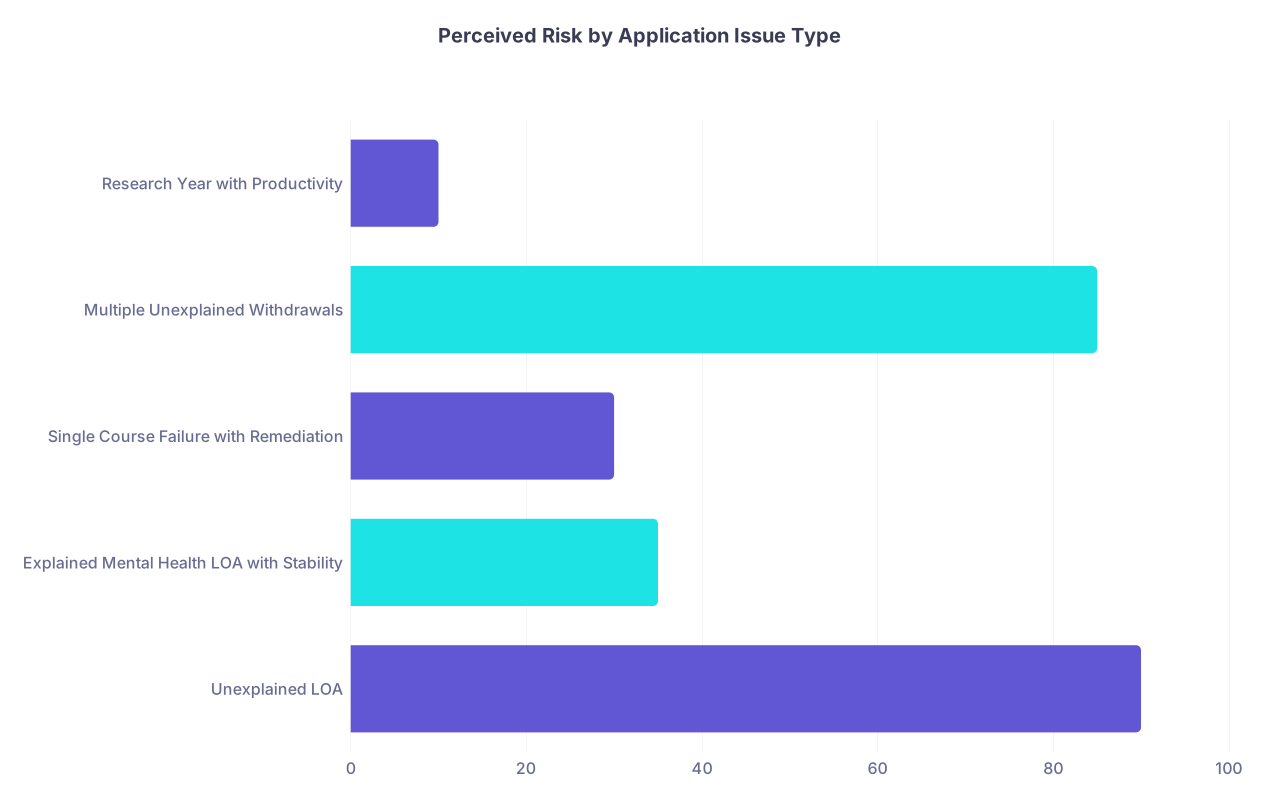
| Category | Value |
|---|---|
| Unexplained LOA | 90 |
| Explained Mental Health LOA with Stability | 35 |
| Single Course Failure with Remediation | 30 |
| Multiple Unexplained Withdrawals | 85 |
| Research Year with Productivity | 10 |
High numbers = higher perceived risk.
The important thing: you control whether your situation sits closer to “Unexplained LOA” or “Explained, stable, productive.” The facts are fixed. The framing is not.
How This Plays Out On Actual Committees
You want the real back-room conversation? Here’s what it sounds like when things go well versus badly.
Case 1: The Quietly Solid Comeback
- M2–M3: 8-month leave for depression
- MSPE: clearly states leave, treatment, full return, no professionalism concerns
- CV: continuous rotations after return, Step 2 high, strong letters
Committee:
“Yeah, they had a rough patch, but they’ve been solid since. Look at these evals. I’m fine with this.”
“Same. They clearly handled it, moved on. Not an issue for me.”
This applicant gets ranked like any other strong candidate.
Case 2: The Vague Vanishing Act
- M3: sudden gap, 7 months
- CV: says “personal leave”
- MSPE: very generic line about “time away for personal reasons”
- Rotations after: mostly passes, a few comments about “needs more reliability with follow-up tasks”
Committee:
“What was this?”
“MSPE doesn’t say. Could be anything.”
“Honestly, with our applicant pool, I don’t see a reason to take the chance.”
No one says “we’re rejecting them because of the gap.” Officially, it’s “overall weaker application.” But that hole on the timeline did a lot of the damage.
Strategic Moves If You Already Have Gaps, Withdrawals, or Leaves
You can’t rewrite history. But you can absolutely change how it lands.
Here’s what I’d tell a student sitting in my office with this problem:
Get your story straight with your Dean’s office.
Whatever they write in the MSPE needs to align with how you’ll talk about it. If you’re uncomfortable, ask, “How exactly will this be described?” Do not just hope.Decide what belongs in your personal statement.
Not everything needs to be in there. If the leave is a small detour, a short mention in the experiences section or a brief note in your ERAS bio is enough. The PS should only bring it up if it genuinely shaped your path or perspective.Practice your 30-second explanation out loud.
You need to sound matter-of-fact, not ashamed or evasive. Committees respond more to your emotional tone than to every word.Stack the deck after your return.
If you had a leave, your next year needs to look boringly solid. Show up, be reliable, get clean evals. That’s how you prove the past is past.Choose letter writers who can vouch implicitly for reliability.
A letter that says “I would trust them with my patients and my service any day” does more to erase doubts than any explanation you write yourself.
Quick Visual: How Your Timeline Should Read
You want your trajectory to look intentional and explained, not chaotic.
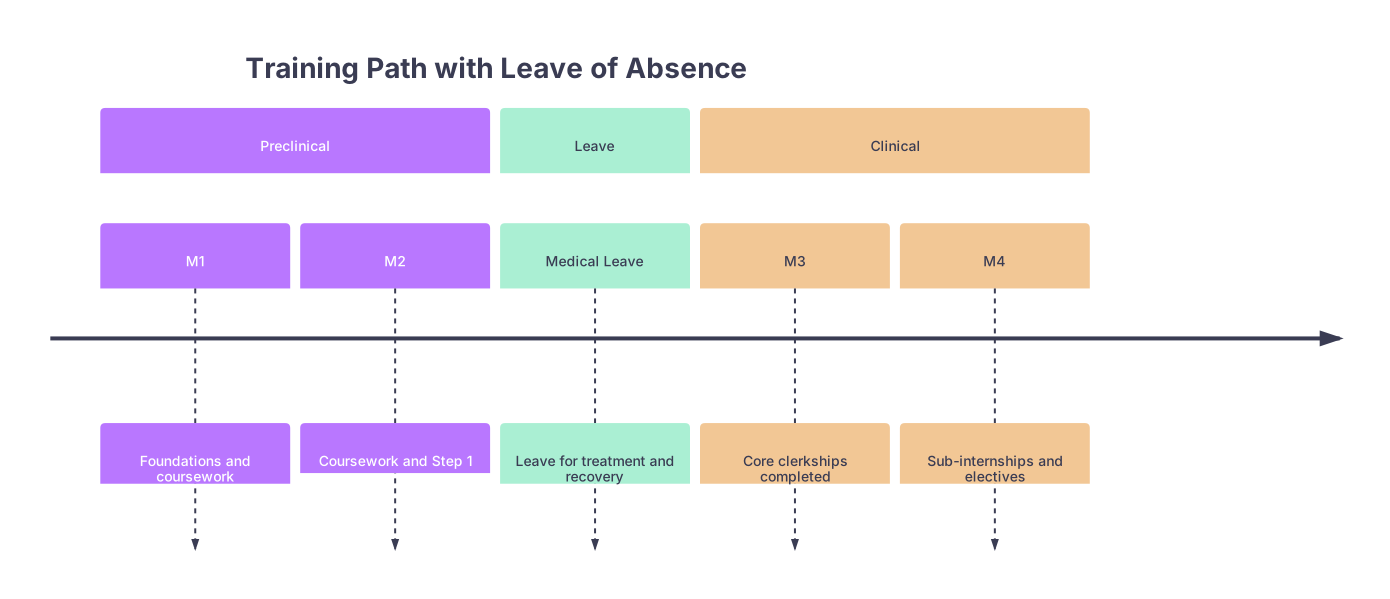
| Period | Event |
|---|---|
| Preclinical - M1 | Foundations and coursework |
| Preclinical - M2 | Coursework and Step 1 |
| Leave - Medical Leave | Leave for treatment and recovery |
| Clinical - M3 | Core clerkships completed |
| Clinical - M4 | Sub-internships and electives |
If the committee can tell this story in 2–3 sentences without confusion, you’ve done your job.
Final Thought
Residency committees are not hunting for perfection. They’re hunting for predictability. Gaps, withdrawals, and leaves aren’t automatic death sentences; they’re question marks. Your job is to walk into that file—through your CV, your MSPE, your statement—and turn those question marks into periods.
Years from now, you’ll barely remember the wording you used to explain that leave. But you will remember whether you owned your story or hid from it. One of those paths gets you ranked. The other gets you quietly passed over.