The biggest ERAS mistakes are not the ones you see on Reddit. They’re the unwritten rules program directors use and never put on any website, brochure, or webinar.
I’ve watched PDs review applications with one hand on the mouse and the other on their coffee, moving at a speed that would horrify you. They are not “holistically reviewing” 1,500 applications in some slow, thoughtful, line-by-line process. They are scanning for signals. And they expect you to know those signals, even though nobody formally teaches them.
Let me walk you through what actually happens behind the scenes—and the unspoken expectations that quietly kill otherwise strong applications.
The Hidden First Pass: How Your Application Really Gets Screened
Most applicants still imagine their ERAS gets read from top to bottom.
No. The initial sort is brutal and fast.
Here’s the order many PDs and coordinators actually look at things for the first pass (varies a bit by program, but the pattern is the same):
- Filters (scores, YOG, visa status, etc.)
- Medical school and degree type (MD vs DO vs IMG)
- Red flags (gaps, failures, professionalism)
- Letters and MSPE “tone”
- Personal statement (for many programs, only after you survive the first filters)
And they’re doing this at pace.
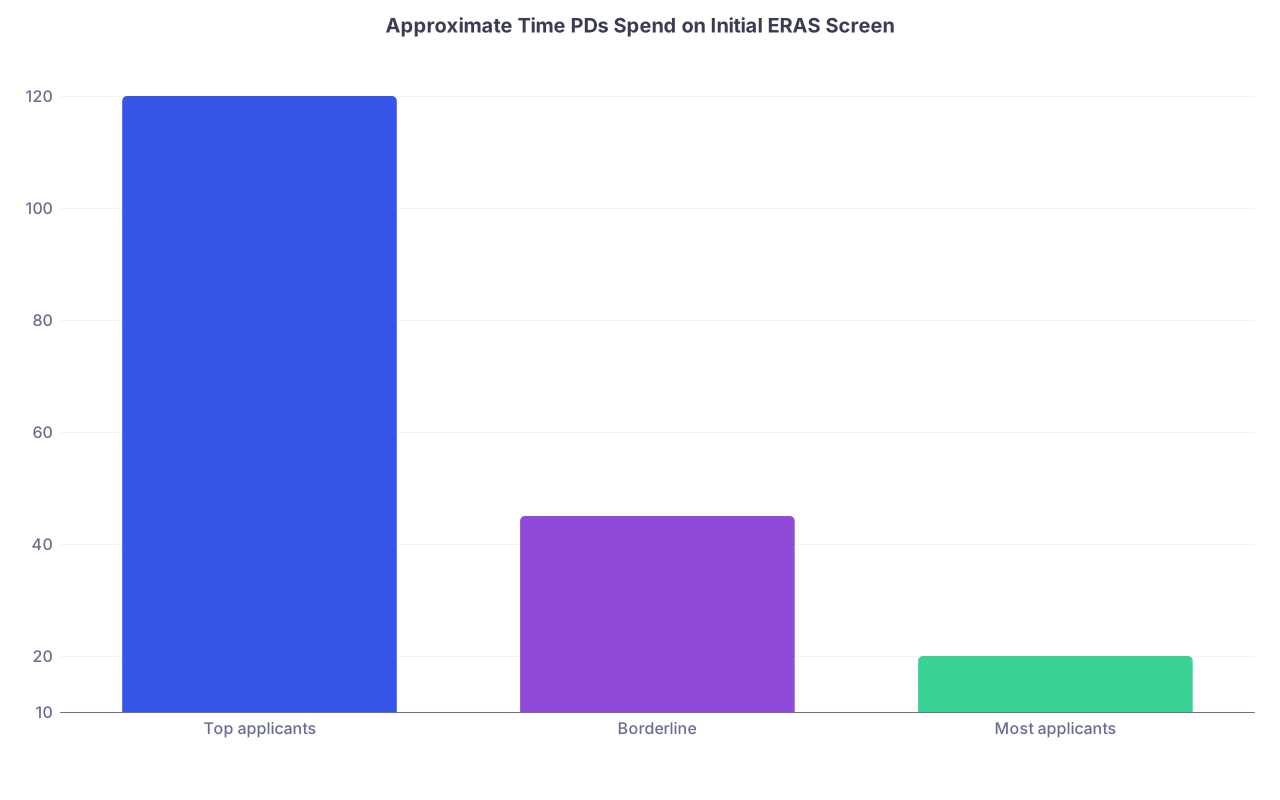
| Category | Value |
|---|---|
| Top applicants | 120 |
| Borderline | 45 |
| Most applicants | 20 |
Those numbers are seconds. Not minutes.
The unwritten rule: if your application doesn’t communicate your value at a glance in those first 20–45 seconds, you’re done. The detailed brilliance of your personal statement won’t save you if your summary page looks sloppy, generic, or confusing.
So what do they expect but never publish?
They expect:
- Your story to be obvious from the top of your application.
- Your interests and trajectory to be coherent.
- Your red flags to be explained before they start wondering what you’re hiding.
If they have to work to understand you, they won’t.
The “Story Line” Test: You’re Either Coherent or Chaotic
Here’s a phrase I’ve heard more than once in selection meetings:
“I just don’t get what this person is about. Pass.”
This is code for: the application has no clear narrative.
The public advice says, “Show that you are well-rounded.” The insider reality is different. PDs prefer directional over “randomly well-rounded.” They want to see some thread running through your experiences, even if it’s loose.
They will not say this on their website, but here’s what they’re mentally checking for:
- Does your activities list align with the specialty you’re applying to?
- Does your personal statement match what your experiences suggest you care about?
- Do your letters reinforce that same picture?
- Or do you look like you decided on the specialty three months before ERAS opened?
If your CV screams “cardiology research, cardiology interest group, cardiology shadowing” and then you’re applying to anesthesia with a last-minute anesthesia elective and a vague PS, PDs notice. You look like someone who struck out in one field and pivoted late.
They don’t need perfection. They need believable trajectory.
So the unwritten expectation: by the time you hit submit, someone glancing at your experiences should be able to say in one sentence, “Oh, this person is clearly into X and has been for a while.”
If they cannot summarize you, they don’t invite you.
The Real Score Rules (That Nobody Prints)
Publicly, programs say: “We review applications holistically.” And many genuinely try.
But behind closed doors, there are thresholds, “soft rules,” and politics you’re never told.
Here’s the part no coordinator puts in a brochure: PDs often have to justify every interview invite to their own faculty. Which means they use numbers as armor.
Common unwritten patterns I’ve seen:
- “We’ll look closely at anyone ≥ [X Step 2 score], below that we need some clear hook.”
- “If they failed Step 1/COMLEX 1, they need amazing letters or a very strong home advocate.”
- “IMG with no US clinical experience? Almost never.”
And they absolutely compare you to their usual ranges, even if they don’t list them online.
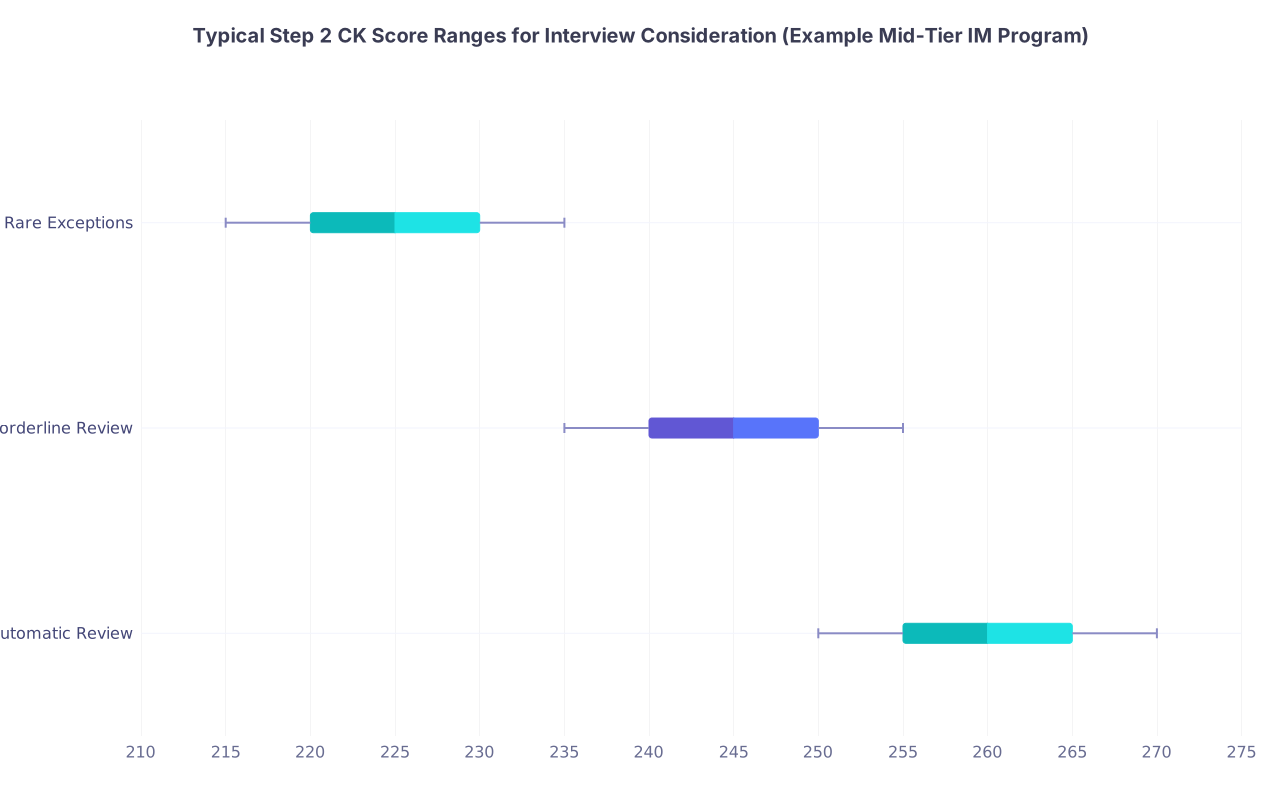
| Category | Min | Q1 | Median | Q3 | Max |
|---|---|---|---|---|---|
| Automatic Review | 250 | 255 | 260 | 265 | 270 |
| Borderline Review | 235 | 240 | 245 | 250 | 255 |
| Rare Exceptions | 215 | 220 | 225 | 230 | 235 |
The unwritten rule is this: if your score is below what that program usually interviews, something else must be undeniably strong—research with them, a phone call from someone they trust, or a glowing letter from a known faculty member.
They expect you to:
- Know your lane. High score, no research? Community and mid-tier places will be fine. Gunning for MGH or UCSF with no scholarly work? They’ll quietly roll their eyes.
- Use Step 2 strategically. For many PDs, Step 2 is now what Step 1 used to be. A late Step 2 score with no explanation reads like you were hoping to hide it.
- Never make them go hunting for your scores. If you’re applying without Step 2 available and you’re not a rockstar in other dimensions, many internal filters will screen you out.
They’re not obligated to tell you their internal cutoffs. And they won’t. But they absolutely use them.
Letters of Recommendation: The Hidden Hierarchy
ERAS treats all letters like they’re equal. PDs do not.
What nobody publishes: there is a name recognition economy in letters that applicants are almost never told about.
Here’s what happens in real time:
I’ve seen PDs see a familiar name on a letter—“Oh, that’s from Dr. [X] at [Big-Name Hospital], they’re tough. This is probably a solid applicant”—before even reading the whole thing.
Or the opposite: “This is another generic letter from [small community site preceptor] we’ve never heard of.”
Do they read them? Yes. Do they weigh some letters more heavily based on the writer and institution? Also yes.
The unwritten expectations:
- At least one letter from someone in the specialty you’re applying to.
- At least one letter from a setting similar to their own (academic for academic programs, community-heavy letters are more acceptable for community programs).
- The MSPE + letters should not contradict your personal statement persona. If you write that you’re obsessed with teaching but your letters do not mention teaching once, that’s noticed.
Also, the PDs can read between the lines better than you think. They know code. “Pleasure to work with” with no adjectives about performance? Lukewarm. “Performed at the level of a strong intern” or “top 5% of students I’ve worked with in the last 10 years”? Those are green lights.
FAQ-level truth nobody says out loud: a merely “fine” letter from a famous person is often worse than a specific, detailed, enthusiastic letter from a less known but clearly invested faculty.
Personal Statements: The Real Filters PDs Use
Here’s the cold reality: many PDs don’t read personal statements on the first pass unless something else has already made you interesting.
But when they do read them, they use them to answer very specific, silent questions:
- Is this person weird?
- Is this person arrogant?
- Is this person going to be exhausting to work with at 3 a.m.?
- Do they understand what this specialty actually is in real life?
They do not care about your poetic origin story unless it tells them something clinically relevant about your maturity, insight, and fit.
Unwritten personal statement rules:
- If it reads like ChatGPT wrote it, they feel nothing and forget you in 10 seconds.
- If it’s full of dramatic trauma dumping with no processing or insight, you get labeled “high maintenance.”
- If you sound like you think you’re a genius who’s blessing their program by applying, you’re done.
They expect brevity, clarity, and a grounded sense of self. Applicants who overcompensate with flowery language often lose out to the one who sounds like a thoughtful, reliable colleague.
PDs remember:
- A small number of genuine, sharp, specific statements.
- Almost none of the generic “I first knew I wanted to be a [specialty] when…” stories.
Write like you’re talking to an overworked attending who has 40 more of these to get through before clinic starts. Because that’s exactly what’s happening.
Red Flags and Gaps: Silence Is the Biggest Mistake
One of the most consistent behind-the-scenes comments I hear in rank meetings is:
“Why didn’t they just tell us what happened?”
Most students think hiding red flags is safer. It isn’t. Not in this era.
Unwritten rule: PDs don’t expect perfection. They expect transparency plus insight.
What they hate:
- Unexplained leaves of absence or multi-month gaps.
- “Academic difficulty” with zero explanation.
- Failures or remediation buried deep in the application without any context in the PS or MSPE addendum.
What they expect:
- A concise, adult explanation that takes responsibility but doesn’t self-immolate.
- A clear demonstration that the issue is resolved and unlikely to reoccur (new supports, change in habits, better performance since).
- That your narrative matches what your MSPE says. If your dean’s letter describes a big professionalism issue and your PS is silent, you look evasive.
The hidden calculus: one red flag with clear growth and strong recent performance can be forgiven. Multiple red flags, no insight, and defensive attitude? Hard pass.
The Unspoken Expectations About Program Fit
Publicly, everyone says: “We’re looking for the best fit.” Sounds vague on purpose.
Privately, they’re looking for:
- People who will not quit.
- People who will not be constant problems.
- People who will not blow up team dynamics.
And they read your application through that lens.
Unwritten fit rules:
- If you apply to a community-heavy program with nothing but ivory-tower research and no mention of loving clinical work or underserved populations, you look misaligned.
- If your CV is full of leadership and advocacy but no real patient care enthusiasm, some surgical and procedure-heavy specialties may hesitate.
- If you only rotated at home and never left your comfort zone, some programs think you might struggle adapting.
There’s also geography, which nobody talks about honestly.
Many PDs quietly prefer:
- Applicants with ties to their region, especially in the Midwest and South.
- Applicants from similar training environments (urban vs rural, academic vs community).
- Applicants who can plausibly see themselves staying in that state or region.
They use:
- Your “geographical preference” signaling.
- Where your med school is.
- Where your clinicals/electives were.
- What you mention in your PS.
If you’ve never once set foot in the Midwest but are applying to 40 Midwestern programs with no local connection, you’re already behind the applicants who have those ties. Not impossible. Just harder.
The Mistakes That Quietly Kill Applications
Let’s get specific. Here are things that repeatedly get people filtered or side-eyed, that no one lists on a website:
- Using the same ultra-generic personal statement for every single program and specialty.
- Activity descriptions that read like LinkedIn fluff: “Led dynamic initiatives to optimize patient care outcomes.” PDs hate this.
- Sloppy or inconsistent dates, missing explanations for gaps.
- Not listing substantial experiences because “I didn’t think it mattered.” (Shadowing, long-term jobs, caregiver responsibilities—if it took major time or changed you, it matters.)
- Overstuffing with trivial 1–2 hour things to look “busy.” That backfires. They can tell.
- Not tailoring anything to the specialty. You’re applying to EM and never once mention acute care, resuscitation, teamwork? That’s noticed.
There’s also a level of professionalism expectation that is never written but absolutely enforced:
- Unprofessional email addresses.
- Voicemail boxes that are full or sound childish.
- Delayed, sloppy responses to program emails.
- Typos in the name of the program or specialty in your PS. (Yes, this kills apps every year.)
They expect you to behave like a junior colleague, not a student winging it.
What PDs Wish Applicants Just Understood
If you were to sit in on a PD strategy meeting, you’d hear the same themes over and over:
“Are they going to show up, work hard, and not make my job harder?”
Everything—scores, letters, PS, experiences—is a proxy for those questions. They’re not trying to build a collection of the most glamorous CVs. They’re building a functioning call schedule for the next 3–5 years.
Here’s the harshest truth: they don’t have time to decipher you. They expect you to make their job easier.
Quick, quiet expectations they never publish:
- Keep your ERAS structured, clean, and readable.
- Don’t play games with partial information; if you’re weaker in one area, offer clarity in another.
- Signal your genuine interest in a way that sounds human, not desperate or robotic. A short, specific note in a secondary or email can help. A three-paragraph essay professing your “lifelong dream” for their random community program? That’s weird.
You’re not just selling your accomplishments. You’re selling low risk and high reliability.

| Step | Description |
|---|---|
| Step 1 | ERAS Submitted |
| Step 2 | Auto Screened Out |
| Step 3 | Quick Scan: Scores, School, Gaps |
| Step 4 | Look for Explanations in PS/MSPE |
| Step 5 | Check Letters & Experiences |
| Step 6 | Mark for Interview Consideration |
| Step 7 | Full Review If Needed |
| Step 8 | Pass Filters? |
| Step 9 | Any Major Red Flags? |
| Step 10 | Well Explained & Improved? |
| Step 11 | Coherent Story & Fit? |
That flowchart is closer to reality than any “holistic review” infographic you’ll see in public.
A Simple Reality Check for Your Application
If you want a blunt exercise that aligns your ERAS with what PDs actually look for, try this:
Print your ERAS out. Hand it to someone who doesn’t know you well—a resident, an attending, even a smart non-med friend. Give them 60 seconds.
Then ask them:
- “What specialty do you think I’m applying to, and why?”
- “What do you think I actually care about in medicine?”
- “Would you invite this person for an interview if you only had 40 spots and 1,000 apps?”
If they can’t answer clearly, you’ve broken one of the central unwritten rules: you’ve made your reader work too hard.
You don’t need to be perfect. You need to be legible.
Years from now, you won’t remember the specific phrasing of your personal statement or how many seconds a PD spent on page two of your ERAS. You’ll remember whether you took ownership of your story—or left it for someone else to half-interpret in a rush.
FAQ (Unwritten-Rule Style)
1. Do PDs really use internal score cutoffs, even if they say they don’t?
Yes. Almost every program has some internal threshold, even if it’s soft. They may not say, “We cut everyone below 235,” but they absolutely prioritize higher scores in the first pass and scrutinize lower scores much more harshly. Exceptions are made, but usually only when there’s a strong advocate or a compelling hook.
2. How much does “name recognition” of my letter writer actually matter?
It matters more than anyone will admit publicly. A strong letter from a known, trusted faculty at a reputable institution gets attention quickly. But a truly excellent, specific, detailed letter from an unknown writer can still carry you further than a bland letter from a superstar. The worst combination is a famous name with a lukewarm, generic letter.
3. If I have a red flag (failure, LOA, professionalism issue), should I always explain it in my personal statement?
If it’s significant and shows up in your MSPE or transcript, yes, it needs some form of explanation somewhere. It does not always have to dominate your PS, but ignoring it entirely makes you look evasive. A short, direct, responsible explanation paired with clear evidence of improvement helps more than silence.
4. Do programs really care about “geographic ties,” or is that just something applicants talk about?
They care. Especially in non-coastal, smaller, or less “destination” regions. PDs worry about people leaving, being unhappy far from family, or using them as a backup. Any believable connection—family, previous schooling, long-term partner, or genuine expressed interest—helps reduce their perceived risk.
5. Is it obvious to PDs when applicants use the same generic personal statement for every program?
Very. They see hundreds of them. When your PS could be sent to any program in any state without changing a word, you blend into the pile. You don’t need a completely different PS for each place, but having at least some specialty-specific and occasionally region- or program-consistent details makes you sound like a real person, not a copy-paste.