A sloppy ERAS can sink an otherwise competitive applicant. Fixing it in 48 hours is possible, but only if you stop winging it and follow a real audit process.
You do not need another vague reminder to “proofread everything.” You need a concrete, hour-by-hour triage plan: what to fix first, what to ignore, and how to avoid breaking something while you are “improving” it.
I am going to walk you through a 2‑day repair job for an ERAS application that is already submitted, mostly built, or frankly a mess. This is the “oh no, I just realized my entries are garbage and interviews start in three weeks” protocol.
The 48‑Hour ERAS Cleanup Game Plan
Let us start with the structure. You have limited time and finite attention. You cannot optimize everything. You fix what programs actually read and what creates real red flags.
Here is how your effort should be distributed over these two days:
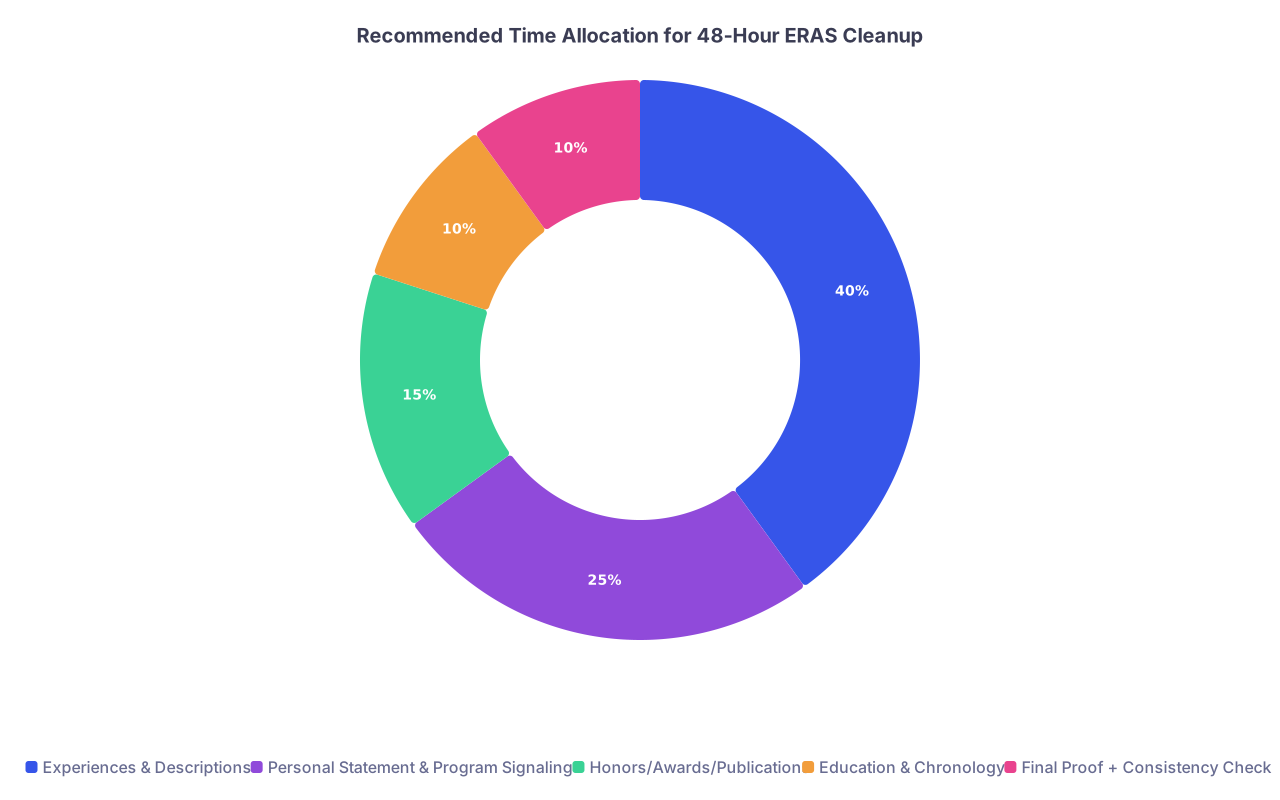
| Category | Value |
|---|---|
| Experiences & Descriptions | 40 |
| Personal Statement & Program Signaling | 25 |
| Honors/Awards/Publications | 15 |
| Education & Chronology | 10 |
| Final Proof + Consistency Check | 10 |
Overall sequence (do not improvise this)
Day 1 – Content Triage and Heavy Lifting (6–8 hours total):
- Global overview and damage assessment (30–45 minutes)
- Experiences section deep clean (3–4 hours)
- Research and publications cleanup (1–1.5 hours)
- Education, gaps, and chronology check (45–60 minutes)
Day 2 – Precision Fixes and Polishing (4–6 hours total): 5. Personal statement + program-specific signaling review (2 hours) 6. Awards, memberships, leadership, volunteer entries cleanup (1–1.5 hours) 7. Consistency, red flag sweep, and formatting pass (1–2 hours) 8. Final read in “program director mode” (30–45 minutes)
If your time is even more limited, you prioritize in this exact order:
- Experiences content and clarity
- Personal statement alignment
- Obvious errors / red flags / inconsistencies
Everything else is “nice to clean,” not “must clean.”
Step 1 (Hour 0–1): Global Damage Assessment
You cannot fix what you have not seen recently and objectively. Most people underestimate how disjointed their ERAS looks because they wrote it in fragments at 2 a.m. over weeks.
1.1 Export and print or save to PDF
Open ERAS and:
- Export/print the full application to PDF.
- If possible, print a hard copy. Reading on paper exposes issues your brain keeps skipping on a screen.
Now you are going to do a fast skim, not a rewrite.
1.2 Skim like a bored faculty member
Read your application in this order, quickly:
- Personal information + education
- Experience section titles only
- Research and publications (titles only)
- Personal statement
- Any program‑specific signals or geographic preferences
On a separate sheet (or a simple Google Doc), create three columns:
- Major problems – Content misleading, confusing timelines, big omissions, inappropriate stuff.
- Moderate problems – Sloppy wording, weak descriptions, redundant experiences, unclear roles.
- Minor problems – Typos, mild format issues, style inconsistencies.
As you skim, jot bullet points, not full edits.
Example entries:
- Major: “3‑month gap after graduation unexplained.”
- Major: “Experience description sounds like I was attending; overinflated.”
- Moderate: “Five ‘Most Meaningful’ all start with ‘I had the opportunity…’”
- Minor: “Mismatched date format (06/2022 vs June 2022).”
This list is your roadmap. Do not start editing inside ERAS yet.
Step 2 (Hours 1–5): Fix the Experiences Section Like a Surgeon
This is where a sloppy ERAS does the most damage. Program directors read these. Residents on the selection committee read these. They compare what you claim to what your letters imply.
2.1 Triage your experiences
Go through every entry and tag it:
- Core clinical – Sub‑internships, acting internships, clinical electives, major longitudinal clinics.
- Research – Labs, clinical projects, QI projects not in publications list.
- Leadership/teaching – Class officer, committee roles, tutoring, TA, longitudinal mentor roles.
- Service/other – Community service, non‑clinical jobs, hobbies, etc.
You want:
- Clear coverage of clinical commitment
- Evidence of reliability and continuity
- A thread that matches your chosen specialty
(If applying to IM and everything screams Dermatology Instagram influencer for 4 years, you have a narrative problem.)
2.2 Common sloppy patterns to kill immediately
You have 48 hours. Focus on these errors first:
- Fluffy, generic descriptions
- “I gained valuable experience in patient care and teamwork.”
Translation: “I did not think about this.”
- “I gained valuable experience in patient care and teamwork.”
- Overinflated roles
- “Independently managed complex ICU patients.”
As a med student? No, you did not. This looks dishonest.
- “Independently managed complex ICU patients.”
- Task lists with no outcomes
- “Pre‑rounded, presented patients, wrote notes, followed up.”
- Redundancy
- Same tutoring job listed three times. Same research project in 4 variations.
- Unclear time commitments
- 8 “ongoing” activities that somehow coexist with 80‑hour weeks.
You fix these with a strict structure.
2.3 Use a simple, repeatable description formula
For each experience, aim for:
- 1 line of context
What is this, at what level, in what setting? - 2–3 bullet‑style sentences (even as paragraphs)
That show:- What you actually did
- Scope / volume if relevant
- 1 tangible outcome or skill
Template:
Short context sentence. Then:
- Led / Organized / Implemented X (with numbers if possible)
- Collaborated with Y (team, role, scale)
- Resulted in Z (improvement, product, impact, or what you learned that is specific)
Example before:
“I had the opportunity to work in the internal medicine ward where I learned to manage patients and worked with an interdisciplinary team.”
Example after:
“4‑week internal medicine sub‑internship at a tertiary care academic hospital. Managed daily care tasks for 6–8 inpatients under resident supervision, including pre‑rounding, presentations, and writing progress notes. Coordinated discharge planning with social work and pharmacy, and presented 2 evidence‑based talks on COPD and HFpEF to the team.”
Specific. Grounded. Honest.
2.4 Fix your “Most Meaningful” experiences first
Programs actually read those. Prioritize them.
For each Most Meaningful:
- Check alignment with target specialty.
If you are applying to Pediatrics and your top 3 are all about interventional cardiology research with zero kids in sight, rethink one choice. - Add 1–2 reflection‑type sentences that:
- Show growth or insight
- Do not slip into personal statement mode
Example:
“This clinic showed me how longitudinal relationships change management decisions; I saw several patients through pregnancy and postpartum. It reinforced my interest in primary care within internal medicine.”
No drama. No “I realized my calling.” Just grounded reflection.
2.5 Deal with weak or filler entries
You have two options:
- Keep and tighten – If they fill a real gap (employment, long‑term commitment).
- Delete – If they are short, irrelevant, and dilute the narrative.
Good reasons to delete:
- 2‑week volunteer event from 6 years ago with no continuity.
- Brief hobby you no longer do, that adds nothing original.
- Duplicate or near‑duplicate entries of the same role.
Rule of thumb: If you cannot write 2 specific, honest sentences that distinguish this from your other entries, cut it.
2.6 Clarify time and commitment without lying
Programs look for continuity and realism.
Fix:
- “08/2018–06/2022, 10 hrs/week” for eight different things. It is not credible.
- Make time estimates realistic:
- Longitudinal volunteering: 2–4 hrs/week typical
- Research during pre‑clinicals: 3–8 hrs/week depending on intensity
- If you do not remember exact hours, pick a reasonable average and be consistent.
If something has ended, mark the end date. Do not leave everything “present” just to look busy.
Step 3 (Hours 5–6.5): Research, Presentations, and Publications
Research sections are where sloppiness becomes outright misleading fast. PDs can and do Google titles. Letter writers will describe what you did. Your story must match.
3.1 Clean the structure
Make sure you separate:
- Publications (peer‑reviewed)
- Submitted / in‑revision manuscripts
- Posters and oral presentations
- Abstracts only
Do not bury a submitted abstract under “Peer‑Reviewed Articles.” That is how you lose trust.
| Work Type | Correct Category |
|---|---|
| Published JAMA article | Peer-reviewed publication |
| Manuscript under review | Submitted / in revision |
| National conference poster | Poster presentation |
| Local QI project summary | Other research / QI activity |
3.2 Kill the CV‑style noise
You are not writing for PubMed. You are writing for busy clinicians.
- Use standard citation format, but keep it lean.
- Clearly mark:
- “Accepted”
- “In press”
- “Submitted”
- If status is uncertain or stalled, downgrade:
- From “Submitted” to “Manuscript in preparation” if it has sat for a year and never actually went out.
Never invent co‑authorship. If you are not on the author list, it does not go here.
3.3 Fix research experience descriptions
For each research experience entry:
- 1 line: Project focus (topic, population, disease area)
- 1–2 lines: Your actual role
- Data collection
- Chart review
- Statistical analysis with supervision
- Drafted introduction/discussion
- 1 line: Outcome
- Poster at X
- Manuscript submitted to Y
- Abstract presented at Z
Avoid “contributed to multiple publications” unless you list them somewhere and your name is on them.
Step 4 (Hours 6.5–7.5): Education, Gaps, and Chronology Sanity Check
Chronology errors are low‑effort to fix and high‑impact if you do not. PDs hate confusion in timelines.
4.1 Build a mini‑timeline outside ERAS
On one sheet, list:
- Undergrad: start–end
- Post‑bacc or masters (if any)
- Med school: start–anticipated graduation
- Significant leaves, LOAs, extra degrees, gap years
Then match that to:
- ERAS education entries
- Experiences date ranges
You are looking for:
- Gaps > 3 months that are totally unexplained.
- Overlaps that are physically impossible (full‑time scribe + full‑time M1).
- Missing entries (e.g., year doing an MPH not clearly listed).
If you have a gap:
- If already addressed in your personal statement or Dean’s letter, do not over‑explain.
- If not addressed, create one concise experience entry:
- “Personal Leave – Family Health” or
- “Non‑degree coursework and exam preparation”
- 2–3 factual sentences; no drama, no oversharing.
Step 5 (Day 2, Hours 0–2): Personal Statement and Signaling Alignment
You are not rewriting your entire personal statement in 48 hours. You are aligning it with your now‑cleaned ERAS narrative and removing self‑sabotage.
5.1 Delete the top 10 clichés first
Scan for these phrases and fix them:
- “I have always known I wanted to be a doctor.”
- “Medicine is the perfect combination of art and science.”
- “This experience changed my life.”
- “I realized my true calling.”
- “I am passionate about internal medicine / surgery / etc.” (said 4 different ways)
Replace with concrete statements:
- A specific patient story that you can actually discuss.
- A clear description of what part of the specialty you actually like (procedural variety, diagnostic reasoning, continuity of care, etc.).
5.2 Align with your experiences
Cross‑check:
- If you emphasize underserved medicine, do you have at least 1–2 experiences that reflect that?
- If you say you are heavily into teaching, do you have teaching entries?
- If you mention major research, is it listed clearly in ERAS?
If something in the statement has no anchor in your experiences, either:
- Add a brief mention to an existing experience description, or
- Cut or soften the claim in the statement.
5.3 Program‑specific or geographic targeting
Do not write 30 custom personal statements in 48 hours. That is how you introduce typos and wrong program names.
Instead:
- Identify 2–3 generic anchor paragraphs you keep the same.
- Customize 1 short paragraph for:
- Region (Midwest vs West Coast)
- Program type (academic vs community)
- Double‑check:
- Program name
- Specialty name (people copy‑paste and send “pediatrics” to IM, I have seen it)
Step 6 (Hours 2–3.5): Awards, Memberships, Leadership, and Volunteering
These sections can quietly undermine you if they are messy.
6.1 Clean awards and honors
For each award:
- Add brief context if not universally known:
- “Top 10% of class”
- “Department‑selected award for leadership in clinical clerkships”
- Remove:
- Minor undergrad stuff that does not matter anymore (high school awards should almost never appear).
- “Participation” certificates listed as “awards.”
6.2 Leadership and memberships
Separate:
- Active roles – Where you did something.
- Passive memberships – Where you paid dues and that is it.
If you are just a member of AMA, ACP, AMSA, etc., you can group:
“Member, national medical organizations (AMA, ACP, AMSA).”
Focus your description time on real roles: committee work, event organizing, curriculum design, peer tutoring.
6.3 Volunteering and service
You want:
- A small number of strong, longitudinal commitments > 20 random one‑off events.
- Clear population and setting: free clinic, homeless shelter, refugee health fair.
If your section is full of single‑day events:
- Group them:
- “Single‑day community health fairs (2019–2022)” with concise description.
- Highlight any repeated or leadership‑level roles separately.
Step 7 (Hours 3.5–5): Consistency and Formatting Pass
This is where you stop rewriting content and start removing distractions: typos, sloppy capitalization, inconsistent style.
7.1 Pick a style and apply it everywhere
Decide:
- Date format: “June 2022” or “06/2022” – then stick to it.
- Past vs present tense:
- Past for completed activities.
- Present only for truly ongoing roles.
- First person:
- Use “I” rarely in descriptions.
- Start sentences with verbs instead when possible (“Led,” “Assisted,” “Coordinated”).
Examples of cleanup:
- Change “i worked with attendings and residents” → “Worked with residents and attendings…”
- Change “6 week rotation” → “6‑week rotation” consistently.
7.2 Run a targeted spellcheck (but do not trust it blindly)
- Copy descriptions into a word processor or Google Doc.
- Run spellcheck.
- Watch for:
- Drug names
- Disease names
- Institution names
Double‑check institutional names against official websites. I have seen “Massachusets” and “John Hopkins” on ERAS. That is memorable in the wrong way.
Step 8 (Hours 5–5.75): Red Flag and Integrity Sweep
You are almost done. This section is non‑negotiable.
8.1 Check for overclaiming or misalignment with letters
Ask yourself:
- Could my letter writers reasonably recognize what I wrote about this experience?
- Would any supervising resident or attending say, “That is not how it happened”?
If there is any doubt, scale back language:
- From “independently managed” → “participated in management of”
- From “led a research team” → “served as primary student coordinator for”
Your application does not need to impress everyone. It must not look dishonest to anyone.
8.2 Review professionalism and appropriateness
Scan for:
- Casual language or slang.
- Patient details that are too specific (HIPAA risk).
- Any mention of:
- Political content framed in an inflammatory way.
- Social media roles that could look unprofessional (if in doubt, either clearly frame it as educational/professional or leave it out).
Step 9 (Hours 5.75–6.5): Final Two Reads – Different Lenses
You are tired and sick of this application. That is exactly when you must do two quick but focused reads.
9.1 Read once as a skeptical program director
Imagine you are a busy PD flipping through 60 applications after clinic. You have 3–4 minutes per file max.
Ask:
- Does the specialty interest feel genuine and supported, or pasted on last week?
- Is the clinical exposure sufficient and coherent?
- Do any dates or claims jump out as unrealistic?
- Would you worry about:
- Reliability?
- Professionalism?
- Inflated ego?
Mark anything that still feels off. Fix only what is necessary.
9.2 Read once as the applicant defending this in an interview
For every major item (Most Meaningful, big research, leadership roles), ask:
- Can I clearly describe what I actually did in 2–3 sentences verbally?
- If asked, “What was your biggest challenge in this role?” do I have a real answer?
- If they pull any line from my application and say “tell me more,” will I sound consistent?
If any entry feels like a story you cannot defend under pressure, edit it down until it is brutally accurate, even if it sounds less glamorous.
A Simple Visual: 48‑Hour ERAS Cleanup Flow

| Step | Description |
|---|---|
| Step 1 | Start 48-Hour Cleanup |
| Step 2 | Global Assessment |
| Step 3 | Fix Experiences |
| Step 4 | Clean Research & Publications |
| Step 5 | Check Education & Timeline |
| Step 6 | Align Personal Statement |
| Step 7 | Clean Awards & Volunteering |
| Step 8 | Formatting & Consistency Pass |
| Step 9 | Red Flag & Integrity Sweep |
| Step 10 | Final Two Reads |
| Step 11 | Stop Editing & Submit Confidently |
When You Should Stop Editing
There is a real risk of over‑editing and introducing new mistakes.
You stop when:
- Experiences are:
- Specific
- Honest
- Not redundant
- Timelines are:
- Coherent
- Free of obvious unexplained gaps
- Personal statement:
- Does not contradict ERAS
- Clearly expresses why this specialty, in concrete terms
- No line in your application makes you nervous that someone will ask, “Is that really true?”
Once those conditions are met, you are done. Stop tinkering. Go sleep. Show up to interviews able to own what you wrote.
Key Takeaways
- A sloppy ERAS is fixable in 48 hours if you prioritize ruthlessly: experiences first, then personal statement alignment, then formatting and red flags.
- Specific, honest, outcome‑oriented descriptions beat generic fluff every time, even if they sound less glamorous.
- Your final test is simple: if a program director read any line of your application out loud and said “tell me more,” you should be able to answer calmly, clearly, and truthfully. If you cannot, rewrite that line.