
Mixed messages from letters of recommendation will quietly sink an otherwise strong application.
Not your Step score. Not your personal statement. A lukewarm or subtly critical letter can do more damage than a single bad interview. I have watched smart, capable applicants get mysteriously “top 1/3 – no rank” feedback, then later see the LoR that did it. It is almost never dramatically negative. It is softly undermining.
This is fixable. But you need a clear, disciplined approach, not vibes and hope.
Below is exactly how to identify problematic residency LoRs, triage the damage, and replace or neutralize them before they cost you a match.
Step 1: Understand How PDs Read Letters (And Why Mixed Messages Kill You)
Program directors do not read every word of every letter. They skim for signals.
Here is what they are hunting for:
- Is this applicant safe to work with at 2 a.m.?
- Is this person in the top group I have seen in the last few years?
- Did this writer actually work with them closely?
- Any red flags about professionalism, reliability, or integrity?
- Any veiled concerns behind “coded” language?
What they hate:
- Generic, template-like letters with no specifics
- “Damning with faint praise” (polite but lukewarm)
- Mixed signals – strong adjectives + subtle concerns in the same letter
- Over-compared or under-compared candidates (“average”, “typical”)
Here is the part most applicants underestimate:
Most PDs have read thousands of letters. They know the code.
- “Performed at the expected level for a medical student” = below average
- “With continued growth, will become an excellent resident” = not ready now
- “Pleasant to work with” with no clinical praise = weak
- “I cannot comment on procedural skills” when they should be able to = concerning
So your first job is to stop assuming “no one will notice” and start assuming, correctly, that every lukewarm phrase will be noticed.
Step 2: Audit Your Current and Pending Letters
You cannot fix what you have not diagnosed. Do an honest audit.
2.1. Collect what you know
Make a simple table for yourself. Something like this:
| Letter Writer | Specialty | Knows Me From | Strength (1–5)* | Risks/Concerns |
|---|---|---|---|---|
| Dr. A | IM | Sub-I | 4 | Old-school, direct |
| Dr. B | Surg | Core clerk | 2 | Rotation went poorly |
| Dr. C | IM PD | Sub-I | 5 | Very supportive |
| Dr. D | Neuro | Research | 3 | Limited clinical exposure |
*Strength = your realistic expectation of how strong the letter is likely to be.
Now, categorize:
- Guaranteed strong (4–5)
- Questionable (2–3)
- High-risk (1–2, or from a shaky rotation)
2.2. If you waived your right to see the letter
You still have data:
- Did the writer enthusiastically agree to write it?
- Did you hear phrases like “I would be happy to write you a strong letter” vs. “Sure, I can write something”?
- How did the rotation actually go? Narrative comments? Final eval? Any professionalism concerns?
If any letter falls into:
- Rotation where you barely worked with the attending
- Rotation where you had documented issues (late notes, unexcused absences, conflict with team)
- Attending with a reputation among students for “vague” or “harsh” letters
…put that letter on the high-risk list.
2.3. If you did not waive your right (or you can see the letter)
Look for:
- Specific examples vs generic fluff
- Explicit ranking language: “top 10%”, “one of the best students I’ve worked with in 5 years”
- Any hesitation language: “with guidance”, “with further development”, “in time”
- Any missing domains: zero mention of work ethic? of clinical reasoning? of teamwork?
Make three piles:
- Keep without hesitation – detailed, enthusiastic, specific, no hedging.
- Keep but supplement – okay but generic, no red flags, needs stronger letters beside it.
- Replace if humanly possible – mixed messages, veiled criticism, or faint praise.
Step 3: Decode Mixed and Problematic Letters
You may not spot the problem immediately because the letter sounds “nice.” You have to read for what is not there and what is softly implied.
3.1. Common “mixed message” patterns
Here are patterns I have seen tank people:
Praise + subtle warning in one sentence
- “She is intelligent and will do well in the right environment.”
Translation: not adaptable; may struggle outside narrow settings.
- “She is intelligent and will do well in the right environment.”
Generic superlatives with no details
- “He is excellent and hardworking.”
Translation: I do not know this student well enough, or I do not strongly endorse them.
- “He is excellent and hardworking.”
Over-emphasis on personality, under-emphasis on clinical skill
- “Patients love her and she is very kind” with no mention of diagnostic reasoning, reliability, or follow-through.
Translation: nice, but I would not trust her alone on nights yet.
- “Patients love her and she is very kind” with no mention of diagnostic reasoning, reliability, or follow-through.
Future tense predictions instead of present competence
- “I am confident that with time he will become a solid resident.”
Translation: he is not solid now.
- “I am confident that with time he will become a solid resident.”
Explicit “average” language
- “Performed at the expected level for a student at his training level.”
Translation: this student is not competitive for strong programs.
- “Performed at the expected level for a student at his training level.”
3.2. Coded negatives that scare PDs
Some phrases are almost always red flags:
- “Can be defensive at times”
- “Benefits from close supervision”
- “Still developing efficiency”
- “Had some early challenges but improved” (unless the improvement is clearly dramatic and recent)
One or two of these can torpedo a mid-tier application.
Step 4: Decide When You Must Replace a Letter
You cannot fix every mildly generic letter. You should prioritize replacing letters that are:
- Actively harmful (negative or clearly ambivalent)
- Critical for your specialty (your main home department letter)
- Easy to replace with something better
4.1. Letters you should definitely replace (if you can)
A letter from a rotation where:
- You had a professionalism note
- You clashed with the attending or resident team
- Your final evaluation said “meets expectations” with no positives
A letter whose writer:
- Hesitated or sounded lukewarm when you asked
- Does not remember you well
- Has a known history (from classmates) of “backhanded” letters
A letter that:
- You have actually read and seen coded negatives in
- Over-emphasizes a historic issue you have already overcome (e.g., Step 1 fail)
If any of those describe one of your LoRs, move that letter onto a Replace ASAP list.
4.2. Letters you may keep but must offset
You can keep a “fine but generic” letter if:
- You have at least 2 truly strong, detailed letters
- The generic letter is not from your main target specialty
- The writer’s name carries some weight but their content is thin
You do not need four perfect letters. You need 2–3 strong, clean, aligned ones and nothing obviously undermining.
Step 5: Strategically Curate Your LoR Set for Each Specialty
For ERAS, you can assign different letters to different programs. Use that flexibility.
5.1. Basic structure by specialty
Typically:
For categorical IM:
- 2 IM letters (at least one from a Sub-I)
- 1 additional clinical letter (IM, subspecialty, or related field)
- Optional: 1 research or “bonus” letter
For surgery:
- 2 surgery letters (one from a Sub-I, ideally a program director or chair)
- 1 more surgical or ICU/trauma letter
- Optional: 1 additional clinical or research letter
For competitive fields (Derm, Ortho, ENT, etc.):
- 2–3 in-field letters
- 1 medicine or core clerkship letter
- Research letter if your project is substantial
Map your letters to this structure and see where the problematic ones sit.
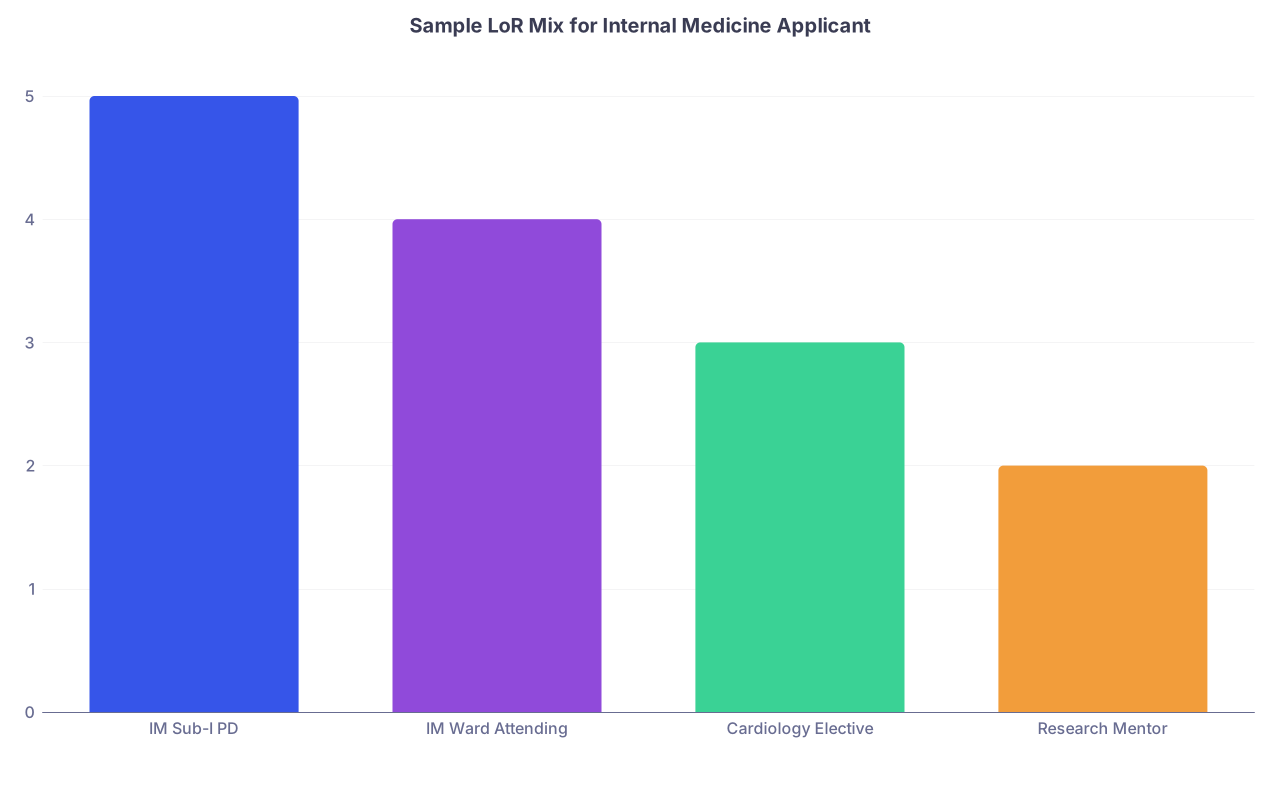
| Category | Value |
|---|---|
| IM Sub-I PD | 5 |
| IM Ward Attending | 4 |
| Cardiology Elective | 3 |
| Research Mentor | 2 |
(Think of 5 as “must include,” 1–2 as “optional/only if needed.”)
5.2. Use letter assignment to quarantine weaker letters
If you have to keep a questionable letter (e.g., too late to replace fully):
Assign it only to:
- Community programs where you have other strong signals
- Backup specialty programs where you need an additional letter but have no better option
Do not assign it to:
- Your top 10–15 programs
- Any program where you are asking someone to advocate for you (home program, away rotation site)
Your ERAS letter assignment is one of your best tools to limit damage.
Step 6: How to Replace a Problematic Letter – Step by Step
Now the core fix: getting a better letter in its place.
6.1. Identify your best replacement targets
Your ideal replacement writer:
- Worked with you recently
- Observed your direct clinical work (not just research)
- Has some authority (program director, clerkship director, subspecialty attending)
- Actually likes working with you and has said so directly
Examples:
- The attending from your Sub-I who emailed, “You were one of the best students we’ve had in a while.”
- Your research PI who is also a clinician and saw you present cases or interact with patients.
- A faculty member who explicitly said, “I would be happy to support your application.”
6.2. Ask the right way (and explicitly ask for a strong letter)
You are not asking for “a letter.” You are asking for a strong, detailed letter.
Template you can adapt:
Dear Dr. [Name],
I wanted to thank you again for the opportunity to work with you on [rotation/project] in [month]. I learned a great deal from [specific clinical/academic experience].
I am applying to [specialty] residency this cycle, with a particular interest in [brief focus]. I was hoping you would feel comfortable writing a strong letter of recommendation on my behalf. You were able to directly observe my [clinical reasoning, work ethic, patient care, etc.], and your perspective would be very valuable to programs.
I am happy to provide an updated CV, my personal statement draft, and a brief summary of the work we did together to make this easier.
Thank you for considering this request.
Sincerely,
[Name]
That phrase — “strong letter of recommendation” — does two things:
- Signals that you are seeking an enthusiastic endorsement.
- Gives them a graceful exit if they cannot honestly provide one.
If they respond with anything like “I can write a letter, but I am not sure how strong it will be,” you do not use that letter.
6.3. Give them the materials that make a letter strong
Make it easy for them to write specifics.
Send:
- Updated CV
- Personal statement draft
- ERAS experiences list (bullet point format is fine)
- A one-page “Letter Aid” document:
- 3–5 specific cases or projects you worked on with them
- Any positive feedback they gave you during the rotation
- Your career goals and the kinds of programs you are applying to
This is not “writing your own letter.” It is jogging their memory so they can write something real.
Step 7: Timing and Logistics – What If ERAS Is Already Submitted?
You are probably wondering: “Is it too late?”
Usually, no.
7.1. If applications have not been released yet
If ERAS has not transmitted to programs:
- Replace the bad letter before you assign letters and certify.
- Delete the old letter from your assignment list.
- Assign the new letter in its place once uploaded.
7.2. If applications are already out but interviews are ongoing
You can still:
- Add a new, stronger letter to ERAS.
- Email select programs (especially ones that have not rejected or interviewed you yet) saying:
Dear Dr. [PD Name],
I wanted to share an additional letter of recommendation that speaks to more recent clinical work during my [Sub-I/elective]. I have uploaded this to ERAS.
I remain very interested in [Program Name] because [specific reason].
Thank you for your consideration,
[Name, AAMC ID]
Do not mention that you are replacing a problematic letter. Just add strength.
7.3. If rank lists are already being built
At that stage, most PDs will not reshuffle their view of you because of one more letter. Focus your energy earlier in the cycle if you can.
Step 8: Handling the Awkward Reality – What If the Problem Is Your Home Program PD Letter?
This one is common and tricky.
Scenario I have seen:
- Home program PD writes a lukewarm or coded letter.
- Applicant applies broadly.
- Away rotation PD or mentor writes a significantly stronger letter.
Here is the play:
Still include the home PD letter for most programs. They expect it.
Make sure you also have:
- A very strong letter from an away/a different PD or chair.
- Strong sub-I attending letters that clearly state you can function at resident level.
For your very top programs:
- Consider weighting away PD/attending letters higher in the assignment (e.g., 2 away letters + 1 home PD, or 2 home + 1 away, depending on comparative strength).
- Use your personal statement and interviews to show maturity, insight, and consistency with the strong letters.
You almost never outright drop the home PD letter unless there is some genuinely toxic relationship or they explicitly told you they cannot support you. In that rare case, you need:
- A written explanation strategy with your dean’s office.
- Very strong alternative PD/chair-level letters from other institutions.
Get your dean or student affairs dean involved if you are in this situation. Do not freelance it.
Step 9: Use Your Dean’s Letter / MSPE to Counter-Balance
The MSPE is another major narrative document. It can sometimes soften or reinforce what is in your LoRs.
If you know there is a problematic rotation or mixed message:
Meet with your dean/student affairs early.
Review:
- Any professionalism incidents and their resolutions.
- Any big improvements across clinical years.
Ask explicitly:
- “How will this be reflected in my MSPE?”
- “Is there a way to clearly document my growth and current performance?”
A clear trajectory in the MSPE (“early struggle, then strong performance”) can offset a single old letter that hints at issues. But you must be proactive.
Step 10: Build a System Now So You Never End Up Guessing Again
This is the part almost nobody does, and it costs them.
10.1. Plan your LoRs a year in advance
As an M3 or early M4:
- Identify 4–6 potential letter writers before you need them.
- Rotate with them strategically:
- Sub-I with a PD or APD
- Elective with a clinically active faculty member who teaches a lot
- Act like every day is an audition for a letter. Because it is.
10.2. Ask while you are still fresh in their mind
At the end of a strong rotation:
- Ask for feedback directly:
- “Do you have any suggestions for how I can grow into an excellent [specialty] resident?”
- If the feedback is positive:
- “Would you feel comfortable writing me a strong letter of recommendation for residency?”
If they hesitate, that is your signal. You move on. No resentment, just data.
10.3. Track your letters like a project manager
Simple spreadsheet or note:
- Writer
- Date requested
- Date ERAS upload requested
- Date actually uploaded
- Assigned to which programs

| Step | Description |
|---|---|
| Step 1 | Identify rotation/mentor |
| Step 2 | Perform well clinically |
| Step 3 | Ask for strong LoR |
| Step 4 | Do not use; find new writer |
| Step 5 | Send CV & materials |
| Step 6 | Track upload status |
| Step 7 | Assign letters per program |
| Step 8 | Enthusiastic yes? |
It is not glamorous. It is how adults run important processes.
Step 11: Special Situations – Dual Applications, Career Changes, and Red Flags
You are not the first person to have a messy application narrative. It just means you need to be more deliberate.
11.1. Dual applications (e.g., IM + Neuro, FM + Psych)
Curate two stacks of letters:
- Stack A (IM): 2 IM + 1 generalist + maybe 1 research
- Stack B (Neuro): 2 Neuro + 1 IM + research if neuro-related
Do not send psychiatry-heavy letters to an FM program unless they showcase generalist skills. Align each letter stack to the specialty’s culture and expectations.
11.2. Major red flag in one letter (e.g., documented unprofessional behavior)
If you know a specific letter references a big incident:
- Confirm with your dean what is documented formally.
- Avoid using that particular letter unless absolutely required.
- Get multiple other writers to address:
- Your current reliability.
- How you responded/grew from the incident.
Programs are far more forgiving of a documented past issue if there is a clear, consistent story of growth across multiple recent letters. Not one forced apology paragraph in a single note.
Step 12: What To Do Today
You do not fix LoR problems by worrying about them. You fix them by acting in sequence.
Here is your immediate checklist:
List every current or planned LoR with:
- Writer
- Rotation
- Perceived strength (1–5)
- Risk level (low / moderate / high)
Mark any letter as “Replace if possible” if:
- Rotation went badly
- Writer was lukewarm
- You have concrete reason to suspect mixed messages
Identify 2–3 stronger potential writers from:
- Recent Sub-Is
- Away rotations
- Enthusiastic attendings
Email those 2–3 people today using the “strong letter” language and offer your materials.
Open ERAS (or your tracking doc) and plan letter assignment:
- Top 10–15 programs get only your best letters.
- Weaker/generic letters are quarantined to backup programs or not used at all.
Do step 1 right now: write down the name of one letter you are worried about. Then decide whether it belongs in your “Replace ASAP” column. If it does, draft the email to a better writer before you close your laptop today.