
The most overused personal statement clichés will quietly kill your residency chances.
Not because programs “hate” you. Because they literally stop reading you.
I’ve watched faculty go through 200+ personal statements in a weekend. I’ve seen the eye-rolls at “ever since I was five…” and the immediate scroll past another “I learned the importance of empathy” paragraph. If you write like everyone else, you get treated like everyone else: skimmed, forgotten, ranked lower.
Let me walk you through the biggest traps—what they sound like, why they hurt you, and how to avoid writing the exact same essay as 500 other applicants.
1. The Origin Story Clichés That Make You Sound 17
The “origin story” is where most people blow it.
Cliché #1: “Ever since I was a child…”
You know this one:
- “Ever since I was a child, I knew I wanted to be a doctor.”
- “From a young age, I was fascinated by the human body.”
- “My journey to medicine began when I received a toy stethoscope…”
Programs see this 100 times a day. It makes you sound:
- Naive
- Unreflective
- Stuck in childhood fantasy rather than adult decision-making
The real problem? It dodges the real question: Why are you pursuing this specialty now, as an adult, with actual clinical experience?
Avoid this mistake by:
- Starting in adulthood, not kindergarten
- Anchoring your motivation in clinical reality, not vague “fascination”
- Showing how specific experiences in med school or post‑bacc solidified your path
Stronger alternative openers:
- “On my third night on call as a sub‑intern on internal medicine, I realized I wasn’t tired—I was hooked.”
- “In the ED, at 3 a.m., I watched an exhausted attending sit down at eye level with a terrified patient. That five‑minute interaction did more than stabilize vitals; it recalibrated my idea of what good medicine looks like.”
You’re not writing a Disney origin story. You’re applying for a job.
Cliché #2: The Tragic Backstory as Your Whole Personality
Another classic move: turning your personal loss into your entire application identity:
- “My grandfather’s death from cancer inspired me to pursue oncology.”
- “When my sibling was diagnosed with X, I knew I would dedicate my life to medicine.”
- “My own journey as a patient made me want to become a doctor.”
Let me be blunt: there’s nothing wrong with these experiences. They’re real and painful. The mistake is leaning on them as your primary qualification.
- The story is emotionally heavy but professionally thin
- You never bridge from “this happened to me” to “here’s how I showed up differently in clinical settings”
- It feels like trauma marketing rather than thoughtful reflection
Use personal hardship carefully:
- 1–2 concise paragraphs max
- Focus on how it changed your behavior, not just your emotions
- Tie it to specific, mature decisions: how you study, how you interact with patients, what you value in a team
If your personal story stops at “this made me want to help people,” you’ve just joined the largest cliché club in medical education.
2. The “I Want to Help People” Non‑Statement
If your main reason for medicine or your specialty is, “I want to help people,” you’ve basically said nothing.
Everyone in this process “wants to help people.” It’s assumed. It’s like a pilot saying, “I want planes to land safely.” No one’s impressed.
Red Flag Phrases:
- “I want to help people at their most vulnerable.”
- “I hope to provide compassionate care to all my patients.”
- “I want to give back to my community.”
Again, not bad values. Just painfully generic.
What programs actually want to know:
- How do you help people—what does that look like on the floor?
- What kind of patients and problems are you drawn to?
- How do you handle patients who aren’t grateful, compliant, or easy?
Upgrade the cliché like this:
Instead of:
“I want to help people at their most vulnerable.”
Try:
“I’m drawn to ICU medicine because it forces hard conversations about goals of care. During my sub‑I, I learned I could sit in discomfort, translate medical language for families, and still advocate honestly for realistic outcomes.”
See the difference? One is a poster slogan. The other is a concrete professional stance.
3. The Hero Narrative: “I Saved the Day” (No, You Didn’t)
Nothing gets an application side‑eyed faster than a med student writing like they were the attending.
You’ve seen this style:
- You “noticed” what everyone else missed.
- You “advocated” when the team was ignoring something big.
- You “took charge” in a critical situation.
Programs read that and think:
- This person has no insight into hierarchy.
- This person might be dangerous as an intern.
- This person doesn’t understand their actual role.
Watch for this pattern:
- Long story about a single patient
- You are the star
- Attending and residents are background furniture or implicitly incompetent
- Patient outcome is magically great because of you
How to fix it:
- Center the team, not you
- Describe your role accurately: student, observer, contributor
- Emphasize what you learned, not what you single‑handedly did
A safer version:
“As a medical student, my role was small but clear: gather information, communicate it cleanly, and support the team’s plan. In caring for a complex heart failure patient, I learned that even a well‑crafted one‑liner and solid note can move care forward efficiently.”
Humble, accurate, still competent.
4. Buzzword Soup: When Your Statement Sounds Like a Brochure
Residency reviewers are allergic to certain overused words. Not because the values are bad, but because they’ve been drained of meaning.
The Usual Suspects:
- “passionate”
- “resilient”
- “empathy/empathetic”
- “lifelong learner”
- “team player”
- “hardworking”
- “dedicated”
- “grit”
One or two of these used sparingly is fine. A paragraph loaded with them is just white noise.
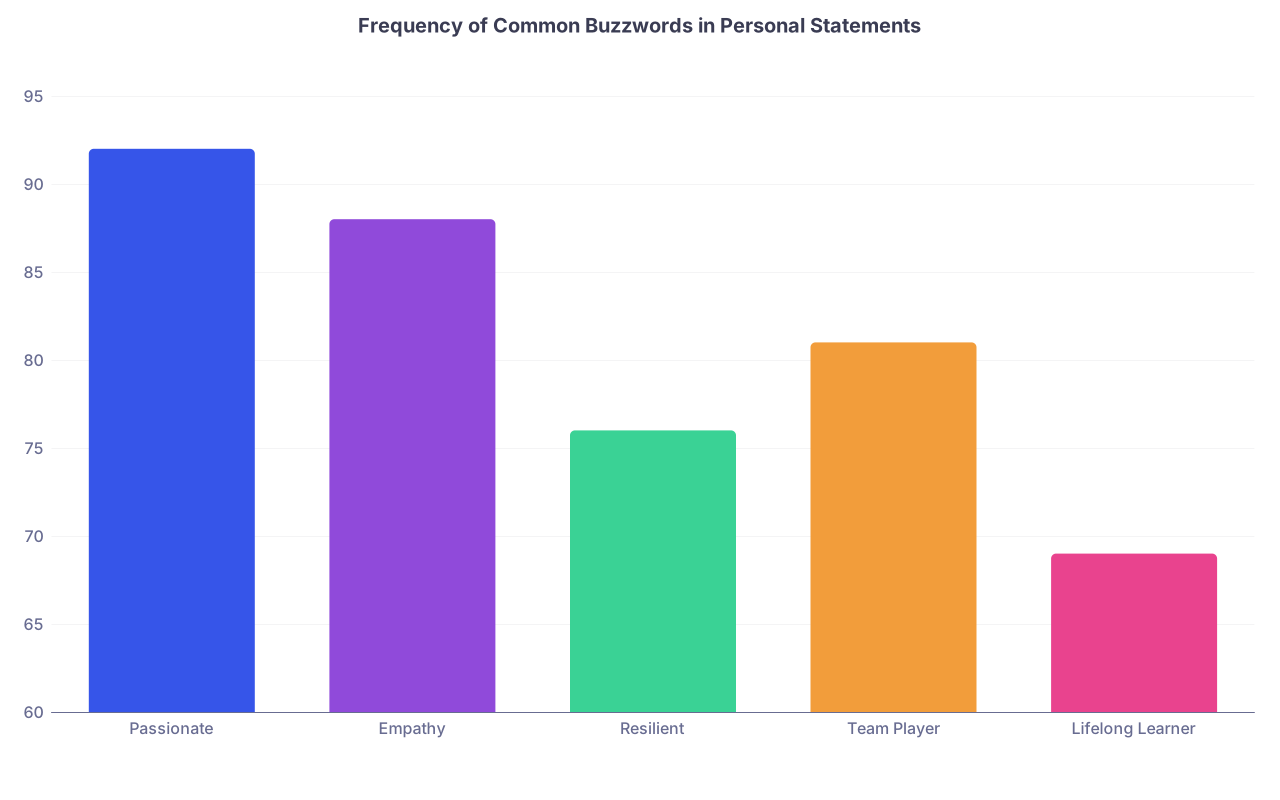
| Category | Value |
|---|---|
| Passionate | 92 |
| Empathy | 88 |
| Resilient | 76 |
| Team Player | 81 |
| Lifelong Learner | 69 |
When every third word is a buzzword, reviewers simply stop believing you. It feels like filler. It reads like you wrote for vibes, not substance.
Instead of naming traits, show them:
- Rather than: “I am resilient.”
- Say: “During my third year, my father was hospitalized twice across the country. I coordinated my schedule with my clerkship directors, kept up with rotations, and still passed Step 2 on my first attempt. It wasn’t pretty, but I learned how to protect patient care while barely holding my personal life together.”
You don’t have to announce you’re resilient. Anyone reading that paragraph knows.
5. The Generic Specialty Love Letter
Programs can tell when you’ve written one generic statement and swapped out “internal medicine” for “family medicine” or “psychiatry.”
And they don’t like it.
Giveaways that your statement is generic:
- You describe things every specialty does: “continuity of care,” “teamwork,” “building patient relationships,” “problem-solving”
- You could change the specialty name and nothing else breaks
- You give 1–2 superficial reasons for the field (“I like procedures and continuity” for literally everything)

What’s missing? Specificity. Depth. Evidence you understand the actual work of the specialty.
Concrete ways to avoid this:
- Reference real experiences: “On my EM rotation at County Hospital, I loved the mix of resuscitation, undifferentiated complaints, and fast decisions with limited data.”
- Mention specialty‑specific realities: call structure, patient population, chronic vs acute care, procedural volume, inter‑service dynamics
- Show you understand trade‑offs: no specialty is perfect; acknowledging that makes you sound like an adult, not a romantic
Compare:
- Weak: “I love internal medicine because it combines complex problem‑solving with continuity of care.”
- Stronger: “I like that internal medicine demands longitudinal thinking. On wards, I saw that the best internists could manage diuresis today while still planning for what the patient’s life will look like three months after discharge.”
If your statement could apply equally well to neurology, peds, and anesthesia, it’s not helping you.
6. The “I’m Basically Perfect” Robot Statement
Trying to present as flawless is another quiet killer.
You know the tone:
- Every challenge is instantly overcome
- Every story ends with you looking good
- There’s no real failure, doubt, or growth—just steady excellence
Programs don’t buy it. And they don’t trust it.
They already have your Step scores and transcript. They know your numbers. The personal statement is where they decide if you’re:
- Self‑aware
- Coachable
- Honest about your limitations
| Tone in Statement | Common Program Reaction |
|---|---|
| Flawless / no weaknesses | “Lacks self-awareness” |
| Honest but defensive | “Blames others, risky” |
| Honest + reflective | “Trainable, grounded” |
| Overly self-deprecating | “May lack confidence” |
Better approach:
- Admit a real weakness or misstep (not just “I care too much”)
- Show how you responded over time
- Emphasize systems you built: what you changed in your habits, communication, or planning
Example:
“I struggled on my first surgical rotation. I was slow in the OR and quiet on rounds. After clear feedback from my senior, I started pre‑rounding earlier, rehearsed presentations at home, and asked to scrub in on more cases. By the end, I still wasn’t the fastest, but I was reliable, prepared, and comfortable speaking up.”
This doesn’t make you look weak. It makes you look real.
7. The Overstuffed Autobiography
Another common mistake: trying to fit your entire life into 750 words.
Signs you’re doing this:
- Childhood story
- College research
- Global health trip
- Every leadership title
- Every hardship you’ve ever faced
- Plus three patient vignettes
Result? A blur. No depth. Nothing sticks.

| Step | Description |
|---|---|
| Step 1 | Brainstorm experiences |
| Step 2 | Try to include everything |
| Step 3 | Wordy, unfocused draft |
| Step 4 | Reviewer skims |
| Step 5 | Low impact |
| Step 6 | Select 2-3 key threads |
| Step 7 | Focused, specific narrative |
| Step 8 | Reviewer remembers you |
Avoid this by brutally prioritizing:
Pick 2–3 threads that align with the specialty and your actual story:
- Intellectual fit (what kind of thinking/work you enjoy)
- Clinical behavior (how you show up on the team)
- Values/growth (how you handle stress, conflict, setbacks)
Cut the rest. Or move them into ERAS experiences where they can breathe.
The question is not “Is this impressive?” It’s “Does this help a PD picture me as an intern on their service at 2 a.m.?”
If not, it’s optional.
8. The Boring, Vague Closing Paragraph
You’ve seen this ending:
“In conclusion, I am excited to pursue [specialty] and continue developing my skills. I am confident that my dedication, hard work, and passion will make me a strong resident. Thank you for your consideration.”
This is verbal beige. It adds zero information. It sounds like ChatGPT on autopilot. (Yes, they can tell when people phone in the ending.)

Use the ending to do something useful:
- Reconnect to your specialty with one clear sentence
- Preview how you’ll function as a resident
- Land on a specific, grounded image of you on the job
For example:
“As a future family medicine resident, I want to be the person who knows my patients well enough to notice when something is off, who calls them when they miss follow‑ups, and who is still energized by clinic on Friday afternoons. I’m not perfect, but I’m reliable, curious, and fully committed to the messy, long‑term work of primary care.”
That sticks far better than “thank you for your consideration.”
9. Red Flags That Quietly Sink You
Some elements don’t just bore programs—they raise actual concern.
Subtle but real red flags:
Blaming language
“The attending failed to recognize…”
“The system let the patient down” (with you as the lone hero)Overly grand language
“I will revolutionize the field of…”
“I am uniquely suited to…”Inconsistent humility
Saying “teamwork matters” then writing like you’re the only competent person on your rotationTone mismatch with performance
Cocky tone with average scores/grades = risk of poor insight
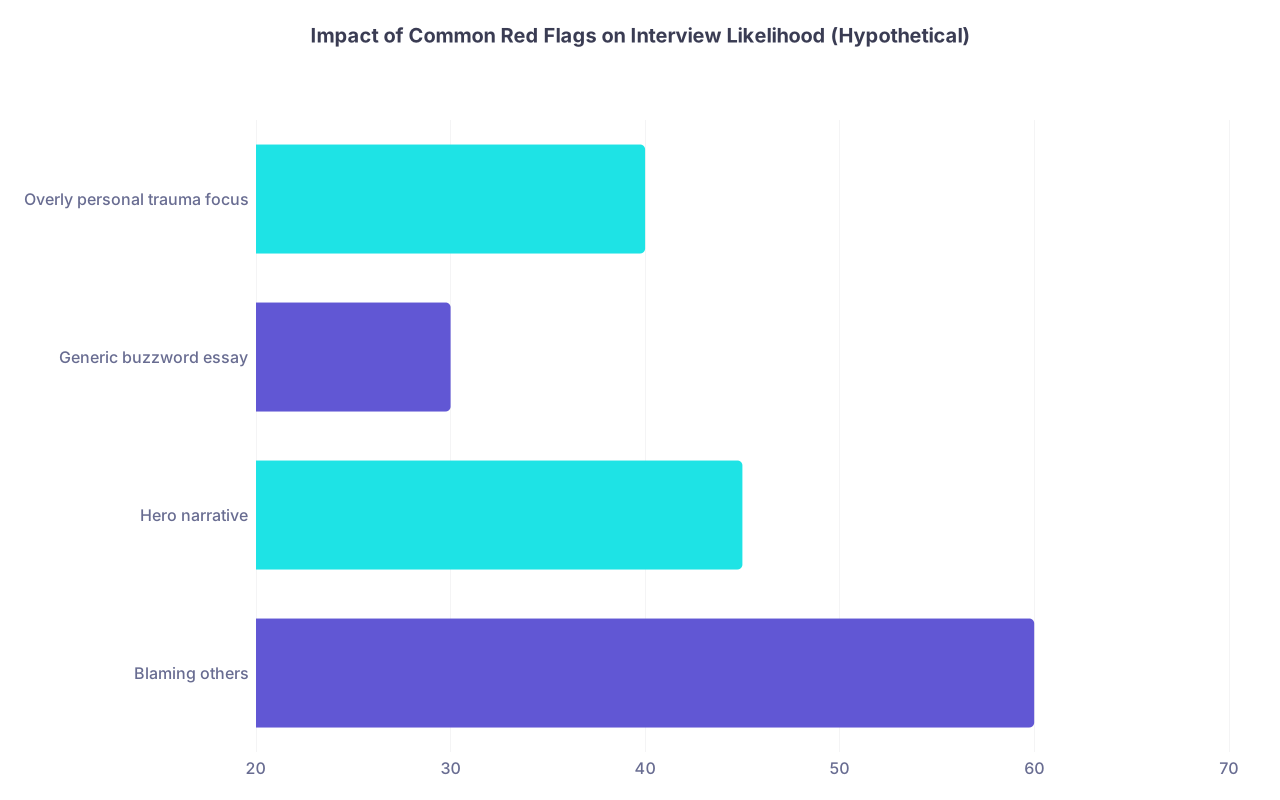
| Category | Value |
|---|---|
| Blaming others | 60 |
| Hero narrative | 45 |
| Generic buzzword essay | 30 |
| Overly personal trauma focus | 40 |
You can absolutely criticize systems or acknowledge brokenness. Just don’t center yourself as the only enlightened one in the story.
A better tone:
“Our discharge process for non‑English‑speaking patients clearly had gaps. As a student, my influence was limited, but I started by making sure instructions were interpreted and asking the intern if we could involve social work earlier.”
Mature. Honest. Grounded in your actual role.
10. How to Make Your Statement Actually Sound Human
Let’s flip this. You avoid clichés by sounding like a specific person, not a template.
Here’s a simple framework that rarely goes wrong:
Open with a specific clinical moment from med school or later
Not childhood. Not abstract. A day, a patient (de‑identified), a real scene.Use that moment to illustrate what attracts you to this specialty
- Type of thinking
- Type of patients
- Type of work (procedural, cognitive, acute, longitudinal)
Show how your prior experiences prepared you
- A couple of key roles/experiences
- What you actually did, not just titles
Acknowledge growth and limitations
- Where you struggled
- What you changed
- How that makes you a better trainee
End with a grounded picture of you as a resident
- How you’ll show up on day 1
- What kind of teammate you are
- What you’re hungry to learn

| Step | Description |
|---|---|
| Step 1 | Specific Clinical Opening |
| Step 2 | Connect to Specialty |
| Step 3 | Key Experiences & Skills |
| Step 4 | Growth & Reflection |
| Step 5 | Grounded Future Resident Image |
Do that in clear, plain language, and you’ve already outperformed half the applicant pool.
Quick Checklist: Clichés to Hunt and Delete
Before you submit, go through your statement with a red pen (literally).
Circle or cut:
- Any sentence starting with “Ever since…”
- “I want to help people” (or variants)
- “I am passionate…” (unless followed by something very specific)
- “Thank you for your consideration”
- Any story where you’re the lone hero
- Any trait you name without evidence (hardworking, resilient, empathetic)
- Any sentence that would apply to any specialty
If you wouldn’t say it out loud in a conversation with a blunt attending, it probably doesn’t belong.

FAQ (Exactly 5 Questions)
1. Is it always bad to mention childhood or early experiences?
No, but it’s usually overdone and shallow. If you briefly reference childhood (“I grew up translating for my parents in clinic, which made healthcare feel familiar early on”), that’s fine. Just don’t start and stay there. The meat of your statement should live in your adult, clinical experiences and current understanding of the specialty.
2. Can I reuse my medical school personal statement for residency?
You can steal a couple of sentences or themes, but reusing it wholesale is a mistake. The residency statement must answer: “Why this specialty?” and “What will you be like as a resident?” A med school essay about why medicine in general usually misses both targets and sounds stale and immature compared to who you are now.
3. How many patient stories should I include?
Usually one, maybe two short ones. The more stories you cram in, the less depth you give any of them. One well‑told vignette that shows how you think, feel, and act on a team is far more powerful than four superficial “I was so inspired” snapshots.
4. Is it risky to talk about mental health struggles or major personal hardship?
It can be, depending on how you handle it. Programs worry about whether you’ll be safe and reliable under stress. If you choose to include it, keep it concise, emphasize treatment/recovery, and focus on what systems you have in place now (therapy, support, boundaries) and how you’ve functioned successfully since. Do not make the hardship the entire essay or leave questions about current stability.
5. How long should I spend revising my personal statement?
Longer than you think—and earlier than you want. A solid process: rough draft in 1–2 days, then at least 2–3 rounds of revision over a couple of weeks. Have 2–3 people read it: one who knows you well, one in your specialty, and one who will be brutally honest. If all of them say at some point, “This part sounds generic,” believe them and fix it.
Remember:
- Clichés don’t just sound bad—they make you invisible.
- Specific, grounded, slightly imperfect honesty beats polished nonsense every time.
- If your statement could have been written by half your class, rewrite until it couldn’t.