Your current personal statement is probably not “fine.” It is probably generic, unfocused, and forgettable. That is fixable—but not with another light edit the night before ERAS submission.
You do not need a new personality. You need a structured rewrite.
I am going to walk you through an exact, step‑by‑step process I use with residents and applicants whose statements are getting them interviews despite their scores, not because of them. If you follow this, you will end up with a statement that:
- Sounds like a real person, not ChatGPT or a template.
- Shows judgment, not just hardship.
- Makes it very easy for a program director to say: “I can see this person on our team.”
Let’s get to work.
Step 1: Diagnose Why Your Statement Is Weak
Before you rewrite a word, you need to know what is actually broken. Most weak statements fall into the same predictable buckets.
Here are the big problems I see over and over:
The trauma autobiography
Endless childhood hardship, vague “ever since I was young,” and very little about who you are as a clinician now.The CV rehash
Every line from your ERAS experiences copied into paragraphs. No story, no reflection, zero value added.The specialty Wikipedia entry
Half the essay explaining what internal medicine / EM / OB/GYN is and why it matters. You are telling PDs about their own jobs. They hate it.The flattery letter
“I would be honored to train at your prestigious institution…” with no evidence that you can actually do the work.The buzzword salad
Passion. Compassion. Teamwork. Lifelong learning. None of it backed by concrete behavior.
Now do a quick, brutal self‑audit of your current draft. Print it. Grab a pen.
Mark the following:
Highlight in yellow every sentence that:
- Could have been written by 500 other applicants this year, or
- Contains a cliché or vague claim (passionate, always knew, love helping people).
Circle in blue every place you:
- Describe a specific moment (a page, a patient, a decision, an internal conflict), or
- Show your thinking or judgment.
Underline in red any time you:
- Explain what you actually want in residency (type of program, learning style, clinical environment), or
- Give PDs a glimpse of how you function on a team or under pressure.
If your page looks mostly yellow with very few blue circles and red underlines, you do not need polishing. You need a rebuild.
Step 2: Strip It Down to What Actually Matters
You cannot fix a weak draft by adding more adjectives. You fix it by reducing it to the few things that should be there.
Your residency personal statement has four jobs. That is it:
- Show you understand the specialty’s reality (not the brochure).
- Show how you think and work—on a normal day, not a movie scene.
- Show what kind of training environment you will thrive in.
- Give them 2–3 easy conversation hooks for the interview.
Everything else is noise.
On a blank page, answer these prompts in bullet form. Fast, 10–15 minutes. Do not wordsmith. Just get content.
One real clinical moment
- What is a case, interaction, or day that changed how you see this specialty?
- Where did you screw something up, misunderstand something, or see a senior do something that reset your expectations?
How you actually work
- When you are on a busy service, what do your co‑interns or residents rely on you for?
- When things fall apart at 2 a.m., what do you default to?
How you think about patients
- Give one example where your thinking about a patient evolved over the course of a day / week.
- What do you do that a lazy student would not bother with?
What you want from residency
- More volume or more hand‑holding?
- More autonomy or more structure?
- Academic track, community track, or undecided but with specific interests?
Do not try to write prose yet. You are gathering raw material.
Now, from that mess of bullets:
Put a star next to one concrete clinical story that:
- You remember clearly.
- You can talk about easily without sounding fake.
- Shows you doing something, not just watching an attending be great.
Put a check next to 2–3 behaviors or traits that:
- You can back up with examples (pre‑rounding habits, following up labs, calling families, building checklists).
- Actually matter for residency (reliability, owning mistakes, managing uncertainty).
Those will be the spine of the new essay.
Step 3: Build a Strong Skeleton (Template That Actually Works)
Now we shape this into a structure that does not waste the reader’s time.
Think in four parts:
- Hook (short scene, 3–6 sentences)
- Reflection and link to specialty
- Who you are on a normal day
- What you are looking for in a program + closing
Here is a simple, repeatable template.
3.1 Hook: One Specific Moment
Aim: Drop us into a real, specific scene—no childhood, no origin myth, no drama you did not earn.
Bad:
“Ever since I was young, I have been fascinated by the human body…”
Better pattern:
- 1–2 sentences: concrete setup (time, place, patient or task).
- 2–3 sentences: your action / thought in that moment.
- 1 sentence: quiet pivot toward what this showed you about the specialty.
Example pattern (fill in with your story):
During my first month on night float, I admitted a middle‑aged man with decompensated heart failure who insisted he “just needed stronger pills.” I was more worried about his blood pressure and his visible anxiety than his request for a new prescription. While my senior managed the diuresis, I found myself sitting on the edge of his bed at 3 a.m., drawing his cardiomyopathy on a scrap of paper. That conversation, in a quiet corner of an overfull ward, showed me what internal medicine actually feels like: managing physiology and fear at the same time.
No adjectives about passion. No grand claims. Just a scene.
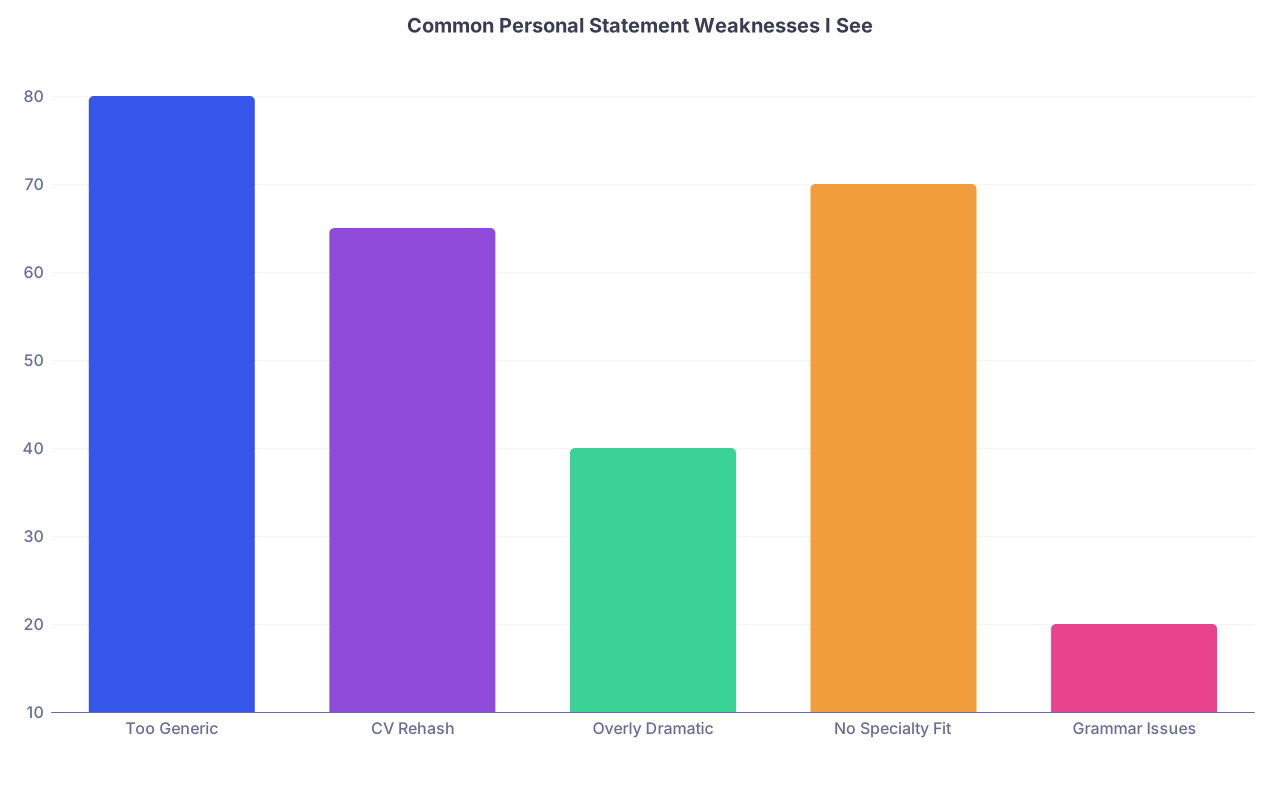
| Category | Value |
|---|---|
| Too Generic | 80 |
| CV Rehash | 65 |
| Overly Dramatic | 40 |
| No Specialty Fit | 70 |
| Grammar Issues | 20 |
3.2 Reflection: Why This Story Matters For Your Specialty
Now you earn the story. Most applicants never do this; they just throw in a random patient vignette and move on.
Write 1–2 short paragraphs that answer:
- What did this moment change in how you see the specialty?
- What did it show you about the kind of doctor you want to be?
- How does it connect to the everyday work of that field?
Patterns you can use (adapt, do not copy):
- “That night taught me that [specialty] is less about [naïve assumption] and more about [real insight].”
- “I had expected [X]; instead, I saw [Y].”
- “Since then, I look for [behavior / signal] in every patient with [problem], because…”
Avoid big generic statements like “This confirmed my passion for surgery.” That is meaningless. Show how your behavior changed.
3.3 Who You Are on a Normal Day
This is where you separate yourself from 100 other “hard‑working, compassionate, team‑oriented” people. You prove it with concrete habits.
Write 1–3 paragraphs that cover:
- How you approach your work on the wards or in the ED.
- How your team can count on you.
- How you handle uncertainty, feedback, and mistakes.
Use specific, small behaviors:
- Pre‑rounding pattern (“I like having an updated one‑liner and overnight events for each patient before sign‑out ends.”)
- Follow‑through (“If I say I will call a family, I document it and set an alarm so it happens before sign‑out.”)
- Owning mistakes (“I once missed X on a lab review; here is how I changed my system.”)
You want the reader thinking: “I know exactly how this person will function on my service.”
Do not list adjectives. Replace adjectives with actions.
Instead of: “I am a team player and strong communicator.”
Write: “I text the intern taking over my patients a short summary of any unresolved issues before I leave, because I have seen how easy it is for those to disappear into the chart.”
3.4 What You Want from Residency + Closing
Program directors care about fit more than your poetic origin story. They want to know:
- Will this person actually be happy here?
- Are we built to train someone like this?
In 1–2 paragraphs:
State what kind of environment you learn best in:
- “high‑volume, high‑acuity ED where seniors give early autonomy but clear backup”
- “inpatient‑heavy academic program with strong teaching on rounds and exposure to complex pathology”
- “smaller community program where I can know the faculty well and see the full spectrum of undifferentiated complaints”
Name 2–3 things you hope to develop:
- Procedural skills
- Comfort with rapid decision‑making
- Longitudinal care of complex patients
- Teaching junior learners
Closing line pattern:
- “I am looking for a program where I can bring that same [specific habit / mindset] to a team that pushes me to become a reliable, thoughtful [specialty] physician.”
- “I hope to train in a program that values [X] and expects its residents to [Y], because that is the environment where I know I do my best work.”
Stop there. Do not thank them for their time. Do not repeat your entire essay in the last paragraph.
Step 4: Rewrite Using a Clear Workflow (Draft, Then Tighten)
You now have:
- One core story.
- A few clear reflections.
- Concrete behaviors.
- A sense of what you want in residency.
Time to build the new draft.
4.1 Draft 1: Write Fast, Fix Later
Rules for Draft 1:
- 45–60 minutes, no edits while writing.
- Follow the 4‑part structure above.
- Aim for 900–1000 words. You will cut later.
If you stall, use simple scaffolding phrases while drafting:
- “In this moment, I realized…”
- “Since then, I have tried to…”
- “On a typical day on [rotation], I…”
- “I am looking for a residency where…”
You will remove or refine those later. Right now you are building clay to sculpt.
4.2 Draft 2: Cut the Garbage
Now you put on your editor hat. Goal: 650–750 words, clean, specific.
Pass 1: Delete or replace:
- Any sentence that could plausibly appear in a pre‑med personal statement.
- Any generic praise of the specialty (“EM is fast‑paced and diverse”).
- Any sentence starting with “I have always…”
Pass 2: Make verbs do the work.
Weak:
“I was able to learn how to manage…”
Strong:
“I learned to manage…”
Weak:
“I was given the opportunity to perform…”
Strong:
“I performed…”
Pass 3: Check balance.
Rough proportion that works:
- Hook story + reflection: 35–40%
- Who you are on a normal day: 40–45%
- What you want from residency + closing: 15–20%
If your childhood or early college occupies more than 10% of the essay, cut it.

| Step | Description |
|---|---|
| Step 1 | Diagnose Weak Draft |
| Step 2 | Extract Real Content |
| Step 3 | Build 4-Part Skeleton |
| Step 4 | Write Fast Draft |
| Step 5 | Tight Edit & Cut Clichés |
| Step 6 | Targeted Feedback |
| Step 7 | Polish & Final Checks |
Step 5: Fix the Most Common Specific Mistakes
Now we clean up the predictable errors that quietly kill otherwise decent statements.
5.1 The Over‑Dramatic Patient Story
Problem: You turn a routine case into a TV drama. It feels fake or exploitative.
Fix:
- Keep identifying details vague or altered.
- Focus on your thought process and actions, not the gore or tragedy.
- One patient story is enough. Two maximum.
Question to ask yourself:
“If I told this story to the patient’s family, would I feel proud of how I am using it?”
If not, pick a different case.
5.2 Over‑explaining the Specialty
Program directors know what family medicine / neurology / anesthesia is. You do not need to educate them.
Delete:
- Definitions (“Internal medicine is the field of medicine that focuses on…”)
- Mission statements (“Emergency medicine plays a vital role in the healthcare system by…”)
- Historical references or quotes from famous doctors.
Replace with how you experience the specialty on the ground:
- “What I enjoy about neurology is the slow, methodical reasoning it demands. A normal CT rarely ends the work; it just changes the questions.”
That tells them you actually get it.
5.3 Using Trauma as a Personality
Many applicants over‑lean on their own or family illness stories. Not because they are dishonest, but because that is the easiest narrative they know.
You can mention personal background. You should not let it eat the essay.
Better approach:
- 2–4 sentences max on relevant personal story.
- Then explicitly pivot to how it shapes your behavior now.
Pattern:
Growing up as the translator at my grandmother’s appointments did not make me a doctor. What it did give me was a low tolerance for vague explanations and a habit of asking “What did you understand from what I just said?” when I talk with patients whose first language is not English.
You turn a generic “I was inspired” story into a current, observable skill.

Step 6: Get the Right Kind of Feedback (And Ignore the Wrong Kind)
Most people wreck their statement in the feedback stage. Too many cooks, wrong cooks.
Here is the rule: Only ask people who actually read residency personal statements regularly or who know you clinically. Everyone else is noise.
Good sources:
- Program director or APD you worked with.
- Clerkship director or attending who knows you well.
- Senior resident in your target specialty who has seen a bunch of statements.
- One trusted friend who will tell you if it does not sound like you.
Bad sources:
- Random classmates who also have weak statements.
- Anyone who insists on “making it sound more impressive” instead of more you.
- Family members who want you to talk more about your childhood.
When you send your draft, give them 3 focused questions:
- “Does this sound like me when you have worked with me?”
- “Is there anything that feels generic or could belong to any applicant?”
- “After reading this, would you have one or two specific questions to ask me in an interview?”
Then listen. You do not have to take every suggestion. But if two different clinicians flag the same thing, fix it.
Limit yourself to 1–2 rounds of feedback. After that, you are curve‑fitting to opinions and losing your voice.
, Late Application, Limited Programs Applied, Interview Performance](https://cdn.residencyadvisor.com/images/articles_svg/chart-where-strong-applicants-actually-lose-points-7404.svg "Where Strong Applicants Actually Lose Points")
| Category | Value |
|---|---|
| Weak Personal Statement | 60 |
| [Poor Letters](https://residencyadvisor.com/resources/common-residency-mistakes/lor-pitfalls-recommendation-letter-mistakes-that-raise-red-flags) | 55 |
| Late Application | 30 |
| Limited Programs Applied | 20 |
| Interview Performance | 45 |
Step 7: Final Polish Checklist (Before You Upload to ERAS)
Last pass. This is where you clean the surface mistakes that scream “careless.”
Use this checklist line by line:
Formatting and basics
- 650–750 words. Single spaced. No strange fonts once pasted into ERAS.
- No bold, italics, or underlining. Just clean text.
- No program‑specific names unless you are writing a truly separate PS (and then triple‑check them).
Language
No clichés:
- “Ever since I was a child…”
- “I have always known…”
- “I want to give back to the community…”
No empty buzzwords without behavior concrete behind them:
- Passion, compassion, dedication, calling, dream.
Replace abstract statements with examples.
Content balance
- At least one paragraph that clearly shows you understand the specialty’s day‑to‑day reality.
- At least one paragraph with specific habits that your colleagues would recognize in you.
- A clear, honest description of what you want from training, without sounding demanding.
Tone
Confident but not arrogant:
- “I want to develop…” not “I have already mastered…”
- “I am eager to take on increasing responsibility…” not “I am ready to be fully independent…”
Responsible with weakness:
- You can briefly mention growth areas, but always pair them with concrete steps you are taking.
Example:
I tend to initially over‑collect data before committing to a plan. On my ICU rotation this became obvious, and my attending pushed me to state my best guess before ordering more tests. I now force myself to write a one‑sentence assessment and plan in my notes before looking up the next lab or study.
Proofreading
Read it out loud once. You will catch clunky sentences instantly.
Spellcheck for:
- “residency” vs “residencies”
- “program” vs “programme”
- Specialty names capitalized (Internal Medicine, Emergency Medicine).
Make sure your name and AAMC ID are on your working document, even though ERAS strips headers. You want version control.

Step 8: Use Your New Statement as an Interview Tool
A strong personal statement is not just for screening. It also makes your interview easier.
You want clear, obvious hooks that invite questions like:
- “Tell me more about that night float case you mentioned.”
- “You wrote that you like high‑autonomy environments. What does that look like to you?”
- “You mentioned changing your sign‑out habits after a near‑miss. What happened?”
Prepare 2–3 quick, concrete expansions for each major element in your statement:
- The main clinical story
- One example of your typical work habits
- One example of something you are trying to improve
If you cannot comfortably talk about it in an interview, it does not belong in the essay.

| Aspect | Weak Version | Strong Version |
|---|---|---|
| Opening | Childhood dream, vague ambition | Specific clinical scene with clear stakes |
| Specialty Insight | Generic praise of field | Concrete understanding of daily work |
| Self‑Description | Adjectives (hard‑working, passionate) | Habits and behaviors on real rotations |
| Program Fit | Flattery of “prestigious program” | Clear description of training environment wanted |
| Word Count | 900–1000+, rambling | 650–750, tightly edited |
Quick Recap: What Actually Fixes a Weak Personal Statement
If you remember nothing else, keep these in front of you while you rewrite:
- One real clinical story, honestly told, beats three dramatic vignettes.
- Replace adjectives with actions; let your habits do the bragging.
- Show you understand the actual daily work of the specialty and what kind of program fits you.
Do that, and your personal statement stops being a liability and starts doing its real job: making a busy program director think, “I want to meet this person.”