If you bombed an interview, you do not need another pep talk. You need triage and a rehab protocol. Fast.
I have watched applicants with average scores match at top places because they fixed interview problems in time. I have also watched 260+ scorers get quietly buried because nobody was honest with them about how bad their interviews were.
This is the blunt truth: if your interviews are weak, the rest of your application is just expensive wallpaper. The good news? A lot can be fixed in 7 focused days if you stop guessing and start using a deliberate system.
Here is that system.
Step 0: Do a Ruthless Post‑Mortem (Today, Before You “Move On”)
You cannot fix what you will not name. Vague feelings like “it just did not go well” are useless.
1. Capture the interview while it is still fresh
Do this for every interview you think went badly. Today.
Open a document and write, in bullet form:
- Exact questions you remember
- Your actual answers (not the version you wish you gave)
- Moments where:
- The interviewer’s body language changed (leaned back, stopped nodding, checked clock)
- You rambled
- You froze
- You contradicted yourself
- Any red-flag reactions:
- Long silence after your answer
- “Hmm…” followed by a topic change
- Clarifying questions that suggested they did not get your point
Force yourself to be specific. “I was nervous” is useless. “I could not give a single concrete example when asked about conflict with a nurse” is actionable.
2. Classify your failure type
Most “bad” interviews fall into a few predictable buckets. Be honest and pick what actually happened, not what sounds nicer.
| Failure Type | Main Symptom | Primary Cause |
|---|---|---|
| Rambling | 3+ minute unfocused replies | No structure |
| Generic Answers | Sound like everyone else | No story prep |
| Low Energy | Flat, monotone, tired | Fatigue / mindset |
| Defensive | Arguing, over-explaining | Ego / lack of insight |
| Incoherent Timeline | Confusing path, gaps | No narrative practiced |
You can absolutely have more than one, but pick the top 1–2 you must fix this week.
3. Get external data (not from your mom)
Ask for blunt feedback from:
- A resident you know at any program
- A trusted attending who has interviewed residents
- A career advisor who has actually sat on selection committees
Send them:
- Your recollection of 3–5 questions and your answers
- Your CV and personal statement
- A one-sentence summary: “I think the interview went poorly because ___.”
Tell them explicitly: “Please do not sugarcoat. I would rather be uncomfortable now than unmatched in March.”
If you have an upcoming interview within 7–10 days, you are not “upset”; you are in active rehab. Treat it that way.
Step 1: Build a One‑Week Rehab Plan (No More “Winging It”)
A weak interview is almost never a personality problem. It is a systems problem. You either lack:
- A clear story
- A predictable structure for answers
- Fluency with common questions
- Reps with real-time pressure
The one-week fix hits all four.
Here is your 7-day intensive schedule. No, you should not do this half-heartedly.
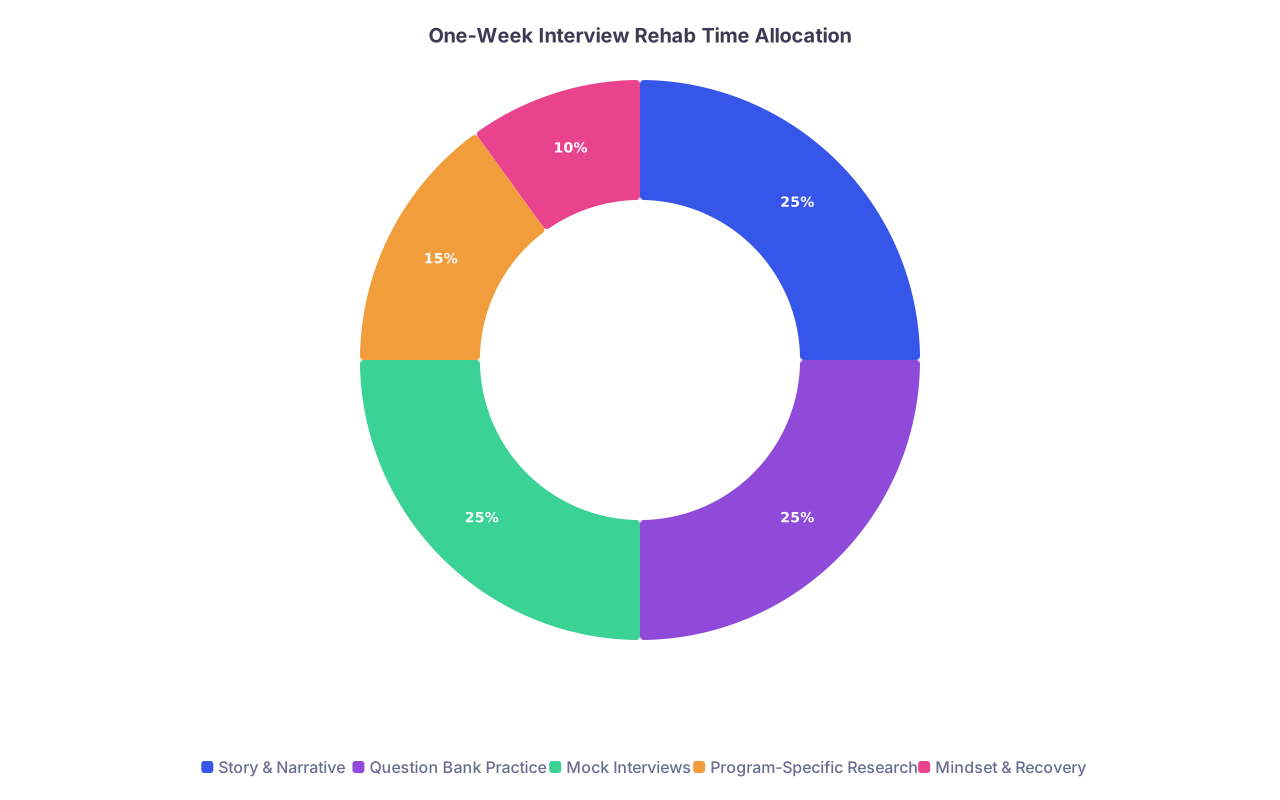
| Category | Value |
|---|---|
| Story & Narrative | 25 |
| Question Bank Practice | 25 |
| Mock Interviews | 25 |
| Program-Specific Research | 15 |
| Mindset & Recovery | 10 |
Overall daily blocks (minimums)
- 60–90 minutes: story + “why this specialty/program” work
- 60 minutes: targeted question drills
- 30–45 minutes: mock or recorded self-interview
- 15–30 minutes: program research + tailoring
- 15 minutes: mental reset (walk, quick workout, breathing)
You are temporarily in “interview boot camp.” One focused week here is worth months of random podcast/listening “prep.”
Step 2: Fix the Core Narrative Problem
If your overall story is mushy, every answer will feel scattered. Programs are listening for a coherent narrative:
Who are you, how did you get here, what do you want, and why should we invest in you?
1. Define your “three pillars”
Pick 3 themes that define you as an applicant. Not 10. Three.
Common examples:
- “Evidence-driven, team-oriented, great with complex patients”
- “Procedurally inclined, calm in chaos, strong teacher”
- “Systems thinker, quality improvement focused, strong communicator”
Write them down:
- Pillar 1: ____________________
- Pillar 2: ____________________
- Pillar 3: ____________________
Every major answer during the interview should highlight one or more of these pillars, with an example.
2. Write a 60-second “who I am” script
This is the backbone of:
- “Tell me about yourself”
- “Walk me through your journey”
- “How did you end up choosing [specialty]?”
Structure (keep it under 60–75 seconds spoken):
- 1 sentence: Where you are now (MS4 at X, prelim at Y, etc.)
- 2–3 sentences: The path – key turning points, not your entire CV
- 2 sentences: Why this specialty (with 1 concrete clinical moment or rotation)
- 1 sentence: What you are looking for in a program / what you bring
Draft it. Then speak it out loud. You will hate it at first. Revise until you can say it without sounding like a robot or an Instagram bio.
Step 3: Install Answer Structure (So You Stop Rambling)
Rambling is the number one interview killer I see, and it is fixable in 48 hours if you commit to structure.
You do not need 10 frameworks. You need two.
1. Use STARR for behavioral and experience questions
Behavioral questions:
- “Tell me about a time you had conflict with a colleague.”
- “Describe a time you made a mistake.”
- “Give an example of leadership.”
Use STARR:
- Situation – brief context
- Task – what your role/responsibility was
- Action – what you did (3–4 steps, concrete)
- Result – what happened (numbers, outcomes, feedback)
- Reflection – what you learned and how you changed
Practice compressing the S + T into 1–2 sentences. Most applicants waste time there.
Example (compressed):
“On my IM sub-I, a nurse and I disagreed about discharging a patient who was still hypoxic on exertion. As the acting intern, my job was to clarify the plan and make sure it was safe.”
That is S + T. Then jump to A, R, Reflection.
2. Use Point–Reason–Example–Tie-back (PRET) for opinion/fit questions
For:
- “Why our program?”
- “What are your strengths?”
- “Where do you see yourself in 5–10 years?”
Use PRET:
- Point – one clear sentence answering the question
- Reason – why you believe that / why it matters
- Example – one brief, specific illustration
- Tie-back – connect to residency / their program / future
Example: “What is a strength you bring?”
- Point: “One of my biggest strengths is that I stay calm and organized when things are chaotic.”
- Reason: “I have always gravitated to high-acuity settings, and I like bringing structure when others are overwhelmed.”
- Example: “On my trauma surgery rotation, we had a multi-car MVC with four simultaneous activations… [brief concrete description] … I took the initiative to track labs, imaging, and to-do items for two of the patients so the resident could focus on procedures.”
- Tie-back: “In residency, that same approach will help me manage busy call shifts safely and support my team.”
Write 3–5 PRET answers tonight:
- Why this specialty?
- Why this program (generic version)?
- Biggest strength?
- Biggest weakness?
- Long-term career goals?
Then practice speaking them, not reading them.
Step 4: Build a Brutally Focused Question Bank
You do not have time this week to prepare for 200 different questions. You do not need to.
Most residency interviews pull from the same 30–40 core questions with slight variations. You must be fluent in those.
1. Core question set (non-negotiable)
Write out answers (bullets, not paragraphs) for at least these:
Story & motivation
- Tell me about yourself.
- Why this specialty?
- Why our program / what are you looking for in a program?
- How did you decide on medicine?
Strengths / weaknesses
- What are your three biggest strengths?
- What is your biggest weakness? (Pick a real one, with a growth story.)
- How would your attendings describe you?
Behavioral
- Tell me about a conflict with a nurse / resident / attending.
- Tell me about a time you made a clinical mistake.
- Tell me about a time you received difficult feedback.
- Tell me about a time you were overwhelmed and what you did.
- Tell me about a time you advocated for a patient.
Red flags / sensitive topics (if applicable)
- Can you explain this gap in your training?
- Can you walk me through your Step failures?
- Why did you switch specialties / reapply?
If you have a red flag and you hope they “do not ask,” that is magical thinking. They will. Prepare.
2. Create “answer maps,” not scripts
For each question, you want:
- 1–2 key points you must hit
- The example story you will use (labeled with STARR if behavioral)
- The tie-back to your pillars / fit for residency
Example: “Tell me about a time you made a mistake.”
- Key point 1: Own responsibility clearly, no blame-shifting.
- Key point 2: Show active learning and a specific system you changed.
- Example: Missed dose reconciliation on admission → medication omission → near-miss → debrief with attending → personal checklist / system change.
- Tie-back: Emphasis on patient safety, openness to feedback, not defensive.
When you practice, speak from the map, not a memorized paragraph. That is how you sound natural and still be precise.
Step 5: Run Daily Mock Interviews Under Real Conditions
Reading questions is not practice. Talking in your head is not practice. You need reps with:
- A camera
- A person staring at you (or at least your own recorded video)
- Time pressure
1. Daily 20–30 minute mock schedule
For the next 7 days:
- Pick 6–8 questions (mix storytelling, behavioral, strengths/weaknesses, and one tough one).
- Set up:
- Laptop camera at eye level
- Professional-ish background
- What you will actually wear (especially if you had a sloppy or distracting appearance last time)
- Record yourself answering them in one continuous take.
Use a timer:
- 1–2 minutes max per answer
- If you hit 3 minutes, you are rambling. Period.
2. Review with a critical checklist
Watch the recording. Yes, it is painful. Do it anyway.
Score yourself 1–5 (5 = strong) on:
- Clarity: Did I actually answer the question? Or dodge it?
- Structure: Did my answer have a beginning, middle, end? STARR/PRET?
- Conciseness: Did I hit the point within 30 seconds?
- Specificity: Did I use concrete examples instead of vague platitudes?
- Presence: Eye contact with camera, posture, facial expression, energy
You will immediately see patterns: maybe your eyes drift, you say “umm” every 2 seconds, or you never give a clear final sentence.
Fix one thing per day. Not ten. For example:
- Day 1: Cut filler words by 50% (pause instead of “umm”).
- Day 2: End every answer with a clean, one-sentence summary.
- Day 3: Keep every behavioral answer under 2 minutes.
3. At least two live mocks with a human
By the end of the week, you want:
- 1 mock with a peer or co-resident
- 1 mock with someone senior (resident / fellow / attending / advisor)
Give them:
- Your CV and personal statement
- List of programs you are interviewing at
- Permission: “I want you to be tough. Please do not be nice to spare my feelings.”
Ask them three questions afterwards:
- “Would you want me as a co-resident based on that?”
- “What about me made you hesitate?”
- “What specific answer made you lose some confidence in me?”
If you are not slightly uncomfortable with the feedback, they either held back or you are already strong. If it is the latter, great—you are just refining.
Step 6: Patch the Most Common Failure Modes
Let me be specific about the usual train wrecks and how to fix each fast.
1. Rambling and word salads
Symptoms:
- Answers drift into 3–4 minutes
- You see interviewers looking at the clock or at their notes
- You keep adding “one more thing” at the end
Fix protocol:
- Write a 1–2 sentence “headline” answer for each major question.
- Practice starting with that headline. Always.
- “My biggest strength is X. The reason I say that is Y.”
- “The main reason I chose internal medicine is that I like A and B.”
- Use your phone timer while practicing. Cut yourself off at 2 minutes. Force yourself to pick the most important details.
2. Generic, forgettable answers
Symptoms:
- You say things like “I just love helping people” or “I am a team player.”
- You could swap your name with any other applicant’s and nothing changes.
Fix protocol:
- Ban empty words in your prep: “passionate,” “nice,” “team player,” “hard-working” — unless they are followed by a specific example.
- For every strength/trait, attach one concrete, named story:
- The SICU night you stayed two hours late to help a co-intern stabilize a crashing patient.
- The QI project that reduced ED boarding by X%.
- The med student teaching session that got you actual feedback comments.
If you cannot back a trait with a story, you do not get to use that trait in an interview.
3. Defensive or awkward around weaknesses
Symptoms:
- You insist your “weakness” is actually a strength.
- You over-explain failures or blame systems / other people.
Fix protocol (for “biggest weakness”):
- Pick something real but non-fatal for residency, such as:
- Trouble asking for help early.
- Tendency to over-prepare and get bogged down in details.
- Difficulty speaking up around strong personalities.
- Use this structure:
- Name it plainly.
- Brief example of when it showed up.
- Specific steps you have taken to work on it.
- Concrete change you have seen.
Example:
“I used to delay asking for help longer than I should have, especially early in third year, because I did not want to look incompetent. On my surgery rotation, I once tried to manage a post-op patient’s pain and fluids on my own for too long before calling my senior, and it slowed down the right intervention. Since then, I have adopted a much clearer threshold for escalating—anytime vitals are trending the wrong way or I am considering a second IV bolus, I call. My seniors have actually commented that I now err on the side of appropriate caution, which is exactly what I want in residency.”
That is believable and reassuring.
Step 7: Tighten Program‑Specific Fit (So You Stop Sounding Copy‑Pasted)
Programs can tell in 10 seconds if you have done real homework or you came in with generic fluff.
You do not have to memorize the entire website. But you must be able to answer:
- “Why our program?”
- “What types of programs are you looking for?”
- “How would you see yourself fitting here?”
1. Create a one-page “program fit sheet” for each place
For each upcoming interview, write:
- 3 specific things you like about them:
- A unique rotation (rural track, VA emphasis, global health)
- A known culture point (strong mentorship, wellness not as a punchline)
- Research / QI focus that matches your interests
- 1–2 residents or faculty you looked up (by name)
- How this program intersects with your three pillars
Use their own language sparingly. Do not parrot the mission statement line by line; pick what genuinely matches you.
2. Craft a 30‑second “why this program” answer
Structure:
- Start generic but true: “I am looking for X and Y, which your program clearly offers.”
- Then go specific: “For example, your [trauma-heavy county rotation / advocacy curriculum / global health track] aligns with my experience in…”
- Tie-back: “That is exactly the environment where I think I will grow into the kind of [specialist] I want to be.”
Practice this with each program’s specifics. Written in bullets, then spoken from memory.
Step 8: Fix Your Nonverbal and Energy Problem
If your feedback suggests “low energy,” “flat,” or “unsure,” you cannot ignore it. Programs are trying to imagine you on 2 a.m. cross-cover.
1. On‑camera presence tweaks
Quick wins:
- Raise the camera to eye level. No “looking down at your laptop.”
- Sit up. Do not lean back like you are watching Netflix.
- Use a slight, natural smile as your default expression when listening.
- Nod briefly when the interviewer speaks. Show you are engaged.
Watch one of your recorded mocks with the sound off. Ask: “Would I believe this person is interested and awake?”
2. Voice and pacing
- Speak 10–15% slower than normal. Anxiety makes you speed up.
- End sentences cleanly. Do not trail off.
- Use short pauses instead of filler words.
- Vary your tone. If everything sounds identical, you sound bored.
You do not need to become a TED speaker. You just need to sound like a competent colleague who cares.
Step 9: Manage Mindset and Recovery (So You Do Not Choke Again)
One bad interview often poisons the next ones. You walk in carrying that failure like a lead vest.
You must consciously reset.
1. Reframe the “bad” interview
Write down:
- 3 specific things you did poorly (structural, not emotional)
- 1–2 things you actually did well
Then write one sentence:
“That interview was my wake-up call about ______, and I am now fixing it by ______.”
This is not therapy. It is mental housekeeping so you stop ruminating and start executing.
2. Pre-interview routine
For each upcoming interview, create a 20-minute pre-game:
- 5 minutes: Review your three pillars and core stories.
- 5 minutes: Skim your program fit sheet.
- 5 minutes: Stand up, stretch, and do 1–2 minutes of controlled breathing (e.g., 4 seconds in, 6 out).
- 5 minutes: Power posture, light walk, glass of water, final tech check.
You want your body to associate this routine with “I am ready,” not “I am panicking.”
Step 10: If You Think You Already Crashed the Entire Season
Sometimes the damage is already done:
- Multiple bad interviews.
- You realized too late that your performance was consistently weak.
Do not lie to yourself. But also do not catastrophize blindly.
1. Triage your current season
Look at:
- How many interviews you have completed
- How many you have left
- Where your weak performance was most obvious
If you have even 2–3 interviews left, this one-week rehab is still absolutely worth it. One or two strong interviews at the right programs can change everything.
2. Plan for worst‑case now, not in March
If you are very late in the season and suspect you underperformed broadly:
- Start:
- Strengthening your backup plans (prelim, transitional, SOAP strategy)
- Gathering honest feedback for next cycle, if needed
- Keep:
- Doing the rehab anyway. Skills you build now carry over to:
- SOAP calls
- Next application cycle
- Job interviews for the rest of your career
- Doing the rehab anyway. Skills you build now carry over to:
It is not defeatist to plan contingencies. It is smart.
Your One Concrete Assignment for Today
Do not bookmark this and move on. Do one high‑impact action before you sleep:
- Open a blank document.
- Write out:
- Your three pillars.
- A 60‑second “tell me about yourself” using the structure above.
- Bullet outlines (not scripts) for:
- “Why this specialty?”
- “Why our program?” (generic version)
- “Biggest strength”
- “Biggest weakness”
- Then set up your phone or laptop and record yourself answering just two questions:
- “Tell me about yourself.”
- “Why this specialty?”
Watch it once, score yourself 1–5 on clarity, structure, and energy, and write down one thing you will fix tomorrow.
That is how the rehab starts. Not by thinking about “being better,” but by seeing the problem clearly and doing one deliberate rep to fix it.