
It is 11:47 p.m. a week before ERAS submission.
You have 78 internal medicine programs in your cart. Or 14. You are not sure which is worse.
Your friends are tossing out numbers like “I did 120 IM programs and still stressed” and “I only applied to 30, it’s fine if your letters are good.” Reddit is a mess. Your dean’s office gave you a range so wide it might as well be a horoscope.
Here is what you are actually worried about:
- Did I overapply and waste thousands of dollars on programs that will never interview me?
- Or did I underapply and quietly sabotage my Match?
- Do I still have time to fix this list without blowing up my entire strategy?
Yes, you do. Let’s fix it properly.
1. First, Diagnose Your Situation (Over vs Under)
You cannot fix your list until you call the problem by its name. Overapplied and underapplied look different on paper.
Quick reality check: Numbers and context
Use this as a starting reference, not a rigid rule. These are typical ranges for a U.S. MD applicant with roughly average stats for the specialty.
| Specialty | Rough 'Normal' Range |
|---|---|
| Internal Medicine | 35–60 programs |
| Family Medicine | 20–40 programs |
| Pediatrics | 25–45 programs |
| Psychiatry | 30–50 programs |
| General Surgery | 40–70 programs |
| EM (post-merge) | 30–60 programs |
| OB/GYN | 40–70 programs |
You push higher if:
- You are DO/IMG in a competitive specialty
- You have significant red flags (fails, leaves, year off without strong justification)
- You are very geographically restricted (e.g., partner’s job, visa, family obligations)
You push lower if:
- You are very strong for the specialty (top board scores or strong research, AOA, home program)
- You are flexible on geography and program type
- You have strong mentorship and targeted list-building
Signs you are overapplied
You are probably overapplied if:
- You applied to:
80–100 programs in a core specialty (IM, FM, peds, psych)
100–120+ in a surgical or more competitive specialty
- You have dozens of programs on your list that:
- You cannot even describe why you picked
- You would feel “miserable but matched” at
- You added because “everyone says apply to 100+”
- Your budget is imploding
- You cannot comfortably afford the application + potential interview travel/housing (even for virtual, you may pay for away rotations, equipment, etc.)
- You have not filtered by:
- Step/COMLEX cutoffs
- Visa status requirements
- DO/IMG friendliness
- Region you actually can live in
Overapplied = high volume, low targeting.
Signs you are underapplied
You are probably underapplied if:
- You applied to:
- <25 IM/FM/peds/psych programs (unless you are an absolute standout at a strong home program)
- <35–40 surgery/OB/EM/anesthesia/rads programs if you are middle-of-the-pack
- Your list is:
- Mostly “reach” or “dream” programs, very few true safeties
- Concentrated in 1–2 cities/regions because “I really want to be here”
- Missing community or lower-tier academic programs
- You have risk factors and did not adjust numbers:
- Below-average scores for the specialty
- No home program
- No research in research-heavy fields (derm, rads, rad onc, neurosurg, ENT, etc.)
- DO/IMG without clearly DO/IMG-friendly programs on the list
Underapplied = too much optimism, not enough volume.
When you can be both at once
Yes, this happens constantly.
- 90 programs total
- 60 are dream or mid-to-high tier academic
- 10 are community but still competitive cities
- 20 are “I found them on a list and clicked”
- And almost no genuine safety programs that actually take people like you regularly.
This is the classic mistake: overapplied in cost, underapplied in probability.
2. Establish Your Personal Target Range (Realistically)
Forget what people throw around in group chats. You need a personalized range.
Step 1: Put yourself into a risk category
Be blunt. I am going to be.
Lower-risk applicant (for a given specialty) if most are true:
- US MD from a mid-to-strong school
- Scores at or above median for matched applicants in that specialty
- No fails, no major professionalism flags
- Strong home program in specialty with clear support
- Reasonable geographic flexibility
- Good clinical evals and at least “solid” letters
Moderate-risk applicant if:
- Scores are near the lower third of matched applicants
- You are DO/IMG in a moderately competitive field
- You have no home program in that specialty
- You are somewhat geographically restricted
- Some minor concerns: late switch of specialty, weak research where it actually matters
Higher-risk applicant if:
- Step 1 or 2 fail; multiple exam attempts
- Significant course/clerkship failures or leaves without a strong rehabilitated narrative
- DO/IMG in competitive or medium-competitive specialty
- Very narrow geographic window or visa complications
- Weak letters or faculty support
Step 2: Use a simple target formula
For most core specialties (IM, FM, peds, psych):
- Lower-risk:
- 30–45 programs
- Moderate-risk:
- 45–70 programs
- Higher-risk:
- 70–100 programs
For more competitive/general surgery / OB / EM / anesthesia / rads:
- Lower-risk:
- 40–60
- Moderate-risk:
- 60–90
- Higher-risk:
- 90–120
You then adjust for:
- Dual applying (if yes, each list can be smaller but total cost larger)
- Extreme geography limits (push the number up)
- Budget constraints (you may need to narrow and target smarter)
The point: pick a number range and stick to it. Your job now is reshaping the programs inside that number, not chasing Reddit ranges.
3. Triage Your Current List: Keep, Cut, Add
Now we get to the surgery.
You have a list that is too big, too small, or badly composed. Time to restructure it like an actual strategy, not a panic spreadsheet.
Step 1: Label every program A / B / C
Go line by line.
A = Strong Fit / Target or Safety
- You meet or exceed their typical matched stats
- They routinely take applicants like you (US MD/DO/IMG, similar scores)
- You would genuinely be fine training there
- Geography is acceptable
- No obvious visa or Step cutoff mismatch
B = Reach but Possible
- Programs maybe 10–20 points above your Step 2 median or with more selective reputation
- They occasionally take applicants like you, but not often
- You are willing to go there, but you know it is an uphill battle
C = Weak / Bad Fit
- You are clearly below their usual stats, with no compelling offset
- They almost never take DO/IMG and you are DO/IMG
- Geography you do not want and you have no compelling reason to be there
- You added it just because your advisor said “add more”
- Or you literally do not remember why it is on your list
Do not overthink. Your gut plus a quick check on program websites and match data is enough.
You should end up with something like:
- A: 30 programs
- B: 40 programs
- C: 25 programs
Step 2: Check A/B/C balance
Here is the problem pattern I see constantly:
- A (true targets/safeties): 15
- B (reaches): 65
- C (randoms): 30
That is a set-up for disappointment. 90+ programs and still underapplied in a meaningful way.
A functional distribution for a single specialty:
- Roughly 40–60% A programs
- 30–50% B programs
- C programs should be:
- 0 if you are trying to be cost-efficient
- At most 10–15% if you are just curious about a few “lottery tickets”
So if your target total is 60 programs:
- Aim for:
- A: 25–35
- B: 20–30
- C: 0–5 (max)
Programs that are C and not clearly a lottery dream? Cut them.
4. How to Cut Smartly (If You Overapplied)
If your total > your target range, you need to prune.
This is where people freeze because they are terrified they will cut the one program that “would have” interviewed them. Let me be direct: if you have 110 programs and cut 25 low-yield ones, you did not sabotage yourself. You just saved money.
Step 1: Automatic cuts
Remove any program that:
- Does not sponsor your visa (if applicable)
- States a strict Step/COMLEX cutoff above your score
- Historically never takes DO/IMG and you are DO/IMG
- Lists explicit requirements you do not meet:
- Graduation within 3–5 years and you are older than that
- Specific number of US clinical months when you do not have them
Do not argue with program websites. If they say no, believe them.
Step 2: Geographic honesty
Ask three questions per program:
- Could I actually live here for 3–7 years without being miserable or financially wrecked?
- Do I have any connection or reason (family, partner, previous training, realistic interest) to explain my presence here in a personal statement or interview?
- If this were my only match, would I feel okay—or devastated?
If the honest answer to the last one is “I would be devastated,” that program should not be on your list. Being “grateful to match anywhere” is something people say, not how they feel at 2 a.m. in PGY-2 with no support.
Cut places that are both:
- Low desirability for you
- Low probability of interviewing you
Step 3: Adjust for yield
Programs vary by how many applications they receive and how selective they are. A few signals of lower yield for you:
- Very “name brand” academic centers in saturated cities (Boston, NYC, SF, LA, Chicago)
- Programs with strong fellowships / research institutes when you have minimal research
- Programs that heavily recruit from their own med school or region only
The trick is not to cut all of them. Just put them in perspective.
If your list has:
- 30+ such heavy-competition B programs and you are borderline or below their usual ranges
- Trim 5–10 of the least realistic or least desirable ones (no regional ties, no research, etc.)
Step 4: Forced budget cut technique
If your ERAS cart total is giving you palpitations, use a forced cut:
- Decide on a maximum number you are willing to pay for
- Example: “I will not exceed 70 programs in IM.”
- Rank your current programs by:
- A vs B vs C
- Personal desirability
- Fit/probability
- Start from the bottom and delete until you hit your target number.
Do not re-add them an hour later. That is how you end up at 110 again.
5. How to Safely Expand (If You Underapplied)
Now the other side. Too few programs or a list full of reaches.
Step 1: Confirm your risk level
If you are:
- Below specialty median scores
- DO/IMG in a U.S.-competitive field
- No home program / weak letters / red flags
Then fewer than:
- 40–50 core specialty programs
- 60–70 competitive/general surgery/OB/etc.
…is usually dangerous. Not suicidal. But dangerous.
Step 2: Hunt for realistic programs, not just more programs
You are not just adding volume. You are adding probability. Here is how:
Use FREIDA, program websites, and NRMP data to identify:
- DO-acceptance rates
- IMG match history
- Average Step scores if published
- Class composition (look at resident photos and bios)
Prioritize:
- Community programs and smaller academic centers
- Programs in less saturated regions:
- Midwest outside major metros
- South outside of Atlanta/Houston/Miami
- Smaller cities that less people are “dreaming” of
- Programs that explicitly state:
- They consider DO/IMG
- They do holistic review
- They do not have strict Step cutoffs
Ask around:
- Talk to recent grads from your school who matched as DO/IMG or with similar scores
- Ask: “Which 5–10 programs felt most ‘realistic’ and responsive for you?”
- Those names matter more than random Reddit lists.
Step 3: Make sure you are not just adding more reaches
If you are underapplied and your “fix” is:
- Adding 10 more dream-city academic programs in NYC and LA
…you solved nothing.
For every 1 new “reach” you add, add at least 2 true targets/safeties where residents look like you on paper.
6. Fixing the Mix: Academic vs Community, Region, and Tier
Even if your total number is okay, the composition can quietly sink you.
Academic vs community distribution
Reality: many applicants overstuff their lists with big-name academic programs and forget community hospitals exist.
For most IM/FM/peds/psych applicants:
- If you want academic fellowships later:
- A mix of academic & strong community is fine
- Fellowship is still possible from good community programs
A reasonable balance:
- 30–50% academic
- 50–70% community / smaller academic-affiliated
If you are struggling with interviews, it is usually not because you “had too many community programs.”
Region spread
You do not need to apply in all 50 states, but you do need some diversification unless you have a powerful reason not to.
Quick rule:
- At least 3–4 regions or multi-state areas unless:
- You have a spouse/partner locked to a city
- You have major family caregiving duties
If your list is:
- 80% Northeast big cities + 20% “I guess I’ll add these two random Midwest programs”
You are still regionally underapplied.
Spread looks more like:
- Northeast: 30%
- Midwest: 25%
- South: 25%
- West: 20%
Adjust for where you actually can see yourself, but you get the idea.
7. A Concrete 24-Hour Fix Protocol
You are close to the deadline. You do not have a week for this. Here is what you do today.

| Step | Description |
|---|---|
| Step 1 | Export current program list |
| Step 2 | Label A/B/C |
| Step 3 | Cut C programs & low-fit B |
| Step 4 | Add realistic A/B programs |
| Step 5 | Check academic vs community mix |
| Step 6 | Check geography & visa/cutoffs |
| Step 7 | Lock final list & stop editing |
| Step 8 | Total within target range? |
Step-by-step
Step 1: Export current list (30–45 minutes)
- Pull your programs into a spreadsheet.
- Columns: Name, City/State, Type (academic/community), A/B/C, Notes, Cutoff/visa, Preference 1–5.
Step 2: Label A/B/C (1–2 hours)
- Skim each program website:
- Look at current residents, requirements, location.
- Mark:
- A: good fit, realistic, acceptable place to live
- B: reach but plausible
- C: questionable or low desire or low probability
Step 3: Compare to your target range (15 minutes)
- Example: You are a moderate-risk IM applicant, goal = 60–70 programs.
- Current: 95 programs (A: 25, B: 40, C: 30).
- You need to remove ~25–30, and probably turn some B into A by adding better fits.
Step 4: Cut C programs first (1 hour)
- Remove any C programs that:
- Mismatch with your stats/visa
- Are in locations you truly do not want
- Have no track record with your profile
Step 5: Trim low-yield B programs (1 hour)
- Rank B programs by:
- Your genuine interest
- Probability (look at residents, cutoffs, etc.)
- Cut the bottom chunk until you hit your target total.
Step 6: If under target, add smart A/B programs (1–2 hours)
- Use FREIDA/NRMP/word-of-mouth to find:
- Community-heavy, DO/IMG-friendly, or less-saturated geographic areas.
- Add in batches of 5–10, focusing on realistic fit.
Step 7: Final sanity checks (30 minutes)
Create a quick summary view:
| Category | Count |
|---|---|
| Total Programs | 65 |
| A Programs | 32 |
| B Programs | 28 |
| C Programs | 5 |
Ask yourself:
- Do I have enough A-level programs to feel secure?
- Do I have some geographic spread?
- Are my C programs truly “lottery tickets” I am okay paying for?
If yes, lock it. Stop refreshing Reddit.
8. Cost, Sanity, and When to Stop Editing
One more piece everyone pretends is secondary but actually controls their life: money and stress.
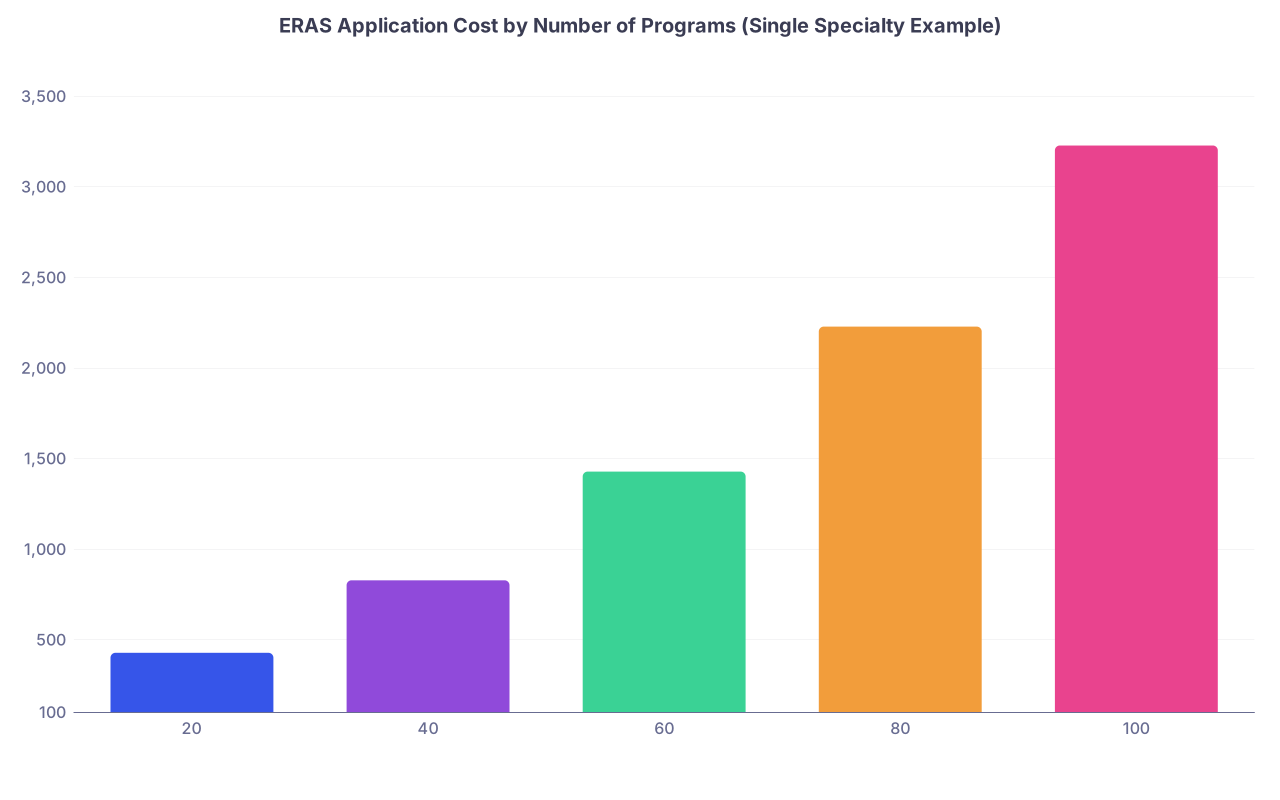
| Category | Value |
|---|---|
| 20 | 427 |
| 40 | 827 |
| 60 | 1427 |
| 80 | 2227 |
| 100 | 3227 |
The difference between 60 and 100 programs is not theoretical. It is over a thousand dollars. Before interviews.
Set a hard limit
- A hard financial cap:
- “I will not exceed 70 programs total this year.”
- A hard emotional cap:
- “I will not let this list dominate every waking thought for the next week.”
When to not touch the list anymore
You stop editing when:
- Your total is inside your target range for your risk level
- Your A/B ratio makes sense (at least ~40% realistic A programs)
- You have:
- Removed obvious mismatches
- Fixed big geographic or tier imbalances
- Further changes are just swapping one mid-tier Northeast program for another
At that point you are not optimizing. You are just bleeding time and anxiety.
Lock the list. Focus on:
- Personal statements tailored to regions or program types
- Strong letters and communication with mentors
- Having your story straight for interviews
That is what moves the needle next.
9. Example Transformations (So You Can See It in Practice)
Two typical situations I see.
Case 1: Overapplied and under-targeted IM applicant
Initial:
- US MD, Step 2 = 230, no red flags, no home IM program
- 105 IM programs
- A: 20
- B: 40
- C: 45
- Huge concentration in Northeast and California
Fix:
- Target range: 60–70 programs
- Cuts:
- Remove 30 C programs with strict Step expectations and no DO/IMG history
- Remove 10 B programs in extremely competitive metros with no ties
- Adds:
- +5 A-level community programs in Midwest and South with residents from similar schools
Final:
- 65 programs
- A: 30
- B: 30
- C: 5 “dream lottery” places
Cost down. Odds up.
Case 2: Underapplied DO psych applicant
Initial:
- DO, decent clinical grades, Step 2 slightly below psych average
- 28 psych programs
- A: 8
- B: 18
- C: 2
- Almost all in the West Coast + NYC
Fix:
- Risk: moderate to high (DO, scores slightly low, psych tightening)
- Target: 55–70 programs
- Adds:
- +20 A-level programs in Midwest/South with clear DO presence
- +10 B-level community programs in mid-sized cities with IMG/DO representation
- +5 more in-state or near-state programs with ties
Final:
- ~63 programs
- A: 30
- B: 30
- C: 3
Now they have a real cushion.
10. Bottom Line
You are not trying to win “most applications sent.” You are trying to match once.
The key moves:
- Set a realistic target range based on your specialty and risk level, then force your list to fit it.
- Fix the composition, not just the count: enough A-level realistic programs, some B-level reaches, almost no trash C-level “why is this here” programs.
- Cut mismatches and add realistic fits systematically, then stop editing and redirect your energy to the parts of the application that still matter: statements, letters, and showing up well on interview day.