
Most residency applications are rejected before a human being ever reads a single word you wrote.
Let me be blunt: you’re imagining program directors poring over your personal statement with coffee in hand. That’s not what happens. The first cuts are made by cold, rigid filters—some explicit, some unofficial, some that even the residents at that program have no idea exist.
I’ve sat in those meetings. I’ve watched 4,000 applications shrink to 600 in under ten minutes. Nobody “holistically reviewed” those 3,400 people. The software did.
You want to avoid getting silently killed by those filters? Then you need to understand them the way coordinators and PDs actually use them—not the sanitized version you hear on webinars.
Let’s walk through the real filters that screen you out instantly, and how you stay on the right side of them.
The Myth of Holistic Review (And the Spreadsheet That Actually Decides)
Most programs will tell you they do “holistic review.” Fine. Some try. But here’s what really happens first:
The coordinator exports all the ERAS data into a spreadsheet or into their applicant tracking system. Then they start slicing.
They’ll have 2,000–6,000 applications for 10–30 spots. Nobody is reading 6,000 files in depth. So they build filters—some clicking checkboxes in software, some mentally.
A typical first-pass conversation between a PD and coordinator sounds like this:
“What are we doing for Step 1/2 this year?”
“Let’s start at 220 for Step 2, auto-drop anyone with more than 1 failure unless we know them.”
That’s the guillotine. No compassion. No context. Just filtered.
And the worst part? These filters are rarely published. The website still says “we consider all applications” while they’re literally excluding you with one click.
The Big Three: Scores, Attempts, and Timing
1. USMLE/COMLEX Score Cutoffs (That They Swear They Do Not Have)
Programs love to say, “We don’t have strict cutoffs.” Many of them are technically telling the truth—they have “guidelines,” not “cutoffs.” Functionally? It’s a cutoff.
Here’s what actually happens: they set a soft filter, see how many applicants remain, then adjust.
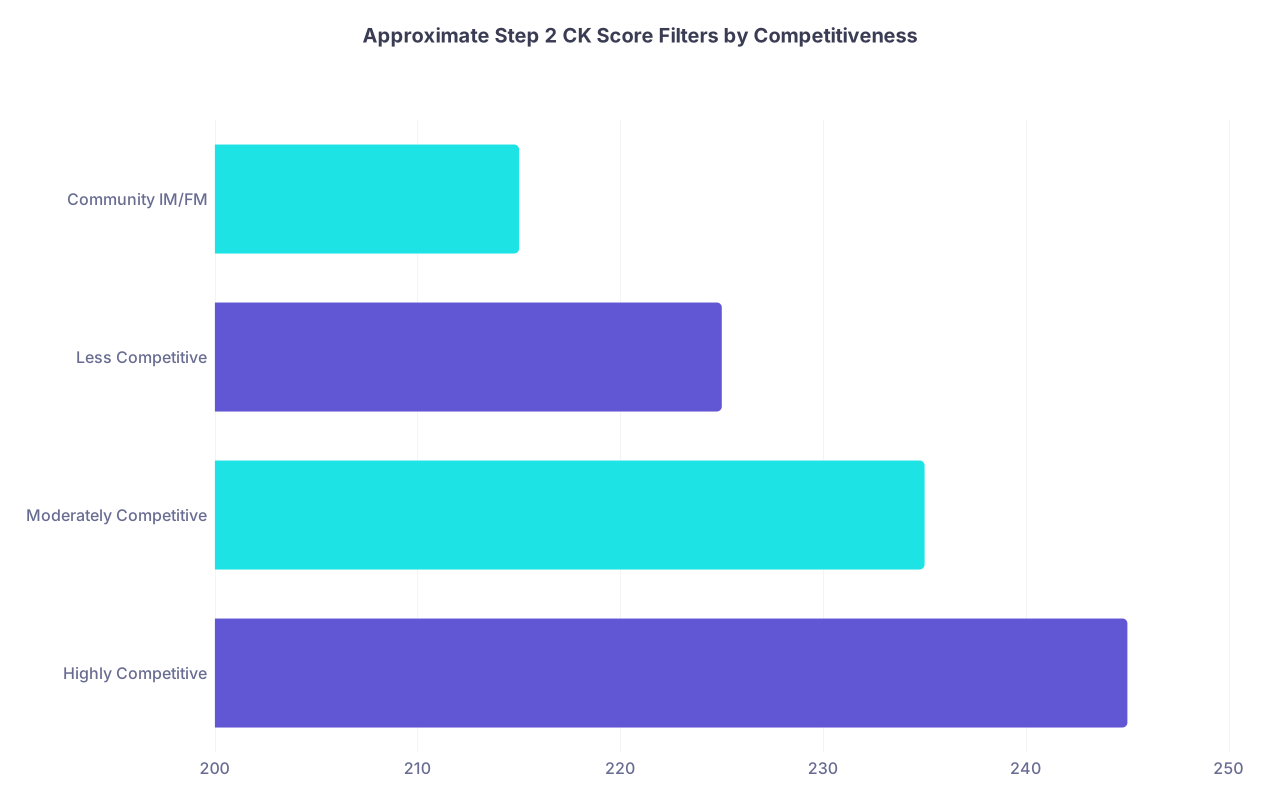
| Category | Value |
|---|---|
| Highly Competitive | 245 |
| Moderately Competitive | 235 |
| Less Competitive | 225 |
| Community IM/FM | 215 |
Those numbers are not magic. But they’re in the ballpark of what I’ve seen:
- Competitive academic IM, EM, Anesthesiology: many start filtering around 235–240+ for Step 2.
- Community IM, FM, Psych: 210–220+ is often the first rough range.
- Transitional year / prelim medicine: weird mix; some extremely high screens, some very forgiving.
What screens you out instantly:
- Step 2 below their quiet line when they’re drowning in applicants.
- COMLEX-only scores at programs that don’t want to wrestle with conversions.
- Huge score gaps (e.g., 190 on Step 1, 255 on Step 2) can trigger extra scrutiny; not always a kill, but flagged.
What helps you survive:
- Step 2 taken early with a solid score before apps are reviewed.
- If you’re DO, also taking USMLE Step 2 for programs that care but never say it publicly.
And yes, there are programs where the PD literally tells the coordinator: “Hide everyone under 220 unless they’re from our med school.” That’s why your advisor at a mid-tier MD school with a 215 might get 12 interviews while you, with the same score from a Caribbean school, get none.
2. Exam Failures and Attempts: The Quiet Red Line
Failed Step/COMLEX attempts are one of the most brutal silent filters.
Many programs don’t list it, but internally they have policies like:
- “No more than 1 USMLE failure total.”
- “No Step 2 failures.”
- “No failed CS/PE unless we know them.”
Here’s how it plays out practically:
The coordinator checks a box: “Filter: 0–1 attempts per Step exam.” The system wipes a chunk of you out. Nobody reads your beautiful explanation in the personal statement. Nobody cares that you were sick, caring for family, or misunderstood the exam format.
At a couple of places I know:
- A single Step 1 failure is an almost-automatic no for categorical surgery and ortho.
- A failed Step 2 is the real killer in IM, EM, and most fields now that Step 1 is pass/fail.
If you have a failure: You need to understand you’re already below the line at a lot of places. Your survival depends on:
- Applying more broadly.
- Heavy emphasis on your upward trajectory (strong Step 2, strong COMLEX Level 2).
- Direct contact/advocacy from faculty who know the PD.
But do not delude yourself that “strong letters and experiences” neutralize a failure everywhere. They do not. At many programs, nobody with a red F flag is opened at all.
3. Application Timing: The “Late = Dead” Reality
This one irritates students because they think everything is “fair” until the deadline. That’s not how programs operate.
Most competitive programs start reviewing as soon as ERAS opens for them. They fill their initial interview list early, then add from there. Late applications come in pre-labeled as: “Didn’t prioritize us.”
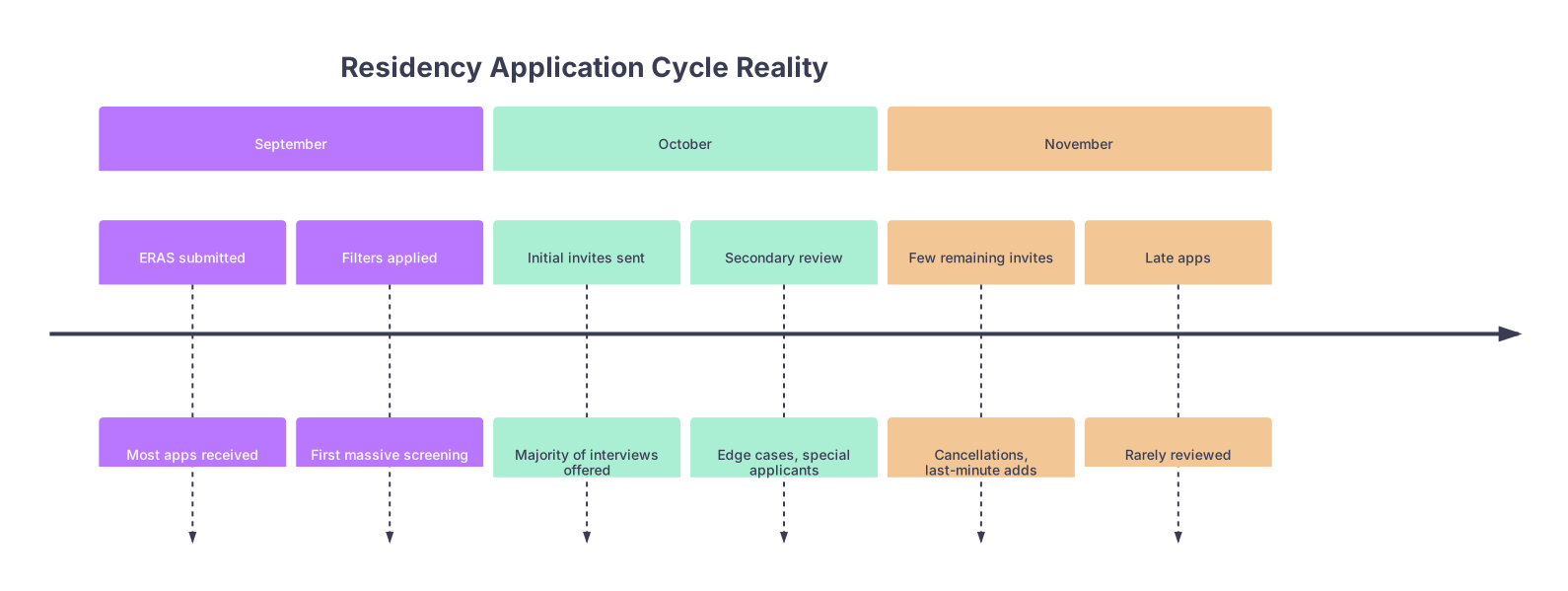
| Period | Event |
|---|---|
| September - ERAS submitted | Most apps received |
| September - Filters applied | First massive screening |
| October - Initial invites sent | Majority of interviews offered |
| October - Secondary review | Edge cases, special applicants |
| November - Few remaining invites | Cancellations, last-minute adds |
| November - Late apps | Rarely reviewed |
What screens you out instantly:
- Submitting late September or October to competitive programs.
- Taking Step 2 late so your score’s not in when they run initial filters.
- LORs that show up after they already finished first-pass review.
You need to assume this: if your application is not complete with Step 2 and core letters on day 1 or within that first week, you’re moving yourself into the second tier of consideration automatically.
The Hidden Institutional Filters Nobody Talks About
These are the ones you never see on websites, but they change everything.
4. School Type, Region, and “Fit Bias”
Programs absolutely use your medical school as a proxy:
- US MD from a known school: gets the benefit of the doubt.
- DO: varies widely; some programs treat DO and MD the same, others quietly de-prioritize.
- Caribbean/IMG: often auto-screened out except for specific, known schools or special connections.
Here’s how that looks behind the scenes:
“Can we filter for US grads first?”
“Yeah, let’s sort by ‘US MD/DO’ and review those, then we’ll see how many IMGs we can realistically consider.”
That single click just removed you from early review if you’re an IMG. By the time they get to IMGs, interview slots are scarce.
Region matters too:
- Northeast programs like seeing Northeast schools.
- Texas likes Texans (and the TMDSAS crowd).
- Programs in less “desirable” areas lean harder on local/regional applicants because they’re more likely to stay.
If you’re from outside their usual pattern and don’t explain your geographical interest clearly, you get silently passed.
5. Citizenship and Visa Status: The Unspoken Wall
Many programs do not want the administrative headache of visas. They won’t put that on their website because it looks bad, but internally they say:
“We’ll consider J-1 only.”
“No H-1Bs this year.”
“US citizens/green cards only.”
So what happens? The coordinator applies an “Include only U.S. citizen/perm resident” filter for the first pass. If they have plenty of applicants, they never even open the rest.
If you need visa sponsorship:
- You’re playing on hard mode.
- You must target programs that explicitly say they sponsor your visa type.
- Even then, you’re competing with domestic applicants and often reviewed later.
Do not waste 40 applications on programs that historically have zero or one IMG per decade and no clear visa history. That’s not strategy, that’s wishful thinking.
The “Sloppy Application” Filters That Kill You in Seconds
These aren’t just about being polished. They’re about reliability. PDs are paranoid about bringing in residents who are messy, careless, or dangerous.
6. Red-Flag Language and Professionalism Issues
Coordinators and PDs do quick scans for immediate red flags:
- Unexplained gaps longer than 6–12 months.
- Vague references to “personal issues” without clarity.
- Personal statements that sound bitter, arrogant, or unstable.
I’ve watched PDs read one sentence from a PS and instantly say, “No, not dealing with that drama.” You never get the chance to explain.
Common instant-kill professionalism flags:
- Using residency program names incorrectly (copy-paste fails).
- Referring to the wrong specialty (“I look forward to training in Internal Medicine” in your EM app).
- Obvious spelling errors in the first paragraph of your PS.
- Addressing the program as “Dear Sir or Madam” or similar formality robot nonsense.
You might think that’s petty. They think: “If this person is this careless with their future, what are they going to do with patient care and documentation?”
7. Incomplete or Inconsistent Data
ERAS is full of applicants who sabotage themselves with sloppiness.
A coordinator might quickly sort and filter by:
- Missing letters.
- Missing MSPE.
- Missing Step 2 when they require it before interview.
They click “show only complete files” when they’re overwhelmed. If yours isn’t complete at that moment, it never even lands on the PD’s screen.
Or they notice contradictory data:
- You list your grad date as 2021 in one place and 2022 in another.
- Your CV says you did a year of research; your experiences show four months.
- You contradict your own story in different sections.
To a PD, that’s either dishonesty or disorganization. Both are poison.
The Quiet Priorities: Who Gets Bumped Up the List
Not all filters are about exclusion. Some are about fast-tracking applicants they want.
Here’s the pecking order PDs often use when they’re flooded:
| Priority Tier | Typical Applicants |
|---|---|
| Tier 1 | Home students, rotators, strong faculty recommendations |
| Tier 2 | Regional schools, known “feeder” schools |
| Tier 3 | Other US MD/DO with solid scores |
| Tier 4 | Strong IMGs with connections |
| Tier 5 | All other applicants |
You will rarely see this written anywhere. But in conference rooms, I’ve seen PDs literally sort lists this way:
- “Show me our home students and rotators first.”
- “Next, let’s see applicants from X, Y, Z schools we trust.”
- “Now pull US MD/DO with Step 2 > 235.”
- “Ok, now let’s see IMGs with > 245 and no failures.”
Everyone else? They may or may not ever be opened.
So if you think your application exists in a vacuum, it does not. You’re being compared within priority groups you don’t even know you’re in.
How to Stay Out of the Filter Graveyard
You can’t hack your way around all of this, but you can drastically reduce your chance of instant death.
8. Build Your Strategy Around Real Filters, Not Fantasy
First, stop fighting the reality. You are not going to “explain your way” around:
- Three exam failures.
- Massive gaps with no documentation.
- Extremely low scores at hyper-competitive programs.
Instead, you:
- Target programs that have historically taken people like you (same exam profile, same school type, same visa).
- Apply early—complete, with scores and letters in.
- Shore up the things you can control in the months before applying, especially Step 2.
If your Step 1 was weak or pass/fail, Step 2 is your lifeline. Programs are using Step 2 as the new backbone filter. That’s not theoretical; I’ve watched PDs say, “Just sort by Step 2 and dump anyone below 230 for now.”
9. Clean, Consistent, Boringly Professional
You want your file to survive the 10-second glance without triggering anyone. That means:
- Zero typos in the first 3–4 lines of your personal statement.
- No weird, vague, or dramatic language about mental health, family issues, or injustice unless you’ve carefully anchored it and discussed it with someone who’s sat on a selection committee.
- Consistent dates and details across CV, experiences, and personal statement.
- Every required document in on day one if at all possible.
Look, nobody’s giving you an extra interview because your hobbies section is charming. But I have seen applicants lose interviews because they came off as unstable, abrasive, or careless in that section.
10. Use Connections Intelligently (This Is How People Actually Jump the Line)
There’s another quiet “filter” you never see in the software: the “email from someone I respect.”
- A chair they know.
- A faculty colleague from residency or fellowship.
- A trusted program director at another institution.
…suddenly your application gets pulled out of the mass and reviewed individually.
That means:
- If you’re an IMG or have red flags, you absolutely should be cultivating one or two strong advocates who are willing to email on your behalf.
- Away rotations matter not just for exposure, but because faculty there can put your name directly in front of a PD.
I once watched a PD say “We’re full on interviews,” then 30 seconds later add another slot for a candidate after getting an email from a trusted colleague: “This student is fantastic; please look at them.”
That’s not fair. It’s how the game is played.
Visual: Where Filters Knock People Out
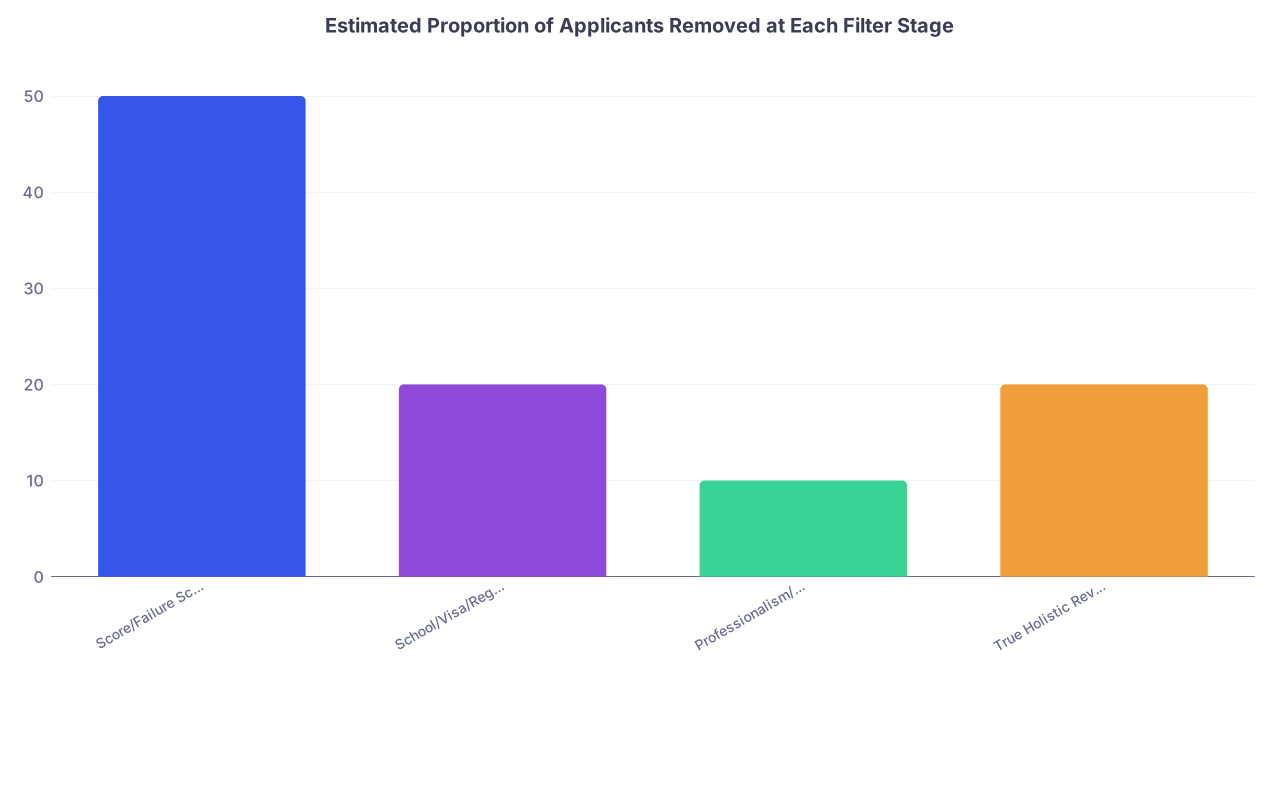
| Category | Value |
|---|---|
| Score/Failure Screen | 50 |
| School/Visa/Region | 20 |
| Professionalism/Completeness | 10 |
| True Holistic Review | 20 |
Roughly speaking (and this matches what I’ve seen across several programs):
- Around half of applicants die at score/failure filters.
- Another chunk disappears based on school, visa, and regional preference.
- A smaller group is tossed for professionalism/completeness.
- Only a minority ever get anything resembling “holistic” review.
You want to be in that last group before anyone has to work hard to like you.
A Quick Reality Check Flow
This is how decisions often feel inside a program, whether they admit it or not:

| Step | Description |
|---|---|
| Step 1 | All Applications |
| Step 2 | Auto Reject |
| Step 3 | Priority Tiering |
| Step 4 | Hold/Backup List |
| Step 5 | Offer Interview |
| Step 6 | Score Above Filter? |
| Step 7 | School/Visa Acceptable? |
| Step 8 | Complete & Professional? |
| Step 9 | Interview Slots Left? |
Most people are fighting at the very bottom of that pyramid, wondering why they were “unlucky.” The truth is they never got past B or C.
FAQs
1. If programs deny having score cutoffs, should I believe them?
Believe that individual faculty might try to be holistic. But operationally, most programs use some form of score screening because they’re drowning in applications. When they tell you, “We don’t have strict cutoffs,” they might mean, “We occasionally make exceptions.” Don’t take their public line as a guarantee your 205 will be read at a program where the average matched resident has a 245.
2. Can a strong Step 2 really compensate for a weak Step 1 or COMLEX Level 1?
Yes—up to a point. A big jump (e.g., 205 to 235) helps, because PDs love “upward trajectory.” But it doesn’t magically erase failures, major gaps, or a weak overall profile. It will pull you through more initial filters, especially now that Step 1 is pass/fail, but it doesn’t put you on equal footing with someone who has consistently strong scores and no red flags.
3. I submitted in late October. Am I automatically doomed?
Not automatically, but you’ve made your life much harder—especially at competitive programs. Many interview slots are already spoken for by then. Your best bets are:
- Community and less competitive programs.
- Places that historically send out later invites.
- Programs where you have direct connections who can flag your application for a second look.
4. How do I know which programs are likely to filter me out?
Look at hard data, not hope. Study each program’s:
- Recent residents’ backgrounds (US MD vs DO vs IMG, average scores if available).
- History of sponsoring visas.
- Previous match lists from schools similar to yours.
If your profile is way outside their norm, assume you’re getting cut at one of the early filters unless there’s a specific reason they should pull you up (a connection, a rotation, a direct email from a trusted faculty member).
Bottom line:
Most residency applications die in software filters, not faculty meetings.
Your scores, attempts, school, visa status, and timing decide if anyone ever really reads your file.
If you build your strategy around those actual filters instead of the PR version of “holistic review,” you stop being random collateral and start giving yourself a real shot.