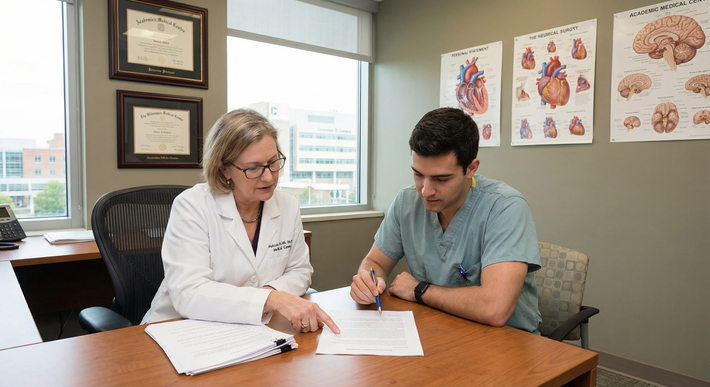
The biggest threat to your Match is not your Step score. It is you, on interview day, doing small stupid things you think do not matter. They do.
Program directors do not usually tank you for one catastrophic moment. They move you down quietly for a dozen micro-mistakes: tone, timing, how you treat people who “don’t count,” how you carry yourself when you think no one is watching.
You are being evaluated from the minute you step out of the Uber until you’re back in your hotel room venting to your co-applicants. That sounds paranoid. It is also true.
Let’s walk through the mistakes that quietly get you dropped down — or off — rank lists, and how to avoid becoming the cautionary story at the next faculty meeting.
Mistake #1: Treating Anyone as “Unimportant”
If you remember only one thing, make it this: every single person you interact with can influence your rank.
I’ve watched programs move applicants down because the coordinator said, “They were a little rude at check-in,” or because a resident said, “They barely spoke to the other applicants.”
The “Invisible” People You Ignore at Your Own Risk
- Program coordinator
- Admin staff at front desk
- Residents “just hanging out” at lunch
- Other applicants
- IT staff / AV support
- Shuttle or hotel staff connected with the program
The mistake is subtle: you’re polite enough, but you’re transactional. You only “turn it on” for attendings and the PD, then go flat with everyone else. That two-face behavior is obvious from the outside.
How it gets you dropped:
- Coordinator tells PD: “They showed up late, didn’t apologize, and were staring at their phone while I was giving instructions.”
- Residents report: “They were really intense with faculty but kind of cold and dismissive with us.”
- Other applicants mention in passing: “Weird vibe — they kept trying to one-up people.”
You don’t want your name to come up in those debriefs.
Avoid this mistake by:
- Greeting the coordinator like a human being, not a gatekeeper
- Learning and using people’s names if they’re wearing badges
- Putting your phone away when staff are talking to you
- Making basic small talk with other applicants instead of scanning for “who matters more”
If you have to choose between impressing one more attending or not being an ass to the admin who runs the program’s life, pick the admin.
Mistake #2: Looking Disengaged (Even for 30 Seconds)
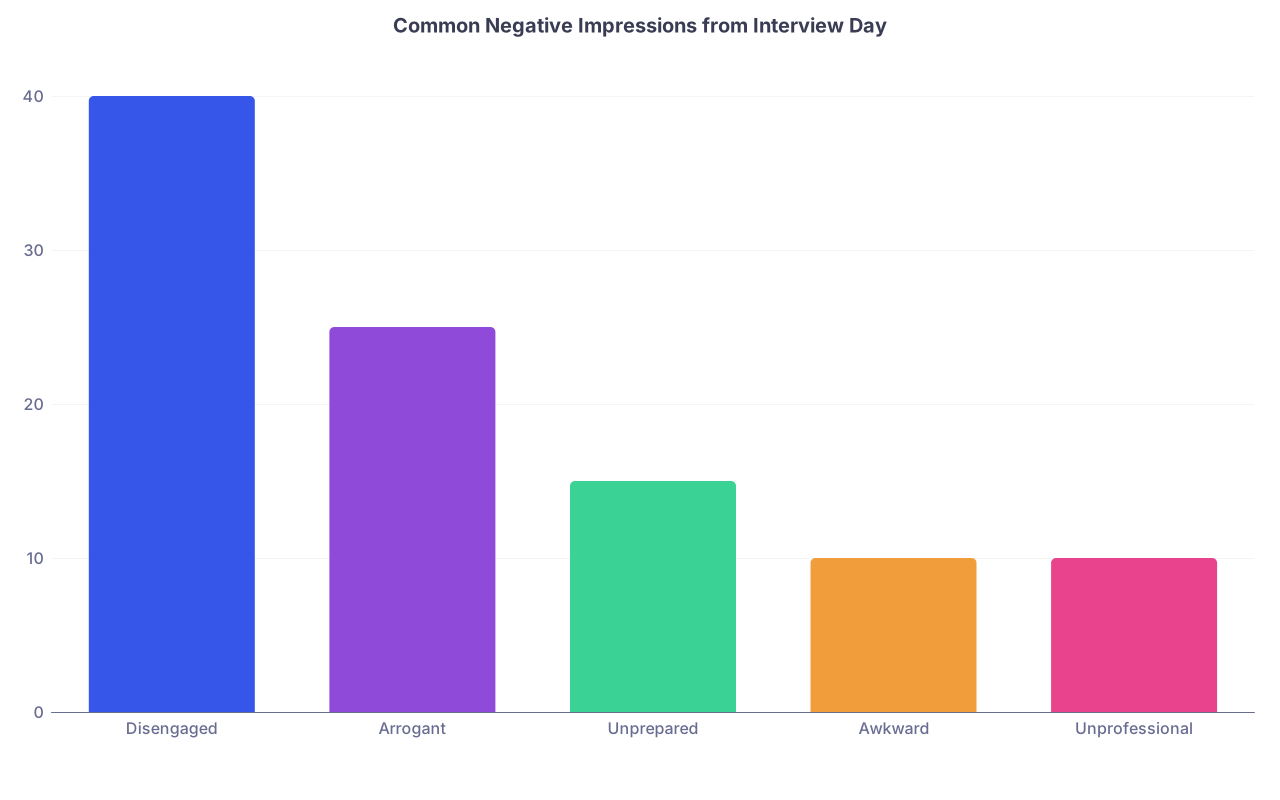
| Category | Value |
|---|---|
| Disengaged | 40 |
| Arrogant | 25 |
| Unprepared | 15 |
| Awkward | 10 |
| Unprofessional | 10 |
You might think, “I was just tired,” or “I just needed to check my email.” Interviewers don’t see your intention; they see your behavior in a 5–10 minute slice of time. And they generalize.
The biggest quiet killer: looking bored or disengaged during presentations, tours, or resident panels.
Behaviors that scream “I don’t really want to be here”:
- Checking your phone during any official session
- Looking at the floor instead of whoever’s speaking
- No follow-up questions, ever
- Slouched body posture with crossed arms
- Doodling constantly on the agenda or staring into space
You don’t need to be fake-hyper. But you must look like you care.
Specific scenarios I’ve seen backfire:
- Morning PowerPoint about curriculum — half the room is nodding; one applicant is clearly scrolling under the table. Guess who gets mentioned later as “seemed uninterested”?
- Resident Q&A — everyone else asks at least one question over 45 minutes; one applicant never engages, no nods, no comments, just blank. Comment at debrief: “Felt like they really didn’t want to be here.”
How to avoid looking disengaged when you’re exhausted:
- Keep your phone out of sight during any structured activity. Not face-down on the table — in your bag or pocket.
- Make deliberate eye contact with whomever is talking at least some of the time.
- Nod occasionally. Literally. Active listening matters.
- Ask at least 1–2 genuine questions throughout the day (you can prepare them in advance).
If you feel your face going dead from fatigue, mentally tell yourself: “This is two days for the next three to seven years of my life. Sit up.”
Mistake #3: Overcompensating Into Arrogance
Some applicants try so hard to appear confident they overshoot into arrogant, and they never see it coming.
Arrogance is rarely “I’m so amazing” said out loud. It’s usually more subtle:
- Interrupting faculty or residents mid-sentence
- Correcting minor details (“Actually, that guideline changed in 2022…”) to show you know more
- Dominating group conversations at lunch
- Talking about your CV in a way that’s basically a performance review
- Name-dropping every 90 seconds
Programs are allergic to people who will be toxic co-residents. Arrogance screams “future problem.” It is not a small ding. It can move you from top third to “do not rank” in one comment.
Red-flag phrases that come off badly, even if you mean well:
- “Honestly, I’ve been the top of my class everywhere I’ve gone…”
- “I basically ran that project; my attending just signed off.”
- “I don’t really struggle with time management; I’m just very efficient.”
- “I’d be bored in a low-acuity program.”
- “I’m looking for a place that matches my level of drive. I’ve found that can be hard.”
You may think you’re stating your drive. They hear: huge ego, low insight.
Better approach:
- Let your CV speak for itself unless directly asked
- Give credit to mentors and teammates when describing accomplishments
- When talking about your strengths, anchor them to patient care or team benefit, not self-glorification
If you’re not sure whether you sound arrogant, you probably already do. Dial it back by 20%.
Mistake #4: Turning the Social Events Into an Interview-Free Zone
The pre-interview dinner. The Zoom “resident social.” The breakfast chat before the day officially starts. You think: “This is just for me, no big deal.” Wrong.
These are evaluation goldmines.

Residents are not just “being nice.” Many programs explicitly ask them for rank input. And residents can be brutally honest.
Behaviors that get noticed at socials:
- Drinking too much (yes, still a thing, every year)
- Ignoring quiet applicants and only talking to senior residents or chiefs
- Complaining extensively about your current program, school, or home institution
- Fishing for rank list info (“So where do you guys rank people with 260+?”)
- Saying anything disparaging about other programs, regions, or patient populations
I’ve personally seen an applicant go from “solid” to “do not rank” because at dinner they got a little too comfortable and said, “Honestly, I don’t love working with psych patients; they’re just so draining.” That quote went straight to the PD.
How to handle socials without tanking yourself:
- Limit yourself to one drink, two max, and only if everyone else is drinking
- Talk to a variety of people — interns, seniors, co-applicants — not just whoever seems powerful
- Keep your complaints extremely mild and non-personal
- Avoid trash talk about other hospitals, cities, or patient populations, even if residents start it
The social is not a safe venting space. It is a filtered reality show audition. Act accordingly.
Mistake #5: Being Weird About Other Applicants
Programs do notice how you treat your “competition.” It’s actually one of the easiest ways to assess your baseline professionalism.
Common mistakes:
- Subtly one-upping (“Oh, you only applied to 12 programs? I did 45.”)
- Competitive humblebragging about scores or research
- Freezing out certain applicants (FMG, DO, older, etc.)
- Hogging the conversation in group settings, talking over others
- Making snide comments after someone leaves (“Did you see how nervous they were?”)
Even if no faculty member is physically present, residents often sit nearby. Coordinators overhear. There are ears everywhere.
Co-applicants will also talk. I’ve seen more than one comment in debrief meetings that started with, “One of the other interviewees told me X about Y, and it was not a good look.”
Better pattern:
- Be decently kind. You don’t have to be fake best friends.
- Ask people about their interests, not their board scores.
- If there’s an awkward pause, you don’t need to fill it with CV flexing.
You’re not just auditioning to be a resident; you’re auditioning to be someone’s co-resident. No one wants a shark in the workroom.
Mistake #6: Being Too Scripted — Or Too Unstructured
There are two equal and opposite disasters:
- The robot who memorized 40 sample answers and recites them.
- The rambler who clearly thought, “I’ll just be myself” and crashes into incoherence.
The Over-Scripted Applicant
You know this person. Perfect posture, perfect pauses, but every answer sounds like step-by-step notes from a YouTube video:
- “That’s a great question.” (every time)
- “I would say my three strengths are…”
- “I’m passionate about lifelong learning and teamwork.”
Faculty can smell pre-fabricated content from a mile away. It reads as inauthentic, and worse, rigid. Do you want a resident who can’t have a normal conversation?
The Under-Prepared Rambler
On the other side: the applicant who has obvious raw material but no structure.
They’re asked, “Tell me about a time you had a conflict on a team,” and 5 minutes later they’re still describing the rotation schedule before they ever hit the actual conflict.
This person looks disorganized. Poor insight. Poor time management. Not great for a job where your handoff note has to be concise and coherent at 6:45 a.m.
The sweet spot:
- You have 6–8 core stories (leadership, conflict, failure, growth, ethical tension, difficult patient, etc.)
- You know the main beats, not a script
- You answer with a rough structure (situation → what you did → what changed → what you learned)
- You sound like a human being, not a commercial
Practice out loud a handful of times. Then stop before you turn your personality into a monologue.
Mistake #7: Ignoring Basic Professional Signals
Some applicants think “professionalism” is how you look. Suit, tie, pressed shirt, done. It’s not. It’s also:
- Punctuality
- Communication
- Respect for boundaries
- Judgment about what’s appropriate

Here are things that actually get written down:
- Showing up barely on time, flustered, with no explanation
- Failing to respond to pre-interview emails promptly or missing forms
- Not reading the schedule and asking questions that were already clearly answered
- Being overly familiar in tone or humor (especially risky with older faculty)
- Dressing noticeably outside the norm (too casual, flashy, or revealing)
No one cares if your suit is navy or charcoal. They care if you show you can’t follow simple instructions in a low-stress setting.
Easy wins to avoid this category of mistake:
- Default to “business formal” unless the program explicitly says otherwise
- Build in a serious buffer to your arrival time (like 30–45 minutes early)
- Read every email from the program twice; handle every request within 24 hours
- Keep your humor dry and low-risk until you’ve calibrated the room
- Don’t complain about logistics to faculty or the PD; save that for your group chat
If you can’t manage your behavior for one day, they’re not going to trust you with a 28-hour call.
Mistake #8: Asking the Wrong Questions (or None)
“Any questions for us?” is not a throwaway closer. It’s an assessment: Did you think about this place at all, or are we just slot #17 out of 40?
Two ways to lose points here:
- Ask nothing. Shrug. “I think you covered it.”
- Ask basic, lazy, or self-centered questions.
Examples of questions that quietly hurt you:
- “So how competitive is your fellowship placement compared to [prestigious program]?”
- “How often do residents get to moonlight, and how much do they make?”
- “Can you bump up vacation time or is it fixed?”
- “What are your Step cutoffs?” (how did you get here without knowing that?)
- “Do you think I’ll be able to live comfortably on the salary here?” (to PD, in a tight budget program)
Those questions scream: this is about me.
Better: questions that show you’ve done your homework and are actually picturing yourself working there.
Examples:
- “How does the program support interns when they’re on their first ICU month?”
- “What changes have you made recently based on resident feedback?”
- “What distinguishes your graduates who thrive here from those who struggle?”
- “How do residents get involved in QI or curricular projects?”
Have 6–8 of these written down. Use 1–2 per interview, and rotate them so you’re not asking the PD the same thing three faculty already answered.
Mistake #9: Mishandling Technical or Clinical Questions
Some programs still ask clinical reasoning questions. Not all, but enough that this kills a few applicants every year.
Here’s the mistake: you try to fake it. Or you get defensive when you don’t know.
Faculty are not looking for a mini-fellow. They want to see how you think and how you handle not knowing.
Bad responses:
- Guessing wildly with overconfident tone
- Throwing out buzzwords hoping something sticks
- Saying, “We didn’t cover that at my school,” in a bitter way
- Getting flustered and shutting down
Better pattern:
- Take a breath and think out loud in a structured way
- Start broad, then narrow
- If you truly don’t know, say so and show how you’d find out
Example: “I’m not familiar with the specifics of that medication, but in that situation I’d first check for drug interactions and renal function, then look up dosing in [resource] before ordering.”
That’s an honest, safe, responsible answer. Programs like safe and responsible far more than they like guessy genius.
Mistake #10: Destroying Yourself After the Interview With Thoughtless Communication
You survived the day. You didn’t spill coffee. You didn’t insult anyone. Then you sabotage yourself afterward.

| Step | Description |
|---|---|
| Step 1 | Interview Day |
| Step 2 | Thank You Emails |
| Step 3 | Neutral/Positive Impact |
| Step 4 | Negative Impression |
| Step 5 | Optional Update Email |
| Step 6 | Rank List Decisions |
| Step 7 | Appropriate Tone? |
Things that can hurt you in the 48 hours after:
- Sending blatantly copy-pasted thank-you emails with the wrong program or interviewer name
- Writing excessively long “love letters” basically begging to be ranked highly
- Violating NRMP communication rules (“I will rank you first” phrasing, etc.)
- Hinting at quid pro quo (“If you rank me highly, I will definitely rank you first.”)
- DM’ing residents on social media with weird or overly personal follow-ups
Programs take professionalism very seriously. Sloppy or needy communication stands out in a bad way.
Thank-you email rules that keep you safe:
- Short (3–6 sentences)
- Specific to something you actually discussed
- No ranking promises; at most: “I remain very interested in your program.”
- Sent within 24–72 hours
If you’re going to mess up the program name, better to send nothing.
Mistake #11: Underestimating How Much the Little Stuff Adds Up
Here’s the part people don’t like hearing: there’s rarely a single “You are done” moment. It’s aggregation.
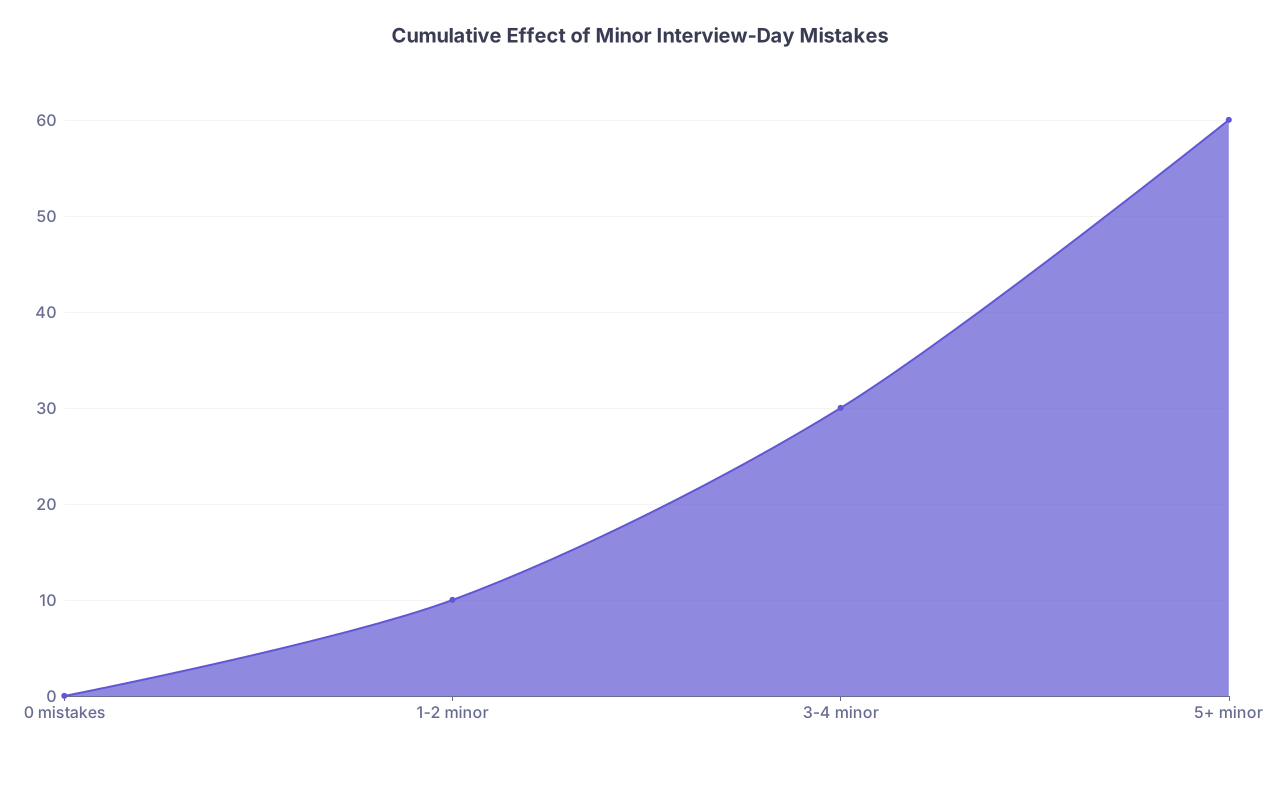
| Category | Value |
|---|---|
| 0 mistakes | 0 |
| 1-2 minor | 10 |
| 3-4 minor | 30 |
| 5+ minor | 60 |
You might do one small thing — show up 5 minutes late but you called ahead and apologized — and you’ll probably be fine.
But stack three or four:
- Slightly rude with coordinator
- Bored face during noon conference
- One weird comment at dinner
- Overly long, generic thank-you email
Now you’re no longer in the “safe middle.” You’re drifting downward, and when the rank meeting happens and there’s a tie, you lose.
Residents and faculty remember impressions, not checklists. “Seemed intense,” “Odd vibe,” “Not sure they really want us,” “Made a weird comment about psych patients” — those kinds of half-formed memories sink people.
Your job is not to be perfect. Your job is to avoid giving anyone an easy negative story to tell.
Mistake #12: Acting Like the Program Needs to Impress You
Yes, you are also interviewing them. Yes, you should evaluate fit. That does not mean acting like a shopper doing them a favor.
There is a specific kind of applicant who gives off, “Convince me why you deserve me” energy. They rarely intend it. It’s in the questions they ask and the way they react to answers.
Signs you’re veering into that territory:
- Saying, “At other places I’ve interviewed, they offer X — do you?” in a slightly challenging tone
- Making faces or obvious negative reactions to answers about call schedules or patient populations
- Asking about prestige metrics more than patient care or education
- Acting underwhelmed by anything that isn’t cutting-edge or fancy
Programs see this and think: flight risk, unhappy resident, high-maintenance.
You absolutely should have standards. You absolutely can decide to rank them low. Just don’t project condescension while you’re still a guest.
Better frame: curiosity, not comparison.
Quick Reality Check: Virtual Interviews Are Not Immune
For virtual seasons, people got sloppy. They assumed the lack of physical proximity meant the rules were softer.
They are not.
Virtual-specific ways to hurt yourself:
- Poor camera angle (looking down at them from a bed, dim lighting)
- Clearly interviewing from a shared noisy space with no attempt at privacy
- Eating during the interview (yes, people did this)
- Looking at a second monitor the whole time you’re talking
- Taking a call or texting mid-interview
The same principles apply: engaged, respectful, prepared. If anything, on Zoom your micro-expressions and distractions are more noticeable because your face is the whole frame.
The Core Moves That Keep You Off the “Drop” Pile
You do not need to be the most charismatic person in the room. You do not need a scripted persona.
You just need to avoid the landmines that quietly push you down rank lists:
- Treat everyone like they matter. Coordinator, resident, admin, co-applicant. No two-faced behavior.
- Look like you want to be there. Phone away, engaged body language, ask a few real questions.
- Stay humble and professional. Don’t brag, don’t trash talk, don’t overshare, don’t get sloppy at socials or in follow-up.
Protect yourself from these mistakes and you let your actual strengths show — instead of getting buried under “weird vibe” comments you never hear about.