It’s late January. You’re refreshing your email, dissecting every interview you did, replaying small moments: the awkward joke on the morning Zoom, the time you couldn’t get Epic to cooperate on a case presentation, the resident happy hour where you left early because you were wiped.
Meanwhile, in some windowless conference room, the residents you met for exactly one day are sitting around a table, eating cold pizza, and doing something you never really believed they did:
They’re quietly killing — or saving — your rank on the list.
Not with dramatic speeches. Not with “this person is unsafe” theatrics. With offhand comments. With silence. With one-liners like:
- “I just didn’t get great vibes.”
- “Seemed a little too high maintenance.”
- “I don’t think they’d actually be happy here.”
From the outside, applicants think faculty run rank meetings. On paper, yes. In reality, at most non-malignant programs, residents swing way more weight than anyone tells you publicly. Especially in borderline cases. And they can absolutely torpedo you without ever saying the word “no.”
Let me walk you through how it actually works — and the subtle ways residents sink applicants they don’t like, don’t trust, or just don’t want to work night float with at 3 a.m.
How Rank Meetings Actually Work (And Where Residents Fit In)

| Step | Description |
|---|---|
| Step 1 | Applicant Interview Day |
| Step 2 | Resident Impressions |
| Step 3 | Faculty Evaluations |
| Step 4 | Preliminary Rank List |
| Step 5 | Rank Meeting Discussion |
| Step 6 | Resident Comments |
| Step 7 | Program Director Decisions |
| Step 8 | Final Rank List |
Most applicants imagine a formal, data-driven process. File reviews. Objective scoring. A PD making carefully considered decisions.
What actually happens is messier, faster, and way more human.
Let me give you the typical structure I’ve seen at mid-to-large academic programs:
- Faculty and PD have a preliminary rank list based on scores, letters, Step, and their own interviews.
- Residents have usually submitted brief impressions: thumbs up, neutral, or “no thanks,” often in some half-baked Google form or survey.
- Then you get one or two rank meetings. Everyone piles into a room — PD, APDs, core faculty, chief residents, a handful of regular residents. Coffee, pizza, a projected Excel sheet or ERAS export on the screen.
Now here’s the part people outside the room don’t get:
When the faculty are on the fence, they look directly at the residents and ask some version of:
“So… do you guys actually want to work with this person?”
And that’s where the quiet torpedoes get launched.
The Subtle Weapons: How Residents Kill You Without Saying “Reject”
Residents almost never say, “We should not rank this person.” That raises eyebrows. That demands justification. PDs get nervous if residents start sounding vindictive or petty.
What they do instead is far more effective and harder to challenge.
1. The Lethal Lukewarm: “I Just Didn’t Get Great Vibes”
This is the most common resident torpedo, and it sounds harmless.
You’ll hear a faculty member say: “I thought they were strong. Nice Step 2, great letter from Hopkins. What did you all think?”
Then a resident leans back and says, “I don’t know. I just didn’t get great vibes.”
And then everyone stops pushing for you.
Nobody fights for a “meh” applicant. PDs are not trying to fill their program with projects. They want people residents are excited about because that usually means fewer headaches.
What actually triggers this “meh” response?
- You were fine on paper but socially flat at the social or lunch.
- You answered questions correctly but came off rigid, overly rehearsed, or oddly formal.
- You didn’t ask any real questions. Just the usual brochure stuff.
- You gave nothing personal. No moment where a resident thought, “I’d like to have this person on my team.”
On evals, it usually shows up as: “Seemed nice enough, nothing stood out.” That is a kiss of death when you’re competing with people residents described as “absolutely awesome.”
2. The “Wrong Fit for Our Culture” Card
This is the resident’s version of a veto that sounds politically correct and inarguable.
Sample language I’ve heard, nearly verbatim:
- “They’re smart, but I don’t think they’d enjoy our culture.”
- “They seemed more like a [high-powered research/elite academic/9–5 clinic] type. I think they’d be happier elsewhere.”
- “They might struggle with our volume and intensity.”
Translation: “We don’t want to deal with this person on nights or as a co-intern.”
“Culture fit” gets pulled when:
- You complain about work hours or call in a way that sounds whiny.
- You emphasize wanting more protected time than the program realistically gives.
- You talk like you’re above scut or think you’re destined for some hyper-elite path and this program is beneath you.
- You’re visibly turned off by the patient population, city, or hospital environment.
No resident is going to say, “They seem entitled,” in front of the PD. They’ll say, “I just don’t think the fit is great.” Same result. You quietly slide down the list.
3. The “High Maintenance” Label
This one is brutal. Once a resident uses the phrase “high maintenance,” you’re essentially done in that room for any competitive spot.
It usually gets triggered by behaviors like:
- You asked excessive logistical questions: call swaps, vacation rules, moonlighting, day-off policies — in a way that felt like you were looking for loopholes rather than trying to understand reality.
- You told stories that made you sound like you escalate small conflicts quickly.
- You expressed how prior programs “did things wrong” a bit too often.
- You made too big a deal about food, parking, housing stipends relative to the work.
What residents are really thinking is: “This person will be the one constantly emailing chiefs, texting us about scheduling issues, and nitpicking everything.”
During the meeting, it sounds like:
- “I got the sense they might need a lot of hand-holding.”
- “They asked a lot about time off… like, a lot.”
- “I think they might generate more work than they take off the table.”
Faculty hear that, shrug, and move on to the next applicant they don’t expect noise from.

Where You Actually Lose Points: Socials, Hallways, and Tiny Moments
You think you’re getting evaluated in the formal 30-minute faculty interview blocks. Residents do not care nearly as much about those.
The real damage — or boost — happens in the informal zones: the pre-interview Zoom, the resident-only lunch, the evening social, the hallway walk between conference rooms.
Let me break down the biggest silent killers.
4. The Social Assassin: How You Behave at the Resident Dinner
Most of you think the “resident dinner” or virtual social is casual. It is not. It is a graded event with no official score.
Residents go back and fill out comments like:
- “Top three of the night.”
- “Super awkward, barely engaged.”
- “Only talked about prestige and fellowships.”
- “Seemed disinterested in our lives here.”
The ways people quietly torpedo themselves at socials:
You only talk to faculty.
If you’re in-person and a faculty member happens to stop by or appears at an event, and you visibly angle toward them and away from residents? Every resident clocks it. You just told them where you think power really lies, and it is not with them.
You cluster with your classmates.
On Zoom pre-interview or hybrid events, I’ve seen applicants clearly more engaged with the people they already know. Residents later say: “Didn’t seem super interested in getting to know us.”
You interrogate instead of converse.
If every question is transactional — “How are your fellowship match numbers?” “How many of your residents get their first-choice fellowship?” “How often do people go to top 10 programs?” — you sound like someone who’s using the place, not joining it.
You drink poorly.
One drink, fine. Two, probably still fine. Three and you’re talking over people, being overly familiar, or making edgy jokes? Someone will bring it up in the room.
5. The “Did You See That?” Micro-Moment
Residents are hyper-sensitive to small interpersonal cues, partly because they’re used to reading patients and families quickly, and partly because they know they’re the ones who will be trapped with you in call rooms.
They notice things faculty don’t:
- How you talk to support staff during the tour. Did you ignore the nurse who said hi? Did you say thanks when someone opened a door or brought food?
- How you interact with other applicants. Are you dismissive? Do you brag subtly? Do you correct people?
- Whether you seem genuinely curious or just cycling through canned questions.
I’ve heard a resident say during a meeting: “I watched them talk to the front desk person. It was… not great.” That one sentence tanked that applicant’s support in the room. Nobody wants someone who’s rude to staff. It’s poison for resident-staff relationships.
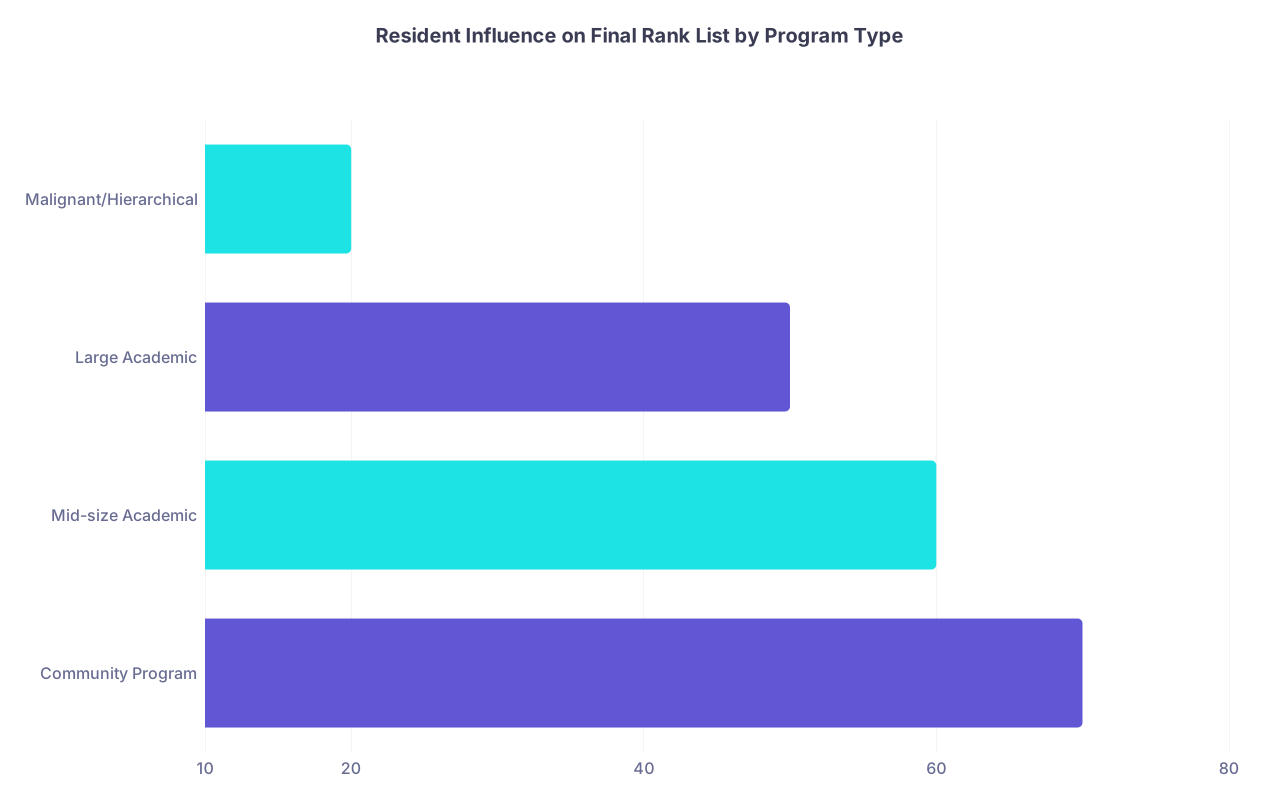
| Category | Value |
|---|---|
| Community Program | 70 |
| Mid-size Academic | 60 |
| Large Academic | 50 |
| Malignant/Hierarchical | 20 |
The Nuclear Option: “I Would Not Feel Comfortable…”
Most resident comments are shades of gray. But there is one phrase that makes PDs sit up straight:
“I would not feel comfortable having this person as my co-resident.”
Or the variant:
“I would not feel comfortable letting this person take care of my family member.”
Residents don’t use this lightly. They know it carries weight.
What triggers that level of concern?
Not “they were a little awkward.” Not “they seemed introverted.”
It’s when you cross into genuine red-flag territory:
- You make inappropriate jokes. Dark humor is one thing; punching down at patients, marginalized groups, or staff is another.
- You brag about cutting corners or bending rules to get out of work.
- You demonstrate poor insight about a major error or professionalism issue.
- You talk badly about current or prior residents/attendings in a way that feels vindictive, not reflective.
In the room, when a resident says the magic phrase — “I wouldn’t feel comfortable with…” — you can watch the faculty shift. People flip to your file looking for anything to support dropping you.
They rarely say “do not rank” explicitly. What happens instead is your name quietly drifts way down the list, into the “only if we don’t fill” tier.

How PDs Use Residents (And Why Your Best Faculty Interview Won’t Save You)
Here’s the dirty secret: many PDs do not fully trust their own read off 20-minute Zoom boxes. They know they see you at your absolute most polished and artificial. Residents see you when you relax.
So PDs use residents as a calibration tool.
Common pattern I’ve seen:
- Faculty: “I thought she was fantastic. Really bright, very driven.”
- Resident #1: “She was very intense at dinner. I think she’d do fine, but I worry she’d struggle with work-life balance here.”
- Resident #2: “Yeah, she asked a lot about research time and protected days, but didn’t ask much about our actual day-to-day.”
PD doesn’t throw you out. But in a stack of “fantastic” applicants, that slight resident hesitation moves you from #3 to #12.
Residents also get listened to disproportionately when:
- They have served on multiple interview seasons and earned the PD’s trust.
- They’re chiefs or senior residents who know how the sausage gets made.
- There’s a clear resident consensus (“We all really liked him” vs “None of us connected with her”).
I’ve watched PDs bump applicants 5–10 spots up because a chief resident flat-out said, “We need this person. They’re a worker, and everyone loved them.”
And I’ve watched them slide people 10–20 spots down because three residents said, “We all felt kind of weird after talking to him.”
Your dazzling faculty interview does not override that.
| Resident Phrase | Typical Effect on Rank |
|---|---|
| "Everyone loved them; top of our list." | Moves up significantly |
| "Great on paper, but vibes were off." | Slides down 5–15 spots |
| "High maintenance; might need hand-holding." | Slides down multiple tiers |
| "I would not feel comfortable working with them" | Effectively near DNR |
The Hidden Traps You Don’t Realize Residents Hate
There are a few patterns that torch applicants over and over. They don’t show up on any “how to interview well” PDF, but they come up constantly in resident debriefs.
1. Acting Like You’re Doing the Program a Favor
This shows up mostly in competitive specialties and strong applicants.
You say things like:
- “I’m mostly deciding between here and [elite name-drop].”
- “I want to match somewhere that can support my goals in [ultra-competitive fellowship] at a high level.”
Residents don’t mind ambition. They do mind condescension. If they sense you’re just using the program as a safety or a stepping stone, they’ll quietly push you down and raise people who actually seem to want to be there.
2. Over-sharing Personal Drama
Yes, programs want humans, not robots. But there’s a difference between being authentic and emotionally dumping.
Residents get spooked when you:
- Launch into detailed family drama with strangers.
- Over-explain why you hate your current institution.
- Bring up past mental health crises in a way that sounds unresolved and unstable rather than reflective and treated.
Nobody wants to sound discriminatory or insensitive, so they will never say “mental health” or “personal issues” out loud as a concern. They’ll say things like:
- “I worry they might struggle with the stress here.”
- “They seemed a little fragile.”
Vague, non-specific language. Very powerful in a rank meeting.
3. The Overpolished Robot
Being too slick is almost as bad as being a mess.
Residents see through:
- Over-scripted answers delivered like you’ve rehearsed them in front of a mirror 20 times.
- Zero vulnerability. Everything is strength, resilience, passion, growth.
- No real personality or humor.
In debriefs, they’ll say:
- “I have no idea what they’re actually like.”
- “Felt like talking to a Step 2 prep video.”
Those people rarely get tanked outright. They just never get anyone in the room so excited that they move up the list.
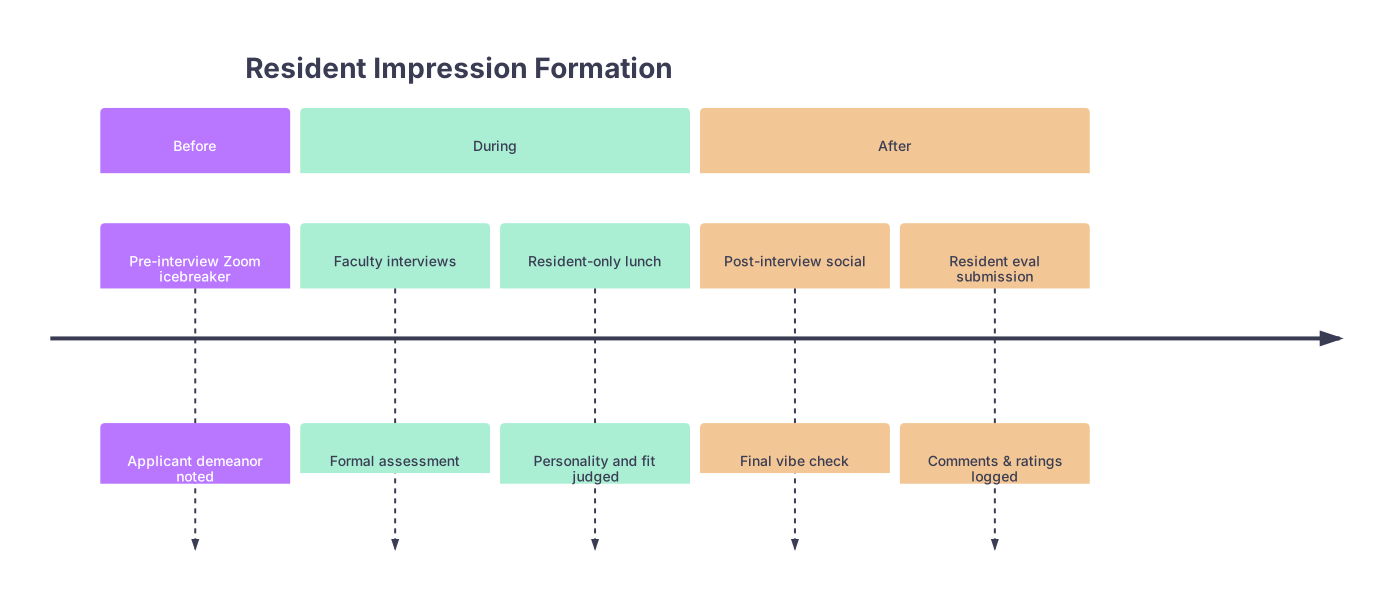
| Period | Event |
|---|---|
| Before - Pre-interview Zoom icebreaker | Applicant demeanor noted |
| During - Faculty interviews | Formal assessment |
| During - Resident-only lunch | Personality and fit judged |
| After - Post-interview social | Final vibe check |
| After - Resident eval submission | Comments & ratings logged |
What Actually Helps You: The Behaviors Residents Push Up the List
You’re reading this to avoid landmines, but let’s be practical. A few specific things reliably make residents speak up for you in that room.
They’re not glamorous.
You show you understand what residency really is.
You ask about workload, not just research. You ask what a rough call looks like. You ask how people support each other when everyone’s drowning. Residents hear: “This person gets it.”
You notice the right things.
You remember someone’s name from the tour. You reference something a resident said earlier. You comment thoughtfully on the patient population or the city, not just the shiny facilities.
You’re authentically decent to everyone.
Front desk. Food service. Security guard. Other applicants. I’ve watched residents recant their lukewarm impression because someone said, “They were the only one who thanked the MA who brought in coffee.”
You show some self-awareness.
If you talk about a time you were wrong, messed up, or had to change, and you don’t make yourself the secret hero of the story, residents take note. They’re thinking, “Can this person take feedback at 2 a.m. when they’re exhausted and I tell them their note is unsafe?”

The Part Nobody Tells You: You’re Being Ranked Against People We Already Like
This is the context you’re missing when you mentally replay one “off” answer and catastrophize it.
You’re not being ranked in a vacuum. You’re being compared against:
- The applicant who made every resident laugh at dinner.
- The one who connected over a shared hobby and then followed up with a thoughtful thank-you email.
- The one a resident’s med school friend texted them about: “She’s the hardest worker in our class. You want her.”
So when you give off even a faint whiff of “more work for us” — high maintenance, bad vibe, low insight — residents think: Why would we fight for this person when we have 20 clearly great ones?
That’s how you get quietly torpedoed. Not because you were terrible, but because you were mediocre in a stack of people who weren’t.
FAQs
1. Can a single resident actually tank my application?
Yes, but it’s rare and usually requires a real red flag. One well-respected senior or chief saying, “I had a seriously bad interaction, and here’s exactly what happened,” is enough to drop you far down the list. For more routine “meh” impressions, it usually takes a soft consensus — two or three residents independently saying you were off — for a PD to really act on it.
2. Do resident socials and pre-interview Zooms really matter that much?
They matter more than applicants want to believe. At several programs I’ve worked with, the resident-only social carried as much practical weight as the faculty interview, especially for tie-breakers. If you’re stellar on paper, a bad social won’t usually take you from top 10 to unranked, but it can easily push you behind 10–20 other people the residents actually liked.
3. If I’m introverted or quiet, am I just doomed in resident evaluations?
No. Residents are totally fine with quiet. They are not fine with disengaged, arrogant, or weirdly cold. A quiet applicant who asks two thoughtful questions, listens well, and is kind to people will do better than an extroverted applicant who dominates conversations. You do not need to be the funniest person in the room. You just need to show up as a decent, present human.
4. Is there any way to recover if I realize I had a bad interaction with a resident?
Sometimes. A short, sincere thank-you email that acknowledges something specific you discussed can soften a mediocre impression. But if you said something truly off, there isn’t a magical fix. Your best move is to not double down: don’t send a long defensive explanation, don’t over-contact people, and don’t try to “correct the record” through backchannels. That often makes you look even higher maintenance.
In the end, two truths matter:
Residents absolutely influence your rank more than you think, and they do it with small, casual comments that sound harmless in isolation.
And most of the “torpedoes” are avoidable if you show up as someone residents can imagine surviving a night shift with — respectful, curious, low-drama, and real.