
The biggest reason red flags sink residency applications is not the red flags themselves. It is applicants pretending they do not exist.
You will not “slip through” with an unexplained failure, LOA, or gap in training. Programs notice. They talk. And if you do not control the story, they will write their own—usually the worst possible version.
This is fixable. But only if you stop hiding and start explaining with strategy.
Below is a concrete framework I use when I help people who have:
- Step failures
- Course/clerkship failures or repeats
- LOAs for academic, medical, or personal reasons
- Disciplinary issues or professionalism concerns
- Multi‑month or multi‑year gaps
Not theory. Actual “here’s what to say, where to say it, and how to not sound like a walking red flag.”
Step 1: Identify Your Real Red Flags (Not What You Wish They Were)
Most applicants underestimate what programs consider a red flag, or they mislabel what matters.
Let’s sort it out.
| Category | Usually a Red Flag | Usually Not a Red Flag |
|---|---|---|
| USMLE/COMLEX | Fail, big jump in attempts | Slightly low but passing score |
| Pre-clinical courses | Repeated courses, academic probation | One marginal pass |
| Clerkships / clinical evals | Failing or repeating a core rotation | Single “pass” among mostly “honors” |
| LOAs (Leave of Absence) | Unexplained, long, or late in school | Short, clearly explained LOA |
| Disciplinary / professionalism | Formal actions, Title IX, ethics issues | One minor professionalism note with remediation |
| Time gaps post‑graduation | >6 months unexplained | Structured research year with output |
If you are not sure what your red flags are, assume:
- Anything that shows up clearly in your MSPE/Dean’s Letter
- Any USMLE/COMLEX failure or repeat
- Any LOA longer than 1–2 months
- Any professionalism or disciplinary notation
- Any unexplained timeline gaps on your CV
Programs notice patterns:
- Academic inconsistency
- Poor test‑taking + late Step 2
- “Vanished” for a year with no documented reason
- Multiple “concerns” in MSPE narrative
Write down your list. Not the soft, polite version. The real one:
- “Step 1 failed once, passed on second attempt, barely.”
- “LOA M3 year for 8 months—mental health.”
- “Dismissed from first medical school, re‑admitted elsewhere.”
You cannot fix what you refuse to name.
Step 2: Decide Where Each Red Flag Must Be Addressed
Different red flags belong in different parts of the application. Dumping everything into one giant “sob story” paragraph is a mistake.
Use this mapping:
| Red Flag Type | Primary Location | Secondary Location |
|---|---|---|
| USMLE/COMLEX failure | ERAS “Education/Training interruptions” or PS | Interview discussion |
| Course/clerkship failure | MSPE (automatic) + PS or addendum | Interview |
| LOA (medical/personal/academic) | ERAS interruption section | PS (brief) + interview |
| Disciplinary/professional action | ERAS “adverse actions” questions | PS only if needed + interview |
| Time gaps after graduation | CV + PS (if large) | Interview |
General rule:
- If ERAS asks you directly (LOA, dismissal, conviction, etc.) → you MUST answer clearly there first.
- Use your personal statement or a short supplemental explanation to add context and growth, not to hide behind emotion.
What you must not do:
- Hide a Step failure and hope they “miss it.” They will not.
- Skip the LOA question or write “N/A” when you took one. Dishonesty is worse than the LOA.
- Put a vague “personal circumstances” explanation that sounds like you are avoiding responsibility.
Your goal:
Each obvious red flag should have a consistent explanation across:
- ERAS fields
- MSPE
- Personal statement (when appropriate)
- Interviews
If your story changes between documents, that alone becomes a red flag.
Step 3: Use the 4‑Part “Red Flag Narrative” Framework
Here is the framework I push applicants to use. Every serious red flag explanation should follow this structure:
- Clear, factual description of what happened
- Concrete cause(s)—no vague hand‑waving
- Specific actions taken to fix or address it
- Evidence of sustained change and why it will not recur
If you miss any of these, the explanation feels incomplete or suspicious.
3.1. Part 1 – State What Happened (Plainly)
Bad:
- “I faced some challenges in my second year that impacted my performance.”
Better:
- “I failed Step 1 on my first attempt, scoring 194, and passed on my second attempt with a 223.”
Rules:
- One sentence, two at most.
- No excuses yet. Pure facts.
- Accept the word “failed,” “dismissed,” “LOA,” “probation.” Programs are not fooled by euphemisms.
3.2. Part 2 – Own the Cause Without Self‑Destructing
Programs are trying to answer: “Will this happen again in residency?”
They hate:
- Blaming “the school,” “the exam format,” “one bad day.”
- Overly vague “personal reasons.”
- Dramatic backstory with no insight.
You need a specific, believable driver:
- Poor study strategy
- Underestimating workload
- Untreated mental health issue
- Family crisis with concrete obligations
- Health condition with documented treatment
Examples:
Academic:
- “I relied on passive studying (re‑reading notes) and did not use high‑yield question banks, which left me unprepared for the exam style.”
Health:
- “At the time, I was untreated for major depression, which significantly affected my concentration, sleep, and reliability.”
Family:
- “I became the primary caregiver for my ill parent, and I chose to prioritize their care over my coursework, which led to my LOA.”
Do not overshare every emotional detail. Do share enough that a rational adult can say, “Okay, that actually explains the event.”
3.3. Part 3 – Detail the Actions You Took to Fix It
This is where most applicants underperform. They say, “I learned a lot,” but never show it.
You must show process:
- What changed in your study system, schedule, support, or health care
- Who helped (advisor, therapist, dean, learning specialist)
- What ongoing supports are in place now
Bad:
- “I worked harder and was determined to do better.”
Good:
- “I met weekly with the learning specialist to redesign my study plan, shifted to active recall with UWorld and spaced repetition, and completed two full self‑assessments before my next attempt.”
For health:
- “Under formal care with a psychiatrist, started evidence‑based treatment, and set a schedule that separated recovery time from clinical responsibilities.”
Specific actions are what reassure PDs you will not unravel during intern year.
3.4. Part 4 – Show Evidence That the Problem Is Solved
Words do not convince people. Data do.
You need at least one of:
- Strong Step 2 or Level 2 score after a Step 1 failure
- Consistent passes/honors after earlier course failures
- Completed rotations without professionalism issues after a prior incident
- Time since event with no recurrence
- Letters that explicitly vouch for professionalism and reliability
Examples:
Testing:
- “Since then, I passed Step 2 CK on my first attempt with a 244, reflecting both improved study methods and consistency.”
Academics:
- “Following my return, I completed all remaining clerkships on time, with no repeated courses and strong clinical evaluations.”
Professionalism:
- “There have been no further professionalism concerns in over three years of clinical training, as attested by my MSPE and letters.”
Do not just say “I will be a better resident.” Show why that is a reasonable conclusion.
Step 4: Apply the Framework to Specific Red Flag Types
Let’s get more tactical. I will walk through templates and examples you can adapt.
4.1. USMLE/COMLEX Failures
These are among the most common landmines.
Goal: Demonstrate:
- You understand exactly why you failed
- You have already proven success on a later exam
- There is virtually zero risk of failing boards in residency
Where to address:
- ERAS education interruption (if applicable)
- Personal statement (briefly, if it is one of your main red flags)
- Interview
Sample structure (personal statement, 3–5 sentences):
Fact:
- “I failed Step 1 on my first attempt, scoring 194.”
Cause:
- “At that time, I underestimated the volume of material, relied on passive review, and did not begin question‑based learning early enough.”
Action:
- “I met regularly with our academic support office, shifted to a question‑driven schedule using UWorld and NBME self‑assessments, and practiced exam‑day routines.”
Evidence:
- “On my second attempt, I passed with a 223, and I later scored 244 on Step 2 CK, reflecting a more disciplined and effective study approach that I continue to use.”
Do not:
- Blame “bad luck.”
- Include a long emotional meltdown description.
- Pretend a marginal second score is a major victory. Be honest yet confident.
If you failed Step 1 and Step 2:
- You must show major systemic change and probably strong COMLEX or in‑training exam performance, research productivity, or other extraordinary strengths.
- For some competitive specialties, you may need to recalibrate specialty choice toward programs more open to academic struggles (FM, psych, IM at certain tiers).
4.2. Course or Clerkship Failures
Programs tolerate the occasional pre‑clinical stumble more than a core clerkship failure. But both must be addressed.
Key point: A single early academic failure with clean performance afterward is survivable. Multiple scattered failures signal chronic issues.
Example (pre‑clinical course failure):
- “During my first year, I failed the neuroscience course and was placed on academic probation.”
- “The transition from lecture‑based learning to large‑volume, self‑directed study exposed significant weaknesses in my time management.”
- “With guidance from the academic dean, I structured daily review blocks, adopted Anki for spaced repetition, and set weekly content goals that I tracked with a mentor.”
- “After remediation, I passed the course and have had no subsequent course failures, performing at or above the class average in all remaining pre‑clinical blocks and clerkships.”
For a clerkship failure, you must address:
- Whether this was knowledge, skills, or professionalism
- Why it will not show up when you are an intern
Example (failed internal medicine clerkship for performance, not professionalism):
- “I initially failed my internal medicine clerkship due to poor test performance and difficulty organizing presentations.”
- “I struggled to synthesize complex patients into concise, prioritized problem lists and underestimated the time needed to prepare for the shelf exam.”
- “I worked one‑on‑one with a faculty mentor on daily oral case presentations, used a structured template for notes, and began shelf review six weeks before the repeat rotation.”
- “On the repeat clerkship, I passed comfortably, improved my clinical evaluations, and have since received strong feedback on my internal medicine sub‑internship regarding my organization and handoffs.”
If the failure involved professionalism, you must say so and describe the remediation. Vague language there sets off alarms.
4.3. Leaves of Absence (LOAs)
Programs are much more accepting of LOAs than applicants think—when they are:
- Transparently explained
- Time‑limited
- Tied to clear treatment or resolution
Where you must address:
- ERAS “leave of absence” section (required)
- Brief mention in PS if it is central to your growth story
- Interview
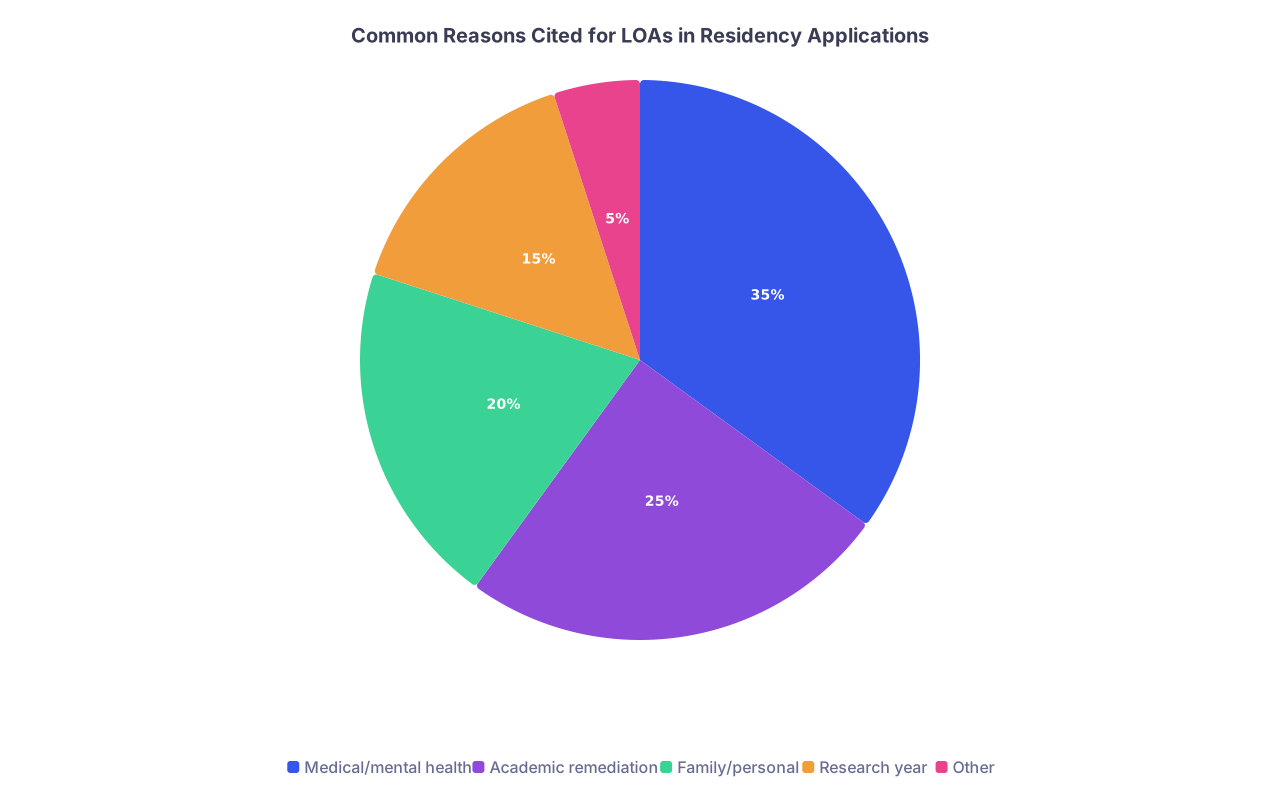
| Category | Value |
|---|---|
| Medical/mental health | 35 |
| Academic remediation | 25 |
| Family/personal | 20 |
| Research year | 15 |
| Other | 5 |
Example (mental health LOA):
ERAS explanation (short, factual):
- “I took a medically‑approved leave of absence from March to October of my third year for treatment of a mental health condition. I completed recommended treatment, returned at full capacity, and have had no further interruptions in training.”
If needed, PS elaboration (only if it contributes to your narrative of maturity and resilience):
- “Midway through third year, I experienced significant depression and anxiety that impaired my functioning. On the advice of my physician and the dean, I took a leave of absence for comprehensive treatment. During that time, I engaged in psychotherapy, optimized my medical management, and developed concrete coping strategies that I continue to use. Since returning, I have completed all remaining clerkships without interruption, maintained reliable performance, and learned how to ask for help early rather than silently deteriorating.”
You do not need to name diagnoses or medications. Focus on:
- You sought appropriate care
- The treatment was effective
- You have ongoing support and insight
For family LOAs, be clear about your role and why a LOA was required, not just “I was sad.”
4.4. Disciplinary / Professionalism Issues
These are the most dangerous red flags. Not automatically fatal, but close if handled poorly.
Programs care about:
- Honesty
- Patient safety
- Team trust
Common issues:
- Cheating / plagiarism
- Unprofessional behavior with staff or patients
- Boundary violations
- Repeated tardiness / unreliability
You must:
- Describe the incident clearly (without re‑litigating it)
- Accept responsibility, even if you disagree with parts of the process
- Spell out the remediation and proof of changed behavior
Bad:
- “There was a misunderstanding regarding a professionalism concern.”
Better:
- “During my second year, I was cited for unprofessional conduct after I spoke disrespectfully to a staff member in front of patients.”
Followed by:
- “I was required to complete a professionalism remediation course and meet regularly with a faculty mentor. I also received feedback training and began using structured self‑reflection after clinical shifts.”
- “There have been no further professionalism concerns in over three years of training. In clinical rotations, my evaluations consistently highlight respectful communication and teamwork, and I have chosen a field where interprofessional collaboration is central to care.”
Do not:
- Attack your school, dean, or accusers in your application. It makes you look volatile.
- Minimize a serious event as “minor.”
You can acknowledge disagreement with specific aspects without sounding defensive:
- “Although I did not initially agree with every aspect of the process, with time I have come to accept the core feedback: my reaction in that situation did not meet professional standards.”
4.5. Gaps After Graduation or Between Training Steps
A 3–6 month quiet period between graduation and the Match is not ideal but is manageable if you:
- Show structured use of time (research, observerships, work, caregiving)
- Have a clear explanation and continuity
A 1–2 year gap with no clear activity is a major red flag.
You need to:
- Account for the time month‑by‑month in your CV as much as possible
- Highlight any medically related activities, exams, research, or certifications
- Explain logistics (visa, family, pandemic disruptions) without sounding like you were idle or aimless
Example (1‑year gap for family + research):
- “After graduation in 2023, I relocated to the United States both to support my spouse’s job transition and to pursue clinical research while preparing for the Match.”
- “I worked as a full‑time clinical research coordinator in cardiology at X Hospital, contributing to patient recruitment and data analysis for two ongoing studies, and I am a co‑author on one manuscript under review.”
- “During this time, I also completed USMLE Step 2 CK and engaged in U.S. clinical observerships to strengthen my familiarity with the healthcare system.”
The worst explanation is no explanation.
Step 5: Where Applicants Commonly Screw This Up
Let me be blunt: I have seen people with survivable red flags kill their chances with bad explanations.
Here is what to avoid:
Overexplaining drama, underexplaining change
- Three paragraphs on how hard life was, one line on what you did to fix it. Programs see this as emotional but not reliable.
Blame‑shifting
- “The exam was unfair.”
- “The faculty member targeted me.”
Sometimes that is even true, but if your tone is mainly grievance, PDs picture you arguing over every evaluation.
Vagueness
- “Personal issues.” “Health problems.” “Family matters.”
These sound like you are hiding something worse.
- “Personal issues.” “Health problems.” “Family matters.”
Inconsistency across documents
- LOA dates in ERAS do not match MSPE.
- Story in PS conflicts with what you say at interview.
This screams unreliability.
Making the red flag the center of your identity
- Your entire personal statement becomes “I failed, I struggled, I overcame.”
No. You are more than your worst semester. Address it cleanly, then pivot to strengths and why you are a fit for the specialty.
- Your entire personal statement becomes “I failed, I struggled, I overcame.”
Step 6: How to Practice Your Explanation for Interviews
You need a spoken version of each red flag explanation. Short. Calm. Rehearsed but not robotic.
Use this spoken template (aim for 60–90 seconds):
- One sentence: what happened
- Two to three sentences: main causes
- Two to three sentences: what you changed
- One to two sentences: results and reassurance
Example (spoken, for a Step failure and LOA combo):
- “During my second year, I failed Step 1 and subsequently took a leave of absence to address underlying depression and anxiety that had been building.”
- “I had been trying to push through without help, using ineffective study methods and ignoring worsening sleep and concentration. Eventually, it affected both my academics and my health.”
- “With support from my dean, I stepped away to receive structured treatment, met regularly with a therapist, and worked with our academic support team to completely overhaul my study plan to focus on question‑based learning and realistic schedules.”
- “Since returning, I have passed Step 1 and Step 2 on the first attempt, completed all clerkships without interruption, and my clinical evaluations describe me as reliable and steady under pressure. I am confident in the systems I now have in place and in my readiness for the demands of residency.”
Then stop talking. Let them ask follow‑ups if they want more.
Practice out loud. If you choke up or ramble, keep trimming until you can say it the way you would explain a complicated case: factual, clear, and focused on management.
Step 7: Decide If You Need Extra Structural Help (Not Just “Better Wording”)
Sometimes the honest answer is: the red flags are significant enough that you must change strategy, not just phrasing.
Signals you need more than a polished explanation:
- Multiple USMLE/COMLEX failures with only modest later scores
- Academic dismissal and re‑entry at another school
- Repeated professionalism issues
- Large gaps with minimal clinical activity
In those cases, consider:
- Adjusting specialty choice to those historically more open to such profiles (family medicine, psych, some internal medicine and peds programs).
- Targeting community programs rather than highly academic or competitive ones.
- Securing strong advocacy from faculty who know your story and can vouch that you are safe, reliable, and ready.
- Doing a research year or prelim year before re‑applying, if feasible, to build a new track record.
An excellent explanation cannot erase a catastrophic record. But it can:
- Get you seen as a human being rather than a datapoint
- Move you from auto‑screen rejection to “maybe” pile
- Tip the scales when a PD is on the fence
Step 8: Put It All Together in Your Application
Here is a straightforward checklist to operationalize this:
List your red flags (honest, specific).
Map each one to ERAS fields, PS, and interview plan.
For each red flag, draft:
- 2–4 sentence written explanation following the 4‑part framework
- 60–90 second spoken explanation
Check for:
- Consistency of dates and facts across MSPE, ERAS, PS, and CV
- Concrete actions and evidence, not just emotional language
Have:
- One blunt friend or mentor read your explanation and answer: “If you were a PD, would you worry this will happen again?”
- If yes, revise the action and evidence portions until the answer is no.
Open a blank document right now and write out your single biggest red flag using the 4‑part framework: what happened, why, what you changed, and proof it worked. No euphemisms, no drama. Once you can read that aloud without flinching, you are a lot closer to being the applicant who owns their story instead of the one running from it.