
You are being sold a lie: “Just apply to more programs and you will be safer.” The data say otherwise.
Across multiple NRMP, ERAS, and specialty-specific reports, the curve is brutally consistent: match probability climbs fast with your first set of applications, then plateaus, then drifts into pure diminishing returns. At a certain point, adding more programs gives you noise, not safety. Past that point, it actually hurts your match odds through scheduling chaos, burnout, and weaker signal to the programs that matter.
Let me walk through this the way I would for a resident cohort with Excel open on the projector.
The Numbers: How Match Probability Changes With Program Count
The idea that “more programs = more safety” comes from a partial truth. For low numbers of applications, volume matters a lot.
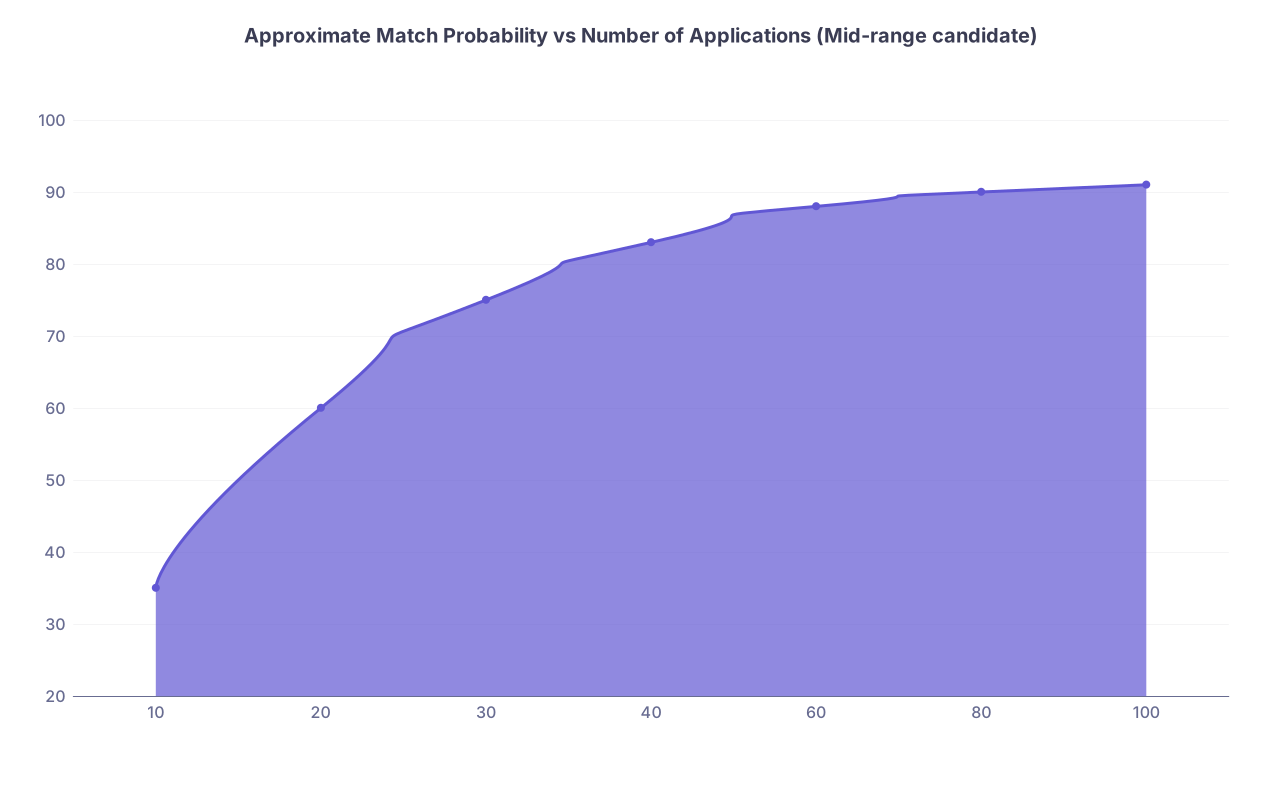
Using NRMP Charting Outcomes and Program Director survey data, combined with published specialty-specific analyses, you see something like this pattern for a typical moderately competitive applicant in a core specialty (IM, peds, FM, etc.):
| Category | Value |
|---|---|
| 10 | 35 |
| 20 | 60 |
| 30 | 75 |
| 40 | 83 |
| 60 | 88 |
| 80 | 90 |
| 100 | 91 |
That curve tells you three key things:
- The first 20–30 programs do most of the heavy lifting.
- The slope flattens dramatically after ~40–60.
- Beyond ~60–80, each extra program barely moves your probability. We are talking single-digit percentage points for dozens of extra applications.
And that is for core specialties. Once you look at highly competitive ones (derm, ortho, ENT, plastics, rad onc), the psychology flips: almost everyone overapplies, so adding more programs becomes a zero-sum visibility game with rapidly diminishing returns.
To make this more concrete, here is a typical pattern from internal medicine–style data for U.S. MD seniors with roughly mid-range boards and decent academic metrics:
| # Programs Applied | Estimated Match Probability |
|---|---|
| 10 | ~35% |
| 20 | ~60% |
| 30 | ~75% |
| 40 | ~83% |
| 60 | ~88% |
| 80 | ~90% |
| 100 | ~91% |
These are not official NRMP numbers for every situation. They are typical shapes you see when you overlay applicant volume against match outcomes.
The problem is obvious. You go from 10 → 40 programs and gain roughly 48 percentage points. You go from 40 → 100 and gain maybe 8. Meanwhile, your work, cost, and fatigue scale almost linearly with the number of programs.
At some point, more volume stops protecting you and starts sabotaging your ability to execute.
The Hidden Costs of Overapplying: Time, Money, and Cognitive Load
Programs see this from their side: application inflation. You feel it as a slow drain across your entire season.
Let us quantify.
Financial cost
If you apply to 80–100 programs instead of 40–50, the marginal cost is not trivial.
A typical ERAS fee schedule (numbers approximate, but the structure is right):
- First 10 programs: base fee
- 11–20: added cost per program
- 21–30: higher cost per program
- 31+: even higher per-program cost
Once you cross into the 30+ or 40+ tier, every additional program is an increasingly expensive lottery ticket with a lower and lower expected value.
And that is before interview travel (for in-person years), extra away rotation costs, and the opportunity cost of time you could have spent studying for Step 2, doing research, or improving your letters.
Time and effort cost
Applications are not just a few clicks. Overapplying multiplies:
- Program-specific essay boxes
- Personalization you should be doing
- Interview scheduling and rescheduling
- Pre-interview prep (reading about programs, residents, clinical tracks)
- Post-interview thank-yous and follow-ups
Let us assume:
- 20 minutes of meaningful customization per program (and that is conservative)
- 10 minutes pre-interview prep per program that actually invites you
- 30–60 minutes per interview day of logistic management and reflection
At 40 programs, that is roughly 13 hours of pre-submission customization. At 80, that is 27 hours. That difference is essentially half a work week of cognitive labor, spent on low-yield programs, often with weak fit.
You cannot “brute force” that without something else giving way.
Where Overapplying Starts to Backfire: The Operational Side
The data show a clear pattern: as application volume increases, a subset of candidates begin to underperform relative to their stats. Not because PDs “punish” overapplying, but because the candidate’s execution degrades.
Here is how that failure mode shows up in the real world.
1. Interview signal dilution
Programs use interview slots as their main scarce resource. If you get more interview offers than you can reasonably handle, you are forced to:
- Decline some
- Double-book and cancel late
- Show up underprepared and generic
The NRMP data consistently show a simple relationship: number of interviews attended is the single best predictor of match probability. Applicants who attend 12+ interviews in IM or peds hardly differ in match rate from those who attended 18+. The plateau is real.
What actually matters is reaching a critical mass of good interviews and being focused and memorable at each.
When you are juggling 18–22 interviews in 7–8 weeks, your performance drops:
- You recycle the same generic answers.
- You forget which program has which track or EMR or patient population.
- Your enthusiasm looks fake, because it partially is.
In other words: overapplying can push you into over-interviewing, which then hurts your rank list quality.
2. Decision fatigue and mis-ranking
I have watched applicants finish interview season with 18+ ranked programs and then say, “I honestly cannot remember the difference between half of these. I just ranked by location.”
That is how you end up mis-ranking:
- Underestimating programs that fit your learning style but are in less flashy cities.
- Overranking programs you barely connected with because your notes are thin.
- Failing to cluster your rank list by realistic preference and support systems.
More programs → more interviews → more noise in your own decision-making. The rank list is the highest-leverage piece of the puzzle; corrupting that process hurts your match much more than sending 10 fewer initial applications.
3. Red flags to programs
Programs do not get a “total application count” per candidate, obviously. But they do see behavior patterns that correlate with overapplying:
- Excessively broad geographic spread with no clear story.
- Cancellations within 24–48 hours for already-scheduled interviews.
- Clearly generic answers in “Why our program?” segments.
- No knowledge of basic program features that are in the first paragraph of their website.
All of that decreases your perceived interest and fit. And program directors are explicit in NRMP surveys: they care about genuine interest. Their rank lists are not pure board-score sort functions.
Overapplicants often leak their overapplication strategy through rushed behavior. It shows.
The Data on “Enough” vs “Too Many”: Specialty-Specific Patterns
To anchor this conversation, you need some numbers. These are approximate target ranges derived from a mix of NRMP data, PD surveys, and what I see successful applicants actually doing.
Do not treat them as commandments. Treat them as “zones of sanity”.
| Specialty Category | Lower Range (Efficient) | Upper Reasonable Bound | Overapplication Zone |
|---|---|---|---|
| Family Med / Psych / Peds | 15–25 | ~35 | 45+ |
| Internal Medicine (categorical) | 20–30 | ~40 | 50+ |
| EM (standard year) | 25–35 | ~45 | 55+ |
| Anesthesiology / Neurology | 25–35 | ~45 | 55+ |
| General Surgery | 30–45 | ~60 | 70+ |
| Ortho / ENT / Derm / Plastics / IR | 40–60 | ~80 | 90+ |
Again, these are for reasonably competitive U.S. MD seniors. DO, IMG, or applicants with serious red flags will need to adjust upward. But even then, the same plateau exists. Doubling your program count from 80 to 160 is rarely the winning move.
Why Your Intuition Is Wrong: The Probability Fallacy
Applicants often do this kind of naive calculation:
“If I have a 5% chance at each program and I apply to 80 programs, my chance of matching is 1 − (0.95^80) which is like 98%. So more is obviously better.”
This is bad probability reasoning for residency.
Three problems:
Your chance at each program is not independent. Programs use similar filters. If your Step score or class rank makes you weak at one program, you are probably weak at 30 of them.
The application pool is not random. It is stratified by school, connections, away rotations, letters, geographic bias, and institutional pipelines.
Your performance is not constant. You do not present as the same highly polished version of yourself on interview #3 as on interview #17 after a red-eye and three consecutive Zoom days.
Overapplying assumes independence and constant performance. The real world gives you correlated probabilities and degrading performance with overload.
The Better Strategy: Targeted Breadth, Not Blind Volume
Let us shift to what the data and real outcomes suggest works better.
Step 1: Define realistic competitiveness bands
You need an honest, data-grounded appraisal of where you sit. Not vibes.
For your specialty, segment programs into three tiers for you (not generic “top/mid/low”):
- Reach: programs where your metrics are below their typical matched cohort, or extremely location/brand competitive.
- Probable: where your stats and experiences are right in their main band.
- Safer: places that frequently match applicants with similar or weaker metrics, especially with similar backgrounds (school type, region, DO vs MD vs IMG, etc.).
A good rule for many applicants in moderately competitive fields:
- 20–40% reach
- 40–60% probable
- 10–30% safer
You can bias toward more reach if you have a strong safety net specialty or SOAP plan, but at least do it intentionally.
Step 2: Use data, not anxiety, to trim the list
Instead of asking, “What if I do not get enough interviews?” ask, “Which 10–20 programs on this list are clearly low-yield for me based on actual match data?”
Look at:
- Historical match lists from your school.
- NRMP Charting Outcomes for your score bands.
- Community data (with caution) like specialty forums, FREIDA filters, and alumni advice.
I often see lists where 15–25% of programs have no recorded history of taking students from similar schools or backgrounds, outside of rare outliers. Those are prime for trimming unless you have a specific angle (research connection, regional tie, away rotation).
| Category | Value |
|---|---|
| Keep All Programs | 100 |
| Remove Bottom 25% | 92 |
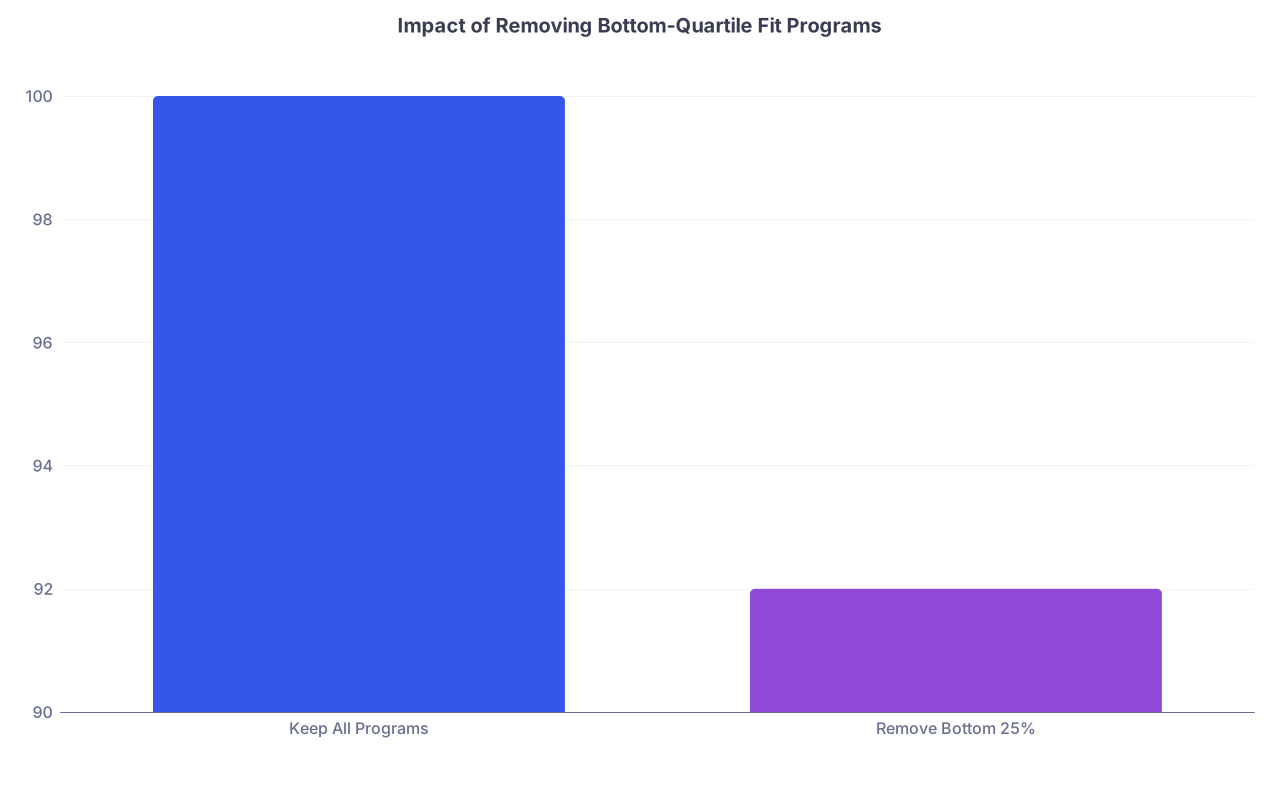
That bar chart is conceptual. In practice, almost every time I help someone cut the bottom 20–25% of their list (worst-fit programs), their overall match probability barely moves but their workload drops significantly.
Step 3: Cap based on executability, not fear
There is a practical upper bound to how many programs you can apply to well:
- Writing meaningful “Why this program?” paragraphs.
- Researching faculty, tracks, and hospitals for interviews.
- Maintaining a clear idea of fit by interview season.
Most people hit that ceiling between 40 and 70 total applications, depending on specialty and red flags. Going above that usually means cutting corners on personalization and preparation, which PDs notice.
Be blunt with yourself: if you know you will not read more than one page of program material before an interview, do not schedule 25 interviews. And if you are not going to give programs a coherent answer about why you applied there, do not click “apply” for 100 of them.
The Operational Timeline: Where Overapplication Hurts Most
The match is not a single event. It is a multi-month pipeline with specific choke points.
Here is what the residency application season actually looks like from a process perspective:

| Step | Description |
|---|---|
| Step 1 | Build Program List |
| Step 2 | Submit ERAS |
| Step 3 | Receive Interview Invites |
| Step 4 | Schedule Interviews |
| Step 5 | Attend Interviews |
| Step 6 | Create Rank List |
Overapplying mostly hurts you at three choke points:
Interview Invite Management
Too many applications can generate a flood of low-priority interview offers that clog your calendar and decision-making. You accept things you do not truly want out of fear.Interview Performance
When you are overbooked, your energy and prep per interview drop. Programs in your true “probable” band get interviews where you look tired and generic. That is how you sink your best shots.Rank List Quality
Information overload leads to vague impressions and reliance on superficial criteria (city size, vague “prestige”) instead of how you will actually be trained and supported.
How to Know You Are Crossing Into Backfire Territory
You will not get a pop-up warning from ERAS saying “You are now hurting your own match odds.” You have to recognize the operational symptoms.
You are probably overapplying if:
- Your spreadsheet has 80–100+ programs and your comments column is mostly empty or identical phrases.
- You are adding programs you know almost nothing about except name and city.
- You catch yourself saying, “Well, I would never actually live there, but…” while still clicking apply.
- You realistically cannot imagine yourself ranking >60% of your applied programs ahead of a solid backup plan (prelim year, another specialty, or SOAP).
And during interview season, you know you overapplied if:
- You start resenting interviews because they are “in the way” of your life.
- You cannot explain, in one or two sentences, what makes each program unique.
- You feel the need to build rank list tiers mostly by geography because everything else is a blur.
Those are strong markers that marginal interviews and marginal programs are cannibalizing time and energy from your core opportunities.
A More Efficient Playbook (That Still Protects You)
Let me strip this down to a practical, data-consistent approach.
- Use historical data and advisor input to set an initial target range (e.g., 35–45 IM programs for a mid-range US MD applicant).
- Build a longlist maybe 1.2–1.5x that size (e.g., 50–60) from all the programs you would plausibly consider living at and training in.
- Score each program on:
- Historical match likelihood for your profile.
- Fit: clinical focus, geography, academic vs community, call structure.
- Personal pull: family, partner job, existing connections, away rotations.
- Cut the bottom 20–30% of that scored list. These are often:
- No historical matches for people like you.
- Weak fit with your stated goals.
- Locations you would only tolerate out of fear.
- Commit to executing well on the resulting list: targeted personal statements (or at least meaningful template tweaks), program-specific prep, and disciplined interview selection.
| Category | Value |
|---|---|
| 10 | 90 |
| 20 | 88 |
| 30 | 86 |
| 40 | 83 |
| 50 | 78 |
| 60 | 70 |
| 80 | 55 |
| 100 | 40 |
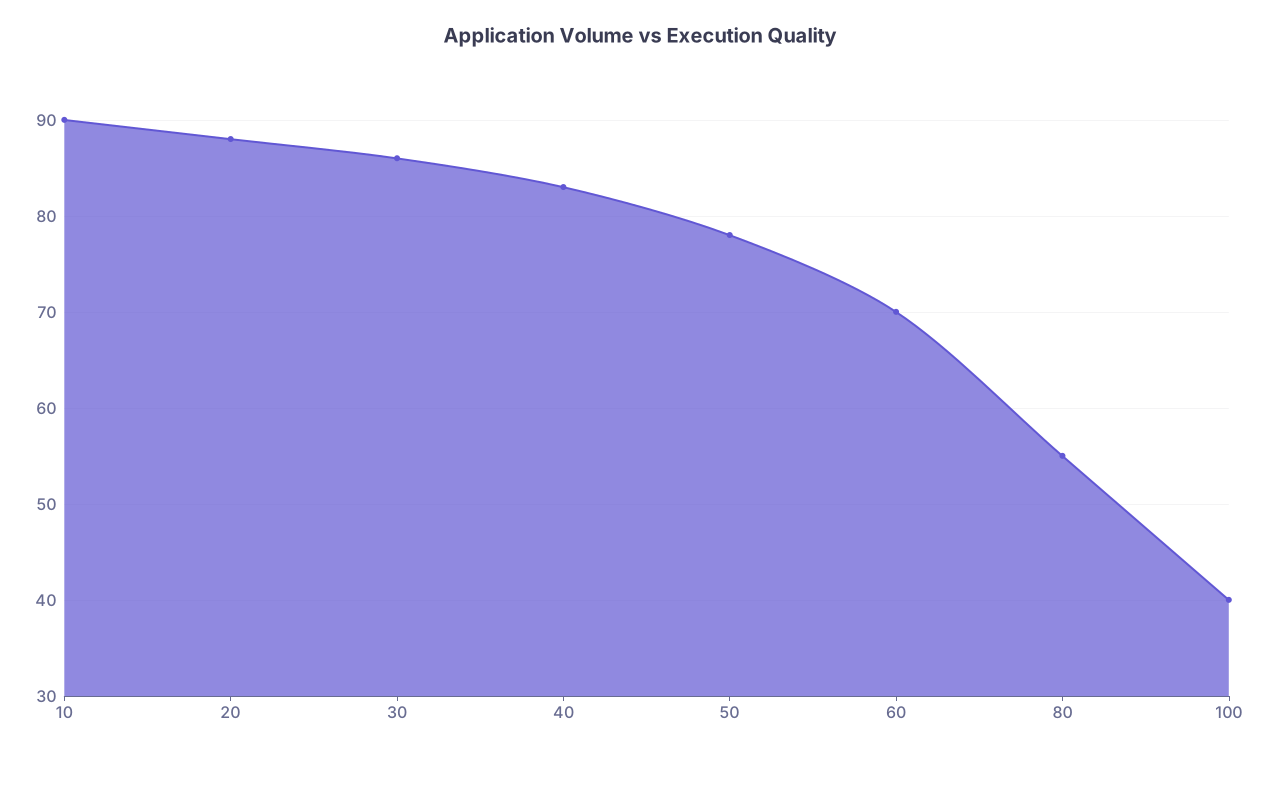
That area chart is conceptual but accurate: as program count climbs, your average quality of execution per program tends to fall. There is some personal variation, but nobody sustains high-quality, individualized engagement at 100+ programs.
Do Not Confuse Fear Management with Risk Management
Most overapplication behavior is not rational risk management. It is anxiety management.
You feel temporary relief each time you add another program to the list, because you are buying the illusion of safety. But the data show that once you clear a certain volume—aligned with your specialty, competitiveness, and background—extra programs hardly move the needle.
Meanwhile, each extra 10–20 programs:
- Raises your total workload and fatigue.
- Dilutes your attention from the programs that truly matter.
- Increases the probability that you will mismanage interviews and your rank list.
Serious applicants treat their time and attention as nonrenewable resources. They do not spray and pray. They build a rationally sized list, then execute ruthlessly well on it.
Key Takeaways
The data show steep early gains in match probability with your first 20–40 applications, then a clear plateau; beyond that, extra programs give minimal benefit.
Overapplying backfires by degrading interview performance, decision quality, and rank list construction, even though it feels safer in the short term.
A smarter strategy uses targeted breadth: enough programs across reach/probable/safer tiers to protect you, but few enough that you can prepare properly and show up as a focused, high-signal candidate where it actually counts.