
The myth that “one failed exam destroys your match chances” is statistically lazy thinking. The data say something more precise — and much more uncomfortable: the context of that failure, plus everything you do afterward, moves your odds up or down in very quantifiable ways.
Let me walk through what the numbers actually show about failed exams, red flags, and match probability. Not vibes. Not anecdotes from a panicked Reddit thread. Real, pattern-level data.
What Counts as a “Red Flag” — And How Often It Shows Up
Red flags are not mysterious. Program directors are remarkably consistent about what they consider problematic. The NRMP Program Director Survey (PD Survey) gives you a pretty clean hierarchy.
Common exam-related red flags:
- Failing USMLE Step 1 or COMLEX Level 1
- Failing USMLE Step 2 CK or COMLEX Level 2-CE
- Multiple exam failures (Step + Shelf, or repeated attempts)
- Big score gaps (e.g., 2-digit jump down or erratic pattern)
- Remediation or repeating a year tied to exam issues
From PD Survey data across multiple cycles, roughly:
- Around 10–15% of US MD applicants report some academic or professionalism concern in ERAS when you combine all types.
- The subset with an actual failed licensing exam is smaller — realistically in the low single digits of applicants overall in any given year — but they are heavily overrepresented among unmatched applicants.
You can think of it this way: failure is a minority event among applicants, but a majority “signal” among those who never match.
That does not mean “fail = guaranteed no match.” It means you are starting from a lower baseline probability, and the slope upward is steeper.
Baseline Match Probabilities: Where You Start Without Red Flags
Before we talk about failure, we need a control group. Average numbers. Without drama.
For recent NRMP Main Residency Match cycles (US seniors):
- US MD seniors: ~92–94% match rate overall
- US DO seniors: ~89–92%
- US-IMGs: ~60–65%
- Non-US IMGs: ~55–60%
Now layer in competitiveness by specialty. Using approximate recent figures:
| Specialty Category | Approx Match Rate |
|---|---|
| Primary Care (FM, IM, Peds) | 94–97% |
| Mid-competitive (EM, Anes, Psych, Neuro) | 85–93% |
| Competitive (Gen Surg, OB/GYN) | 80–90% |
| Very Competitive (Derm, Plastics, Ortho, ENT, Rad Onc) | 60–75% |
These are broad bands, but they define your baseline. If you have no major red flags and reasonable scores (near or slightly below the specialty mean), your match probability roughly tracks that category.
Now watch what happens numerically once a failed exam enters the picture.
One Failed Exam: How Bad Is “Bad” in the Data?
The PD Survey repeatedly asks programs how they treat exam failures. The numbers are blunt.
Across most core specialties:
- >80% of programs say they are “seldom or never” willing to interview an applicant with a failed Step 1 or COMLEX Level 1 unless there is a clear explanation and strong overall file.
- But that “never” is not truly never. There is a consistent minority — typically 15–30% of programs depending on specialty — that will review such applicants if everything else is strong.
So a failure does two things mathematically:
- It shrinks the number of viable programs.
- It raises the bar for interviews from those that remain.
You can model it as a hit to both your program pool size and your per-program interview probability.
Approximate effect on interview odds
Let’s use a simplified example for a mid-competitive specialty (e.g., EM or Anesthesia) for a US MD senior.
Without red flags (decent Step scores, solid CV):
- Apply to 50 programs
- ~40 will seriously review you
- ~15–20 interview offers (30–40% hit rate on serious reviews)
- Match probability: ~85–90%
With a single licensing exam failure, but then a strong pass and solid Step 2:
- Apply to 80–90 programs
- Maybe 30–40 programs seriously review you (many auto-screen out)
- ~8–12 interviews (20–30% hit rate – programs more cautious)
- Match probability: often drops to ~60–75%, highly dependent on how you explain the failure and your Step 2 score.
The exact numbers vary, but the pattern does not: you are now playing a high-volume, high-variance game. The “long tail” of extra applications is not optional; it is how you mathematically restore your cumulative probability.
Different Failures, Different Damage: Not All Red Flags Are Equal
The data show pretty clean gradients in how bad each scenario is.
1. Failed Step 1 / COMLEX Level 1, then strong Step 2 / Level 2
This is the most salvageable scenario.
- PD Survey: For many core specialties, 40–60% of programs say a single failed Step 1 is a concern but not a dealbreaker if Step 2 is strong.
- If Step 2 score is ≥ specialty mean and there are no other issues, many PDs interpret this as “late bloomer” or “fixed the problem.”
Practical impact:
- Competitive specialties: huge hit; you are probably out unless your application is otherwise stellar.
- Mid-competitive: damaged but not fatal; you must apply broadly and overperform on Step 2.
- Primary care: often forgiven with a convincing narrative and clear improvement.
2. Failed Step 2 CK / COMLEX Level 2
This is worse than a Step 1 failure in most PDs’ eyes.
Rationale: Step 2 is closer to real-world performance. Failing it raises concerns about clinical readiness and test-taking reliability.
- Many PD Surveys show higher “never interview” percentages for failed Step 2 than for failed Step 1.
- For some competitive specialties, a failed Step 2 is functionally disqualifying unless you bring something extreme to the table (high-tier research, connections, etc.).
If you fail Step 2 after already barely passing Step 1 or Level 1, the cumulative pattern looks bad regarding trajectory and ceiling.
3. Multiple exam failures
Here the numbers get brutal.
Programs that say they will “almost never consider”:
- Single failure: often 40–60% of programs
- Multiple failures: often 70–90% of programs, especially in competitive fields
In probability terms, you are not just losing a linear fraction of programs. You are collapsing the program universe.
If you are a US MD with:
- Multiple failures
- Below-average scores on retakes
- No unique differentiator
You are often looking at:
- Realistic shot only in Family Medicine, Pediatrics, maybe Psych or Pathology, and even then with broad applications and a perfect explanation story.
- Match probability that may drop well below the typical ~90%, possibly into the 40–60% band, unless you massively over-apply and strategically target.
Specialty-Specific Tolerance: Who Forgives and Who Does Not
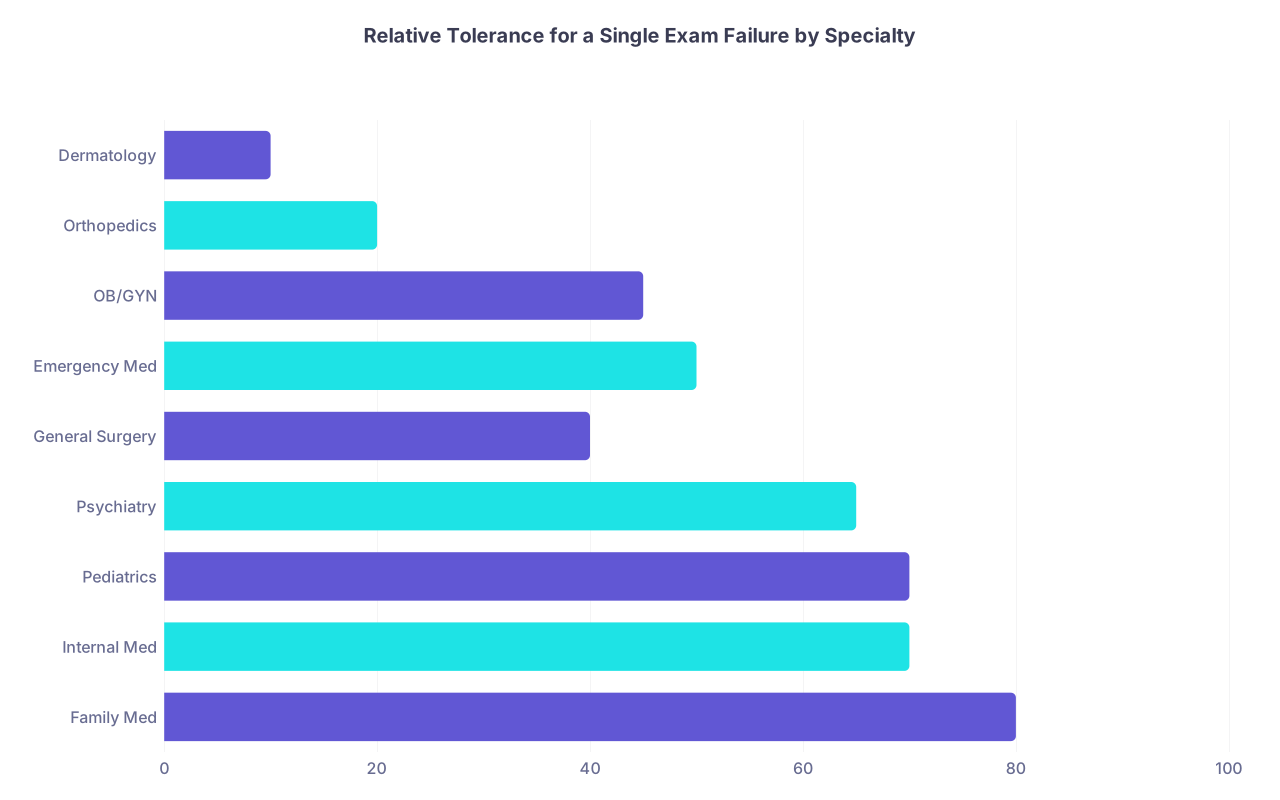
The data are stark when broken down by specialty. Some fields are pragmatic; others are unforgiving.
| Category | Value |
|---|---|
| Family Med | 80 |
| Internal Med | 70 |
| Pediatrics | 70 |
| Psychiatry | 65 |
| General Surgery | 40 |
| Emergency Med | 50 |
| OB/GYN | 45 |
| Orthopedics | 20 |
| Dermatology | 10 |
Interpretation (approximate “% of programs that may still consider you with a single explained failure and strong Step 2”):
- Family Medicine: ~80%
- IM / Peds: ~70%
- Psych: ~65%
- EM / OB/GYN / Gen Surg: ~40–50%
- Ortho: ~20%
- Derm: ~10% (and those 10% usually want insane research, connections, or both)
If you insist on a highly competitive specialty after a failed exam, your match probability is not just low; it is mathematically irrational compared to switching into a more forgiving specialty.
I have seen the same pattern repeatedly:
- Student A with a Step 1 fail and then 250+ Step 2, applies Ortho, 80+ programs, <5 interviews, no match.
- Student B with the same profile, but pivots to IM and applies 40–50 programs, gets 15+ interviews, matches easily.
Same underlying academic history. Different specialty tolerance curves. You cannot out-wish the distribution.
IMG vs US Grad: Red Flags Hit Harder When You Start Lower
For IMGs, the base rates are already lower. A red flag subtracts from a smaller number.
Baseline match rates:
- US-IMGs: ~60–65%
- Non-US IMGs: ~55–60%
A single exam failure can drop this dramatically, particularly in competitive specialties. In practice:
- A US-IMG with one exam failure often effectively removes themselves from most competitive and mid-competitive specialties.
- Realistic lanes are usually Family Med, Internal Med (community-focused), sometimes Psych or Peds with an aggressive application strategy.
For non-US IMGs with a failure:
- Match probability can easily fall well below 40% unless
- Scores on retake are very strong,
- There is significant US clinical experience, and
- Applications are focused on high-IMG, high-volume programs.
The number of programs that are both IMG-friendly and tolerant of failures is finite. You are playing a constrained combinatorial game.
Retake Scores: How High Do You Need to Climb Back?
Program directors do not just care that you eventually passed. They care how you passed.
Empirically, from talking with PDs and reviewing internal spreadsheets over several cycles, the mental thresholds look like this for Step 2 CK after a failed Step 1:
- ≤ 220 (or just above passing): Seen as barely compensatory. Many programs stay uneasy.
- 225–235: Acceptable but does not “erase” the failure. You are still flagged.
- 240–250: Starts to look like a real turnaround, especially in primary care and mid-tier IM programs.
- >250: Strong evidence of capacity; many PDs will downgrade the impact of the original failure.
This is not about perfection. It is about slope. Programs like to see:
- Preclinical → Step 1: trouble
- Clinical performance + Step 2: steep upward trajectory
Your goal on retakes is not “just pass.” That is mathematically naïve. Your goal is to land in at least the mean or slightly above for the specialty you are realistically targeting.
How Many Programs Do You Need to Apply To After a Failure?
This is where the data can actually guide behavior directly.
For US MD seniors without major red flags:
- Many match solidly with 20–40 applications in mid-competitive fields.
With a single exam failure:
- The “sweet spot” shifts upward. I typically see safer outcomes at:
- 50–80 programs for mid-competitive fields
- 80–100+ for more competitive fields (if you are stubborn and stay in the game)
For IM / FM / Peds after a failed exam:
- US MD: 40–60 programs is a reasonable target if the rest of the file is strong.
- US-IMG / Non-US IMG: 80–120 programs is common, with a heavy focus on IMG-friendly programs.
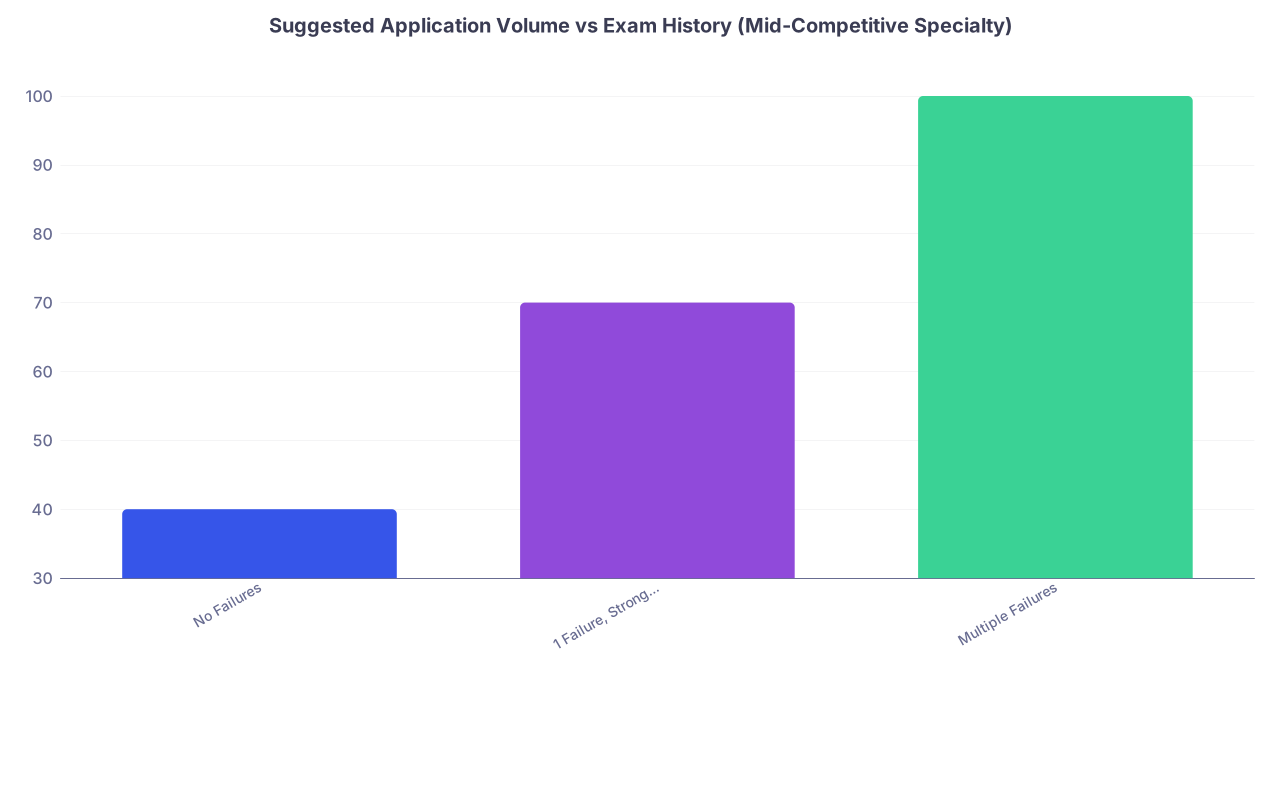
You can visualize it this way:
| Category | Value |
|---|---|
| No Failures | 40 |
| 1 Failure, Strong Step 2 | 70 |
| Multiple Failures | 100 |
The marginal benefit of each additional application decreases, but if your per-program interview probability is low, the volume is the only lever you have.
Other Red Flags That Stack with Failed Exams
Programs do not assess exam history in isolation. They see patterns.
Common stackable red flags:
- Clerkship failures or multiple remediation
- Repeating a year for academic reasons
- Professionalism citations
- Gaps in training with vague explanations
Each one adds friction. Two or more, and you move from “red flag” to “radioactive” for a lot of programs.
Qualitatively, a single exam failure + a repeated shelf + a “required to repeat a year” notation looks far worse than a single licensing exam failure that was followed by straight Honors and a strong Step 2.
The data pattern across PD comments is consistent:
They do not want to fight the dean’s office to defend you. If your record requires an essay just to explain, your program universe shrinks again.
Personal Statement and LoRs: Do They Actually Move the Needle?
Yes, but not the way applicants hope.
Program directors do not read your personal statement to discover that you failed Step 1. They already saw it in the score report. What they want from your explanation:
- A clear causal story (illness, family crisis, untreated ADHD, catastrophic study approach)
- A specific change plan (new resources, test coaching, time management, treatment)
- Objective evidence that it worked (Step 2 score, clinical grades, narrative comments)
Hand-wavy “I learned to work harder” nonsense scores a zero. The data-oriented narrative matters.
Letters of recommendation help in exactly one way here: they provide counterevidence to the worry that your exam failure predicts poor clinical performance.
Phrases that help:
- “Despite a past exam issue, [Name] performed at the level of our strongest students.”
- “I would have no hesitation having [Name] as my resident.”
- “Their fund of knowledge and clinical reasoning are well above average.”
You are trying to replace a negative quantitative signal (failure) with multiple strong qualitative signals and a new quantitative trajectory (Step 2).
Strategic Pivots That Actually Improve Match Probability
You cannot undo the failure. But you can move along axes where the odds are still favorable.
The data-driven pivots:
Change specialty to one with higher tolerance and higher baseline match rates.
Moving from EM or OB/GYN to IM or FM after a failure can easily double your realistic match probability.Maximize Step 2 or Level 2 score.
A +15–20 point overperformance relative to your cohort changes how programs mentally categorize you.Broaden geography and program type.
Community programs, non-coastal regions, and IMG-friendly institutions often have more flexible cutoffs and more seats.Consider a research year or prelim / transitional path only if it clearly enhances your candidacy.
A random research year without publications or strong mentorship is just “one more year” with no payoff.
You are working with conditional probabilities. Given a failure, the best move is not “wish for the best.” It is to optimize the conditional branch where your numbers still add up to something reasonable.
What the Numbers Actually Say
To strip it down to the essentials:
A single failed exam is a serious but not universally fatal red flag.
The combination of a strong retake, upward trajectory, and a realistic specialty choice restores a lot of lost probability.Multiple failures or a failed Step 2 move you into a much smaller universe of programs.
You are now competing in a narrower, more tolerant segment. Volume and targeting become non-negotiable.Specialty, test trajectory, and application strategy interact.
The data are clear: choosing a forgiving specialty and overperforming on Step 2 moves your match odds more than any amount of “hope” in a competitive field.
You cannot negotiate with a score report. But you can absolutely play the numbers game smarter than most applicants do.