
If a LoR Writer Is Late or Ghosting You: Backup Plans and Scripts
What do you actually do when it’s September, ERAS is open, and your “sure thing” letter writer has gone silent?
This is one of those situations that nobody really prepares you for. Advisors say “ask early” and “send reminders.” Fine. You did that. Now it is the week before you planned to certify your ERAS application, your letter is still “Not Received,” and you are watching other people’s screenshots of “Application Submitted” in your group chat.
Let’s deal with the real scenario, not the ideal one.
I’ll walk you through:
- How to triage the situation based on timing
- What scripts to use for nudges, escalation, and graceful backup requests
- When to cut your losses and replace the writer
- How to prevent one late letter from tanking your cycle
- What to do if this is your “chair letter” or your “only home specialty letter”
You’re not the first person this has happened to. You will not be the last. But how you handle it matters a lot.
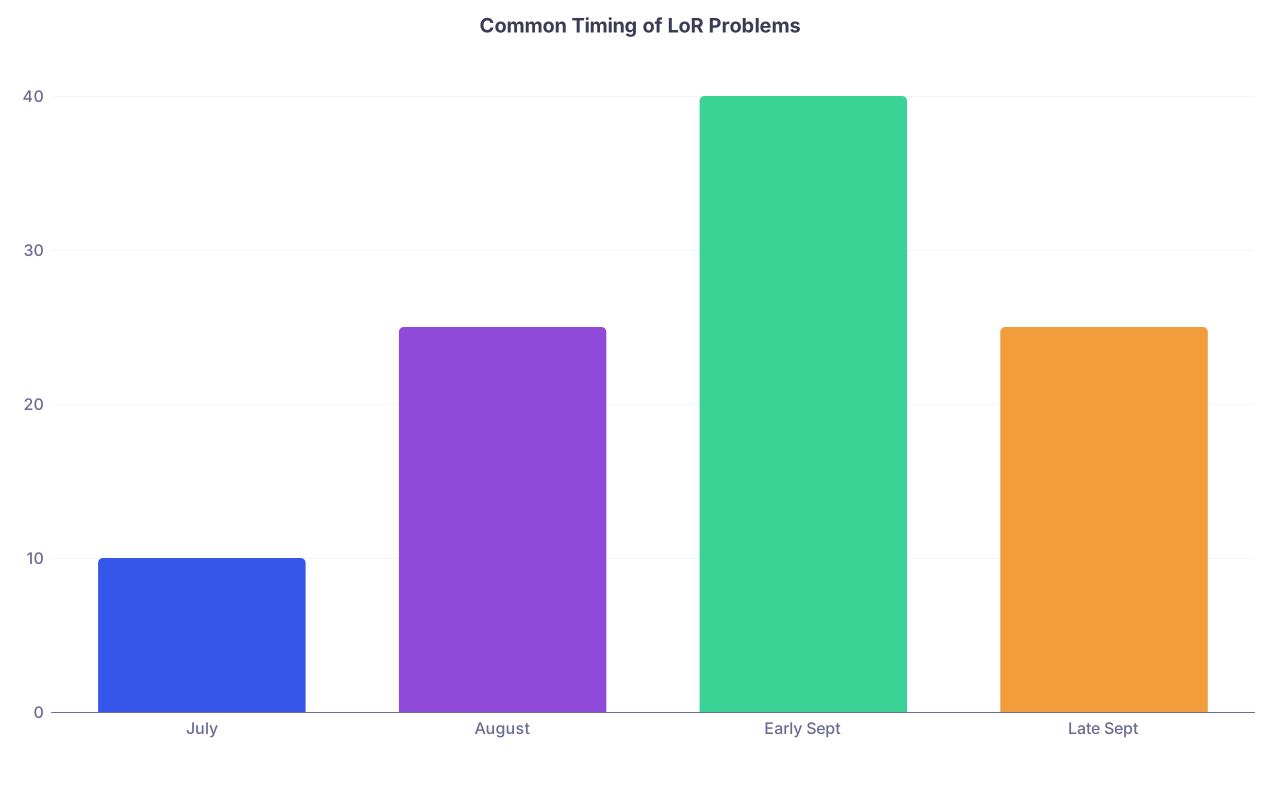
| Category | Value |
|---|---|
| July | 10 |
| August | 25 |
| Early Sept | 40 |
| Late Sept | 25 |
Step 1: Diagnose Your Situation (Timing and Risk)
First question: how bad is this… right now?
Look at three things:
- Today’s date relative to ERAS opening and MSPE release (usually Sept 28–30).
- How many other letters you already have in.
- How critical this particular writer is (home specialty vs random attending).
Rough triage:
| Situation | Risk Level | Typical Move |
|---|---|---|
| 3–4+ weeks before MSPE | Low | Nudge politely, no panic |
| 2 weeks before MSPE | Medium | Strong nudge + line up backup |
| ≤ 7 days before MSPE | High | Hard nudge + actively replace |
| After ERAS submitted | Variable | Add/replace letters as they come |
If you’re:
- More than 3–4 weeks from MSPE: you have time. You’re annoyed, not doomed.
- Within 1–2 weeks: you should be in active backup mode.
- Within a few days: assume the letter is not coming until proven otherwise.
Reality: many attendings write letters late. That’s normal. What’s not normal is total silence after multiple polite reminders. That is where you have to protect yourself.
Step 2: Use the Right Nudge Scripts (Escalating, Not Begging)
You probably already sent the initial polite reminder. If you did it like most students, it was too soft and not specific.
You need three levels of communication:
- Gentle reminder
- Time-anchored, specific ask
- Last-chance + “I’ll pursue a backup” message
Script 1: Gentle Reminder (Use 3–4+ weeks out)
Subject line matters. Many attendings live in inbox chaos.
Subject:LOR for [Your Name] – ERAS due by [date] (quick reminder)
Body:
Dear Dr. [Last Name],
I hope you are doing well. I just wanted to gently touch base regarding the residency letter of recommendation you kindly agreed to write for me for [specialty].
ERAS is now open, and I am planning to certify my application around [date]. The letter request should be in your ERAS portal under my AAMC ID: [ID].
Please let me know if there is any additional information I can provide that would make this easier (updated CV, draft personal statement, bullet points, etc.).
Thank you again for your support and for taking the time to do this.
Best,
[Your Name], [MS4, School]
Fine for early in the game. Too weak when you are 10 days out.
Script 2: Time-Anchored Nudge (Use ~2 weeks out)
Now you add clear timing and some gentle pressure.
Subject:Time-sensitive: ERAS LoR for [Your Name] – target [date]
Body:
Dear Dr. [Last Name],
I hope your week is going smoothly. I am writing to follow up on the residency LoR you kindly agreed to write for my [specialty] applications.
I am planning to certify and submit my ERAS application by [date] to be in the first wave of reviews. If possible, it would help me greatly to have your letter uploaded by [specific date, ~5–7 days away].
I have reattached my CV and personal statement for your convenience. The request should already be visible in the ERAS Letter Writer Portal under my AAMC ID: [ID].
I know this is a busy time. Please let me know if this timeframe is not feasible; I completely understand and can adjust my plans. I am very grateful for your support.
Best regards,
[Your Name]
Notice the key line: “If this timeframe is not feasible…” You’re giving them an out. That’s not weakness. It’s information. You need to know if this is actually not happening.
Script 3: Last-Chance + Backup Activation (Use ≤ 7 days out)
This is where most students chicken out. Do not. This is your career, not a vibes-based project.
Subject:Urgent: ERAS LoR for [Your Name] – deadline this week
Body:
Dear Dr. [Last Name],
I hope you are doing well. I wanted to reach out one more time about the letter of recommendation for my [specialty] residency application.
I am certifying and submitting my ERAS application on [date] to meet my school’s recommended timeline. If you are still able to submit the letter, having it uploaded by [specific date, 2–3 days away] would be incredibly helpful.
I completely understand if your schedule no longer allows you to write a letter this cycle. If that is the case, please do not worry—I will arrange alternate letters so that I can still submit on time.
Thank you again for your time and for everything I learned on your service.
Sincerely,
[Your Name]
That line—“I will arrange alternate letters so that I can still submit on time”—does two things:
- Signals this is now time-critical and they’re holding your app.
- Gives you permission (emotionally) to actually move on.
If they still don’t respond after this? Operationally, this writer is dead to your application. Act accordingly.

| Step | Description |
|---|---|
| Step 1 | LoR not uploaded |
| Step 2 | Send gentle reminder |
| Step 3 | Send time-anchored nudge |
| Step 4 | Wait, confirm upload |
| Step 5 | Send last-chance email |
| Step 6 | Activate backup writer |
| Step 7 | Time to MSPE < 2 weeks? |
| Step 8 | No response in 3-4 days? |
| Step 9 | No response? |
Step 3: Decide Whether to Replace Them (And With Whom)
You can’t just be mad. You have to replace the asset you lost: a decent letter.
First question: what kind of letter was this supposed to be?
- Core specialty letter? (e.g., IM for IM, EM SLOE, etc.)
- “Chair” or department letter?
- Generic “good student, worked hard” letter?
If It Was a Core Specialty Letter
Example: You’re applying EM, and this was supposed to be a SLOE from your home rotation.
High-stakes. But still not binary.
You need to:
- Check minimum letter expectations for your specialty.
- See what you already have locked in.
- Choose the best plausible alternative.
Here’s how that looks in reality:
| Situation | Better Backup | Weak Backup |
|---|---|---|
| Missing 1 EM SLOE | Another EM SLOE (away) | IM/FM attending letter |
| No home IM letter for IM | Strong subspecialty IM letter | Non-IM but inpatient-heavy letter |
| Missing surgery letter | Trauma/acute care letter | Basic OR observer letter |
You prioritize:
- Someone in the same specialty, even if not as “famous.”
- Someone who actually supervised you closely.
- Someone who likes you and will write with detail.
A detailed letter from Dr. Relatively Unknown who worked with you for 4 weeks is better than a vague, rushed, name-brand letter that never arrives.
If It Was a Chair Letter
More politics here.
If your school requires a chair letter (IM, psych, etc.) and the department has a process, you probably should not be handling this solo by cold-emailing the chair again and again.
You go through:
- Your dean’s office
- Your advising office
- The residency program coordinator / student clerkship director
Script for your dean/advisor:
Hi [Advisor Name],
I wanted to ask your advice about my [specialty] chair letter. Dr. [Chair] had kindly agreed to write it, and I submitted the ERAS request on [date]. I have followed up a few times (most recently on [date]) but have not heard back, and the letter is still listed as “Not Received” in ERAS.
Since I am planning to certify my application on [date], I am concerned about being without a chair letter. Is there a standard backup plan in this situation, or someone in the department (e.g., vice chair/PD) who might be able to help?
I really appreciate any guidance.
Best,
[Your Name]
Let the political adults handle the political mess if the person is high up.
If It Was a Generic “Extra” Letter
If this is letter #5 for a specialty that reads 3–4 letters? Honestly, you can often drop it and move on.
Programs do not get bonus points because you sent 6 letters instead of 4. They just choose which ones to read.
Step 4: How to Ask Someone Else Late in the Game (Without Sounding Desperate)
This is the part everyone dreads: you need to ask a new writer in August/September and you feel like a disorganized disaster. You’re not. This happens all the time. You just need to frame it correctly.
Target people who:
- Actually know your work (rotation, sub-I, research, clinic)
- Have some reputation in the field or at least stable academic roles
- Have seen you relatively recently (within last 1–2 years ideally)
Late-Season Ask Script (Honest, But Professional)
Dear Dr. [Last Name],
I hope you are doing well. I am applying to [specialty] residency this cycle and very much appreciated the opportunity to work with you on [rotation/project] in [month/year].
I am in a bit of a time-sensitive situation with one of my planned recommendation letters falling through unexpectedly. Given your familiarity with my clinical work, I wanted to ask if you would feel comfortable writing a strong letter of recommendation for my residency application, even with the short notice.
I realize this is an additional ask on your time, so I completely understand if your schedule does not allow for it. If it is feasible, I can provide:
– My CV
– Draft personal statement
– ERAS letter request link
– A brief list of cases/encounters we shared that might be helpful to mentionMy goal is to certify my application by [date], but ERAS will continue to accept letters after that as well.
Thank you for considering this, and regardless, I’m grateful for what I learned on your service.
Best regards,
[Your Name], [MS4, School]
Key moves here:
- You use the word “strong” explicitly. That gives them an exit if they can’t.
- You do not blame the previous writer. You just say “fell through.”
- You acknowledge the time crunch without apologizing for existing.
The “I Didn’t Work That Closely With You” Problem
If they respond, “I’d be happy to, but we only worked together for a week…” that’s not necessarily a deal-breaker. Short rotations can still yield good letters if they saw you on multiple days and liked you.
You can reply:
Thank you so much, I really appreciate your willingness to help.
To make it easier given the shorter time we worked together, I’ve attached my CV and personal statement, and I’m happy to send a short summary of a few cases and interactions that might jog your memory. If at any point you feel you can’t write a strong letter, please let me know—no worries at all.
That last line keeps quality control in your hands.
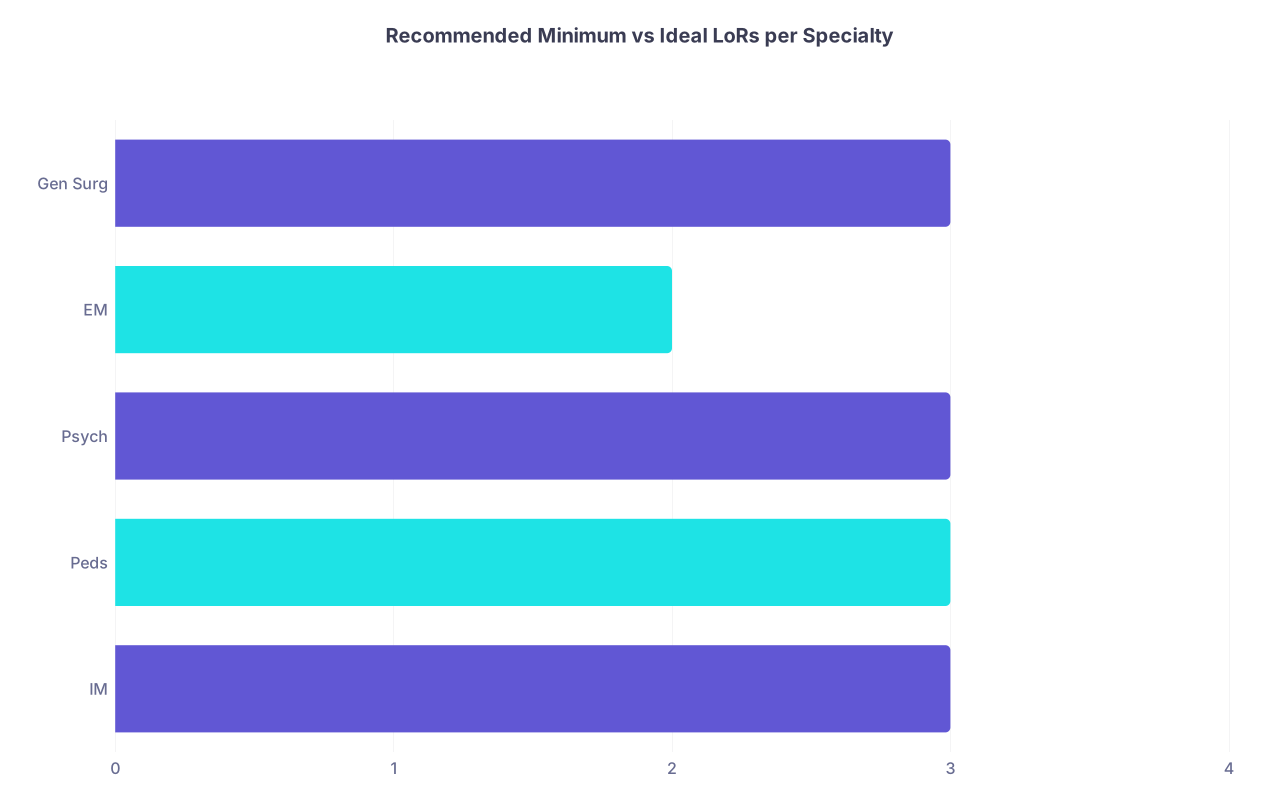
| Category | Value |
|---|---|
| IM | 3 |
| Peds | 3 |
| Psych | 3 |
| EM | 2 |
| Gen Surg | 3 |
Step 5: Clarify How Many Letters You Actually Need
People panic over a missing letter without checking what the floor really is.
Basic pattern (general guidance, always double-check your specialty):
- Most programs read 3–4 LoRs.
- EM: generally want 1–2 SLOEs; non-SLOE letters are nice but secondary.
- IM: often 2+ IM letters; a chair letter sometimes expected/preferred.
- Surgery: 2+ surgery letters strongly preferred.
- Less competitive specialties: quality > quantity; 3 solid letters can be enough.
If you already have:
- 3 decent letters with at least one from your target specialty, you’re not dead.
- 2 strong letters and 1 okay one, you can still submit while improving later.
Do not delay your entire application purely to chase one extra letter. An on-time, complete-enough application with 3 letters often beats a late one with 4.
Programs keep seeing new letters as they come in. Many will review updated files before rank list finalization.
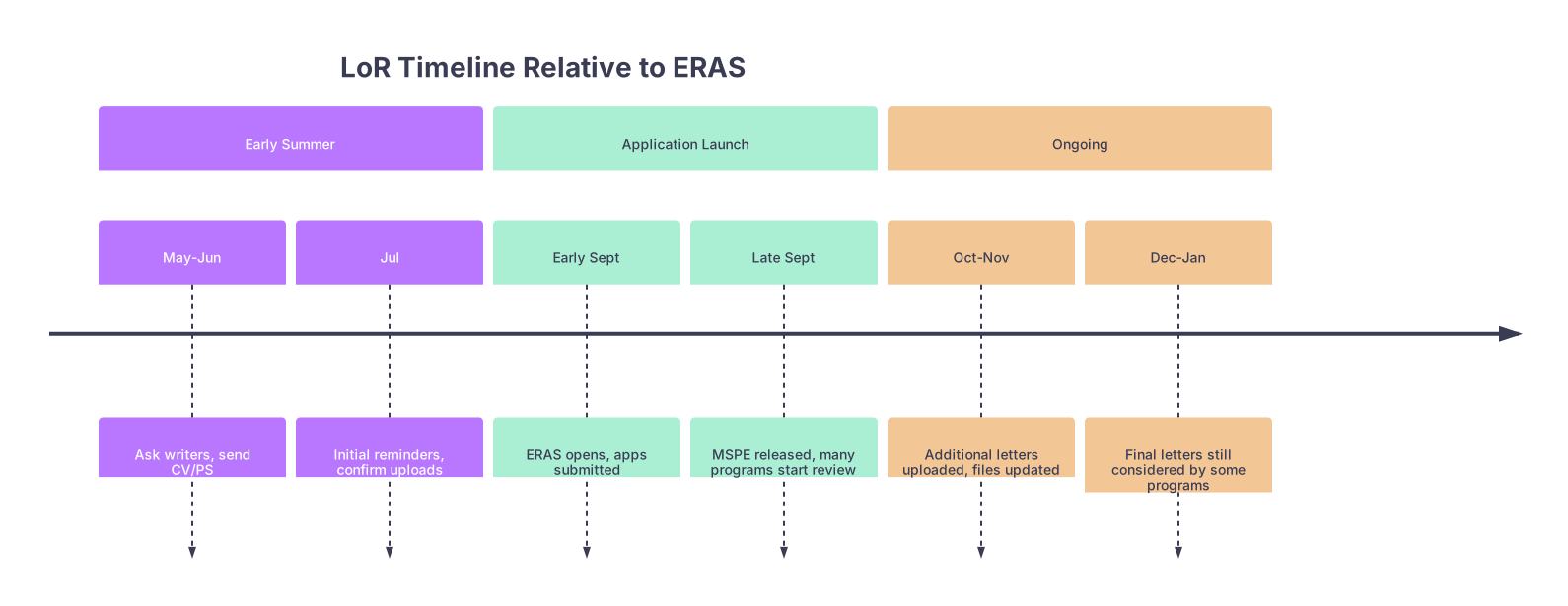
| Period | Event |
|---|---|
| Early Summer - May-Jun | Ask writers, send CV/PS |
| Early Summer - Jul | Initial reminders, confirm uploads |
| Application Launch - Early Sept | ERAS opens, apps submitted |
| Application Launch - Late Sept | MSPE released, many programs start review |
| Ongoing - Oct-Nov | Additional letters uploaded, files updated |
| Ongoing - Dec-Jan | Final letters still considered by some programs |
Step 6: If the Writer Finally Uploads Late—What Then?
You replaced them. You moved on. Then… two weeks into October, they suddenly upload the letter.
What do you do?
If You Still Have Space
ERAS lets you assign up to 4 letters per program (some specialties effectively expect fewer, but technically the system allows 4).
You decide:
- Is this writer significantly more senior or more specialty-aligned than one of your existing letters?
- Is there a weak “generic” letter you’d happily swap out?
If yes, you can go into ERAS and:
- Unassign a weaker letter from some or all programs.
- Assign the new one instead.
Programs see what’s there when they open the app. Some will re-check updates. Some will not. But sending a better mix going forward never hurts.
If You’re Already at 4 Good Letters Everywhere
Then you’re probably done. Do not obsessively re-shuffle just because “they finally did it.” At that point, the letter is a bonus, not a fix.
Write a brief, gracious thank you:
Dear Dr. [Last Name],
Thank you very much for taking the time to submit my residency letter. I really appreciate your support, especially during such a busy time of year.
Best regards,
[Your Name]
That’s it. You do not need to explain the entire saga.
Step 7: Emotional Debrief and Future Damage Control
Let me be blunt: if someone agreed to write you a letter and then ghosted your reminders for weeks, that is unprofessional. You are allowed to be annoyed. Just don’t let the annoyance bleed into your emails or your behavior.
What you can do is learn from it:
- Never rely on only one person for a mission-critical letter.
- Aim for one extra letter in your target specialty earlier in the year.
- Ask, “Would you feel comfortable writing me a strong letter?” when you ask. Their face and hesitation will tell you everything.
If you’re an M3 reading this preemptively, good. Build redundancy early.
If you’re MS4 and already in the storm, your goal now is simple: get to 3–4 competent letters, on time, with at least one from your specialty. Perfect is gone. You’re optimizing for “good enough + on time.”
Step 8: When You Should Loop In Your School
Sometimes you should stop suffering alone in your apartment and get institutional help.
Escalate to your dean/advisor if:
- A required chair/department letter is at risk.
- Multiple students have the same ghosting issue with the same faculty member.
- Your application will be submitted missing the minimum specialty letters your school “strongly recommends.”
Your dean cannot conjure letters from thin air, but they can:
- Nudge a faculty member peer-to-peer (which is way more effective than your email).
- Suggest alternate faculty who routinely write letters.
- Document in your MSPE if there was some departmental mess totally outside your control (rare, but happens).
When you email them, be factual, not dramatic:
I’ve attached screenshots of my ERAS LoR status and the dates of my follow-up emails to Dr. [X]. I’m concerned about being without a [specialty/chair] letter by [date]. Could we discuss possible backup options?
You are presenting a solvable problem, not asking them to fix your emotions.

Quick Do/Don’t Summary
Just to crystalize things:
Do:
- Send clear, time-bound reminders with explicit deadlines.
- Build backup options before you are desperate.
- Be honest but professional when a letter falls through.
- Submit your application when it is “complete enough” (3 letters) rather than waiting indefinitely.
- Use your dean/advisors strategically for high-stakes letters.
Don’t:
- Spam your writer daily or get passive-aggressive.
- Rely on one “famous” attending as your only specialty letter.
- Delay ERAS submission by weeks just for one more letter, unless your specialty absolutely demands it.
- Badmouth the ghosting faculty to programs, during interviews, or on social media. It always gets back.

FAQ (Exactly 5 Questions)
1. Should I delay certifying my ERAS application until all letters are in?
Usually no. Once you have 3 reasonable letters, especially at least one from your target specialty, you should seriously consider submitting on time. Programs can and do see newly uploaded letters later. The damage from being significantly late often outweighs the marginal benefit of one extra letter.
2. Can I reuse a LoR from last year if I’m reapplying?
Yes, if the writer agrees and updates/submits it through ERAS again. Ideally, they tweak it to reflect your growth since last cycle, but even a slightly updated version is usually fine. Do not assume they’ll just copy it over—ask explicitly and re-send the ERAS request.
3. What if my only strong letter is from a non-target specialty?
You still use it. A glowing FM letter for someone applying IM is way better than a vague IM letter from someone who barely knows you. Then you hustle to get at least one letter from closer to your field (subspecialty, inpatient service, research mentor in the same department).
4. Is it rude to ask a new writer “last minute” in August or September?
It’s not ideal, but it is reality and most attendings know this happens. The key is being honest about the time constraint, giving them an easy out, and making it as easy as possible (CV, PS, bullet points, ERAS link). Many will still say yes. If they’re irritated, they’ll just decline.
5. Will programs view me negatively if one of my planned letters never shows up?
They almost never know a letter is “missing.” They just see what you actually send. They are not comparing to some secret list. As long as you hit the typical expectations (3 letters, at least one or two in the specialty), they will judge you on what they read, not on the phantom letter that never appeared.
With a plan, some firm-but-respectful emails, and backup writers lined up, a late or ghosting LoR writer becomes an annoyance—not a catastrophe. You’ve handled one of the uglier logistics of this process. Next comes interviews, thank-you notes, and rank lists—but that’s a story for another day.