
It’s August. Your ERAS token came weeks ago. Your classmates are swapping “what did you get on Step 2?” screenshots. You’re staring at something else: a score report with the word that makes your stomach drop.
Fail. Fail on Step 1. Or Step 2. Or both on the first attempt.
And now the clock’s ticking toward September, and the question hanging over everything is ugly and simple:
How do you present this in ERAS without killing your chances?
Let me be blunt: the failure is not what ruins people’s cycles most of the time. The way they handle it is what torpedoes them. Evasive answers. No plan. Inconsistent explanations. Or an application that screams, “Please don’t look at my scores” instead of, “Here’s why you should still interview me.”
Let’s fix that.
Step 1: Understand What Programs Actually See And Think
Before you decide how to present the failure, you need to be clear on what’s visible and how it’s interpreted. You are not hiding this. You are framing it.
What programs see in ERAS
Programs will see:
- Every USMLE/COMLEX attempt and result you’ve released
- Dates of each attempt
- Whether you passed on a subsequent try
- Score (for Step 2 CK/Level 2 CE, since Step 1/Level 1 are now pass/fail)
They also see:
- Your transcript timeline (gaps, LOA, remediation)
- MSPE comments about academic issues
- Whether you checked “yes” to the questions about failing a USMLE/COMLEX exam
Don’t build your strategy around wishful thinking like “maybe they won’t notice.” They will.
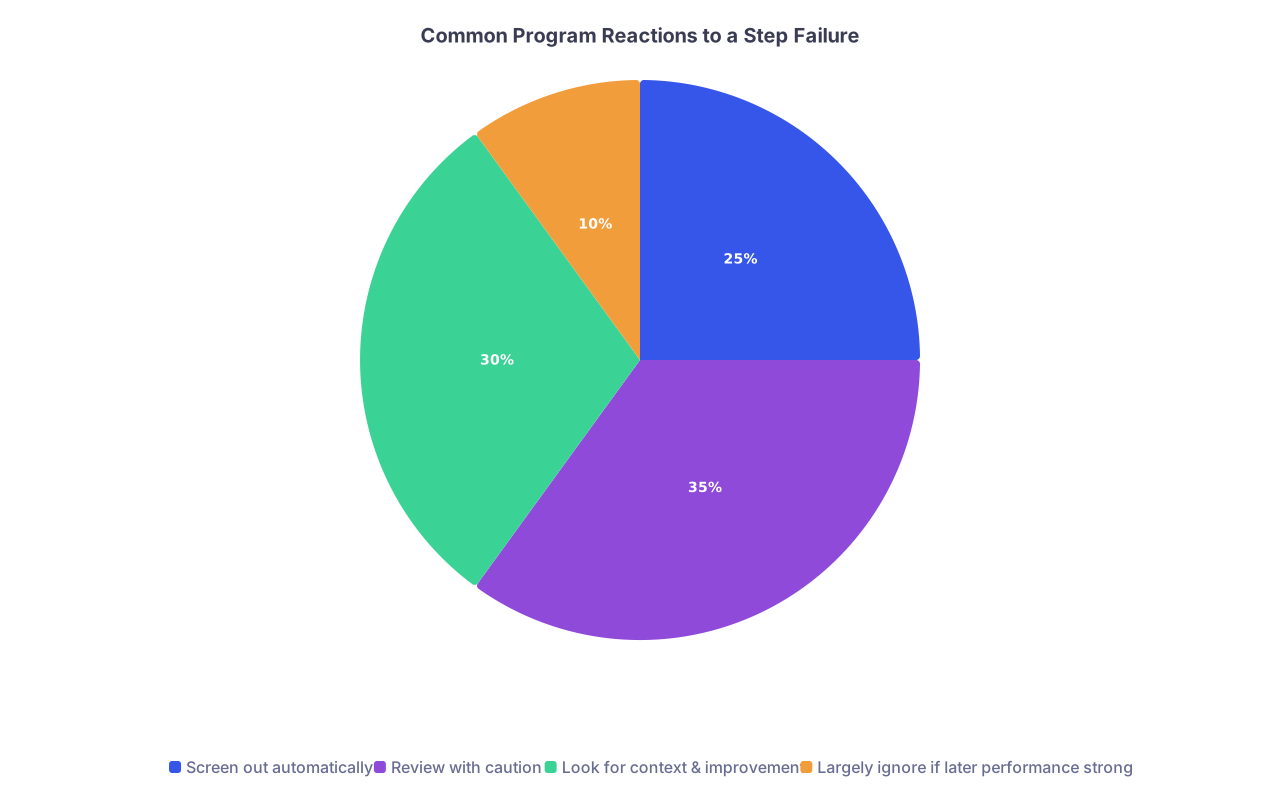
| Category | Value |
|---|---|
| Screen out automatically | 25 |
| Review with caution | 35 |
| Look for context & improvement | 30 |
| Largely ignore if later performance strong | 10 |
What they actually care about
Most programs are asking:
- Does this predict you’ll fail boards again as a resident?
- Does this mean you struggle with pressure, time management, or consistency?
- Did you learn anything, or are you coming in as the same risk you were then?
- Is your story coherent, or are you BS-ing me?
They are not sitting there as cartoon villains laughing at your failure. They’re risk-managing. Passing boards = their accreditation, their data, their time.
Your job: show them you’ve become a lower risk candidate since that failure.
Step 2: Decide What Needs Explicit Explanation (And What Doesn’t)
Not every failure needs a 500-word confession. Oversharing is a real problem.
Use this simple triage:
| Situation | Do You Need To Explicitly Explain It? |
|---|---|
| Step 1 fail, then solid Step 2 (≥ 240 / strong relative to specialty) | Brief explanation, usually in MSPE or PS addendum |
| Step 2 fail but strong pass on second attempt | Yes, more direct explanation somewhere |
| Multiple exam failures (e.g., Step 1 and Step 2, or 2+ attempts) | Yes, structured explanation and remediation plan described |
| Failure plus repeat courses/LOA | Yes, needs integrated narrative across PS and MSPE |
| Failure with no subsequent board score yet (applying early Step 2) | Yes, but keep it concise and forward-looking |
General rule:
The closer the failed exam is to residency (Step 2 / Level 2) and the more times you failed, the more explicit and proactive you need to be about addressing it.
Step 3: How To Answer The ERAS “Have You Failed A Step?” Question
You’ll see this kind of question:
Have you ever failed a USMLE or COMLEX examination?
You check “Yes.”
There’s sometimes a free-text box or you may end up addressing it elsewhere, but the number one mistake here:
People start explaining. Or worse, justifying.
In the ERAS checkbox itself, you do not explain. You simply answer truthfully. The explanation belongs in:
- Your personal statement (brief, targeted paragraph)
- Or the additional info section
- Or a program-specific secondary/portal if they ask
Do not contradict yourself. If you mark “Yes” on ERAS, do not let an advisor pressure you into glossing over it everywhere else. Programs hate inconsistencies more than a single failure.
Step 4: Building The Right Kind Of Explanation
Most applicants either say way too little (“I had personal issues”) or way too much (“My ex broke up with me, my dog died, my landlord…”) and both look bad.
Here’s the structure that actually works.
A. Acknowledge briefly and clearly
One sentence. No drama.
“During my first attempt at Step 1, I did not pass.”
Or:
“I failed Step 2 CK on my first attempt in June 2024.”
Not:
“Despite working incredibly hard and enduring many personal hardships, my performance on standardized testing did not reflect my capabilities and resulted in an unfortunate outcome.”
That language screams avoidance and spin.
B. Give a concise, non-excuse context
One or two sentences max. Root cause, not a sob story.
Examples of acceptable context:
- “I underestimated the volume of material and overrelied on passive studying, which was not effective for me.”
- “I was balancing clinical responsibilities and a family health crisis, and I did not adjust my preparation adequately.”
- “I had undiagnosed ADHD that significantly affected my exam performance; I have since been evaluated and treated.”
Pitfalls:
- Blaming the exam: “The exam was unfair.”
- Blaming med school: “My school didn’t prepare us well.”
- Over-sharing trauma details: keep it professional, not confessional.
C. Describe concrete changes you made
This is the most important part. If you skip this, the failure looks like a random fluke or a personality trait.
You want 3–5 specific interventions, such as:
- Switched from passive reading to daily timed blocks of UWorld/AMBOSS
- Scheduled weekly dedicated review with a faculty mentor or learning specialist
- Completed an NBME every 2 weeks, tracked missed-question patterns, adjusted plan
- Got formal accommodations or treatment for a learning or mental health condition
- Took a lighter clinical load or formal LOA during dedicated study
Make it sound like a plan, not “I just tried harder.”
D. Show results and connect them to residency
You close by showing improvement and why that should matter to them.
Example:
“These changes led to a 42-point improvement on my Step 2 CK, which I passed on my next attempt with a 245. More importantly, they gave me durable study habits I now use for in-service exams and complex clinical questions.”
Programs want: evidence that the risk is now lower. Use numbers, timing, and behavior changes.
Step 5: Where To Put The Explanation (Without Letting It Take Over)
You’ve got limited real estate. Do not turn your entire application into “The Step Failure Story.”
Here’s how I’d place it depending on your situation.
1. Mild scenario: Step 1 fail, now passed, strong Step 2, no other major issues
You likely do:
- 2–3 sentences in your personal statement, mid-body
- Brief factual mention in MSPE (your school usually does this anyway)
- No need to fill “additional info” with more unless there’s nuance (LOA, health issues)
Example PS snippet:
“Midway through second year, I failed Step 1 on my first attempt. I had relied heavily on passive review and did not appreciate how much the exam tested application. With guidance from our learning specialist, I rebuilt my approach around daily timed questions, spaced repetition, and regular self-assessment. I passed comfortably on my second attempt and later scored a 248 on Step 2 CK, using the same structured habits I now bring to my clinical work.”
That’s it. Move on to who you are as a future resident.
2. Moderate scenario: Step 2 fail or multiple attempts, but now passed; solid recent performance
Here you go a bit more explicit:
- Short paragraph in personal statement
- Use “additional info” to outline remediation plan and support systems
- Make sure MSPE explanations align with your version
You might also have a faculty advocate (PD, dean, mentor) explicitly mention your improvement and reliability in a letter.
3. Heavy scenario: Multiple failures + course remediations + LOA
Do not try to bury this. It will show up from five different documents anyway.
What you do instead:
- Integrate the story into your PS but keep it under control: one major paragraph about adversity + growth, then redirect to current strengths
- Use additional info to list concrete steps and outcomes (USMLE improvement, in-training exams, clinical evals)
- Ask at least one LOR writer to directly endorse your reliability and test-taking improvement (“He passed all subsequent shelf exams on the first attempt and is now among the stronger performers in our cohort.”)
The key: make this look like a contained chapter, not an ongoing crisis.
Step 6: Adjusting Your Application Strategy Around The Failure
You can do a perfect job framing the failure and still get burned if your strategy is delusional.
Here’s where you need to be cold-eyed.
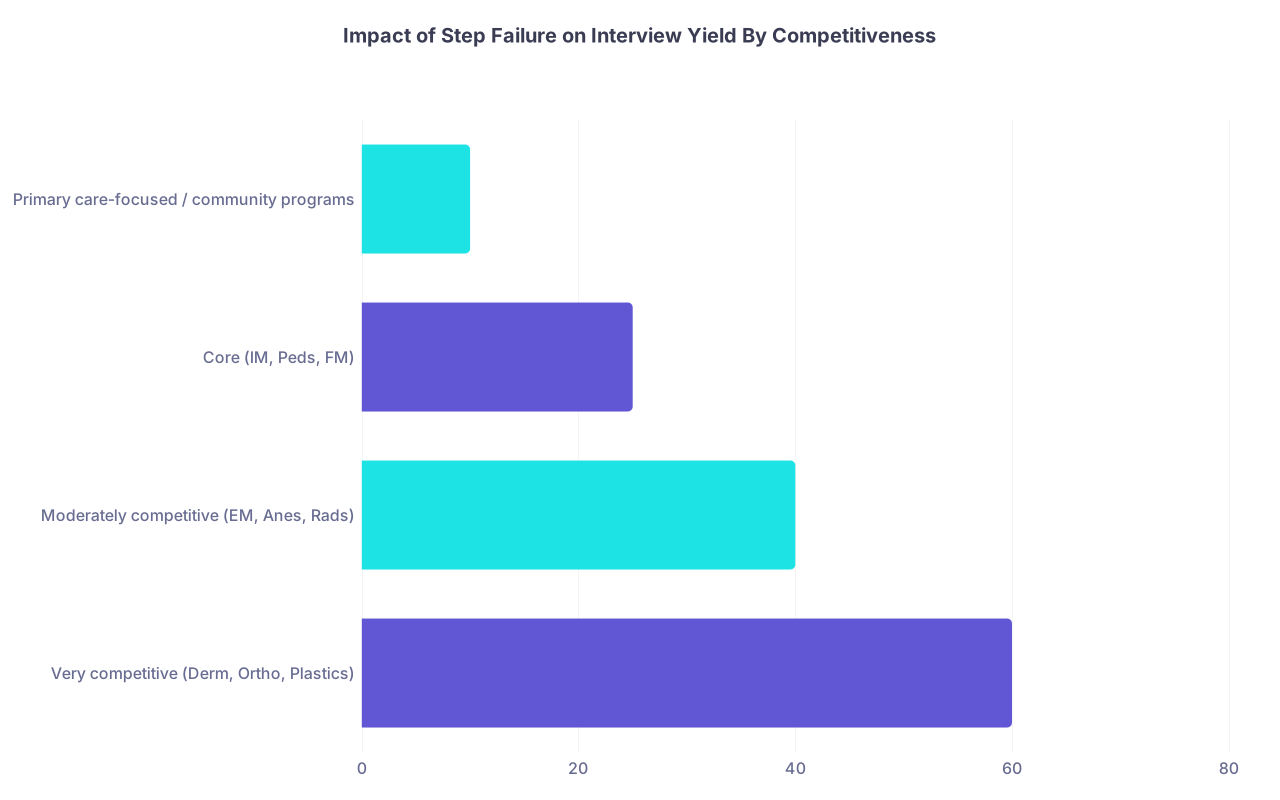
| Category | Value |
|---|---|
| Very competitive (Derm, Ortho, Plastics) | 60 |
| Moderately competitive (EM, Anes, Rads) | 40 |
| Core (IM, Peds, FM) | 25 |
| Primary care-focused / community programs | 10 |
That chart isn’t data from a single study; it reflects reality I’ve seen over and over: a failure hits you hardest in hyper-competitive fields and least in community primary care.
Tactical moves:
- Widen your net. Apply to more programs than your peers with clean scores, especially community and mid-tier academic sites.
- Use home and away rotations strategically. Face time with faculty who can vouch that your exam issues are behind you is gold.
- Have a parallel plan if you’re going after a competitive specialty with a failure. Example: EM + IM, Ortho + prelim surgery + IM, etc.
- Be early with Step 2. If Step 1 was the issue, you want your Step 2 score in ERAS on day one, and you want it strong.
Overconfidence kills here. You can be an excellent future physician and still need a pragmatic match strategy.
Step 7: Handling Interviews Without Imploding
If you have a failure, you will get variants of this question:
“Can you tell me about your Step 2 result?”
Do not act surprised. You should walk into every interview with a rehearsed, consistent, 60–90 second answer that hits the same structure as above.
Here’s a template you can adapt:
- Direct acknowledgment
- Concise root cause
- Specific changes
- Concrete results
- Tie-in to residency
Example:
“Sure. I failed Step 2 CK on my first attempt. At the time, I was transitioning between clinical rotations and studying in a very unstructured way—mostly passive review and not enough timed practice questions. After that, I met weekly with our learning specialist, shifted to daily blocks of timed questions, and took an NBME every two weeks to track progress. I also adjusted my rotation schedule to allow more consistent study time. On my second attempt, I passed with a 241. Since then, I’ve used the same system to prepare for shelf exams and have passed all on the first try. It ended up being a hard but useful lesson about how I need to prepare for high-stakes exams, and it’s a system I plan to apply to in-training exams and boards in residency.”
Say it. Stop talking. Let them ask follow-ups.
Things that kill you in person:
- Looking defensive (“Well, lots of people fail Step 1 now…”)
- Looking ashamed and vague (“Yeah… personal stuff.”)
- Blaming others (“Our school didn’t give us enough time.”)
- Rambling for five minutes
Practice this out loud with a human who’ll call you on your BS. Not just in your head.
Step 8: Align The Story Across All Documents
One of the worst looks: contradictory stories.
MSPE says:
“Student took a leave of absence due to academic struggles and failed Step 1.”
You say in your PS:
“I chose to take time away for personal reflection and growth.”
Programs are not dumb. They read. They compare.
You want alignment among:
- ERAS checkboxes
- Personal statement
- Additional info section (if used)
- MSPE language
- LORs that mention your struggles
That does not mean copying exact phrases. It means the facts match:
- Same exam
- Same number of attempts
- Same general reasons (study strategy vs health vs family)
- Same timeline
Before you submit, literally make a mini audit:

| Step | Description |
|---|---|
| Step 1 | Identify all mentions of failure |
| Step 2 | PS |
| Step 3 | Additional Info |
| Step 4 | MSPE |
| Step 5 | LORs |
| Step 6 | Fix inconsistencies before submission |
| Step 7 | Same exam & attempt count? |
Two hours of checking now saves you from looking dishonest later.
Step 9: Do Not Build Your Whole Identity Around The Failure
Another common trap: turning your entire narrative into “I failed but I’m resilient.”
Resilience is fine. Obsessing over the word “adversity” for 800 words is not.
Programs also need to know:
- How you work in teams
- How you think clinically
- Why this specialty makes sense for you
- What you’ll bring to their residents and patients
Use the failure as one data point that shows growth. Then move on to your actual strengths:
- Great clinical comments
- Leadership work
- QI/research that actually mattered
- Teaching, mentoring, language skills
Think of your failure paragraph as a spice, not the whole meal.
Step 10: If You Don’t Have A Strong “Comeback” Score Yet
This is the nastiest situation: you failed Step 1, your Step 2 date is cutting it close, and you might be submitting ERAS without a clear redemption score.
Here’s exactly what to do:
- Move heaven and earth to take Step 2 before ERAS opens, if at all possible, with adequate prep. A mediocre but passing Step 2 in hand is often better than a giant question mark.
- In your application, be brief but honest about the timeline:
“I failed Step 1 on my first attempt in January. Since then I’ve worked with our learning specialist to build a new study system, and I’m scheduled to take Step 2 CK on September 20th using that approach.” - In interviews, be ready to explain your preparation in detail, and if your score comes in later and is solid, email programs with an update.
- Realize your list needs to be even broader. Uncertainty = risk; you compensate with volume and thoughtful targeting.
Do not panic-schedule Step 2 with two weeks of preparation just to have a score to show. That’s how people fail twice and dig a crater.
FAQ (Exactly 4 Questions)
1. Should I ever not release a failed Step score to certain programs?
If you’re applying to ACGME-accredited programs using ERAS, cherry-picking who sees which USMLE attempts is basically not a thing. Trying to hide a failure by selectively releasing scores almost always backfires once they see your full transcript or MSPE. Assume they will see all attempts and build your strategy around transparency and framing, not concealment.
2. Can a strong Step 2 score “cancel out” a Step 1 failure?
Cancel out? No. Compensate? Absolutely. A strong Step 2 (for your specialty tier) reframes you as someone who learned and improved rather than someone who just struggles with tests. Programs care more about Step 2/Level 2 now anyway. But if you’re shooting for ultra-competitive fields, that Step 1 failure will still narrow your realistic options. You use Step 2 to prove you’re not an ongoing liability.
3. Should I write about my Step failure in every personal statement for every specialty?
If you’re applying to more than one specialty, the failure is part of your overall academic record, not part of “why I love this specialty.” It can be the same short paragraph in each PS, but do not bend your entire narrative around it. You can also choose to keep the explanation entirely in an “additional info” section, but if the failure is significant (Step 2, multiple attempts), I’d address it briefly in each PS so you control the framing.
4. How do I know if my explanation sounds like an excuse?
Test it this way: remove all the “I take responsibility” language and look only at factual content. If 80% of what remains is about other people, circumstances, and misfortune—and less than 20% is about your decisions and your concrete changes—it reads like an excuse. A good explanation is specific about your mistakes, explicit about what you changed, and backed by results. Ask a blunt friend, resident, or advisor to listen to your answer and tell you if it sounds like justification or ownership.
Open your personal statement draft right now and find the part (or the blank space) where your Step failure belongs. Write three sentences: one that states the failure plainly, one that names the real reason, and one that describes the most important change you made afterward. Then stop typing. Walk away for 10 minutes. When you come back, cut any fluff and make those three sentences as sharp and honest as you can. That’s your foundation.