
The MSPE is not a “Dean’s letter.” It is a risk assessment document, and program directors read it exactly that way.
Let me be blunt: your MSPE is the one part of your application you do not control, but it is absolutely shaped by what you did (or failed to do) for four years. PDs learn more from what is slightly “off,” omitted, or oddly phrased than from all the glowing adjectives combined. If you do not understand how they read this thing line by line, you will misjudge how your application is actually landing.
I will walk you through the MSPE exactly the way PDs and selection committees go through it in real time. Section by section, phrase by phrase. And I will point out the landmines where students get quietly filtered out while wondering why their “solid” application underperformed.
How PDs Actually Use the MSPE
PDs do not sit down with your personal statement first. They open ERAS, pull up your MSPE and transcript together, and scan for three things before anything else:
- Reliability
- Risk
- Signal of trajectory (upwards, flat, or downhill)
Step scores, class rank, and honors are the skeleton. The MSPE narrative is the soft tissue that tells PDs how you behave on real wards with real patients and real teams.
In most programs, the reading pattern looks roughly like this:

| Step | Description |
|---|---|
| Step 1 | Open Application |
| Step 2 | USMLE/COMLEX Scores |
| Step 3 | Medical School Transcript |
| Step 4 | MSPE Summary Page |
| Step 5 | Clinical Clerkship Narratives |
| Step 6 | Adverse Actions/Leaves |
| Step 7 | Compare to Letters & Personal Statement |
| Step 8 | Preliminary Risk/Rank Bucket |
Three mistakes I see students make over and over:
- They overestimate how much their personal statement matters and underestimate the MSPE.
- They think “no failures” is enough, and ignore soft red flags buried in narrative language.
- They do not realize that “average” at some schools is interpreted as “weak” in competitive programs.
Let me break this down section by section, exactly how PDs read it.
The Front Page: Summary, Class Standing, and Code Words
This is where the committee decides whether to read everything carefully or skim.
School Context and Grading System
PDs are scanning for:
- Is this a graded or pass/fail preclinical curriculum?
- Are clerkships tiered (Honors/High Pass/Pass) or just Pass/Fail?
- Does the school provide comparative data (quartiles, percentiles, distribution charts)?
If your school hides everything behind “our policy is to not rank students,” PDs know that is not your fault. But they also know they have fewer anchors, so they will lean more on narrative language, anecdotes, and any indirect rank signals they can find.
Class Rank, Quartiles, and “Not Ranked”
Here is the uncomfortable reality: most PDs mentally put you into one of four buckets very early:
- Top 10–25%
- Middle 50%
- Bottom 25%
- Unknown (no rank data / school obscure / confused system)
They will use anything they can:
- Explicit quartiles (e.g., “upper third”)
- Internal designations (e.g., “outstanding,” “excellent,” “very good,” “good”)
- Honors count vs class median
- Any histogram or distribution graphic your school provides
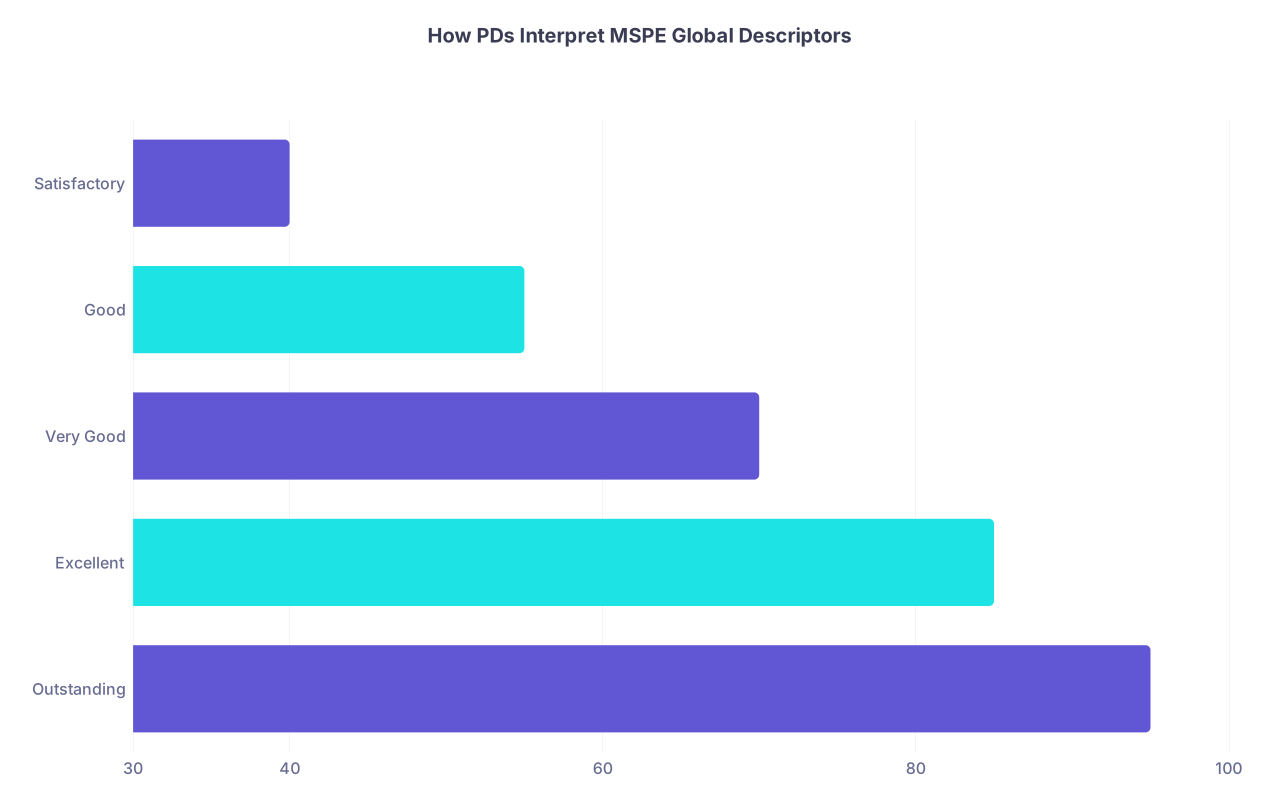
| Category | Value |
|---|---|
| Outstanding | 95 |
| Excellent | 85 |
| Very Good | 70 |
| Good | 55 |
| Satisfactory | 40 |
Those numbers are not scores; they roughly reflect how “competitive” PDs think a candidate is when they see that descriptor as the global MSPE statement. “Good” is not good. It is bottom half at many schools.
Hidden Pitfall #1: Global Summary Language
Look for phrases in your global MSPE summary like:
- “Overall, [Name] has satisfactorily met the requirements for graduation.”
- “With appropriate supervision, [Name] will be able to function as an intern.”
- “Given continued development, we expect [Name] to be a competent resident.”
These are not compliments. They are coded warnings that:
- You are not in the top half of the class, and
- Someone on the committee argued not to oversell you
Better phrases that PDs actually like to see:
- “We give [Name] our highest recommendation for residency training.”
- “One of our top students this year.”
- “We expect [Name] to be an outstanding house officer.”
You cannot rewrite the letter, but your behavior over four years determines which sentences your dean feels comfortable using. If you are early in training and reading this: you are writing your future MSPE every single clerkship.
Preclinical Section: Usually Boring, Except When It Is Not
Most PDs skim preclinical comments unless:
- There were academic difficulties (remediation, failures, repeats)
- There is significant professionalism commentary
- There is a strong pattern of excellence that fits letters and scores
Common pitfalls here:
Hidden Pitfall #2: Remediation and “Extended Curriculum”
If you see language like:
- “Required to repeat the first-year curriculum.”
- “Took a leave of absence between M1 and M2 to address personal issues.”
- “Remediated Foundations of Medicine in the summer.”
PDs do not automatically reject you. But they will look for:
- Clear “story of recovery” – upward trajectory in later years
- No repeat pattern of struggling in related areas
- Honest, consistent explanation in your personal statement and/or ERAS “Education interruptions”
What kills applicants is mismatch:
- MSPE mentions a leave of absence.
- ERAS does not list it clearly.
- Personal statement is silent.
That reads as concealment. And concealment is a bigger problem than almost any single failure.
The Clinical Clerkship Narratives: Where PDs Slow Down
This is the heart of the MSPE. If your school is like most, each core clerkship will have:
- A grade (Honors/HP/Pass, or Pass/Fail)
- A shelf / NBME / exam score or percentile (sometimes hidden)
- A narrative paragraph distilled from multiple faculty evaluations
Here is how PDs typically read these.
1. Start with the Pattern of Grades
They scan down the list:
- Internal Medicine
- Surgery
- Pediatrics
- OB/GYN
- Psychiatry
- Family Medicine
- Neurology / EM / others
They are asking:
- Are there consistent Honors across clinical rotations?
- Are the weaker grades clustered early with later improvement, or worse, is it the reverse?
- Are the strongest grades in the specialty the student is applying to?
| Pattern | PD Interpretation |
|---|---|
| H in IM, Peds, FM; HP in Surg | Strong clinically, slight OR lag |
| HP/Pass early, then Honors later | Clear upward trajectory |
| Mostly Passes, few HP, no Honors | Middle/lower tier, needs context |
| Honors in target specialty only | Possible grade inflation or gaming |
Hidden Pitfall #3: Mismatch With Your Target Specialty
If you are applying to:
- Internal Medicine with a Pass in Medicine
- General Surgery with Pass/Low in Surgery
- EM with poor comments on acute care / organization
PDs will absolutely notice. And they will go line by line in that specific clerkship narrative to find out why.
2. Then They Read the Words
And this is where most applicants get blindsided. They assume “no negative comments” means “good.” It does not. PDs read for adjectives, adverbs, and what is conspicuously absent.
Translating Common Narrative Phrases
Here is the rough translation dictionary PDs use. They will not say this out loud on a webinar, but in closed-door meetings this is exactly how they talk.
| Phrase in MSPE | PD Interpretation |
|---|---|
| "Pleasant, hard-working, punctual" | Reliable but unremarkable; lower half |
| "Mature, insightful, exceeded expectations" | Strong, likely top quartile |
| "Will make a fine resident with continued guidance" | Needs more hand-holding than average |
| "Required more supervision than typical" | High-risk; red or dark yellow flag |
| "Quiet but dependable team member" | Passive; may struggle in high-acuity settings |
| "Strong fund of knowledge" | Academically strong, may be less social risk |
The trickier red flags are soft. Look for:
- “Improved over the course of the rotation” – had problems initially
- “Responsive to feedback” – there was significant feedback
- “By the end of the rotation…” – the beginning was not good
- “Within the scope of a medical student” – did not step up, minimal initiative
Hidden Pitfall #4: The “Faint Praise” Narrative
Here is a real pattern I have seen countless times:
Internal Medicine narrative:
“[Name] was a punctual and polite member of the team. She completed all assigned tasks and interacted appropriately with patients. She will be a reliable intern.”
Surgery narrative:
“[Name] showed enthusiasm in the operating room and readily assisted with cases. She responds to feedback and will continue to grow in her technical skills.”
Family Medicine narrative:
“[Name] built a good rapport with patients and worked well with staff. She will be a solid contributor to any residency program.”
Nothing overtly negative. But there is no “initiative,” no “outstanding,” no “top student,” no “we strongly recommend.” This is classic middle-of-the-pack language, and in competitive specialties that gets you filtered out before interview.
In contrast, PDs love to see:
“Among the top students I have worked with,”
“Needed minimal supervision,”
“Functioned at or near the level of an intern,”
“Frequently sought out additional learning opportunities,”
“Trusted to manage complex patients with appropriate oversight.”
These phrases are not thrown around casually. When they are absent across all clerkships, it matters.
Professionalism, Leaves, and Adverse Actions: The Nuclear Section
Every PD I know scrolls directly to any section titled:
- “Professionalism”
- “Adverse Actions / Academic Difficulties”
- “Leaves of Absence / Interruptions”
This is where careers quietly die. Less because of the event itself, more because of how it is framed relative to the rest of the file.
What PDs Expect To See
If you had an issue, the best-case narrative looks like this:
“During the third-year Internal Medicine clerkship, [Name] had an incident involving delayed documentation of progress notes, which led to a professionalism concern. This was addressed with a formal remediation plan that included closer supervision and a professionalism workshop. [Name] successfully completed this plan, and subsequent evaluations have not raised further professionalism concerns.”
PDs see:
- Specific issue
- Time-bounded
- Concrete remediation
- Clear resolution and no recurrence
This is survivable, especially in less hyper-competitive fields.
Hidden Pitfall #5: Vague Professionalism Language
Be very wary of language like:
- “Concerns were raised regarding professional conduct.”
- “There were several incidents related to communication and teamwork.”
- “He has shown progress in accepting feedback.”
- “She has worked to improve reliability and follow-through.”
Without specifics or a clean resolution, PDs will assume the worst. And if letters or your personal statement sound defensive, minimized, or inconsistent with this, many programs will simply move on.
If you have such wording, you must:
- Address it directly in the “Education Interruptions” / “Additional Info” section of ERAS.
- Make sure at least one trusted faculty letter explicitly vouches for your current behavior.
- Avoid sounding like the MSPE “overstated” things. That reads as blaming.
How PDs Cross-Check MSPE Against the Rest of Your Application
The MSPE is never read in isolation. PDs are constantly triangulating. They look for consistency across:
- MSPE narratives
- Individual letters of recommendation
- Your personal statement
- Your transcript and Step/COMLEX scores
1. Triangulating Narrative vs Letters
Here is what raises eyebrows:
Case 1:
MSPE: “Required more supervision than typical.”
Letter from same department: “One of the best students I have ever worked with.”
PD reaction: Someone is lying or gaming the system. Either the letter writer is exaggerating, or the MSPE is smoothing over something ugly. Both are concerning.
Case 2:
MSPE: “She worked well with the team.”
Letter from another attending in same rotation: “Occasionally had difficulty communicating with nursing staff and managing time.”
PD reaction: internal inconsistency at the medical school level; uncertain risk → move to safer candidate.
Case 3:
MSPE: Neutral / faint praise.
Outside away-rotation letter in your chosen specialty: absolutely glowing with specific examples.
PD reaction: Maybe the home school underrates; this away speaks strongly. They may take a chance, particularly if your clinical grades improved over time.
2. Triangulating Story of Trajectory
PDs love upward trends. They are much more forgiving if narrative and numbers point to:
- Rough M1/M2 year → strong M3/M4 clinical performance
- Personal crisis early → documented, resolved, followed by clean record
- Lower preclinical performance → strong Step 2 CK and excellent clerkship comments
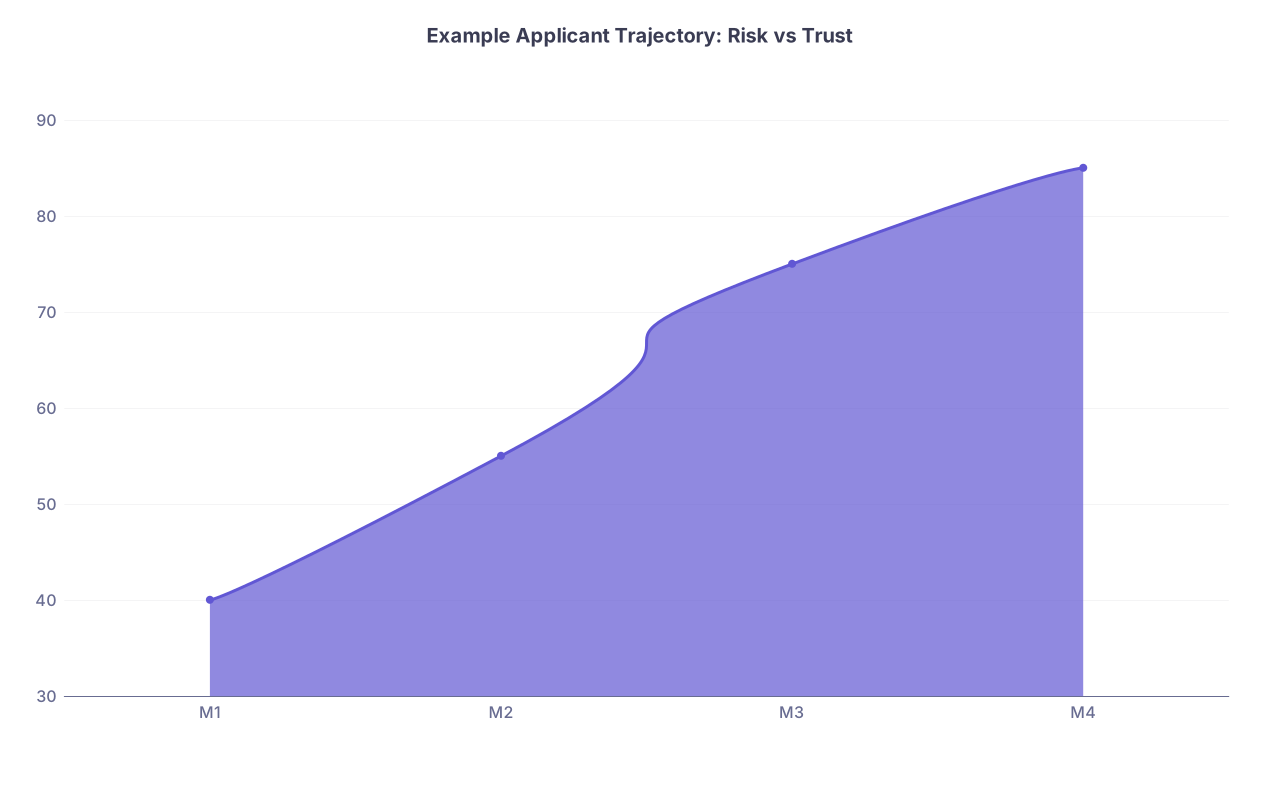
| Category | Value |
|---|---|
| M1 | 40 |
| M2 | 55 |
| M3 | 75 |
| M4 | 85 |
That mental “score” is not about grades alone. It is about how safe you feel as a hire. By M4, PDs want the story to be: “This person has already been battle-tested and came out stronger.”
Downward trends (Honors early, Passes and concerning comments late) are devastating. They look like decompensation under increasing responsibility.
Specific Narrative Pitfalls By Section Of The MSPE
Let us go line by line.
History and Notable Characteristics
This is where schools describe your background, activities, and pre-med story. PDs skim. It occasionally matters when:
- There is a prior career in nursing, RT, EMS, or military → perceived as more clinically mature.
- There are major leadership roles (e.g., national organization, school-wide initiatives) → signal for future chief potential.
- There are subtle red flags (“had a nontraditional path with multiple career changes”) that, combined with other issues, suggest instability.
Students hurt themselves indirectly here by:
- Having a bloated, unfocused activities section that then forces the MSPE to either ignore most things or pick random, unimpressive highlights.
- Over-selling leadership titles that letters later do not substantiate with actual impact.
Core Clerkship Narratives, Line by Line
Take a typical paragraph:
“During the Internal Medicine clerkship, [Name] was a valued member of the team. She was punctual, completed her notes on time, and had a strong fund of medical knowledge. She occasionally needed guidance in prioritizing tasks on busy ward days but was receptive to feedback. She will be a dependable intern.”
PD reading:
- “Valued member of the team” – neutral/positive but generic.
- “Punctual” and “completed notes on time” – baseline expectations.
- “Strong fund of medical knowledge” – good.
- “Occasionally needed guidance in prioritizing tasks” – slightly concerning for efficiency, but not a deal-breaker.
- “Receptive to feedback” – there were issues, but improved.
- “Dependable intern” – safe, not a star.
Now compare:
“[Name] quickly became one of the most reliable students on our service. He independently gathered comprehensive histories, presented succinctly, and formulated thoughtful assessment and plans that demonstrated excellent clinical reasoning. He took ownership of his patients, often anticipating team needs and staying late to ensure that tasks were completed. I would welcome him back as an intern on our service.”
This is top-tier narrative. PDs see “ownership,” “independent,” “excellent clinical reasoning,” “would welcome as intern.” Those phrases go straight into the “high ranking” mental bin.
Sub-Internship / Acting Internship Section
If you have an AI in your chosen specialty, PDs will often treat this as the single most important narrative in the MSPE. Pitfalls here are especially damaging. Wording like:
- “Performed at the expected level of a sub-intern.”
- “Completed all assigned tasks.”
- “Relied on the resident for organization of patient care.”
…is weak for an AI. They want:
- “Functioned at the level of an intern for much of the rotation.”
- “Required minimal supervision on day-to-day tasks.”
- “Demonstrated strong ownership and follow-through.”
If your AI narrative is lukewarm and you are applying to that specialty, your letters must be very strong to compensate.
What You Can Actually Do About All This
You do not write your MSPE. But you absolutely influence what ends up in it, long before M4. Here is how to avoid the worst narrative pitfalls.
1. Optimize The Behavior That Produces Good Narratives
On every core clerkship, you are essentially auditioning for one page of your MSPE. Faculty choose what to write based on:
- Reliability and follow-through (notes, tasks, pages).
- How much “ownership” you show over your patients.
- How you interact with nurses and staff when no one is watching.
- Whether you improve after mid-rotation feedback.
I have never seen a student with consistent comments like “took ownership,” “minimal supervision,” “excellent team member” who ended up with a weak MSPE. It is near impossible.
2. Take Mid-Rotation Feedback Deadly Seriously
Mid-clerkship feedback is not a formality. It is a forecast for what is going into your final narrative. If you hear:
- “You could speak up more.”
- “Organization is a work in progress.”
- “Try to take more initiative.”
Interpret that as: “If nothing changes, your MSPE will say you are quiet, disorganized, and passive.”
Ask directly:
“I want to make sure I am on track for a strong evaluation. What specific changes would you need to see from me in the next two weeks?”
Then execute like your future depends on it. Because it does.
3. Inspect Your MSPE Draft Carefully (And Strategically)
Many schools allow you to review a draft MSPE. Most students just proofread for name spelling and dates. That is naïve.
You should look for:
- Omitted major positive achievements that could be swapped in for weaker filler.
- Wording that is plainly inconsistent with written clerkship forms you have seen.
- Vague professionalism language without clear resolution.
You cannot demand your dean change their honest assessment, and pushing too hard looks bad. But you can:
- Politely ask if specific, documented achievements might be included.
- Clarify if any wording might be misinterpreted by PDs as unresolved concern.
- Ensure that objective data (honors, awards, scholarships) are accurate.
4. Align Your ERAS and Personal Statement With the MSPE Narrative
If your MSPE shows:
- Early academic difficulty → acknowledge and show growth story.
- A professionalism incident → briefly, clearly address it with ownership.
- Strong clinical comments and modest boards → emphasize your real-world strengths.
Your worst move is to pretend the MSPE does not exist and write a personal statement from an alternate universe where none of that happened.
Final Reality Check: What PDs Remember After Reading 100 MSPEs
After a full day of file review, PDs do not remember your Service Club or that line about “dedicated to lifelong learning.” They remember:
- “That student with the professionalism warning but a clear recovery arc.”
- “The one whose Medicine clerkship said they basically functioned as an intern.”
- “The applicant whose AI in their own specialty was surprisingly mediocre.”
- “The nontraditional EMT-turned-student with glowing narratives in every acute setting.”
Your job is to make sure the story your MSPE tells is at least coherent, and ideally compelling:
- No unexplained gaps.
- No mismatch between what you say and what everyone else wrote.
- Clear progression from early student to near-intern level performance.
With that frame, the MSPE stops being a black box and becomes what it really is: the written record of four years of choices on every ward.
You now understand how PDs read it, line by line. With those foundations in place, the next strategic step is learning how interviewers use that same MSPE to shape their questions on interview day. But that is a conversation for another time.