
You are here
You are staring at the “Education” section of ERAS.
There it is: the question about interruptions, leaves of absence, or needing to repeat coursework.
You know you have to say something.
You also know that one clumsy sentence can tank an otherwise solid application.
Maybe you remediated anatomy M1 after a rough first semester.
Maybe you took a one-year leave for depression, family illness, or burnout.
Or you had a professionalism write-up that forced you to repeat a clerkship.
You are not confused about what happened. You are stuck on what to write that does not sound evasive, melodramatic, or reckless.
Let me break this down specifically.
First: What PDs actually worry about
Before we touch wording, you need to understand the problem from the other side of the table.
Program directors do not automatically reject you for:
- A single remediated preclinical course
- A clearly explained medical or family LOA
- A well-documented mental health break that ended with solid performance
They get nervous when they see:
- Vague, hedged explanations
- Blaming language (“the school was unfair…”)
- Patterns of marginal performance without a clear inflection point
- Unexplained gaps or “LOA” with zero context in the MSPE or ERAS
- Signs you still do not own what happened
They are asking one question:
“Can I trust this person to show up, do the work, and not implode when things get hard at 2 a.m. on night float?”
Your wording either calms that fear or amplifies it.
The anatomy of a reassuring explanation
Whether you are explaining a remediated course or a leave of absence, there are four pieces you must hit. Briefly. Cleanly.
- What happened (objective, specific, no drama)
- Why it happened (concise, honest, not self-excusing)
- What you did about it (actions, not vibes)
- How the story ends (evidence that the problem is resolved or controlled)
The mistake most applicants make?
They either underexplain (looks evasive) or overexplain (looks unstable).
You want 3–6 sentences total in most cases. Not a personal statement. Not a confession.
Let me walk you through each category.
Course remediations: how to sound like an adult, not a red flag
We will start with the most common: one or two remediated courses, usually early on.
Typical realities:
- Transition shock M1
- Underestimated volume and did not adjust study strategies
- Life event during exam block
- Poor test-taking strategies despite understanding material
None of those are fatal. The danger is in how you talk about them.
Core principles for explaining remediated coursework
Do not argue with reality.
If you failed the first try and passed the remediation, say so clearly. Do not hide behind “I narrowly missed the cutoff” or “my performance was below expectations.” That hedging irritates PDs.Anchor it in time.
Make clear this was an early, bounded issue (“first semester,” “first year”) that did not persist.Show your pivot.
“I changed how I used practice questions,” “I started meeting regularly with a learning specialist,” “I adopted spaced repetition” – concrete changes.Point to clean performance afterwards.
This is mandatory. If you cannot show an upward trend, your words will not save you.
Bad vs. strong wording for remediations
Here is where people usually screw this up.
| Type | Example Wording |
|---|---|
| Bad | "Due to challenges adjusting to medical school and personal issues, I received a marginal grade in physiology which was later resolved." |
| Better | "During my first semester of medical school, I failed physiology and subsequently remediated the course successfully. I was still adapting to the volume and pace of material. I began meeting weekly with a learning specialist, adopted structured study schedules and active recall strategies, and have passed all subsequent courses and clerkships on the first attempt." |
| Bad | "I had to remediate anatomy because the exam format did not align with my learning style." |
| Better | "I failed anatomy during my first year and passed the remediation exam. My approach over-relied on passive review rather than question-based learning. I changed to a question-heavy, spaced-repetition approach and have since passed all remaining preclinical courses and clinical clerkships without remediation." |
Notice the pattern in the strong versions:
- Plain language: “failed,” “remediated,” “passed”
- Brief cause: “still adapting,” “passive review”
- Specific fix: “weekly with a learning specialist,” “spaced repetition”
- Clean outcome: “passed all subsequent courses / clerkships”
No self-pity. No over-sharing. No excuses.
LOAs: academic, health, personal – what actually reassures
Leaves of absence are trickier. PDs treat a one-off, well-explained LOA very differently from recurrent stops and starts.
Broad categories:
- Academic LOA (extended time to remediate, repeat year, or step away for performance)
- Medical/mental health LOA
- Personal/family LOA (caregiving, death in family, pregnancy, legal issues)
- Research or dual-degree LOA (these are usually not a problem if clearly labeled)
Your job is to answer three things clearly:
- What type of interruption this was
- Whether the underlying issue is now stable/managed
- Whether you performed reliably after returning
How explicit do you need to be?
You do not need a DSM code or intimate medical details. You do need enough information to prevent PDs from imagining something worse.
Compare:
- Vague: “I took a leave of absence for personal reasons and then returned to complete my studies.”
- Reassuring: “I took a one-year leave of absence for treatment of depression and anxiety. I completed therapy, established ongoing care, and returned to full-time coursework with improved performance. Since returning, I have completed all remaining courses and clerkships on schedule without further interruption.”
The second version reduces their anxiety even if “depression and anxiety” sounds scary to you. PDs see that all the time. What they fear is uncontrolled, unexplained instability.
Wording examples by LOA type
1. Academic / performance-related LOA
Use clear language that shows insight, not embarrassment.
Example:
“During my second year, I was placed on an academic leave of absence after failing two preclinical courses. My study strategies were not well adapted to the volume and pace of the curriculum. During the leave, I worked closely with the learning center to develop structured, active learning methods and repeated the year. Since returning, I have passed all subsequent courses and core clerkships on the first attempt.”
You are not sugarcoating. You are demonstrating growth and stability.
2. Medical / mental health LOA
Do not overdramatize, but do not hide behind “personal reasons” if the MSPE already labels it.
Example:
“I took a six-month medical leave of absence during my third year for treatment of a health condition. I completed recommended treatment, returned with clearance from my treating physician, and have maintained my health through ongoing follow-up. Since returning, I have completed all core clerkships and sub-internships on time with strong evaluations.”
For mental health:
“I took a one-year leave of absence during my second year to address depression and burnout. During that time, I engaged in regular therapy, made specific changes to my routines, and learned effective coping strategies. After returning, I completed my remaining coursework and clinical rotations on schedule, with honors in multiple clerkships and consistent attendance.”
That sounds controlled and closed-loop.
3. Personal / family LOA
Here you DO NOT need the gory details. Anchor the reason and resolution.
Example:
“I took a one-year leave of absence between my third and fourth years to assist with a serious family health situation. During that period, I relocated to support a close family member through treatment. Once their condition stabilized, I returned to school and completed my remaining clerkships and sub-internships without further interruption.”
Again: clear, bounded, resolved.
Where to put what: ERAS, MSPE, PS, interviews
Half the anxiety comes from not knowing where to address these issues. People either repeat themselves six times or avoid it completely.
Let me split it out.
1. ERAS “Interrupted Education” / “Extensions” fields
Use this field for:
- Leaves of absence (any reason)
- Repeating an academic year
- Delayed graduation beyond standard length of your curriculum
You want a 2–4 sentence, neutral explanation using the structure we already covered.
Example:
“During my second year, I took a one-year leave of absence to address depression and burnout. I worked with a therapist and my primary care physician, made significant changes to my coping strategies and routines, and returned to full-time coursework the following year. Since returning, I have completed all remaining courses and clerkships on schedule without further interruption.”
Do not attach your entire life story here. PDs skim.
2. ERAS “Adverse Actions” / “Infractions” (if applicable)
If your remediation or LOA was tied to a professionalism issue or formal action, you may need a separate entry. This is where a lot of applicants mishandle tone.
You must show:
- Ownership
- No defensiveness
- A specific behavioral change
Bad:
“I was unfairly cited for unprofessional behavior during my third year.”
Better:
“During my third year, I received a professionalism citation related to punctuality and incomplete documentation. I met with my clerkship director and student affairs to review expectations and developed a detailed system for task tracking and time management. Since then, I have had no further professionalism concerns, and subsequent evaluations have consistently commented on my reliability and responsiveness.”
Own it. Fix it. Move on.
3. Personal statement: usually not the best place
Do not anchor your entire personal statement around your remediation or LOA unless:
- It is central to why you chose the specialty, AND
- You can discuss it in a way that shows maturity, not chaos
Most of the time, your remediation/LOA belongs in the “interruption” boxes and a short, consistent explanation if asked in interviews. Your personal statement should mostly be about who you are now and why this specialty, not a 2-page narrative of your worst semester.
4. Interviews: how to answer without spiraling
Interviewers will often say: “I noticed you had a leave of absence / needed to repeat X course. Can you tell me about that?”
Do not look like a deer in headlights. Have a 60–90 second script:
- One sentence: what happened
- One to two sentences: contributing factors (brief)
- Two sentences: what you changed or learned
- One sentence: performance and stability since
Example answer:
“During my first year, I failed anatomy and remediated the course successfully. I underestimated the volume and relied too heavily on passive review. After meeting with a learning specialist, I shifted to active recall, spaced repetition, and scheduled daily practice questions. Since then, I have passed all preclinical courses and completed my clerkships with strong evaluations, including honors in internal medicine and surgery.”
Say it calmly. Then stop talking. Let them ask a follow-up if they care.
Nuanced wording templates you can adapt
Let me give you some plug-and-edit structures you can actually use.
Do not copy these verbatim. Programs can spot that. Use them as a scaffold.
Template: single preclinical remediation
“During my [first year / first semester] of medical school, I failed [course name] and subsequently remediated the course successfully. I [briefly state why; e.g., was still adjusting to the pace and relied too much on passive review]. I worked with [learning specialist / academic advisor] to adopt [specific strategies – active recall, spaced repetition, scheduled question blocks]. Since then, I have passed all subsequent courses and clerkships on the first attempt.”
Template: multiple preclinical struggles but clean clinical years
“Early in medical school, I struggled with the transition to the volume and pace of the curriculum and remediated [number] preclinical courses. I realized my study methods were inefficient and not well suited to high-volume material. I began meeting regularly with the learning center, implemented structured daily schedules, and used practice questions as my primary mode of learning. These changes were effective; I have passed all clinical clerkships on the first attempt and performed strongly on [Step 2 / clinical evaluations].”
Template: academic LOA with repeated year
“During my [year], I was placed on an academic leave of absence after failing [course(s)/block(s)]. At the time, my study strategies were not well adapted to the demands of the curriculum. During the leave, I worked closely with academic support services, practiced new learning techniques, and repeated the year. After returning, I completed the curriculum on schedule, passed all remaining courses and clerkships on the first attempt, and improved my performance on standardized exams.”
Template: medical LOA (non-psychiatric)
“During my [year], I took a [duration] medical leave of absence for treatment of a health condition. I underwent [brief, non-specific phrasing: ‘recommended evaluation and treatment’] and was cleared by my treating physician to return to full-time training. Since my return, I have maintained my health with ongoing follow-up and completed all remaining coursework and clerkships without further interruption.”
Template: mental health LOA
“I took a [duration] leave of absence during my [year] to address depression and burnout. With support from my physician and therapist, I implemented specific changes in my coping strategies, scheduling, and boundaries. I returned to the curriculum the following year and have since completed all remaining courses and clinical rotations on schedule, with strong evaluations and no further leaves.”
Template: personal/family LOA
“Between [years], I took a [duration] leave of absence to assist a close family member experiencing a serious health issue. I relocated temporarily to provide support during their treatment. Once their condition stabilized, I returned to medical school and completed my remaining clerkships and sub-internships on time, without additional interruptions.”
How PDs actually read this in context
PDs rarely read your explanation in isolation. They look at pattern + text.
They will mentally run through something like this:

| Step | Description |
|---|---|
| Step 1 | See Remediation/LOA Flag |
| Step 2 | Check Performance After Event |
| Step 3 | Multiple Events or Late? |
| Step 4 | Higher Concern; Look for Stability |
| Step 5 | Low Concern; Move On |
| Step 6 | Moderate Concern; Read Explanation Carefully |
| Step 7 | Assess Explanation, Support, Insight |
| Step 8 | Single, Early, Isolated? |
| Step 9 | Strong Upward Trend? |
Your wording modifies their concern, but it cannot overwrite your record. That said, I have seen applicants with:
- One failed M1 course + clean rest of record → matched at strong academic programs
- One-year LOA for depression + strong Step 2 + great letters → matched in very competitive specialties
- Repeated M2 year + honors-heavy clerkship record → matched solidly in IM, peds, FM, psych
What made the difference was:
- Clear growth after the event
- Honest, contained explanation that did not feel like a liability factory
- No whiff of ongoing chaos
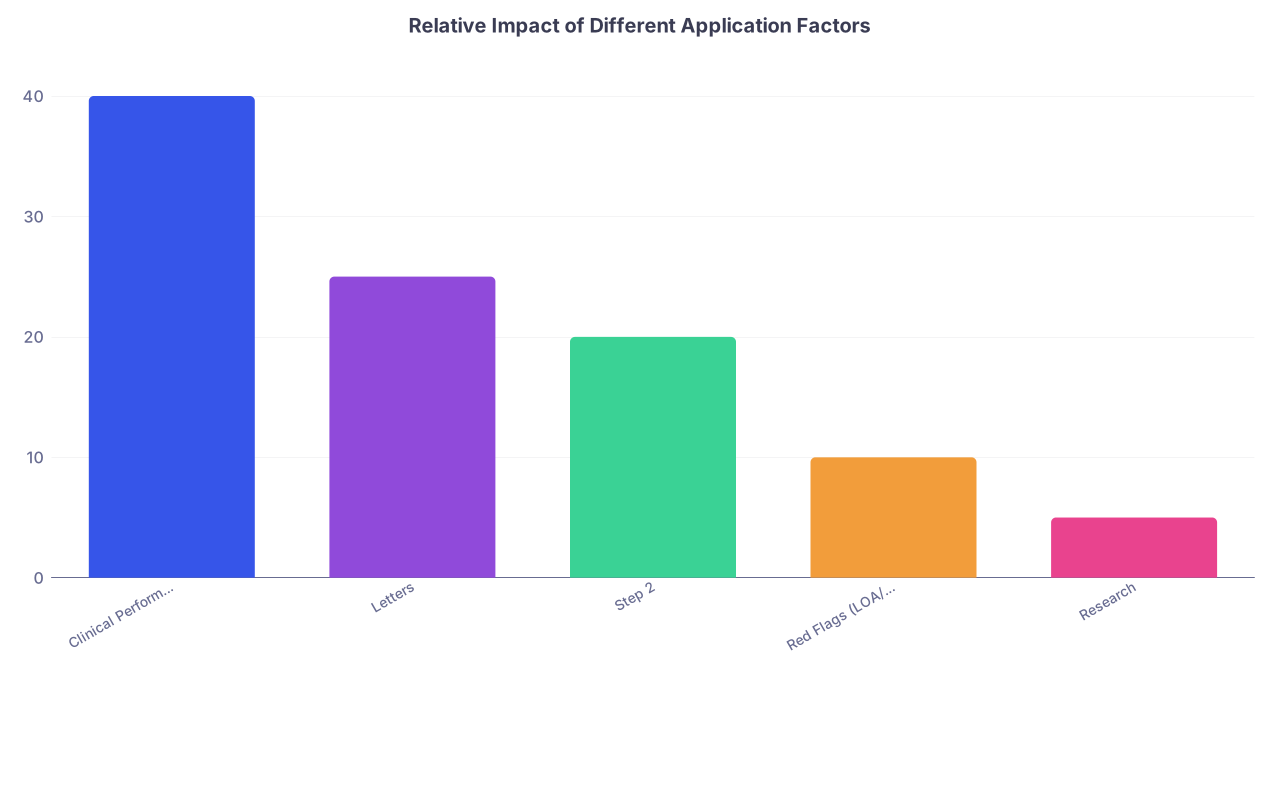
To visualize how LOAs and remediations sit in the big picture, think like this:
| Category | Value |
|---|---|
| Clinical Performance | 40 |
| Letters | 25 |
| Step 2 | 20 |
| Red Flags (LOA/remediation) | 10 |
| Research | 5 |
Those numbers are not exact, but the rough proportions are right. LOAs and remediations matter, but they are not the main driver unless they suggest ongoing instability.
Common self-sabotaging moves to avoid
You can have a relatively minor academic hiccup and turn it into a massive red flag just by how you write about it. I see this constantly.
Here is what to avoid:
Over-sharing your worst moments
“I was suicidal, failed all my exams, and could not get out of bed for months” is not what you put in ERAS. Share that with your therapist, not a PD.Blaming the school, faculty, or exam format
“The grading system was unfair,” “the clerkship director targeted me,” “NBME changed the blueprint.” Even if partly true, it makes you sound high-maintenance.Overly emotional language
“I was devastated, lost, and completely broken…” Use neutral tone. This is not a memoir.Vague non-explanations
“Personal issues,” “unexpected circumstances,” “life events beyond my control.” These make PDs suspect worse realities than the truth.Minimizing or hiding what is already in the MSPE
If your dean’s letter clearly documents an LOA or course failure, pretending it did not happen just makes you look evasive.Turning the explanation into a redemption epic
Three paragraphs about your “journey” through failure is exhausting. Brevity signals stability.
Using advising strategically
One last point: do not do this in a vacuum.
You should:
- Ask your dean’s office exactly how your LOA/remediation is described in your MSPE
- Make sure your ERAS explanation is consistent with the MSPE language
- Have one or two seasoned faculty or advisors (not just friends) read your drafted wording
And be explicit when you ask for help. Show them: “This is my draft for the interrupted education section. Does this sound factual and reassuring, or defensive/overly emotional?”
You want someone who has actually sat on a residency selection committee to look at this, not just your favorite attending who “really likes you.” There is a difference.
Quick visual: Where to address what
| Situation | Where to Address It | Depth of Explanation |
|---|---|---|
| Single remediated course | ERAS interruption section (if required) or brief line if prompted | 2–4 sentences |
| LOA of any kind | ERAS interruption section + MSPE (school writes) | 3–6 sentences |
| Professionalism citation | ERAS adverse action section + MSPE | 3–6 sentences |
| Board failure (Step/Level) | ERAS, sometimes PS or interview if major | 3–6 sentences |
And yes, multiple elements can be summarized in one coherent paragraph if they are related (e.g., academic LOA + course remediation as part of that year). Just stay structured.
Final refinement: tone check
Before you lock in your wording, read it out loud and ask yourself three questions:
- Do I sound like I am still in crisis?
- Do I sound like I am arguing with the school or the system?
- Could I say this, almost verbatim, to a serious attending I respect without cringing?
If the answer to any of those is “no,” revise.
If you are not sure how your explanation lands emotionally, that is where an advisor with real selection experience is invaluable.
Summary: What actually reassures programs
Three points to carry forward:
- Be concise, specific, and neutral: say what happened, why in brief, what you changed, and how your performance has been since.
- Emphasize closure and stability: clearly show that the underlying issue has been addressed and that your record after the event is clean and reliable.
- Avoid drama, blame, and vagueness: those three are what transform ordinary course remediations and LOAs into true red flags.
Your goal is not to erase your history. Your goal is to show you understand it, learned from it, and are now exactly the kind of stable, self-aware resident they want at 2 a.m. when the floor is melting down.
That, when written correctly, is reassuring.